Generative engine optimization (GEO) is the practice of structuring content to be cited in AI-generated answers from ChatGPT, Perplexity, and Google AI Overviews. Gartner predicts a 25% decline in traditional search volume by 2026 as buyers shift to AI chatbots for research — making citation in those answers the new measure of brand visibility.
How GEO differs from SEO
SEO and GEO both optimize content for discoverability — but they target different systems with entirely different ranking signals.
SEO places content in search engine results pages. Success means a high keyword ranking. GEO places content inside AI-synthesized answers. Success means being cited when a user asks a conversational question.
| Dimension | SEO | GEO |
|---|---|---|
| Target platform | Google, Bing | ChatGPT, Perplexity, Google AI Overviews, Claude |
| User action | Clicks a blue link | Reads an AI-generated answer |
| Success metric | Keyword ranking position | Citation rate in AI responses |
| Key signals | Backlinks, page speed, keyword density | Entity coverage, statistics, structured answers |
| Content format | Keyword-optimized article | Answer-first, entity-rich, schema-marked |
| Time to results | 3–12 months | 2–12 weeks |
The practical difference: a page ranking #1 for a keyword can earn zero citations in ChatGPT. A page not ranking at all can be cited consistently if it directly answers the question AI users are asking.
Why AI search is changing buyer behavior
AI chatbots have compressed the research phase of buying decisions. Instead of opening ten browser tabs, buyers type one question and read a synthesized answer.
Gartner predicts a 25% decline in traditional search engine volume by 2026 as buyers shift to AI chatbots for research. ChatGPT reached 300 million monthly active users faster than any consumer software product in history. Google AI Overviews now appear in front of over one billion users per month.
The conversion implication is significant. AI-referred visitors arrive having already read a synthesized recommendation. They are further along in the buying decision than a user who clicked a blog post from Google. Data from 12 million visits across multiple sites shows AI search traffic converts 4.4× better than organic search and 5× better in some B2B categories.
For brands, this means citation in AI answers is not a bonus channel — it is the highest-intent touchpoint in the funnel. Hamming.ai, a B2B SaaS company, saw daily visitors increase from 200 to 1,900 in 12 weeks after deploying a GEO content strategy through Cintra targeting 15 buyer prompts.
What AI models look for when citing content
AI models evaluate content against a different set of signals than search algorithms. Understanding these signals is the foundation of every GEO strategy.
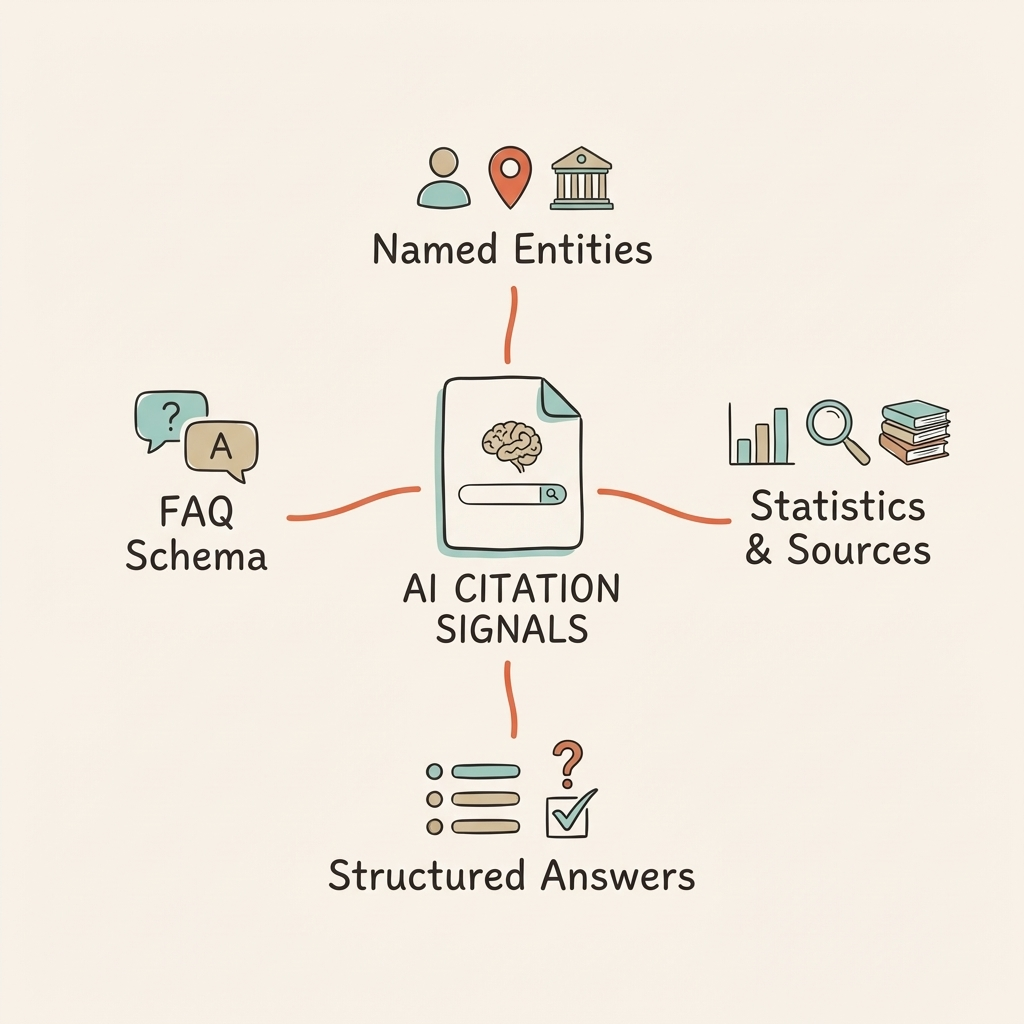
Direct answers. AI models look for content that answers questions without preamble. A section starting with "The three main causes of X are…" gets cited. A section starting with "Many people have wondered about X over the years…" does not.
Named entities. Language models build knowledge graphs. Content that names specific people, companies, products, tools, and studies gives AI models the entities they need to connect your content to buyer queries. Generic content — "many businesses use this approach" — carries far less citation weight than specific content naming exactly which businesses and exactly which approach.
Verifiable statistics. Princeton University research found that content containing statistics and citations performs 30–40% better in generative engine results compared to content without supporting data. Numbers give AI models concrete claims to reproduce.
Structured formatting. Headings, bullet lists, tables, and FAQ sections give AI models pre-formatted extractions. Content that arrives pre-organized requires less AI processing to convert into a response.
Schema markup. JSON-LD schema (FAQPage, Article, HowTo) makes content machine-readable. Schema-marked pages are crawled with higher confidence and cited more consistently.
Six core GEO strategies
These six tactics appear consistently in high-citation content across chatbots and AI Overviews.
1. Answer-capsule formatting. Every page should open with a 15–30 word direct answer to the target question — no context-setting, no preamble. This sentence should make sense lifted verbatim into an AI response.
2. Statistics with named sources. Add specific statistics to every substantive claim, linked to verifiable sources. Research shows this single change increases citation frequency by 30–40%.
3. Entity coverage. Name the specific companies, tools, platforms, and studies relevant to your topic. Generic language gets filtered out; specific named entities get cited.
4. FAQ sections with schema. Add 4–6 buyer-phrased questions at the bottom of every page with direct answers. Deploy FAQPage JSON-LD so the structure is machine-readable. ChatGPT, Perplexity, and AI Overviews regularly extract FAQ answers directly.
5. Community presence. Reddit accounts for 46.7% of Perplexity's citations. A GEO strategy without authentic community engagement misses nearly half of where AI models source their answers. Active threads in relevant communities directly influence AI citation patterns.
6. Content freshness signals. AI models favor recently updated content. Pages with an explicit "Updated: [date]" signal and recent statistics outperform older content on the same topic.
What GEO results look like in practice
Cintra has run GEO campaigns across B2B SaaS, DTC ecommerce, and professional services. The pattern of results is consistent: AI citations begin appearing within 4–8 weeks of GEO content deployment, with measurable traffic impact within 12 weeks.
| Client | Before | After | Timeline |
|---|---|---|---|
| Hamming.ai (B2B SaaS) | 200 visitors/day | 1,900 visitors/day | 12 weeks |
| Keywords.am (SaaS tool) | 3% AI visibility score | 13% AI visibility score | 2 weeks |
| UV Blocker (DTC ecommerce) | 0 AI-referred clicks | 38,000 clicks in 6 months | 6 months |
| Yoga Democracy (DTC apparel) | Baseline | 156% increase in AI recommendations | 8 weeks |
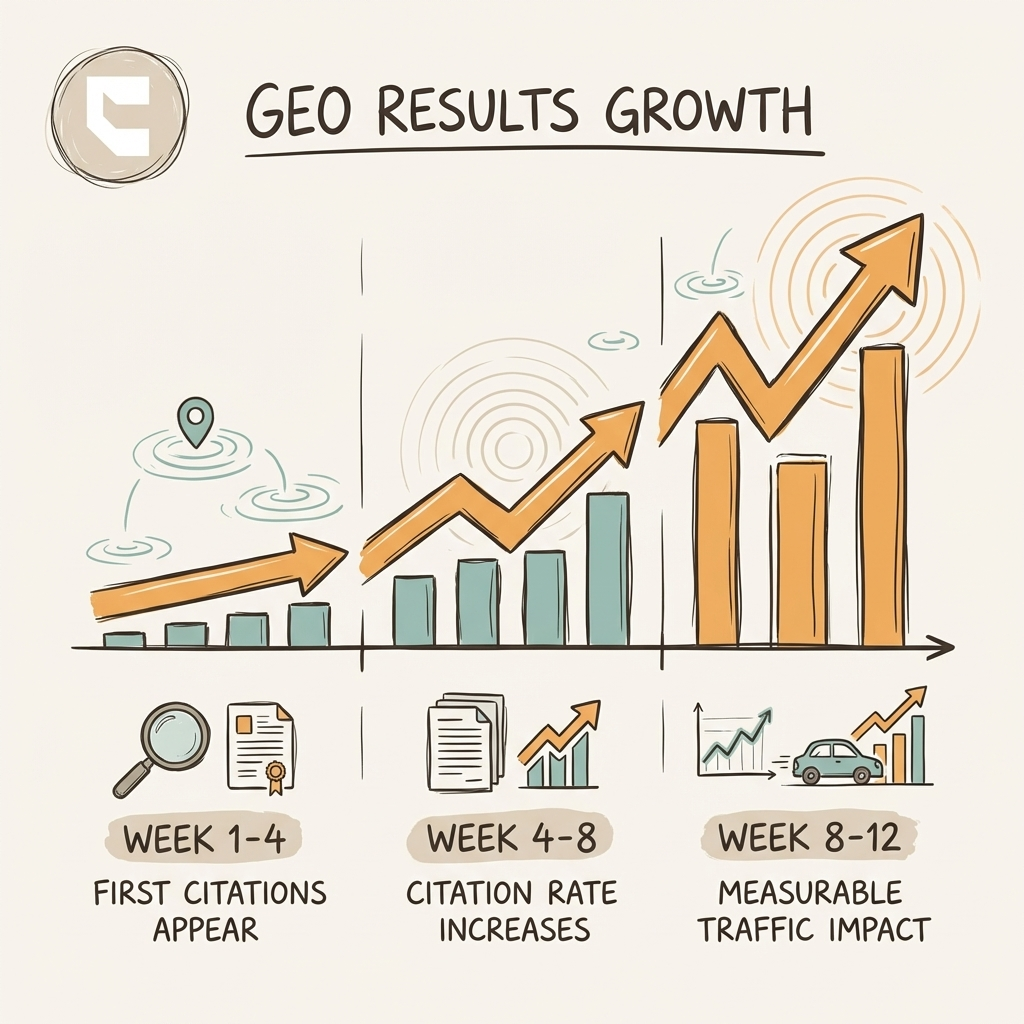
These results share a common foundation: answer-first content targeting specific buyer prompts, combined with FAQ schema, entity coverage, and community signals.
How to get started with GEO
GEO optimization can be applied to existing content or built into new pages from the start. This five-step sequence works for both.
Step 1: Audit your current AI visibility. Run your brand name and core product category through ChatGPT, Perplexity, and Google AI Overviews. Record which competitors are cited and what content types appear. This is your baseline.
Step 2: Map buyer prompts — not just keywords. List the conversational questions your buyers ask AI tools: "What is the best [product] for [use case]?" "How does [your category] work?" These are your target prompts.
Step 3: Restructure top pages for answer-first format. For each target prompt, identify an existing page or create a new one. Rewrite the opening paragraph as a direct 15–30 word answer. Add a stat in the first 50 words.
Step 4: Add FAQ sections with schema. Every optimized page needs 4–6 buyer questions answered directly, with FAQPage JSON-LD deployed. This is one of the highest-impact, lowest-effort GEO changes.
Step 5: Track AI mentions weekly. Use Peec.ai, Profound, or manual prompt testing to monitor when your content begins appearing in AI responses. Adjust based on what's getting cited and what's not.
Cintra handles the full GEO cycle — prompt research, content creation, schema deployment, and citation monitoring — starting at $2,000/month for the DIY plan.