Gartner predicts a 25% drop in search engine volume by 2026. Buyers now ask ChatGPT for "best waterproof hiking boots under $150" instead of scrolling Google results. If your Shopify store doesn't appear in those answers, you lose the sale.
Traditional Shopify SEO — meta tags, alt text, keyword density — misses AI discovery entirely.
Why does your Shopify store need AI search optimization?
Shoppers are abandoning Google for AI chatbots that deliver direct product recommendations in a single prompt instead of ten blue links.
AI models synthesize reviews, product specs, and Reddit discussions to deliver definitive answers. They don't care about keyword density — they need factual accuracy, structured data, and community consensus. UV Blocker went from zero to 38K clicks after implementing these exact strategies. The buying journey has collapsed from five searches to one prompt.
How do you optimize your Shopify store for AI search?
You need to translate your store's data into a language AI models understand through schema markup, detailed descriptions, and community signals.
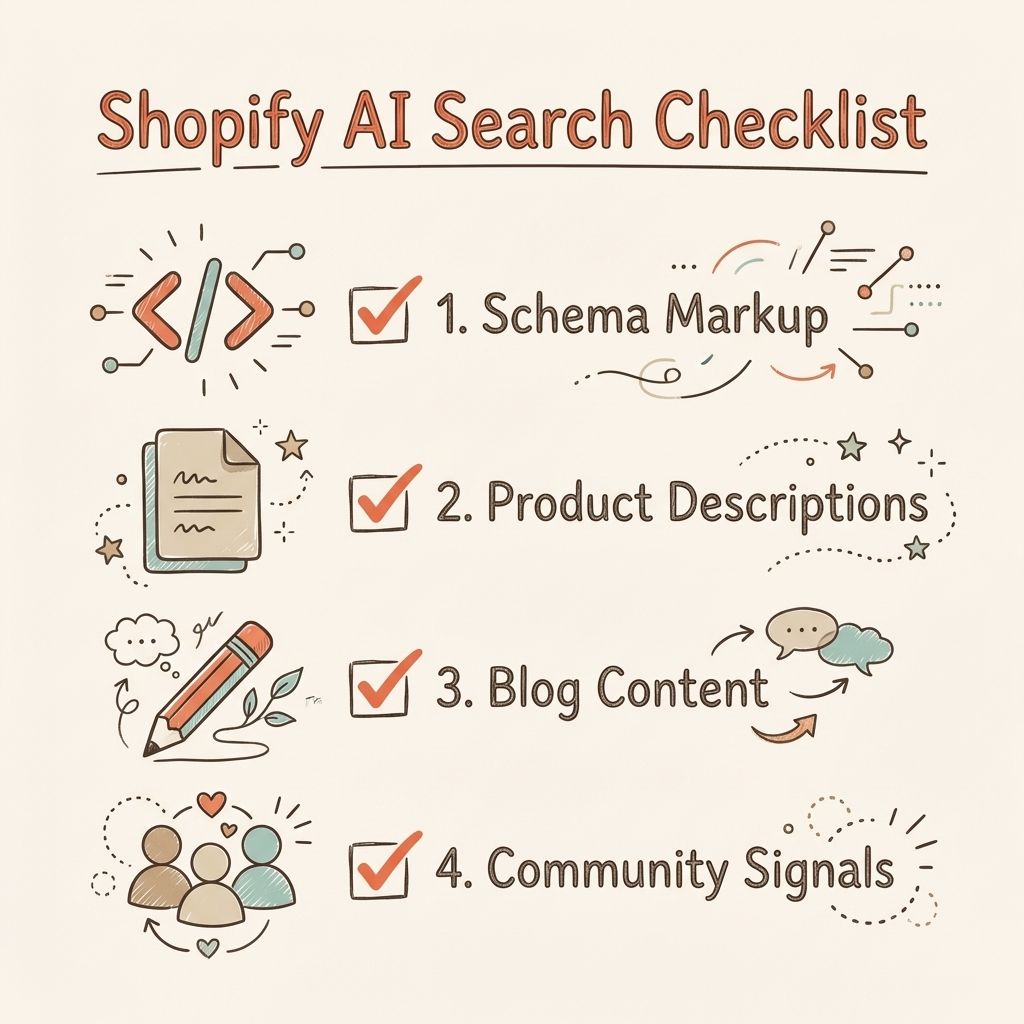
Four areas require attention:
- Schema markup. Implement Product, Offer, and AggregateRating schema on every product page using JSON-LD. AI models use structured data to verify price, availability, and reviews before recommending products.
- FAQ schema. Add FAQ schema to product and collection pages addressing common buyer objections — shipping times, return policies, material composition. AI models extract these answers to satisfy user prompts.
- Product descriptions. Stop listing generic features. Answer specific buyer questions. If you sell a standing desk, explain how it accommodates dual monitors. Give the AI concrete facts to cite.
- Community signals. Reddit threads and Quora answers mentioning your products are trust signals AI models weigh heavily. Authentic participation builds the consensus engines look for.
This process is called generative engine optimization. Our AI visibility playbook covers the full methodology.
What Shopify-specific schema helps AI models recommend your products?
Four schema types form the foundation of ecommerce AI visibility, each serving a distinct role in how AI models parse and recommend products.
| Schema Type | Purpose | AI Impact |
|---|---|---|
| Product | Defines item details | Verifies price, stock, and ratings for specific recommendations |
| FAQ | Answers objections | Provides exact answers to user prompts about features |
| BreadcrumbList | Maps site structure | Helps models understand product categories and context |
| CollectionPage | Defines categories | Surfaces category pages for list-based prompts |
Default Shopify themes include minimal schema. You need specialized apps or custom Liquid code to implement the depth AI models require. Test schema regularly using Google's Rich Results Test — a single syntax error means AI models skip your data entirely.
How do you track AI visibility for your Shopify store?
Track how often AI models cite your products by monitoring buyer-intent prompts across ChatGPT, Perplexity, and AI Overviews.
Start by building a list of high-intent prompts — "best standing desk under $500," "most durable hiking backpack" — and running them across platforms. Record citation status, competitor presence, and which products get recommended.
Benchmark your citation rate against competitors. If Perplexity recommends a competitor for 80% of buyer prompts, identify why — better schema, more Reddit mentions, or more specific product descriptions — and close the gap.
Map each prompt to specific products or collections. If "waterproof boots" triggers your homepage instead of your waterproof boot collection, you'll lose conversions. Review the best AI visibility tools to automate tracking.
Frequently asked questions about Shopify AI search optimization
Common questions cover schema support, timelines, and compatibility with existing SEO.
Does Shopify support the required schema out of the box?
No. Basic themes include minimal schema. You need specialized apps or custom Liquid code to implement Product, Offer, AggregateRating, and FAQ schema at the depth AI models require.
How long until AI models recommend my products?
ChatGPT and Perplexity index new data within weeks of schema updates and community signal building. Google's AI Overviews take longer, often mirroring traditional indexation timelines.
Can AI optimization work alongside my existing Shopify SEO?
Yes. Clean schema and detailed descriptions improve Google rankings while feeding data to AI models. The strategies reinforce each other — you don't have to choose.
What results can Shopify stores expect?
UV Blocker jumped from zero to 38K clicks with AI visibility. Conversion rates increase because AI models send highly qualified traffic — buyers who've already done their research through the chatbot.