AI visibility for DTC brands works differently than it does for SaaS or service businesses because purchase decisions happen faster and product specifics matter more. Gartner predicts a 25% drop in search volume by 2026 as buyers shift to AI chatbots. DTC brands that appear in AI-generated product recommendations capture high-intent buyers at the exact moment they're ready to purchase.
Why does AI visibility for DTC brands require a different approach?
DTC brands face unique dynamics in AI search that distinguish them from other business models seeking citation visibility.
When a buyer asks ChatGPT "what's the best mineral sunscreen for sensitive skin?" or Perplexity "best yoga pants under $100", the AI needs product-level data to form recommendations: ingredients, materials, price points, sizing details, and real customer experiences. Generic brand authority isn't enough. AI models need structured, specific product information to confidently recommend one brand over another.
The purchase cycle is also shorter. A SaaS buyer might research for weeks before booking a demo. A DTC buyer often purchases within the same session they discover the product through AI. This means every AI citation carries higher immediate revenue potential for DTC brands than for most B2B companies.
What are the 5 best strategies for AI visibility for DTC brands?
Five strategies address the specific challenges and opportunities DTC brands face when optimizing for AI-generated product recommendations and citations.
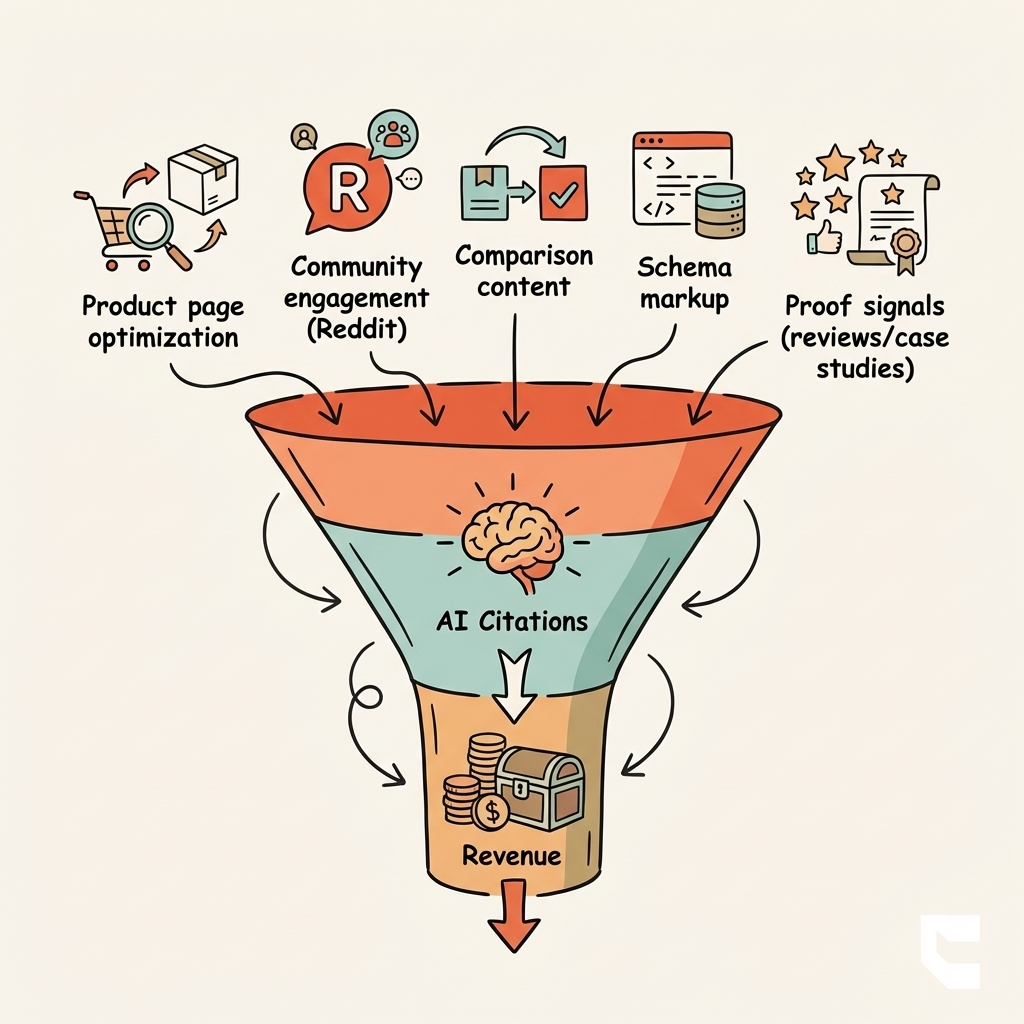
1. Product-specific content targeting buyer queries. Create content answering the exact questions buyers type into AI tools: "best [product] for [use case]", "[ingredient/material] benefits for [concern]", "[your brand] vs [competitor]". Include verifiable specifications, ingredient lists, pricing, and sizing data. AI models pull from factual, structured content when forming product recommendations.
2. Reddit community engagement in buyer subreddits. Reddit accounts for 46.7% of all Perplexity citations. DTC buyers actively discuss product recommendations in niche subreddits. When real users mention your brand as a genuine solution to community questions, AI models ingest those discussions as authentic social proof. Our Reddit engagement service manages 100-200 monthly opportunities across targeted communities.
3. Schema markup on product and collection pages. Product schema (price, availability, reviews), FAQ schema, and collection-level markup help AI models parse your catalog accurately. A Shopify store with complete schema markup across 50 products gives AI systems 50 structured data sources to reference, compared to competitors whose product details are buried in unstructured HTML.
4. Comparison and "best of" content. DTC buyers frequently ask AI which product is best for their specific needs. Publishing honest comparison content — your brand alongside competitors, with clear differentiation on features that matter — positions your brand as a transparent, authoritative source that AI models prefer to cite.
5. Case study and customer proof content. AI models value verifiable results when making recommendations. Documented outcomes like traffic growth, sales increases, and customer satisfaction data give AI confidence to recommend your brand. The UV Blocker case study shows how one DTC brand achieved 38K clicks in 6 months through structured AI visibility.
What results should DTC brands expect from AI visibility?
Results for DTC brands compound across organic traffic, AI citations, and direct revenue metrics simultaneously.
| Metric | Typical Timeline | Example Result |
|---|---|---|
| Perplexity citations | 1-2 weeks | Brand appears in product recommendation queries |
| ChatGPT recommendations | 4-8 weeks | Brand cited in "best [product]" responses |
| Organic traffic lift | 2-3 months | 3x-8.5x increase from AI-optimized content |
| Revenue impact | 3-6 months | Measurable order increase from AI-driven traffic |
UV Blocker grew from 0 to 38K organic clicks in 6 months and doubled weekly orders during off-season. Yoga Democracy achieved a 156% increase in AI recommendations. These outcomes reflect the compounding effect of content, community engagement, and schema working together to build citation authority across multiple AI platforms.
How does DTC AI visibility differ from traditional ecommerce SEO?
Understanding the distinction helps DTC brands allocate resources between traditional optimization and AI-specific strategies for maximum impact.
Traditional ecommerce SEO optimizes for Google's ranking algorithm: keywords, backlinks, page speed, and technical factors. AI visibility optimizes for how ChatGPT, Perplexity, and AI Overviews select sources to cite and products to recommend. The overlap exists in content quality and schema markup, but AI visibility adds community engagement, structured data feeds, and citation-specific content that traditional SEO doesn't address.
The practical implication: DTC brands shouldn't abandon SEO, but should layer AI visibility on top. Start with a free audit to measure where your brand currently appears in AI-generated recommendations compared to competitors. Our ecommerce capability overview details the full methodology.
Frequently asked questions about DTC brand optimization
These questions address timelines, investment levels, and platform-specific considerations for direct-to-consumer brands entering AI optimization.
How much should a DTC brand invest in AI visibility?
Plans start at $2K/month for DIY (strategy + tools, you execute) or $4K/month for done-for-you (full execution). Most DTC brands see positive ROI within 3-4 months as organic AI citations begin replacing paid acquisition costs. The pricing breakdown compares both options in detail.
Does AI visibility work for Shopify stores specifically?
Yes. Shopify's architecture supports product schema, collection markup, and blog content that AI models extract efficiently. Our Shopify optimization guide covers the technical implementation. The key is ensuring product pages include structured data that AI models can parse without ambiguity.
Can small DTC brands compete with large retailers in AI search?
AI models weight content quality and specificity over brand size. A niche DTC brand with detailed product content, authentic Reddit presence, and structured data often outranks major retailers in specific category queries because the content directly answers the buyer's question rather than linking to a generic product catalog.