Choosing between a GEO agency vs in-house AI visibility comes down to three factors: speed, expertise, and budget allocation. Gartner predicts a 25% drop in search volume by 2026 as buyers shift to AI chatbots. The decision on who executes your generative engine optimization strategy determines how fast you capture that shifting attention.
What's the real difference between a GEO agency vs in-house AI visibility?
A GEO agency brings specialized tooling, cross-client data, and proven playbooks from day one. An in-house team means building the capability from scratch.
The core variable is time to results. Agencies operate at volume because they've already solved the infrastructure problems: prompt tracking systems, content pipelines, Reddit engagement workflows, and schema deployment processes. An in-house team needs 3-6 months just to build these systems before producing meaningful output.
Agencies also carry cross-client intelligence. When a tactic works for one SaaS brand, the learning transfers immediately to the next engagement. In-house teams operate in isolation, running experiments without benchmarks from adjacent markets.
When should you hire a GEO agency vs building in-house?
The right choice depends on your current resources, competitive pressure, timeline expectations, and whether your team has AI visibility expertise.
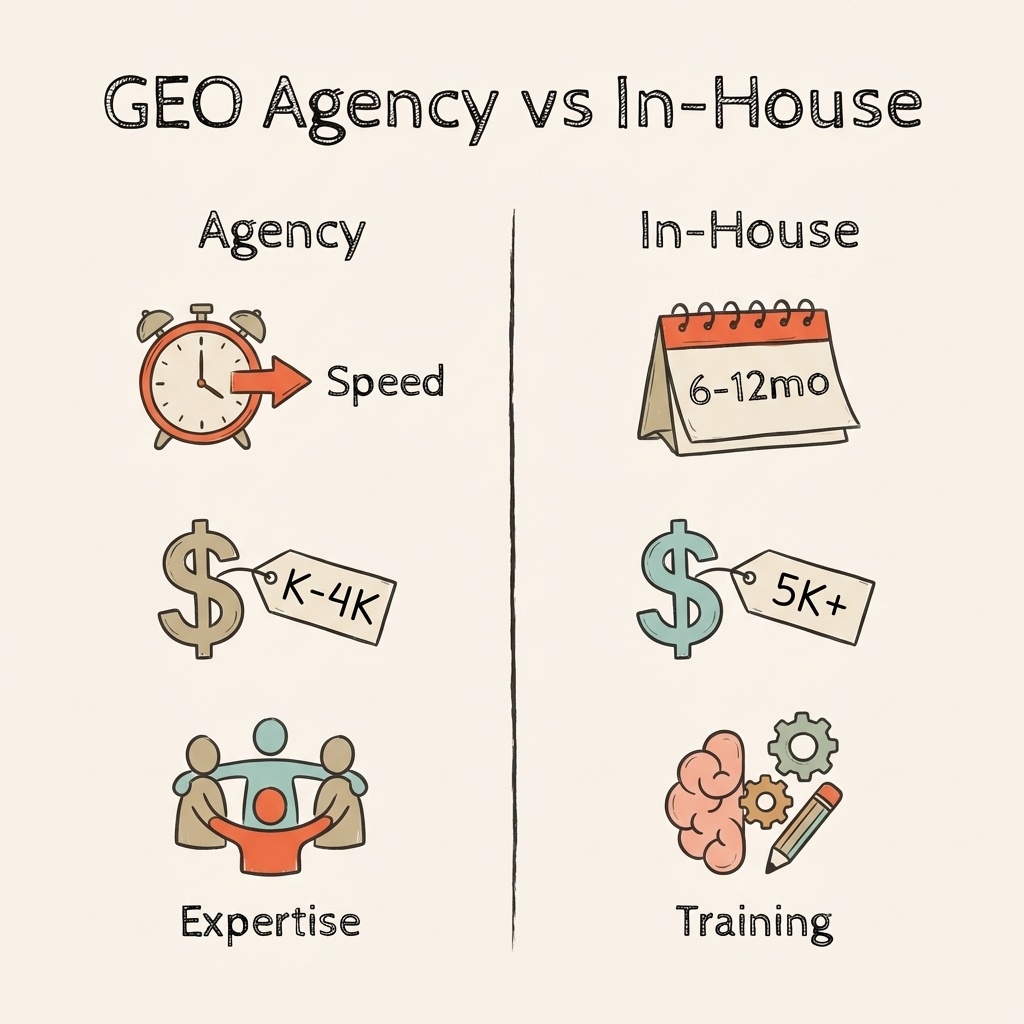
| Factor | GEO Agency | In-House |
|---|---|---|
| Time to results | 2-12 weeks | 6-12 months |
| Monthly cost | $2K-$4K | $12K-$25K (2-3 FTEs) |
| Expertise ramp | Immediate | 3-6 months training |
| Content volume | 50x traditional output | Limited by headcount |
| Brand knowledge | Requires onboarding | Deep from day one |
| Long-term cost | Ongoing retainer | Decreases over time |
Hire an agency when: competitive pressure demands speed, your team lacks AI visibility expertise, or you can't justify 2-3 new full-time hires. Our Keywords.am case study shows what high-velocity execution achieves: 3% to 13% AI visibility in 14 days.
Build in-house when: you already have a content operations team, your timeline extends beyond 6 months, and you're prepared to invest in specialized training and tooling infrastructure.
What does each option actually cost?
The sticker price of either option tells only part of the story. Hidden costs change the math significantly.
Agency investment: $2K-$4K per month for done-for-you execution. This includes content creation, Reddit engagement, schema markup, backlink outreach, and prompt tracking. No hiring costs, no tool subscriptions, no training time. See our full pricing breakdown.
In-house investment: A functional team needs at minimum a content strategist ($70K-$90K), a technical SEO specialist ($80K-$110K), and a community manager ($55K-$75K). That's $205K-$275K in salary alone before tools, training, and management overhead.
Hidden in-house costs compound quickly. Prompt tracking tools run $500-$2K per month. Schema deployment requires developer time. Community engagement takes months to build authentic presence. The trial-and-error learning curve means 3-6 months of suboptimal output before the team hits stride.
The break-even point typically arrives around month 18-24 for in-house teams, assuming they achieve comparable results to an experienced agency.
Can you combine a GEO agency with in-house efforts?
A hybrid model often delivers the best outcome. The agency handles high-velocity execution while your in-house team maintains brand voice and strategic direction.
The most common pattern: start with a done-for-you agency engagement to capture immediate AI visibility, then gradually transition specific capabilities in-house over 6-12 months. Your team learns the methodology through direct collaboration rather than building from scratch.
What to keep with the agency: high-volume content production, Reddit community engagement at scale, and prompt tracking infrastructure. What to bring in-house: brand messaging oversight, strategic planning, and internal knowledge documentation. Our AI visibility playbook details the full methodology either team can follow.
This approach mirrors what works in traditional marketing. You don't build an ad platform in-house. You use specialized partners for execution while maintaining strategic control internally.
Frequently asked questions about GEO agency vs in-house decisions
These questions cover the most common concerns brands face when evaluating which execution model fits their situation.
How long does it take to build AI visibility in-house?
Expect 3-6 months to build the infrastructure (tracking, content pipelines, community presence) and another 3-6 months before measurable AI citation improvements appear. Total runway: 6-12 months to match what an experienced agency delivers in weeks.
What skills does an in-house GEO team need?
At minimum: structured data expertise (schema markup), content strategy focused on AI extraction, community management for Reddit and Quora, and data analysis for prompt tracking. Traditional SEO knowledge helps but isn't sufficient on its own.
Can a traditional SEO team handle GEO?
Partially. Traditional SEO teams understand technical optimization and content creation. But GEO requires different skills: AI prompt analysis, community signal building, and schema deployment specifically for language model consumption. Most teams need 2-3 months of retraining.
What results can I expect from each approach?
Agencies with proven playbooks deliver measurable citation improvements within 2-12 weeks. The Hamming.ai case study achieved 8.5x organic traffic in 12 weeks. In-house teams typically reach comparable performance after 9-12 months of consistent execution.