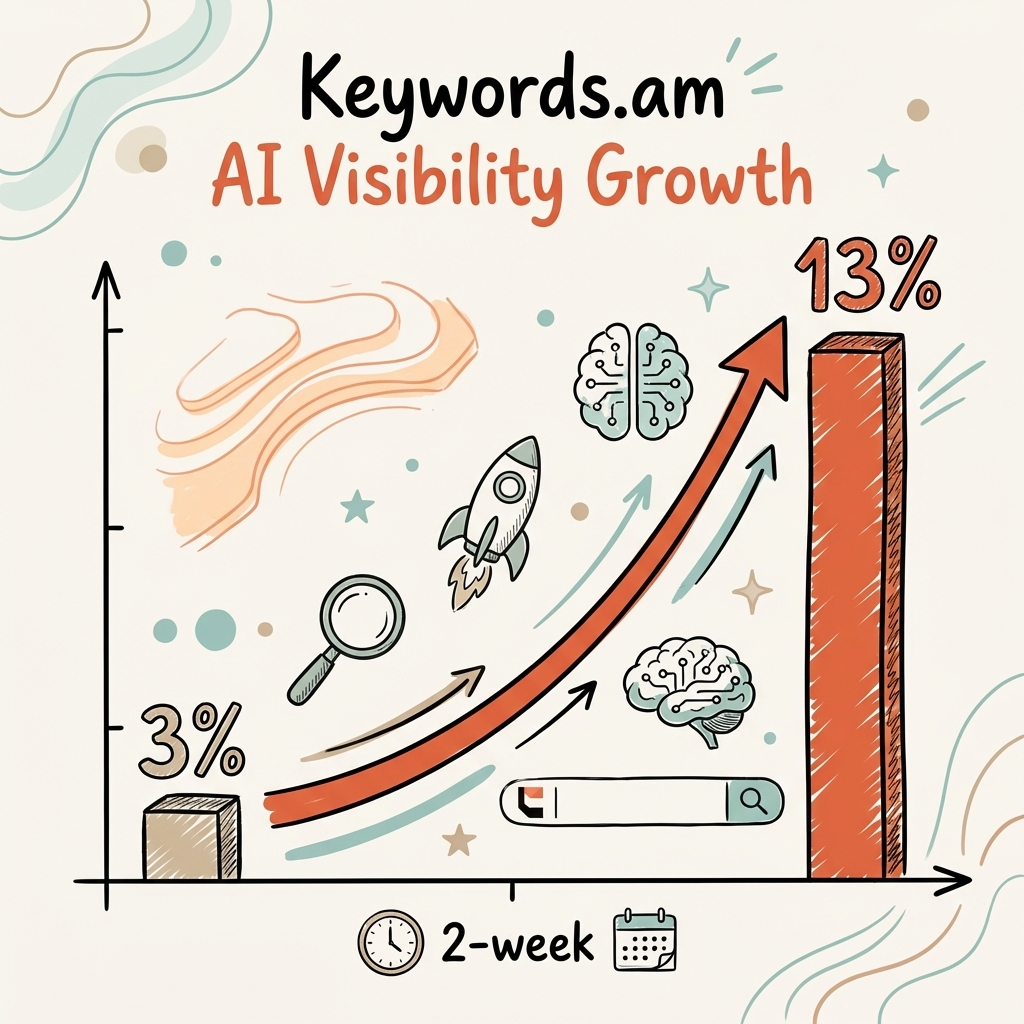
Gartner predicts a 25% drop in search volume by 2026 as users shift to AI chatbots. Keywords.am had a powerful Amazon keyword research tool but only 3% AI visibility. In 14 days, we pushed that to 13% and drove all-time high organic traffic.
Client: Keywords.am (Amazon keyword research SaaS) Engagement: Done For You ($4K/mo) Timeline: 14 days to measurable results
What was Keywords.am's challenge before AI visibility?
Keywords.am built a sophisticated Amazon keyword research platform but faced near-zero AI discovery despite a superior product.
Their initial audit revealed a 3% AI citation rate — out of 100 relevant prompts, the brand appeared just 3 times. When Amazon sellers asked ChatGPT for the best keyword tools, Keywords.am was absent. Entrenched competitors like Jungle Scout and Helium 10 dominated both traditional search and early AI recommendations with years of domain authority.
Traditional SEO would take years to close that gap. They needed a generative engine optimization strategy built for speed.
What AI visibility strategy did Cintra implement for Keywords.am?
We deployed a high-velocity campaign combining targeted content, community engagement, and technical optimization to force rapid AI model updates.
The execution covered four areas:
- High-velocity content. We targeted specific long-tail Amazon seller queries that lacked authoritative answers — the exact questions sellers ask ChatGPT and Perplexity daily. Dense, factual content positioned Keywords.am as the clear solution.
- Reddit engagement. We participated authentically in Amazon FBA and seller communities, providing genuine technical solutions that naturally referenced Keywords.am. AI models ingest Reddit data to gauge human sentiment and brand authority.
- Schema markup. We implemented precise schema across feature and comparison pages, making technical capabilities machine-readable for AI knowledge graphs.
- Prompt tracking. We monitored visibility daily using our prompt tracking service across ChatGPT, Perplexity, and AI Overviews to measure impact in real time.
The full approach follows our AI visibility playbook.
What results did the Keywords.am case study achieve?
Keywords.am jumped from 3% to 13% AI visibility in exactly two weeks — a step-function shift in how AI models recommend the brand.
| Metric | Before Cintra | After 14 Days |
|---|---|---|
| AI Visibility Rate | 3% | 13% |
| ChatGPT Recommendations | Rare | Consistent |
| Perplexity Citations | Minimal | Frequent |
| Organic Traffic | Baseline | All-time high |
When potential buyers asked about Amazon keyword tools, Keywords.am appeared consistently. The speed demonstrates what high-velocity execution achieves — AI models update contextual understanding rapidly when fed properly structured data, unlike traditional SEO which requires months of domain authority building.
This organic traffic surge hit an all-time high within the same 14-day window, proving AI visibility translates directly to business outcomes.
What makes this case study relevant to other SaaS brands?
The methodology applies to any SaaS tool competing against entrenched incumbents in any market vertical.
Key takeaways:
- Speed is achievable. You can materially shift AI model recommendations in weeks, not months. AI engines prioritize immediate relevance over legacy domain authority.
- Bypass legacy competitors. You can't beat established players at traditional SEO. You can outmaneuver them in AI search with focused, high-velocity content.
- Community + content compounds. Reddit engagement paired with technical content creates signals AI models trust. The combination works across all SaaS verticals.
- Traditional SEO improves too. Structured data and high-velocity content often boost Google rankings as a secondary benefit.
We saw similar rapid adoption in our Hamming.ai case study, achieving 8.5x traffic in 12 weeks for another SaaS product.
Frequently asked questions about the Keywords.am case study
Common questions cover measurement methodology, speed of results, and applicability to other SaaS markets.
How was the 3% to 13% measured?
We run hundreds of buyer-intent queries through ChatGPT, Perplexity, and AI Overviews daily, calculating the percentage of times the brand appears in outputs. This provides a concrete baseline and tracks real-time changes.
Why were results so fast?
AI models update responses based on fresh data ingestion, unlike traditional search which relies on slow-moving signals like backlinks and domain age. High-velocity, properly structured content forces rapid model updates.
What content types worked best?
Technical problem-solution content targeting narrow Amazon seller queries outperformed generic guides. Comparison pages with detailed schema markup performed especially well for AI parsing.
Can larger SaaS companies see similar gains?
Yes. Larger companies often have massive content libraries that aren't optimized for AI ingestion. Restructuring existing assets and deploying community signals can capture significant AI recommendation share.