Can AI search visibility reduce ad spend? Yes — it works by shifting buyer acquisition from paid clicks to organic AI citations. Gartner predicts a 25% drop in search volume by 2026 as consumers shift to AI chatbots. Every buyer who discovers your brand through a ChatGPT recommendation is a buyer you didn't need to pay Google Ads to reach.
How does AI search visibility reduce ad spend on paid channels?
AI citations function as free, trusted referrals that bypass the paid advertising auction entirely and deliver higher-converting traffic than most paid channels.
When ChatGPT recommends your product, users perceive it as an objective, curated suggestion rather than a paid placement. This implicit endorsement carries more trust than display ads or sponsored search results. The buyer arrives at your site already pre-sold by the AI's recommendation, shortening the sales cycle and improving conversion rates.
The economics compound over time. Paid ads require continuous spending to maintain visibility. AI citations persist and grow as you build authority, creating an increasingly valuable organic channel that reduces reliance on paid acquisition. This is why brands investing in organic AI citations see costs decline gradually rather than overnight — the savings accelerate as citation authority compounds.
What are 5 ways AI search visibility reduces ad spend?
Five specific mechanisms explain how AI citations translate into lower customer acquisition costs and reduced advertising dependency.
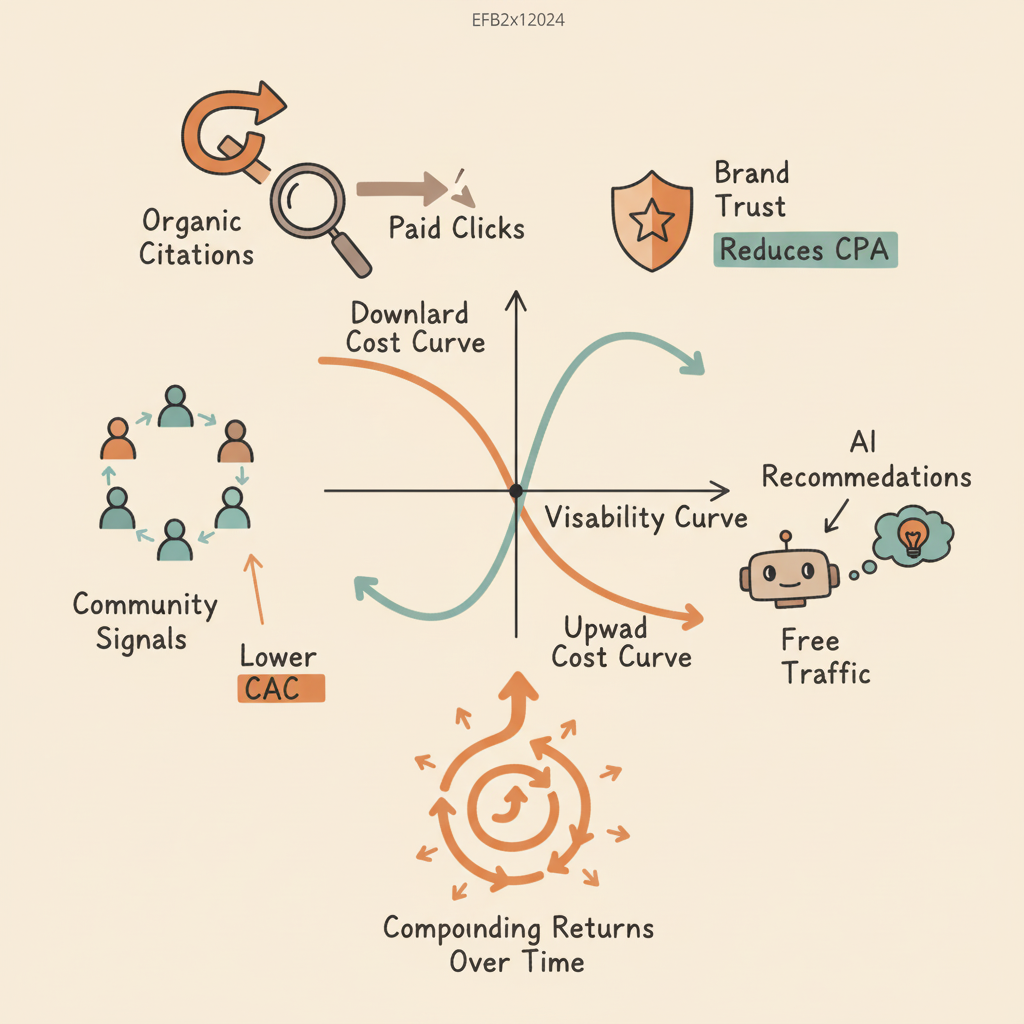
1. Zero cost per click. AI citations generate traffic without per-click charges. A brand recommended in ChatGPT responses receives unlimited referral traffic with no incremental cost. Compare this to Google Ads where competitive keywords cost $5-$50+ per click. Over thousands of queries, the savings accumulate substantially.
2. Higher conversion rates. AI-recommended traffic converts at higher rates because users trust the AI's judgment. A buyer who asks ChatGPT "what's the best project management tool for remote teams?" and receives your brand as a recommendation arrives with stronger purchase intent than someone who clicked a generic display ad.
3. Compounding returns. Paid advertising delivers linear returns — spend more, get more clicks. AI visibility compounds over time. Content and community signals build cumulative authority. Each month of generative engine optimization strengthens your position, reducing the marginal cost of each additional AI citation.
4. Reduced branded search costs. Brands with strong AI visibility often see reduced branded search CPCs because buyers already know the brand name from AI recommendations. They search your brand directly rather than clicking through competitive keyword auctions where you pay premium rates.
5. Lower funnel entry. AI citations typically capture buyers deeper in the purchase funnel than top-of-funnel display ads. A buyer asking ChatGPT for specific product recommendations is closer to purchasing than someone seeing a banner ad. This means fewer touchpoints and lower total acquisition cost.
How do you measure the ad spend reduction?
Measuring AI visibility's impact on ad spend requires tracking both direct attribution and secondary effects across your marketing channels.
| Metric | How to Measure |
|---|---|
| AI referral traffic | Track visits from AI platforms via UTM parameters and referrer analysis |
| Cost per acquisition shift | Compare CPA before and after AI visibility investment |
| Branded search volume | Monitor branded query increases correlated with AI citations |
| Ad spend as % of revenue | Track ratio changes over 3-6 month AI visibility campaigns |
Prompt tracking provides the AI citation data. Combine this with your existing analytics to calculate the total impact. Our AI visibility playbook covers the full measurement framework.
The UV Blocker case study demonstrates the pattern: 38K organic clicks and doubled weekly orders came from AI visibility investment, not increased ad spend. The Hamming.ai case study achieved 8.5x organic traffic growth for a SaaS product through the same organic approach.
Frequently asked questions about AI visibility and ad spend reduction
These questions address whether AI visibility replaces advertising entirely and how quickly cost savings materialize.
Does AI visibility replace paid advertising entirely?
Not entirely, but it shifts the mix significantly. Most brands maintain some paid advertising for brand awareness and retargeting while reducing spend on competitive keyword bidding as AI citations capture that traffic organically. Brands that build organic AI presence lower acquisition costs while keeping targeted retargeting budgets. The optimal balance depends on your market and competitive landscape.
How quickly do ad spend savings appear?
Initial AI citation traffic appears within 2-8 weeks depending on the platform. Measurable ad spend reductions typically follow 60-90 days after consistent AI visibility investment, as organic AI referral traffic builds enough volume to offset paid channels.
What's the ROI of AI visibility compared to PPC?
AI visibility investment ($2K-$4K/month) generates compounding organic traffic with no per-click costs. PPC generates linear traffic proportional to spend. Over 6-12 months, organic AI citations typically deliver 20-40% lower cost per acquisition on competitive keyword categories because the citations capture buyer demand without per-click charges.