Why Your Claude SEO Stack Is Just Expensive Busywork
Your Claude SEO stack feels productive but ranks nothing. These prompt stacks automate data gathering while skipping E-E-A-T, topical authority, and AI citations.
TL;DR
- Claude SEO prompt stacks automate the cheapest part of SEO: basic data gathering.
- These viral stacks produce spreadsheets and audit reports, not publishable content.
- 96% of AI Overview content comes from sources with verified E-E-A-T signals.
- Organic CTR dropped 61% year-over-year for queries triggering AI Overviews.
- 75% of AI Mode sessions end without users clicking any external links.
- Effective AI visibility requires human strategy paired with AI agent execution.
2.5 billion prompts run through ChatGPT daily. A growing chunk of them are Claude SEO stack prompts that promise to replace a $10,000/month agency. They don't.
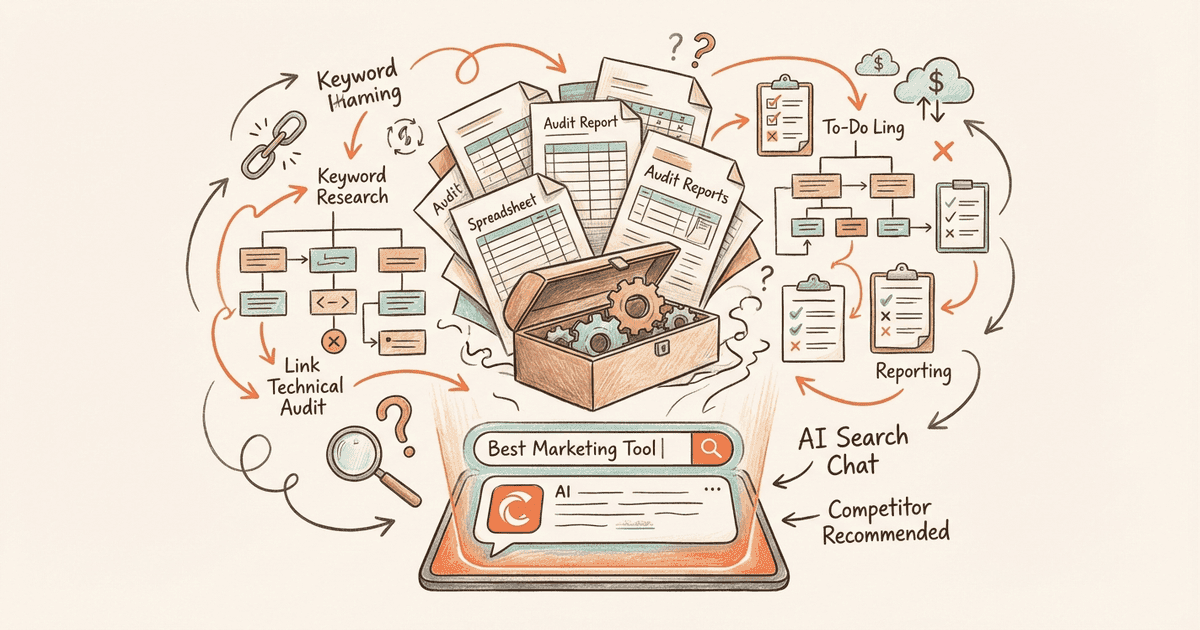
These viral stacks go viral because they feel productive. You paste a massive prompt. You watch the AI spit out an audit. You get a formatted spreadsheet. It looks like work. But feeling productive and being productive are different things.
Marketers fall into this trap constantly. They mistake structured data for search strategy. They spend hours refining prompts that scrape keyword volumes. They forget someone still has to write the articles, build the authority, and earn the links.
This article breaks down what these stacks actually do, what they skip entirely, and what moves the needle in AI search.
What Do Viral Claude SEO Prompt Stacks Actually Do?
Viral Claude SEO stacks automate data gathering tasks like competitor analysis, technical audits, and keyword research. This work produces spreadsheets, not rankings.
You see them on LinkedIn and X every morning. Marketers share eight-part prompt systems designed to replace entire SEO departments. Sarvesh Shrivastava's system claimed $25,000 in additional revenue. The AI Corner documented a 15-prompt workflow that promises to function as a free agency.
The Standard Prompt Stack Structure
These systems follow a predictable pattern. Research and competitive intelligence come first. Then keyword strategy. Then technical audits. Finally content scoring, local SEO checks, and backlink analysis.
Every prompt automates tasks a junior VA already handles. One prompt tells Claude to check your robots.txt. Screaming Frog does this in four seconds. Another asks for a keyword matrix. Any basic SEO tool exports the same data instantly.
Creators boast about time savings. They claim you can compress three to four hours of work into 12 minutes. They insist you can replace $200/month in software subscriptions.
You get organized data. You get structured tables. You get CSV files ready for download. But you don't get execution. You don't get closer to page one.
Why Does Data Gathering Feel Like SEO Strategy?
See where you rank across all AI answer engines.
Enter your domain and we'll scan your citation rate across ChatGPT, Perplexity, and Google AI.
Prefer to talk? Book a free 30-min call
Data gathering feels strategic because it produces tangible outputs like spreadsheets, audit reports, and keyword lists. None of these outputs directly improve rankings.
The productivity trap catches smart marketers daily. Claude outputs beautifully formatted CSVs and technical reports. According to Search Engine Journal, the gap between AI data gathering and strategy execution is widening in 2026. You stare at a 47-row keyword matrix. You feel accomplished. You feel like you did SEO. You didn't.
Audits don't equal content. Spreadsheets don't equal traffic. Competitor analysis doesn't equal competitive advantage.
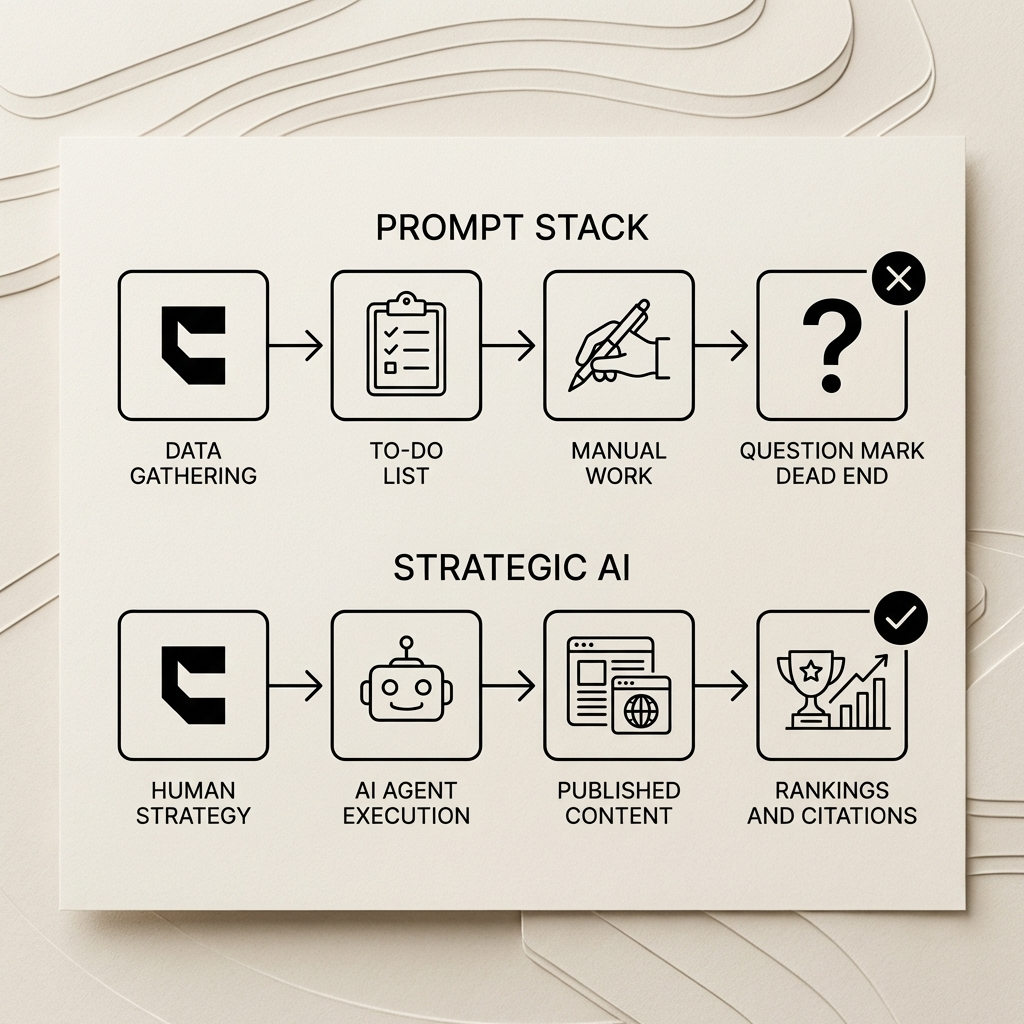
A Claude SEO stack gives you an organized to-do list. It never executes that list. And the list itself is surface-level.
What the To-Do List Actually Contains
You run the prompts and discover your competitors use specific H2 headers. You learn their top articles average 1,200 words. You find out they link to three internal pages per post.
This is observation. Not strategy. You still have to outline the topics, write the content, and build domain authority. The heavy lifting stays entirely undone.
What's Missing from Every Claude SEO Prompt Stack?
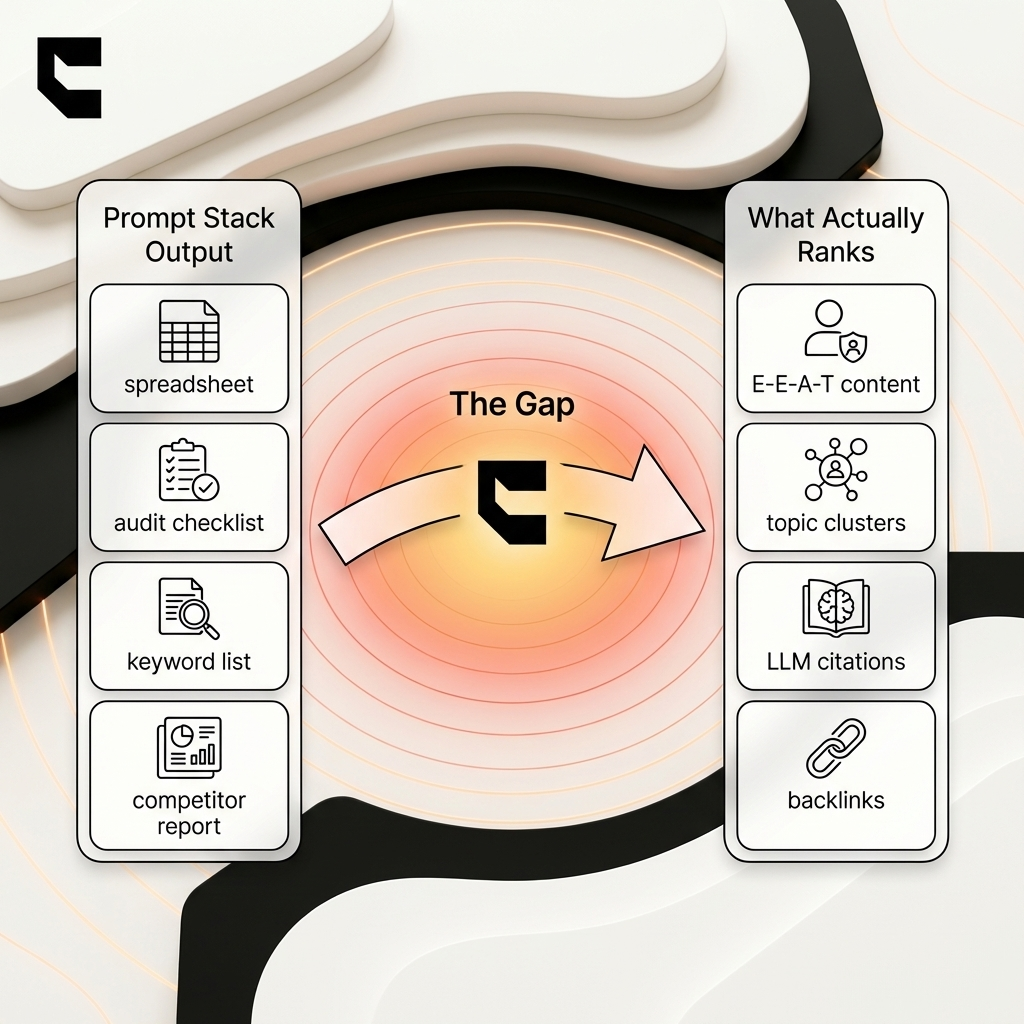
Prompt stacks skip four critical layers: E-E-A-T signals, topical authority building, LLM-citation-ready content, and link acquisition strategy.
No E-E-A-T Signals
Search engines demand proof of authority. 96% of AI Overview content comes from sources with verified E-E-A-T signals, showing an r=0.81 correlation with citation likelihood. Prompt stacks don't create expertise signals. They scrape competitor data. Real E-E-A-T for AI search requires demonstrated experience, original research, and citations from credible sources.
No Topical Authority
Modern AI systems evaluate knowledge consistency across your entire website, not individual pages. A prompt stack optimizes one page at a time. This isolates your content and destroys your cluster strategy.
Building topical authority means publishing 10-15 interlinked articles on a theme. A prompt stack tells you what keywords exist. It doesn't build the content ecosystem that signals expertise to AI models.
No LLM-Citation-Ready Content
Here's where the gap gets embarrassing. 67% of content cited by AI systems includes direct expert quotes. 78% features numerical data with source attribution. Prompt stacks produce neither.
The content ChatGPT actually recommends looks nothing like what a prompt stack tells you to write. You have to structure content specifically to get cited by Perplexity and other AI search engines.
No Link Acquisition
A prompt stack might reverse-engineer competitor backlink profiles flawlessly. It won't send a single outreach email. Analysis without execution is a hobby.
| Capability | Prompt Stack | Strategic AI Execution |
|---|---|---|
| Keyword research | Automated | Automated + intent mapping |
| Technical audit | Automated | Automated |
| Content creation | To-do list only | Full E-E-A-T content at scale |
| Topical authority | Not addressed | Topic cluster strategy |
| LLM citation optimization | Not addressed | AEO-optimized content |
| Link building | Analysis only | Outreach + acquisition |
| Execution | Manual (you do it) | AI agents execute |
The Hidden Cost of "Free" Prompt Stacks
The real cost of free Claude SEO stack prompts is opportunity cost: weeks spent organizing data instead of publishing content that ranks and gets cited.
Claude Pro costs $20/month. Running 15 SEO prompts costs time. You review outputs, format tables, adjust parameters. The result sits in Google Drive. Meanwhile, the search landscape shifts underneath you. Organic CTR dropped 61% year-over-year for queries with AI Overviews.
The AI Visibility Window Is Closing
User behavior is changing permanently. 75% of AI Mode sessions end without external clicks. Users get answers directly in the chat interface. They never visit your website.
The window to build AI visibility is shrinking every month. Prompt stacks don't even address AI visibility. They optimize for a version of search that existed three years ago.
Zero Content Output
AI systems reward comprehensive depth and structural clarity. Articles over 2,900 words average 5.1 LLM citations versus 3.2 for shorter content. A Claude SEO stack doesn't produce a single word of rankable content. It leaves you with frameworks and blank pages.
You save a few dollars on software. You lose thousands of potential visitors. That's the core tension of DIY vs agency AI visibility. You waste months organizing data while competitors publish answers.
What Does AI-Powered SEO Execution Actually Look Like?
Effective AI SEO combines human strategy with AI agent execution, producing E-E-A-T content at scale instead of spreadsheets.
The Human Strategy Layer
Human strategy means competitive positioning and market awareness. It means content angle differentiation and E-E-A-T signal planning. You can't prompt this. It requires genuine expertise from industry leaders.
The strategic decisions matter most: which five topics build lasting authority versus which 50 just chase hollow volume. No prompt stack makes these calls for you.
The AI Execution Layer
We deploy AI agents for daily execution. Our system handles content production at 50x the output of traditional agencies. We manage backlink outreach at scale. We drive targeted Reddit and Quora engagement. We continuously monitor AI visibility metrics.
Human strategy sets the target. AI agents pull the trigger.
The Results
The output is published content that gets cited. We build on Generative Engine Optimization principles every day. Our client UV Blocker went from zero to 38,000 clicks in six months. Hamming.ai saw 8.5x organic traffic in 12 weeks.
We don't hand you a formatted spreadsheet. We hand you qualified traffic, verified citations, and measurable revenue.
Frequently Asked Questions About Claude SEO Stacks
These are the most common questions from marketers evaluating Claude SEO stack prompts for their workflow.
Can Claude actually do SEO?
Claude can automate SEO data gathering and analysis. It can't execute strategy, build topical authority, or create E-E-A-T content without expert human direction. It's a research assistant, not an autonomous strategist.
Are Claude SEO prompt stacks worth using?
They're useful for quick technical audits and basic competitor research. But they skip the high-impact work that improves rankings and AI visibility. Use them to save ten minutes. Don't use them to build a business.
What is the difference between Claude Cowork and Claude Code for SEO?
Claude Cowork runs browser-based tasks like scraping and auditing pages. Claude Code operates within your local codebase. Neither replaces SEO strategy or content creation at scale.
How much does a Claude SEO stack actually cost?
Claude Pro costs $20/month. The real cost is opportunity. You spend weeks organizing data instead of publishing content that ranks. Lost time always costs more than software.
What should I use instead of a Claude SEO prompt stack?
Pair AI execution tools with expert human strategy. Use Claude for data tasks. Invest in E-E-A-T content, topical authority building, and LLM citation optimization for measurable results.
Conclusion
Prompt stacks automate the cheapest part of SEO: data gathering and formatting. They skip the expensive, high-leverage parts: strategy, content, and link building.
The output is a to-do list, not execution. The to-do list itself is surface-level.
AI search is shifting the game. A 61% CTR drop across traditional results. 75% of chat sessions ending without clicks. Prompt stacks don't address any of this.
Audit your workflow today. If your primary output is spreadsheets and reports with no published content, you've automated busywork.
See where your brand appears in AI search
Scan ChatGPT, Perplexity, and Google AI across buyer-intent queries, instantly, no sign-up.
Find out if AI is sending buyers to your competitors.
We audit your AI visibility across ChatGPT, Perplexity, and Google AI –and show you exactly where you rank and what to fix.
“We went from 200 visitors/day to 1,900 visitors/day and 40% of demos are from AI search.”
Sumanyu Sharma · CEO, Hamming.ai
“Cintra helped me go from 3k to 7.5k daily traffic and doubled weekly orders in 1.5 months.”
Russ Coulon · Owner, UV Blocker
“We saw a lift from 3% to 13% visibility in the first 2 weeks, and organic traffic hit its highest ever.”
Ash Metry · Founder, Keywords.am
Related Articles
Organic Traffic Decline 2026: Why It's Dropping and How to Recover
Organic traffic decline 2026 is real. AI Overviews cut clicks 38% on triggered queries. Here's what's causing…
AI Visibility Reporting: What to Track, Who to Tell, and How to Prove ROI
AI visibility reporting requires different metrics and formats than SEO reports. Learn the five core metrics,…
AI Visibility Competitive Analysis: How to Find and Exploit Gaps in 2026
AI visibility competitive analysis across ChatGPT, Perplexity, and 5 other engines. Framework for tracking com…