Is a GEO Agency Worth It? Cost, Timeline, Month 1 vs Month 6
Is a GEO agency worth it for an ecommerce brand? An honest look at the cost vs 2-3 in-house hires, what weeks 6-8 and month 3 should show, and when to skip it.
November 20, 202611 min read

Is a GEO agency worth it for an ecommerce brand? Yes, when it costs less than the 2-3 hires it replaces and lifts AI citations within 6-8 weeks. No, if the store can't give it six months.
That is the short answer. The longer one matters because the money is real and the results are slow at first. More shoppers now ask ChatGPT or Google's AI Overviews what to buy, with prompts like "best mineral sunscreen for kids" or "best iron supplement for women" (examples, not tracked data). The stores named in those answers get the click. The stores left out never learn they lost the sale. With Google Ads CAC still rising, an organic channel that keeps working after the spend stops is worth a lot.
This guide is for founders deciding whether to pay for that channel. It covers what a GEO agency costs next to an in-house team, what should happen in month 1, weeks 6-8, month 3 and month 6, why engagements run six months, and when a GEO agency is not worth the money. Cintra is a GEO agency and wrote this article, so its own claims are used as the bar any agency, Cintra included, should be held to.
Contents
- Is a GEO Agency Worth It for an Ecommerce Brand?
- What Does a GEO Agency Cost Compared With 2-3 In-House Hires?
- What Should Happen in Month 1, Week 6-8, Month 3 and Month 6?
- Why Do GEO Engagements Run Six Months?
- When Is a GEO Agency Not Worth It?
- How Do You Judge a GEO Agency Before and During the Engagement?
- Frequently Asked Questions About Whether a GEO Agency Is Worth It
- The Bottom Line on Whether a GEO Agency Is Worth It
Is a GEO Agency Worth It for an Ecommerce Brand?
A GEO agency is worth it for an ecommerce brand when it costs less than the hires it replaces, lifts AI citations within 6-8 weeks, and runs for six months.
For a store, a GEO agency does four things. It writes structured, citable product and category content. It builds backlinks and outside mentions. It joins community threads, such as Reddit, where the product genuinely answers the question, with affiliation disclosed. And it tracks weekly how often ChatGPT, Google AI Overviews, AI Mode and Perplexity name and cite the brand.
The skeptics deserve a fair hearing. The top Google result for "is a geo agency worth it for ecommerce" is a Reddit thread questioning agencies that sell GEO as a standalone service. They are partly right: a lot of GEO is good SEO fundamentals. The difference is what gets measured (citations and mentions, not only rankings) and the off-site work that most SEO retainers skip.
So the question isn't whether GEO is real. It's whether a given agency passes three tests: cost, checkpoints and horizon.
What Does a GEO Agency Cost Compared With 2-3 In-House Hires?
See where you rank in generative engine results.
Enter your domain and we'll scan your generative engine citation rate across your highest-value queries.
Prefer to talk? Book a free 30-min call
Doing GEO in-house takes 2-3 roles: research and writing, link building and community, and tracking. A good done-for-you agency should cost less than one of those hires.
The roles the work needs
- Buyer-prompt research: which questions shoppers ask AI about the category
- Writing content that AI engines can quote
- Link building and outside mentions
- Community posting on Reddit and similar forums
- Weekly citation tracking across AI engines
Cintra estimates that at 2-3 roles. To get a sense of the cost, here is US median base pay from the Bureau of Labor Statistics, before benefits, tools and management time:
- Writers and authors: $72,270 a year (May 2024), per BLS
- Market research analysts: $76,950 a year (May 2024), per BLS
- Marketing managers, if someone senior runs it: $161,030 a year (May 2024), per BLS
Hiring just a writer and an analyst comes to roughly $150,000 a year in base salary alone. Then come hiring time, ramp-up and the prompt-tracking tools an in-house team has to buy and run.
How agency pricing works
GEO agencies usually quote by scope. Cintra scopes each GEO agency engagement by catalog size, market and technical debt, and says it costs less than one hire and goes live in weeks rather than quarters. The fair comparison for any quote is one salary, not last year's SEO retainer. For the full in-house breakdown, see GEO agency vs in-house.
| In-house team | Done-for-you GEO agency | |
|---|---|---|
| Roles needed | 2-3 (research and writing, links and community, tracking) | Covered by the agency |
| Base cost | ~$72K-$77K per role in median US base pay (BLS, May 2024), plus a manager | Scoped quote; should be under one hire |
| Time to start | Hiring plus ramp: months | Weeks |
| Tracking | Tools bought and run in-house | Weekly citation and mention tracking included |
| Risk if it stops | Knowledge leaves with the hire | Earned citations and content stay with the brand |
Cost only matters if something visible happens. So what should a founder see, and when?
What Should Happen in Month 1, Week 6-8, Month 3 and Month 6?
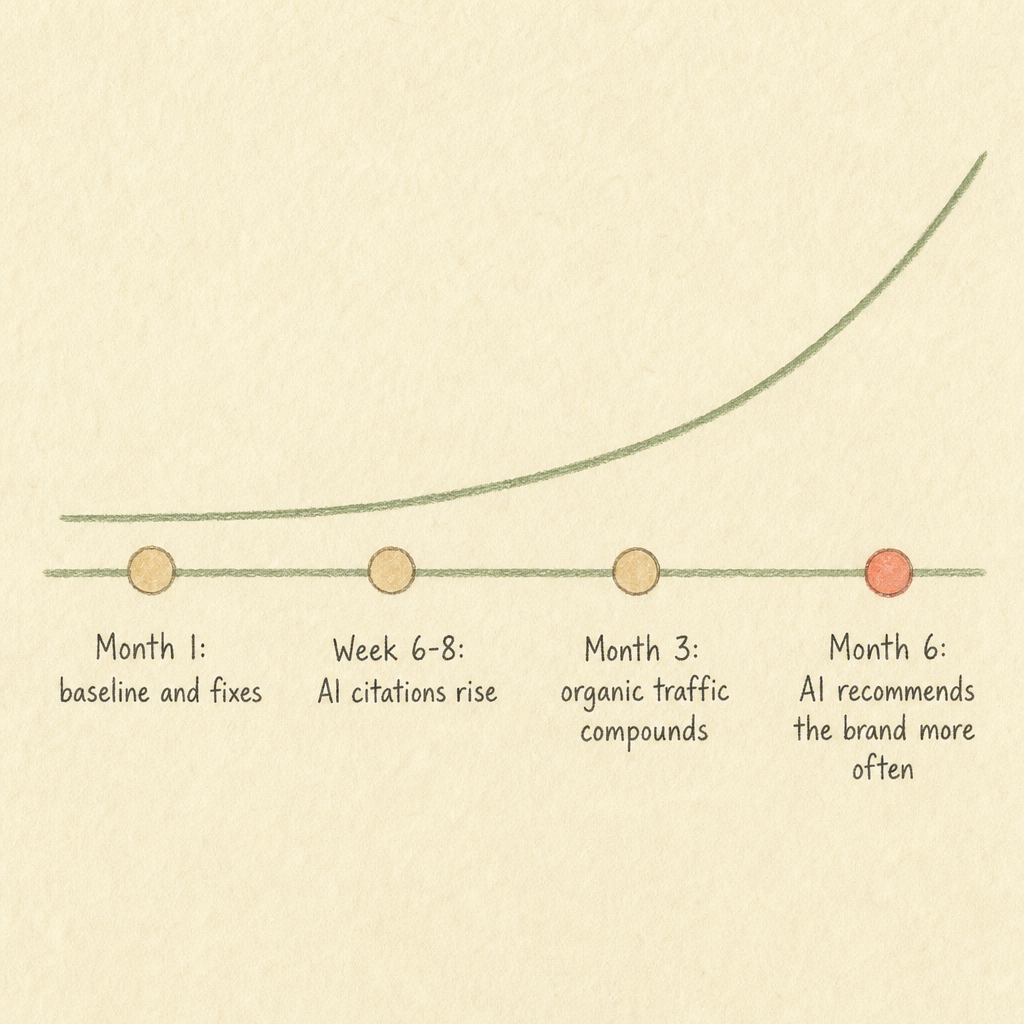
Month 1 sets the baseline and fixes access. By week 6-8, AI citations rise measurably. Around month 3, traffic compounds. By month 6, AI recommends the brand more.
Month 1: baseline and foundations
Visibility is tracked from day one against real buyer prompts and named competitors. The first fixes are about access: making sure AI crawlers can read the site at all. Then product and category pages are restructured so an AI engine can quote them. A founder should expect a baseline score in month 1, not traffic.
Week 6-8: citations move
Most Cintra clients see measurable AI citation increases within 6-8 weeks. The signs to look for are more tracked prompts naming the brand and new pages showing up as cited sources. If nothing has moved by week 8, ask why in writing. More detail on pacing is in how long AI visibility takes.
Month 3: traffic compounds
Organic traffic usually starts compounding around month 3, as cited pages, mentions and threads begin to reinforce each other.
Month 6: the compounding payoff
Month six wins more customers than month one. A competitor who starts later has to out-earn the brand's whole history to catch up.
What it looked like for two ecommerce brands
These are Cintra client results:
- UV Blocker (ecommerce): AI search visibility rose from 9% to 32%. Daily traffic grew from 3k to 7.5k and weekly orders doubled in 1.5 months, during the off-season. Organic traffic grew 70x in 4 months. See the UV Blocker results.
- Three Arrows Nutra (DTC health): $26K in organic revenue in 50 days, with clicks roughly doubling in 60 days, giving the brand an alternative to rising Google Ads CAC.
If results show by week 8, why commit to six months?
Why Do GEO Engagements Run Six Months?
Citations compound. Each cited page, outside mention and thread makes the next citation likelier, so month six earns more than month one, and short engagements miss that payoff.
Cintra runs engagements for six months for exactly that reason: shorter engagements leave the payoff on the table. A 90-day test catches the early citation lift but usually stops just as traffic starts to compound.
The off-site work is the slowest part. Mentions, threads and backlinks take the longest for AI engines to pick up, and it's the part most generalist retainers skip. That is also where a specialist earns its fee.
Six months is not a promise of permanence. AI answers shift as competitors publish, so citations are kept by keeping content fresh and tracking continuing. Six months is a real commitment. So when should a founder not make it?
When Is a GEO Agency Not Worth It?
A GEO agency isn't worth it if the store can't commit six months, sells products nobody asks AI about, can't change its site, or wants a dashboard.
- No six-month runway. If the budget covers only a quarter, the compounding never arrives. Fix ads or retention first.
- No AI demand for the category. If buyers don't ask AI assistants about this kind of product, there's little to win. Test real buyer prompts before paying anyone.
- The site can't change. If nobody can publish or fix pages, no agency can restructure product and category pages.
- Product-market fit isn't there. More visibility for a product with weak reviews and high returns makes the problem bigger, not smaller.
- A dashboard instead of execution. Tracking without execution reports the gap without closing it. What a founder pays for is outcomes, not drafts or task lists.
- Ad-like speed. Anyone who guarantees a ChatGPT placement in 30 days is a red flag.
If none of these apply, the next step is testing the agency itself.
How Do You Judge a GEO Agency Before and During the Engagement?
Ask for a baseline audit on your real buyer prompts, a written week 6-8 citation target, weekly tracking you can see, and a list of what they will publish.
- A baseline on real buyer prompts across ChatGPT, Perplexity, Google AI Overviews and AI Mode, scored against named competitors. Cintra runs this before a free 30-minute strategy session, and the brand keeps the audit either way.
- Checkpoints in writing: citations by week 6-8, traffic by month 3.
- Execution, not decks: who writes, who builds links, who posts threads and how affiliation is disclosed.
- The brand's own voice: content built from the founder's calls and product data, and reviewed before publishing.
- ROI tied to revenue, not only mentions. Cintra's guide to AI visibility ROI shows how to measure it.
Frequently Asked Questions About Whether a GEO Agency Is Worth It
These are short answers to the questions ecommerce founders ask most before hiring a GEO agency, from cost and timing to in-house options.
How much does a GEO agency cost for an ecommerce brand?
Pricing is usually scoped to catalog size, market and technical debt. A done-for-you agency should cost less than one in-house marketing hire.
For reference, US median base pay is $72,270 for writers and $76,950 for market research analysts (BLS, May 2024). Ask for a scoped quote and compare it with one of those salaries.
How long does GEO take to work?
Most brands should see measurable AI citation increases within 6-8 weeks, with organic traffic compounding at around three months.
Is GEO just SEO with a new name?
They overlap on fundamentals, but GEO measures citations and mentions in AI answers and leans on off-site work, like community threads and outside mentions, that most SEO retainers skip.
Can a small Shopify store benefit from a GEO agency?
Yes, if buyers ask AI assistants about its category and it can commit six months. Check with a free audit on real buyer prompts before paying.
Should I hire in-house or use a GEO agency?
In-house needs 2-3 roles and months to ramp. An agency fits when it costs less than one hire and starts in weeks; in-house fits when the team already exists.
The full comparison is in GEO agency vs in-house.
What happens after six months?
Earned citations and content stay with the brand. Keeping them requires fresh content and ongoing tracking, because AI answers change as competitors publish.
The Bottom Line on Whether a GEO Agency Is Worth It
A GEO agency is worth it for an ecommerce brand that can hold it to clear numbers for six months.
- Compare the cost with the hires it replaces, not with an old SEO retainer.
- Week 6-8 and month 3 are the checkpoints: citations first, then traffic.
- Six months is the horizon because citations compound.
- Skip it without runway, AI demand for the category, or the ability to change the site.
See where your brand appears in AI search
Free tool. Scan ChatGPT, Perplexity, and Google AI across buyer-intent queries, instantly, no sign-up.
Find out if AI is sending buyers to your competitors
We audit your AI visibility across ChatGPT, Perplexity, and Google AI, and show you exactly where you rank and what to fix.
Get my free AI audit“We went from 200 visitors/day to 1,900 visitors/day and 40% of demos are from AI search.”
Sumanyu SharmaCEO, Hamming.ai
Related articles

AI Strategy14 min read
How to Pick an AI SEO Agency: 10 US Options (2026)
Choosing an AI SEO agency? 10 US agencies compared on focus, fit and published pricing, plus a 7-question chec…

AI Strategy15 min read
7 GEO Agencies for DTC Brands, Compared (2026)
Looking for a GEO agency for DTC brands? 7 agencies compared on done-for-you work, DTC proof, pricing model an…
AI Strategy12 min read
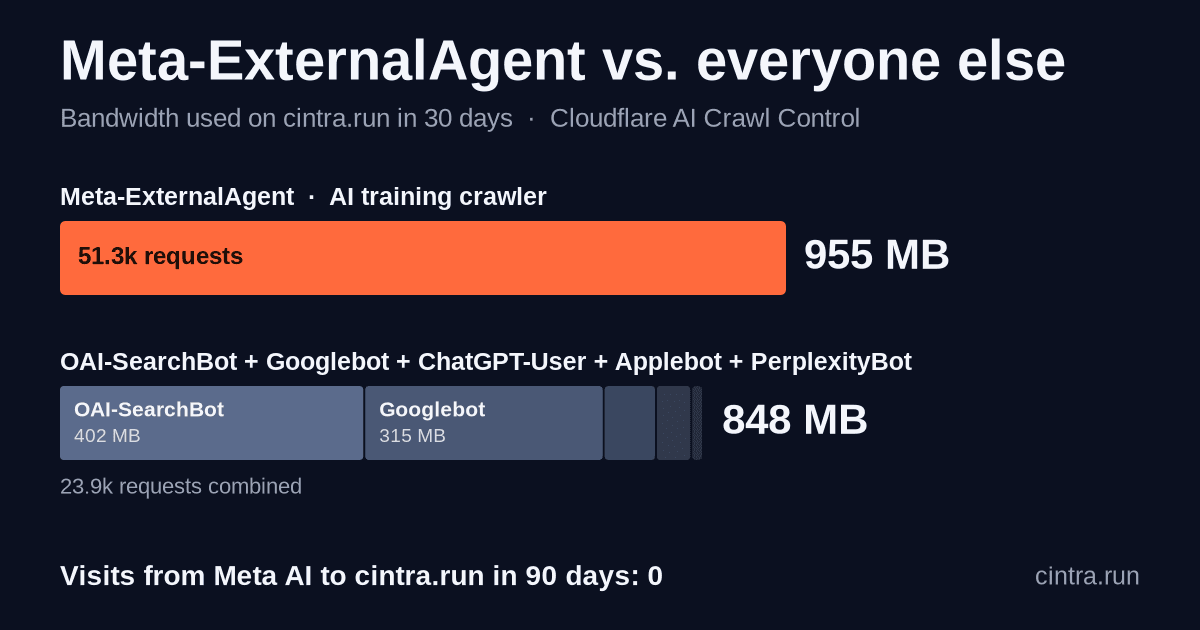
Meta-ExternalAgent Took More Bandwidth Than 5 Crawlers Combined
Meta-ExternalAgent pulled 955 MB from cintra.run in 30 days, more than 5 AI and search crawlers combined. What…