AI Visibility ROI: The Business Case Backed by Real Client Results
AI visibility ROI proven with real case studies: 8.5x traffic growth in 12 weeks, doubled weekly orders, and 156% more AI recommendations. Three named case studies, conversion data, and cost benchmarks.
TL;DR
- Conversion Efficiency: AI search traffic converts 4-23x higher than traditional organic search because users receive high-intent answers before clicking.
- Rapid Growth: Client Hamming.ai saw 8.5x traffic growth in 12 weeks, while UV Blocker doubled weekly orders in their off-season.
- Pipeline Impact: 40% of demos for B2B SaaS client Hamming.ai now originate from Reddit or AI search channels.
- Cost of Entry: Agency support delivers results within 4-12 weeks.
- Measurement: The return on AI visibility is measurable through direct referral tracking, citation monitoring, and pipeline attribution.
At Ahrefs, traffic from AI search converted 23 times higher than traditional organic search traffic. Just 0.5% of visitors drove 12.1% of signups. This statistic represents a fundamental shift in digital marketing. For nearly two decades, the industry measured success in volume: clicks, impressions, and session duration. As artificial intelligence reshapes information retrieval, the metric that matters is shifting from volume to value.
The AI visibility space currently suffers from a narrative problem. The honest position (championed by thoughtful agencies) is that "ROI is hard to prove" due to complex attribution and fragmented platforms. Conversely, many alternatives rely on borrowed case studies from major public companies rather than demonstrating repeatable client results. Few organizations have published a dedicated business case backed by their own client data.
This creates a specific pain point for marketing leaders. Competitors appear in ChatGPT citations and Perplexity answers, but the concrete data to justify a budget reallocation to a CFO is missing. Leaders need proof that this is a measurable channel with a clear return, not a shiny new object.
This article presents the AI visibility ROI business case using three named case studies from Cintra clients: Hamming.ai, UV Blocker, and Yoga Democracy. It details revenue-tied outcomes, examines the 23x conversion advantage, provides a realistic cost analysis, and outlines a measurement framework.
Want to see where your brand ranks in AI search: and who's beating you? Get your free AI visibility audit →
Why Is the AI Visibility ROI Question So Hard to Answer?
See where you rank across all AI answer engines.
Enter your domain and we'll scan your citation rate across ChatGPT, Perplexity, and Google AI.
Prefer to talk? Book a free 30-min call
AI visibility ROI is hard to measure because attribution is fragmented across multiple AI platforms, and most searches don't produce a trackable click.
Traditional metrics don't apply to AI search. Foundation Inc. correctly notes that SEO KPIs like rankings and click-through rates do not map one-to-one with Large Language Model (LLM) behaviors. When a user asks ChatGPT a question, the answer is often generated without triggering a visit to the source website.
Semrush data (Sept 2025) shows 92-94% of Google AI Mode searches end without a click. In a traditional marketing model, this would suggest failure. In the context of AI search, this "zero-click" activity satisfies user intent directly on the platform and builds authority, even if invisible to GA4. The brand mentioned in that answer gains awareness and credibility that influences future purchase decisions.
Attribution is also fragmented. A customer journey might span Perplexity, Reddit, and a direct visit, with the final step getting all the credit. Furthermore, the lack of first-party data in most published case studies creates skepticism. Leaders need proof from direct interventions, not theoretical frameworks applied to existing giants.
The measurement challenge is real but solvable by shifting focus from vanity metrics to business outcomes. When brands look beyond simple traffic volume and analyze pipeline quality, order volume, and citation frequency, the return on investment becomes visible.
What ROI Have Real Brands Seen from AI Visibility?
Real brands have seen 8.5x organic traffic growth, doubled weekly orders, and 156% more AI recommendations within 12 weeks to 6 months.
The most compelling argument for investing in AI visibility lies in the results of brands that have actively committed to the channel.
Hamming.ai (B2B SaaS)
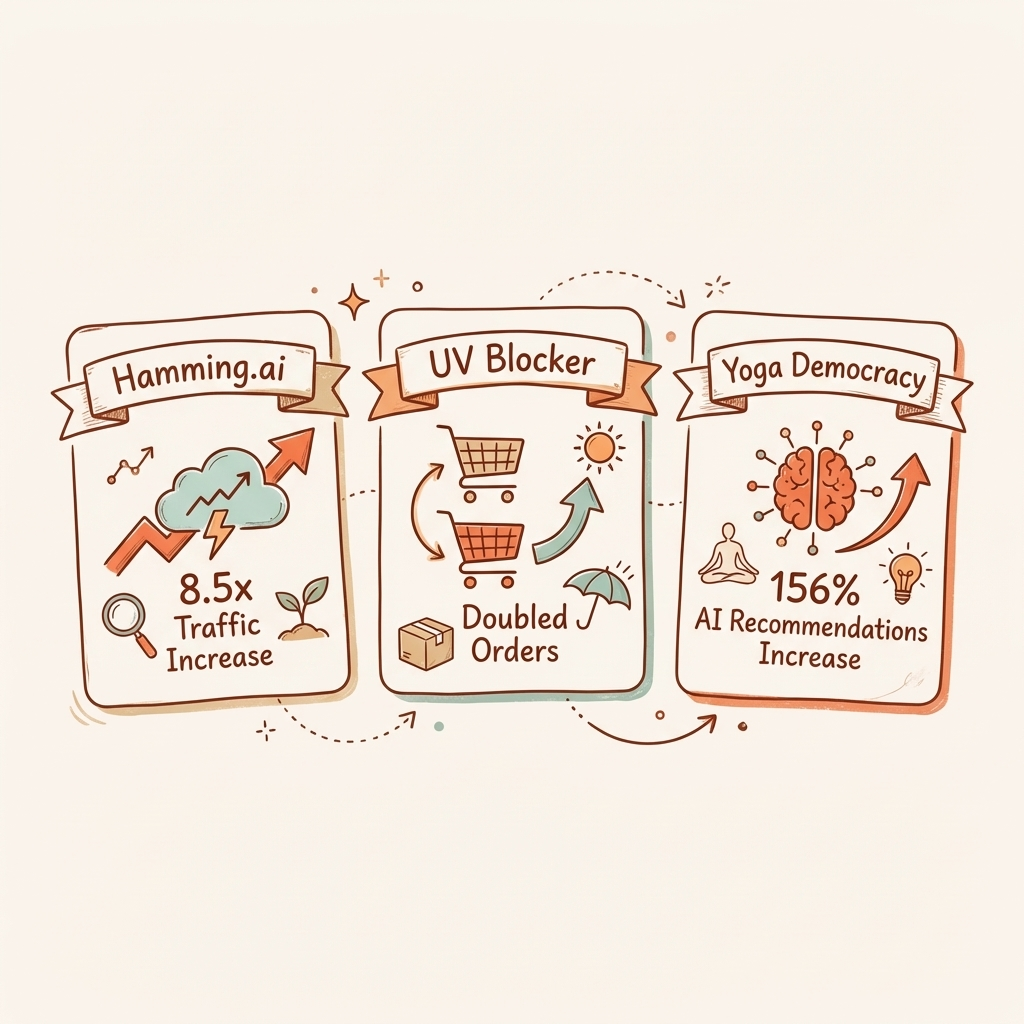
Hamming.ai had a superior product but limited visibility, averaging 200 daily visitors with zero AI search presence. The intervention involved a full AI visibility strategy: expert content for LLM citation, Reddit engagement for social proof, and prompt optimization.
Within 12 weeks, daily traffic surged to 1,900 visitors, an 8.5x increase. Crucially, CEO Sumanyu Sharma reported that "40% of the demos we get are from Reddit or AI search." This shift proves AI visibility drives qualified leads ready to convert, not just traffic volume.
UV Blocker (Ecommerce)
UV Blocker, a new sun protection brand, started with zero organic presence. The strategy focused on high-utility content and community building to establish authority AI models could reference.
In six months, UV Blocker went from zero to 38,000 clicks, with daily traffic stabilizing between 3,000 and 7,500 visitors. Owner Russ Coulon noted, "Cintra helped me go from 3k to 7.5k daily traffic and doubled my weekly orders in 1.5 months in off-season." Doubling orders during the off-season demonstrates the high intent of AI-referred customers.
Yoga Democracy (DTC Apparel)
Yoga Democracy operated in a crowded apparel market with niche visibility. The campaign optimized assets to associate the brand with attributes like sustainability in the AI recommendation layer.
Post-optimization, the brand saw a 156% increase in AI recommendations, moving from a niche player to a mainstream recommendation. This proves the return on AI search investment extends across verticals, from SaaS to ecommerce to direct-to-consumer apparel.
Learn how to get recommended by ChatGPT
How Does AI Visibility ROI Compare to Other Marketing Channels?
AI search traffic converts 4-23x higher than traditional organic and compounds over time, unlike PPC which stops when spend stops.
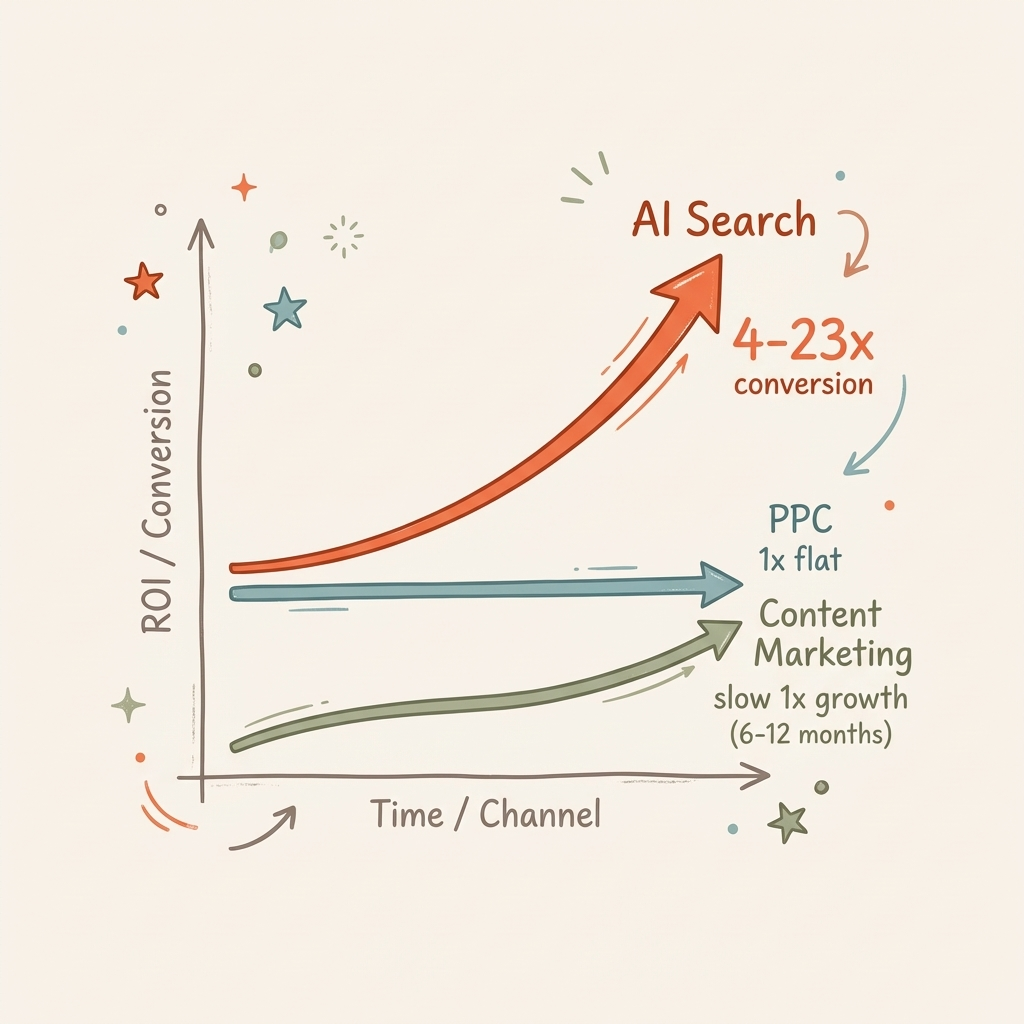
Data suggests that while AI visibility delivers lower volume than traditional search, the value per visitor is significantly higher.
Ahrefs' internal data showed AI search accounted for only 0.5% of traffic but drove 12.1% of signups, a 23x higher conversion rate than traditional organic. AI search acts as a pre-qualification filter. A user who clicks a citation in ChatGPT has already received an answer, evaluated the recommendation, and decided to learn more. These visitors arrive with high intent, making them far more likely to convert than users from a generic search query.
A Semrush study (June 2025) found the average LLM visitor converts 4.4x higher than a standard organic visitor. Platform-specific data from Growth Marshal reinforces this: Copilot traffic converts at 17x, Perplexity at 7x, and Gemini at 3-4x baseline.
| Channel | Conversion vs. Organic | Time to Results | Cost Trend | Compounding? |
|---|---|---|---|---|
| AI Visibility (GEO) | 4-23x higher | 4-12 weeks | Stable | Yes, citations build |
| PPC (Google Ads) | 1x baseline | Immediate | Rising ($2-15 CPC) | No, stops with spend |
| Traditional SEO | 1x baseline | 6-12 months | Stable | Slow compound |
| Content Marketing | Varies | 3-6 months | Stable | Moderate compound |
AI visibility sits in a sweet spot: offering the compounding benefits of organic search with a faster time-to-value (4-12 weeks) and superior conversion efficiency. It is an investment in a durable asset rather than a rental of attention. For data on whether growing AI visibility allows brands to reduce paid ad spend, see does AI search visibility reduce ad spend.
Read more on SEO vs AI search optimization
What Does It Cost to Invest in AI Visibility?
AI visibility investments vary based on scope and goals, with results typically appearing within 4-12 weeks.
Agencies specializing in AI visibility offer managed services covering technical analysis, content optimization, and reputation management.
A DIY approach lowers financial cost but requires significant internal resources. Executing an AI visibility strategy requires a mix of skills: technical understanding of how LLMs process information (like prompt optimization and latent space analysis), editorial capability to produce high-authority content, and community management skills to engage authentically on forums like Reddit. It is not free; it merely shifts the cost from an invoice to internal salaries and opportunity cost. For teams evaluating specialized agency support instead, the best AI search optimization agencies in 2026 are ranked by citation performance across ChatGPT, Perplexity, and Google AI.
The most significant cost is inaction. A 2025 report from Responsive indicates 25% of B2B buyers already use Generative AI over traditional search. Every month delayed is a month competitors build citation momentum. LLMs reinforce established authorities, making it harder for latecomers to displace them.
For a return-on-investment calculation, consider Hamming.ai: 40% of demos now come from AI channels. For most B2B and high-value brands, a few key customers cover the annual investment.
How Do You Measure AI Visibility ROI?
Measure AI visibility ROI through four channels: direct referral tracking in GA4, citation monitoring, pipeline attribution from AI-referred visitors, and brand search lift.
Direct Referral Tracking: GA4 identifies traffic from major AI engines. Brands should create a custom segment filtering for ChatGPT, Perplexity, and AI Overviews referrals. These visitors often exhibit higher conversion rates.
Citation Monitoring: Track brand mentions within LLM responses ("share of voice") for key transactional queries. Manual audits of top keywords provide an immediate baseline, and dedicated tools can automate ongoing tracking.
Pipeline Attribution: Connect AI-referred visitors to revenue via attribution software or post-purchase surveys. Hamming.ai's 40% demo figure came from connecting traffic sources to CRM data.
Brand Search Lift: AI recommendations often drive branded search on Google. An uptick in branded search correlating with AI optimization is a strong secondary signal of return on AI search investment.
For category benchmarks and what typical ROI looks like across industries, the GEO ROI benchmarks guide provides industry-specific data on citation rates, revenue attribution, and payback periods. For context on typical investment timelines, see how long AI visibility takes to generate results. For the specific metrics and KPIs used to track AI visibility program performance, the GEO metrics and AI visibility measurement guide breaks down share of voice, citation rate benchmarks, and reporting frameworks.
See the complete measurement framework
Frequently Asked Questions About AI Visibility ROI
These are common questions leaders ask when evaluating the business case for AI visibility.
How long before AI visibility generates ROI?
Most brands see measurable results within 4-12 weeks. Hamming.ai saw 8.5x traffic growth in 12 weeks; UV Blocker doubled orders in 6 weeks. Timelines depend on existing content foundation and investment level.
Should I stop investing in SEO and switch to AI visibility?
No. SEO is the foundation; 87% of ChatGPT citations come from Bing's top 10 results. AI visibility builds on SEO. The optimal strategy uses SEO for the content base and AI visibility to ensure that content is recommended. For brands prioritizing ChatGPT recommendations specifically, see the best ChatGPT recommendation agency guide for evaluated options.
What if my competitors already have AI visibility?
AI citations change 40-60% monthly. The window never fully closes. Unlike static SEO rankings, AI citations are volatile. Consistent, high-quality content can displace established competitors. If you're looking for agencies with documented results to benchmark against, AI visibility agencies with proven results profiles three agencies ranked by real client outcomes and citation methodology.
Is AI visibility a fad or a long-term trend?
With 800 million weekly ChatGPT users and Gartner predicting a 25% drop in traditional search volume by 2026, the shift is structural. Investing in AI visibility is preparing for the future of information retrieval.
Conclusion
"Is AI visibility worth it?" is no longer a theoretical question. Three brands across SaaS, ecommerce, and DTC verticals invested and achieved significant revenue outcomes within months.
The conversion efficiency of AI traffic combined with compounding citations creates a powerful business case. The risk has shifted from testing a new channel to waiting while competitors capture the citations that will drive the next decade of growth.
See what AI visibility could do for your brand, the data to make the business case is already here. For industry-specific ROI benchmarks and category-level data on AI visibility performance, the GEO ROI benchmarks guide provides the numbers you need for a CFO-ready business case. To find the right partner, the best AI visibility agencies in 2026 are ranked on citation methodology and documented revenue outcomes. If you want full execution without the management overhead, Cintra's done-for-you AI search optimization handles everything from content to community to citation tracking. For the Three Arrows Nutra case study showing how supplements brands build AI visibility, see the Three Arrows AI visibility case study. For brands still asking is GEO worth it, that guide presents three real case studies that answer the ROI question directly.
See where your brand appears in AI search
Scan ChatGPT, Perplexity, and Google AI across buyer-intent queries, instantly, no sign-up.
Find out if AI is sending buyers to your competitors.
We audit your AI visibility across ChatGPT, Perplexity, and Google AI –and show you exactly where you rank and what to fix.
“We went from 200 visitors/day to 1,900 visitors/day and 40% of demos are from AI search.”
Sumanyu Sharma · CEO, Hamming.ai
“Cintra helped me go from 3k to 7.5k daily traffic and doubled weekly orders in 1.5 months.”
Russ Coulon · Owner, UV Blocker
“We saw a lift from 3% to 13% visibility in the first 2 weeks, and organic traffic hit its highest ever.”
Ash Metry · Founder, Keywords.am
Related Articles
Organic Traffic Decline 2026: Why It's Dropping and How to Recover
Organic traffic decline 2026 is real. AI Overviews cut clicks 38% on triggered queries. Here's what's causing…
AI Visibility Reporting: What to Track, Who to Tell, and How to Prove ROI
AI visibility reporting requires different metrics and formats than SEO reports. Learn the five core metrics,…
AI Visibility Competitive Analysis: How to Find and Exploit Gaps in 2026
AI visibility competitive analysis across ChatGPT, Perplexity, and 5 other engines. Framework for tracking com…