Organic Traffic Decline 2026: Why It's Dropping and How to Recover
Organic traffic decline 2026 is real. AI Overviews cut clicks 38% on triggered queries. Here's what's causing it, why your SEO metrics are lying, and how to recover.
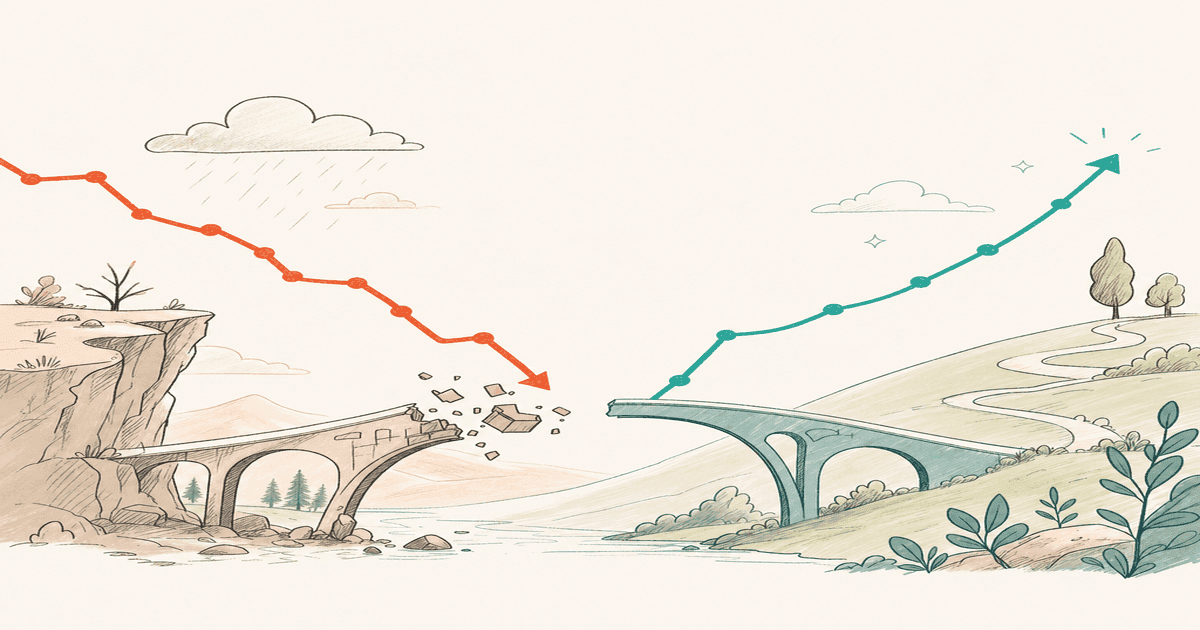
TL;DR
- Organic traffic decline in 2026 isn't an algorithm penalty. AI is intercepting queries before users click.
- AI Overviews cut organic clicks 38% on triggered queries. When they appear, CTR drops 61%.
- Your SEO dashboard looks stable because rankings haven't changed. But clicks per impression are collapsing.
- Two recovery paths: get cited in AI responses (AEO), and diversify to AI-referred traffic that converts 4.4-23x higher.
- A 30-day sprint can establish your AI visibility baseline and start recovery.
- Full traffic restoration to 2022 levels isn't coming back. But the new traffic converts dramatically better.
Your rankings haven't moved. Your content is solid. Organic traffic still fell 20-40% this year.
This isn't a penalty. AI is answering the query before the click happens. Google still shows your page, but users stop at the AI-generated answer box above it.
This guide diagnoses the four forces behind the organic traffic decline 2026, shows why standard SEO dashboards miss the damage, and lays out a 30-day recovery sprint with real case studies.
Organic Traffic Decline 2026: Is It Just You?
It's not just you. Organic traffic is declining across every industry in 2026 as AI search intercepts queries that previously drove clicks to websites.
The shift is already visible in the data. AI Overviews now appear on approximately 13% of Google queries, with projections hitting 20-25% by year-end. When AI Overviews appear, organic CTR drops 61%, according to Seer Interactive's analysis of 5.47 million queries across 53 brands.
That decline isn't limited to one niche. A randomized field experiment by researchers at Indian School of Business and Carnegie Mellon measured a 38% organic click reduction on queries where AI Overviews triggered. Global publisher traffic fell 33% from November 2024 to November 2025, per Chartbeat data published in the Reuters Institute report. The US-specific decline was even steeper at 38%.
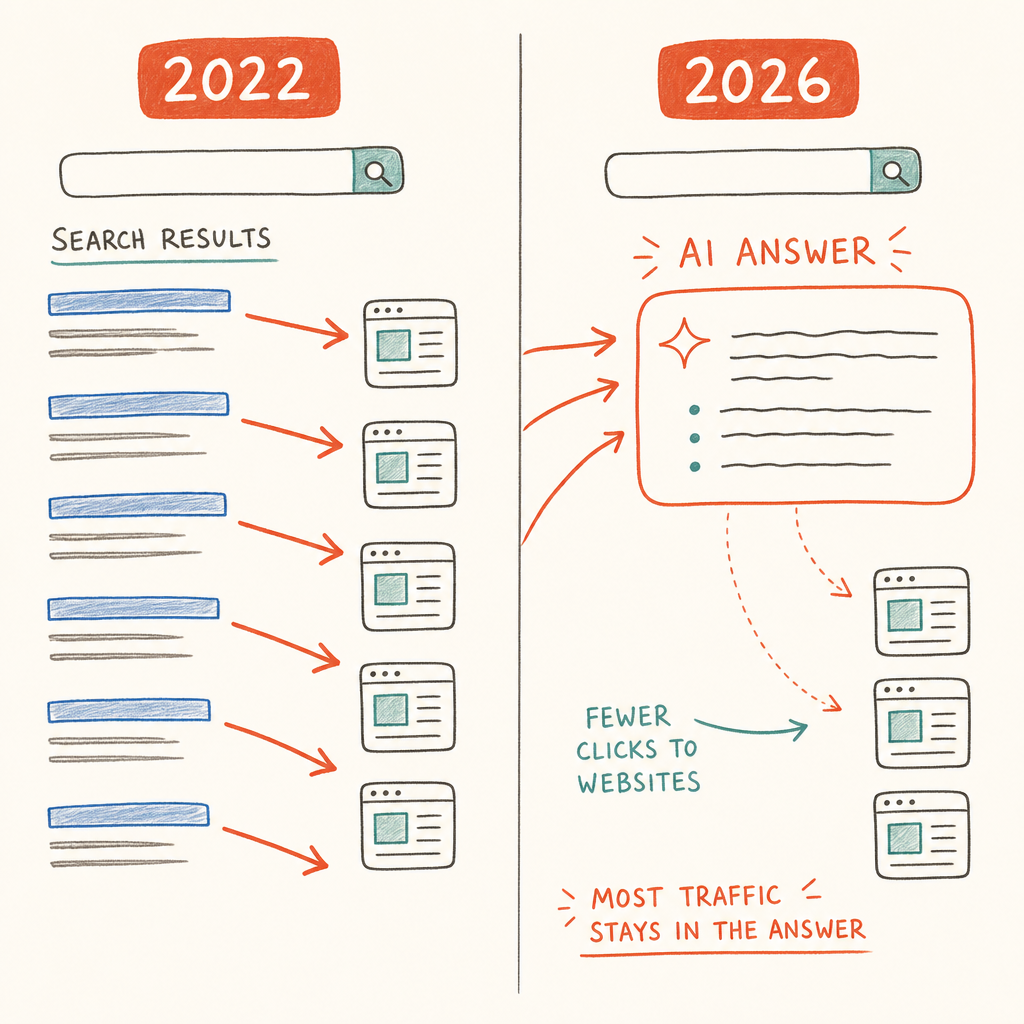
This isn't a hidden penalty. Rankings can look perfectly stable while clicks erode underneath them. That's the structural change. Understanding it starts with how AI Overviews affect your optimization strategy.
What Are the Four Forces Compressing Organic Traffic?
See where you rank across all AI answer engines.
Enter your domain and we'll scan your citation rate across ChatGPT, Perplexity, and Google AI.
Prefer to talk? Book a free 30-min call
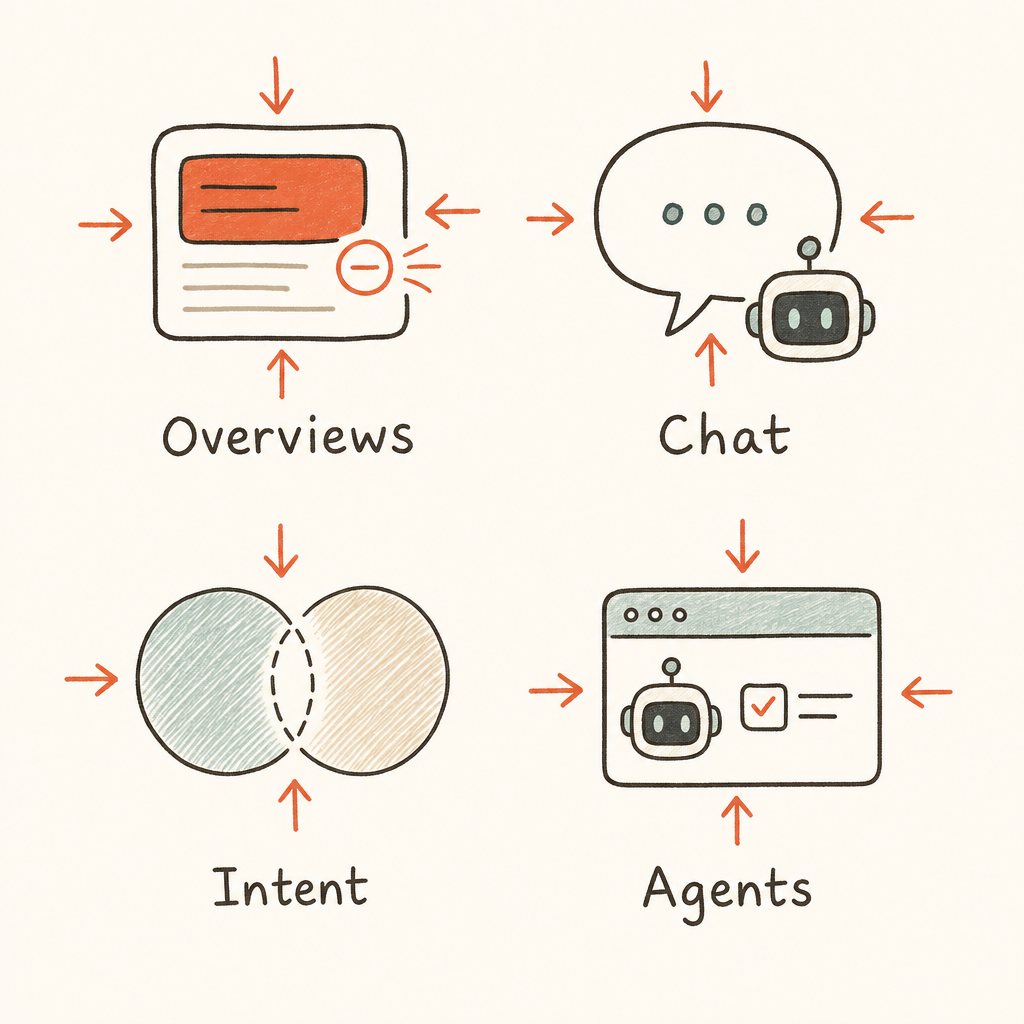
Four forces are compressing organic traffic simultaneously: AI Overview click absorption, AI chat as a research channel, the citation-ranking disconnect, and agentic browsers completing tasks without site visits.
These aren't separate problems. They overlap, and they hit the same pages. A zero-click search strategy starts with that reality, not with old assumptions about blue links.
AI Overview Click Absorption
AI Overviews absorb attention before a user reaches the organic results. On triggered queries, zero-click behavior rises to 72%, meaning most users never leave the results page. On those same queries, CTR falls 61%.
Put it simply: for every 100 clicks a page used to get, it now gets about 39. That change hits informational content first. It also hits the pages that used to feed top-of-funnel demos, email signups, and assisted conversions. The page still ranks. The click is gone.
AI Chat as Primary Research Channel
B2B buyers aren't always starting on Google anymore. G2's 2026 research found 51% of B2B software buyers now start research in an AI chatbot more often than Google, up from 29% in April 2025.
These users never reach Google at all. They're asking ChatGPT, Perplexity, Claude, and Grok questions they would've typed into a search bar 18 months ago. The buyer is now asking a prompt, not a keyword.
The Citation-Ranking Disconnect
Ranking and citation are different systems. Studies show only 17-38% overlap between top Google results and AI citations. Ahrefs found 38% overlap (down from 76% previously), while BrightEdge measured just 17%.
A page can rank #1 on Google and still never appear in ChatGPT, Perplexity, or AI Overviews. Traditional SEO rewards visibility on the results page. AI visibility rewards being selected as the answer source. These are now two separate games.
Agentic Browsers
Agentic features are still emerging, but the direction is clear. Google's AI Mode and task-completion features let AI compare, summarize, and act without sending the user through a full website session. When the AI can book, purchase, or compare on the user's behalf, more clicks disappear from the funnel entirely.
| Traffic Force | Impact on Organic Clicks | Source |
|---|---|---|
| AI Overviews present | -61% CTR | Seer Interactive, 5.47M queries |
| Zero-click on triggered queries | 72% get no click | ISB/Carnegie Mellon field study |
| B2B software buyers starting in AI chat | 51% bypass Google | G2 "The Answer Economy" 2026 |
| Citation vs ranking overlap | Only 17-38% | BrightEdge, Ahrefs |
Here's the uncomfortable part: your current metrics aren't showing you any of this.
Why Are Your SEO Metrics Lying to You?
Traditional SEO metrics like rankings and impressions show stability while actual clicks decline, because AI intercepts the query before users reach your site.
Rankings still matter, but they no longer explain the full picture. Google Search Console shows impressions and average position. It doesn't show whether AI Overviews or ChatGPT intercepted the query before the click. That's why teams keep optimizing content that looks good on paper and underperforms in revenue.
A Page One Power survey of 600 marketing professionals found only 27% consistently track brand appearance in AI-generated answers. That means 73% of marketing teams are measuring Google rankings while AI takes the traffic. They're watching the scoreboard of a game that's already moved to a different field.
The blind spot is specific. Your rankings haven't dropped. Your impressions look fine. But clicks-per-impression is collapsing on informational queries because AI answers the question in the SERP. GSC won't flag this unless you're actively comparing click trends against impression trends by query type.
What to track instead: AI citation rate, mention rate across platforms, and AI-referred conversion rate. Those three numbers tell a story that rankings alone can't. How to measure AI visibility outlines the audit model and reporting structure for each.
What Are the Two Paths to Recover Organic Traffic?
Two recovery paths exist: compete for AI citations so your brand appears in AI responses, and diversify to AI-referred traffic from ChatGPT, Perplexity, and Claude.
Recovery now splits into two lanes. One is citation. The other is referral. What AI visibility is explains the first lane, while AI visibility ROI helps justify the investment in both.
Path 1: Get Cited in AI Responses (AEO)
Pages cited in AI Overviews earn 120% more clicks per impression than uncited pages on the same SERPs, according to Seer Interactive's analysis of 2.43 billion impressions. That's the new prize.
The work is less about broad ranking position and more about being easy to cite, easy to parse, and easy to trust. Answer-first content. Clean definitions. Specific entities. Tight summaries. Strong provenance signals.
Path 2: Diversify to AI-Referred Traffic
AI-referred visitors convert at 4.4x the rate of traditional organic visitors, according to Semrush's study of AI search traffic patterns. Our internal client data shows AI search converts 23x higher overall. The volume is lower, but the intent is dramatically stronger.
That gap shows up in real client work. Hamming.ai grew 8.5x in organic traffic in 12 weeks, from 200 to 1,900 visitors per day, with 40% of demos coming from Reddit or AI search. UV Blocker went from 0 to 38K clicks in 6 months and doubled weekly orders in the off-season. These aren't abstract wins. They're channel shift in plain sight.
The 30-Day Recovery Sprint
A 30-day sprint covers four phases: audit AI visibility, fix technical blockers, optimize top pages for citability, and launch a buyer-prompt content strategy.
Week 1: Audit AI Visibility Across 7 Platforms
Map your presence across ChatGPT, Perplexity, Claude, Grok, AI Overviews, Copilot, and Gemini. Record where your brand appears, where competitors appear, and where you're absent. Set a baseline for citation rate and mention rate.
That baseline matters more than a ranking report right now. It tells your team which prompts are already working and where competitors own the AI conversation about your category.
Week 2: Fix Technical Blockers
Technical access still breaks visibility before content quality even matters. Research indicates 34% of B2B SaaS companies block AI crawlers via robots.txt. Check for lines like:
User-agent: GPTBotwithDisallow: /User-agent: ChatGPT-UserwithDisallow: /User-agent: PerplexityBotwithDisallow: /User-agent: ClaudeBotwithDisallow: /
Also review schema markup, structured data completeness, and crawl paths. If the bot can't reach your content, answer optimization doesn't matter yet.
Week 3: Optimize Top 10 Pages for AI Citability
Take the pages that already drive the most value and make them easier for AI to cite. Add answer capsules near the top of each section. Clarify entities. Strengthen author signals, source references, and page purpose. An AI content audit is the fastest way to find which pages need this work first.
Think in extraction, not just readability. AI needs clean answer chunks it can pull into a response. Long intros and vague subheads make citation harder.
Week 4: Launch Buyer-Prompt Content Strategy
Target prompts, not keywords. Buyers ask ChatGPT and Perplexity questions the way they'd ask a sales rep. Build content around those exact prompts, then support it with comparison pages, FAQ blocks, and use-case pages. Zero-click search strategy covers the prompt framework in more depth.
By day 30, your team should know what's visible, what's blocked, what's cite-worthy, and what buyers actually ask.
What Does Recovery Actually Look Like?
Full traffic restoration to 2022 levels isn't coming back. Recovery means lower traffic volume but dramatically higher-quality visitors who convert at 4.4x to 23x the rate of traditional organic.
That expectation reset matters. The old baseline on informational queries is gone permanently. Brands that keep chasing it waste months.
| Metric | Traditional Organic | AI-Cited/Referred Traffic |
|---|---|---|
| Click-through rate | Baseline (declining) | +120% when cited in AI Overviews |
| Conversion rate | 1x baseline | 4.4x higher (Semrush), 23x overall (Cintra data) |
| Revenue per visitor | Baseline | Higher (intent is pre-qualified by AI) |
| Traffic volume | Declining on informational queries | Smaller but growing channel |
The honest framing: you're not restoring old traffic. You're capturing a new, higher-quality traffic channel. Brands that adapt now own the AI-referred traffic pool while competitors keep optimizing for a click economy that already shrank.
This is a strategic advantage, not damage control. Lower traffic that converts 4-23x better is a better business than high traffic that bounces.
Frequently Asked Questions About Organic Traffic Decline
These are the questions marketers ask most about organic traffic decline in 2026 and the shift to AI search.
How Fast Will You See Results from AEO?
Most brands see measurable AI citation improvements within 4 to 8 weeks. Traffic quality improvements usually follow within 90 days.
Hamming.ai posted 8.5x organic growth in 12 weeks. The speed depends on existing content quality, technical foundation, and how competitive your category is in AI responses.
Does Organic Traffic Decline Affect Every Industry?
Every industry is affected, but informational-heavy verticals like SaaS, finance, and healthcare see the steepest organic traffic decline because AI answers those queries most aggressively.
Ecommerce is hit differently. Transactional intent still sends traffic, but research-heavy product discovery is getting squeezed. The more a page exists to explain, compare, or define, the more exposed it is to AI interception.
Should You Stop Doing SEO?
No. SEO remains foundational. But SEO alone is no longer sufficient. You now need both Google rankings and AI citations to capture full search demand.
This isn't SEO versus AEO. It's SEO plus AEO. Google rankings still matter for queries that don't trigger AI responses and for crawl discovery. They just don't tell the whole story anymore.
How Do You Explain Organic Traffic Decline to Your CEO?
Frame it as a channel shift, not a failure. AI search is creating a new traffic channel that converts 4.4x to 23x higher than traditional organic.
Lead with revenue data, not traffic volume. Show that click counts are down while qualified demand is moving to AI platforms. Position AEO investment as capturing a higher-value channel, not fixing a broken one.
What Tools Track AI Visibility?
You need tools that monitor brand mentions across ChatGPT, Perplexity, Claude, and AI Overviews. Standard SEO tools don't track this layer.
The useful stack measures citations, mentions, and changes over time across platforms. How to measure AI visibility outlines the audit model and reporting structure that supports it.
What Comes Next
The brands that adapt to AI search now will own the next decade of organic growth. The ones that keep measuring Google rankings while AI takes the traffic won't.
We've seen this pattern across every client vertical. The organic traffic decline 2026 is real, but the recovery path is clear: get visible where AI is sending buyers.
Related Reading
- AI Search Advertising: The Complete 2026 Guide, how paid AI placements complement organic citation strategies once your baseline visibility is established
- AI Visibility Competitive Analysis, how to identify which competitors are capturing the AI traffic your brand is losing
- AI Visibility Reporting: What to Track and How to Prove ROI, how to measure the new channel that is replacing the organic clicks you have lost
See where your brand appears in AI search
Scan ChatGPT, Perplexity, and Google AI across buyer-intent queries, instantly, no sign-up.
Find out if AI is sending buyers to your competitors.
We audit your AI visibility across ChatGPT, Perplexity, and Google AI –and show you exactly where you rank and what to fix.
“We went from 200 visitors/day to 1,900 visitors/day and 40% of demos are from AI search.”
Sumanyu Sharma · CEO, Hamming.ai
“Cintra helped me go from 3k to 7.5k daily traffic and doubled weekly orders in 1.5 months.”
Russ Coulon · Owner, UV Blocker
“We saw a lift from 3% to 13% visibility in the first 2 weeks, and organic traffic hit its highest ever.”
Ash Metry · Founder, Keywords.am
Related Articles
Meta-ExternalAgent Took More Bandwidth Than 5 Crawlers Combined
Meta-ExternalAgent pulled 955 MB from cintra.run in 30 days, more than 5 AI and search crawlers combined. What…
AI Visibility Reporting: What to Track, Who to Tell, and How to Prove ROI
AI visibility reporting requires different metrics and formats than SEO reports. Learn the five core metrics,…
AI Visibility Competitive Analysis: How to Find and Exploit Gaps in 2026
AI visibility competitive analysis across ChatGPT, Perplexity, and 5 other engines. Framework for tracking com…