AI Visibility Competitive Analysis: How to Find and Exploit Gaps in 2026
AI visibility competitive analysis across ChatGPT, Perplexity, and 5 other engines. Framework for tracking competitor citations and building a response plan.

TL;DR
AI visibility competitive analysis only works when the audit is platform-specific, prompt-specific, and tied to response priorities.
- AI visibility is fragmented across engines. A competitor can dominate one platform and disappear on another.
- Citation Share, AI Share of Voice, Prompt Coverage, and Brand Mention Prominence give a complete competitive picture.
- Buyer-intent prompts matter more than broad informational prompts.
- Fresh content, topical authority, and strong E-E-A-T signals expose competitor weaknesses quickly.
- Weekly monitoring catches citation shifts before they compound.
Only 11% of domains are cited by both ChatGPT and Perplexity for the same queries. That split turns AI visibility competitive analysis into a platform-by-platform exercise, not a single ranking report.
Traditional competitive analysis tools like Ahrefs, Semrush, and Similarweb still matter for SEO. They don't show who wins AI-generated answers. Competitors can collect high-intent citations in ChatGPT, Perplexity, Gemini, Claude, Grok, and Google AI Overviews while you stay blind.
This guide focuses on competitors, not self-assessment. We cover the four metrics that define AI search position, a repeatable audit process, and a response plan for platform-specific gaps.
Why Does Traditional Competitive Analysis Fail for AI Search?
See where you rank across all AI answer engines.
Enter your domain and we'll scan your citation rate across ChatGPT, Perplexity, and Google AI.
Prefer to talk? Book a free 30-min call
Traditional competitive analysis tracks rankings and backlinks, but AI engines cite sources based on authority signals, content structure, and platform preferences that SEO tools can't measure.
That mismatch shows up immediately in practice. Search "best CRM for startups" on Google, ask ChatGPT, and ask Perplexity. You'll get three different competitive landscapes. Keyword rank trackers were built for fixed result pages. AI search is contextual. The prompt, platform, and source mix all change the answer.
The platform split is not a small edge case. Digital Bloom's 2025 research found that only 11% of domains are cited by both ChatGPT and Perplexity. For baseline tracking context, how to measure AI visibility covers the measurement model underneath this work.
Each platform also prefers different source types:
- Perplexity leans on real-time web results
- ChatGPT blends training data with web search
- Google AI Overviews draw from indexed pages
- Claude uses Brave Search
- Grok leans into X data
AI search competitive benchmarking needs more than a single dashboard. SEO tools tell you who ranks. They can't tell you which competitor gets cited, where, and why.
What Are the Four Metrics That Define AI Competitive Position?
Four metrics define AI competitive position: Citation Share, AI Share of Voice, Prompt Coverage, and Brand Mention Prominence. Each measures a different visibility layer.
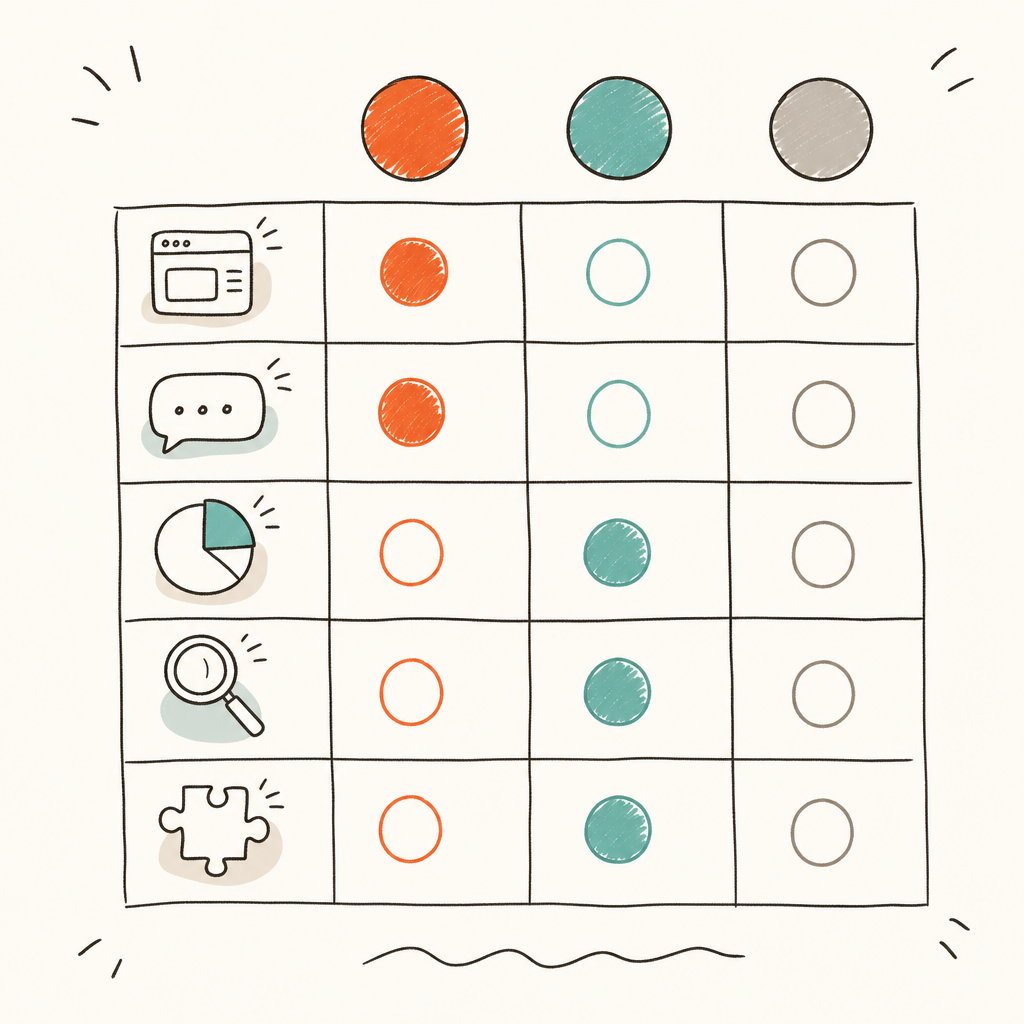
AI search statistics provides market context. The numbers below make competitive benchmarking operational.
Citation Share measures volume. Your brand citations divided by total category citations for a prompt set. If 10 prompts generate 30 mentions and your brand is cited 8 times, Citation Share is 27%.
AI Share of Voice measures breadth of presence. It's the percentage of relevant prompts where you appear vs. competitors. Citation Share tracks volume per appearance. Share of Voice tracks whether you appear at all.
Prompt Coverage measures reach across buyer-intent queries. You can win a narrow set of prompts and still lose the category by missing key buyer questions.
Brand Mention Prominence measures placement and framing inside the answer. First mention matters more than a buried list item. We score it: First Mention = 3 points, Listed = 1 point, Absent = 0.
| Metric | What It Measures | Formula | Example |
|---|---|---|---|
| Citation Share | Volume of mentions | Brand citations / total citations | 8/30 = 27% |
| AI Share of Voice | Breadth of presence | Prompts with brand / total prompts | 15/25 = 60% |
| Prompt Coverage | Reach across buyer queries | Prompts appearing / total relevant | 20/30 = 67% |
| Brand Mention Prominence | Quality of placement | Weighted score (1st=3, listed=1) | Avg 2.1/3.0 |
That matrix becomes the working view for an audit. Our prompt tracking service supports this kind of prompt-level comparison. The best AI visibility tools guide covers other options.
How Do You Run a Competitive AI Visibility Audit?
Step 1: Identify Your AI Competitors
Start with competitors that AI engines already recommend. This list is not always your SEO competitor list. Ask ChatGPT and Perplexity, "What are the best [category] tools or brands?" and compare the names that surface.
Step 2: Build the Prompt Set
Build around buyer intent. For a B2B SaaS category, useful prompts include:
- "Best CRM for startups"
- "CRM with built-in reporting"
- "Recommended CRM for small sales teams"
- "CRM comparison for HubSpot alternatives"
Mix informational, comparative, and transactional queries. 20-30 prompts gives you a statistically meaningful sample.
Step 3: Test Across Platforms
Run each prompt on ChatGPT, Perplexity, Gemini, Claude, Google AI Overviews, Grok, and Reddit. Use the same prompt set across reporting periods. Consistency shows whether changes came from the competitor, the platform, or the prompt itself.
Step 4: Score and Map
Calculate Citation Share, SoV, Prompt Coverage, and Prominence for each competitor across each platform. A clean matrix makes the gap obvious.
How Do Platform-by-Platform Competitive Dynamics Work?
Each AI platform uses different source selection methods, so competitive position changes by engine. Freshness, authority, and social signals carry different weight on each.
ChatGPT blends training data with web search. Brands with authority that predates the current model window have a historical advantage. Newer brands need more web-findable content to compete.
Perplexity is the sharpest recency game. Fresh web content can outrun older pages quickly. A 2026 comparison guide can replace a competitor's 2024 pricing page if it's more complete and current.
Google AI Overviews prioritize indexed content. Existing SEO authority still matters. The competitive picture often mirrors organic strength, but it's not identical.
Claude relies on Brave Search grounding. Less studied platform, but growing in market share.
Grok gives more weight to X discussion signals. Brands active in public conversations have an edge here.
| Platform | Source Method | Freshness Weight | Authority Signal | Competitive Lever |
|---|---|---|---|---|
| ChatGPT | Training + web | Medium | High (historical) | Established authority |
| Perplexity | Real-time web | Very High | Medium | Fresh, comprehensive content |
| AI Overviews | Indexed pages | Medium | Very High | SEO authority + structure |
| Claude | Brave Search | High | Medium | Web presence breadth |
| Grok | X + web | Very High | Low | Social discussion presence |
The mix changes the playbook. What works on Perplexity (fresh content, comprehensive answers) may not move the needle on ChatGPT (where historical authority weighs more).
How Do You Find Competitor Weaknesses to Exploit?
Find competitor weaknesses by identifying stale content, thin topical coverage, missing platforms, and poor E-E-A-T signals. Then create content that fills those exact gaps.
Stale Content
Easiest place to start. If a competitor's pricing page hasn't been updated since 2024, a fresh 2026 comparison guide can displace it on freshness-sensitive platforms like Perplexity.
Thin Topical Coverage
One article rarely holds against a content cluster. A competitor that covers a topic once can be outflanked by 5-8 interconnected pages that establish topical authority.
Missing Platforms
A recurring weakness. Graph Digital's 2026 research says 82% of B2B brands are invisible in AI recommendations. Many brands still optimize for Google only and never build the citation footprint needed for AI search.
Poor E-E-A-T Signals
Check whether competitors have author bios, original data, or expert quotes. If they don't, adding these to your content gives you an immediate advantage.
The Business Case
Brainlabs Digital reports AI search referral traffic converts at 4.4x the rate of traditional organic. Competitive wins in AI search translate directly to conversion wins. A structured AI content audit shows which pages need the fastest fixes.
How Do You Build a Competitive Response Plan?
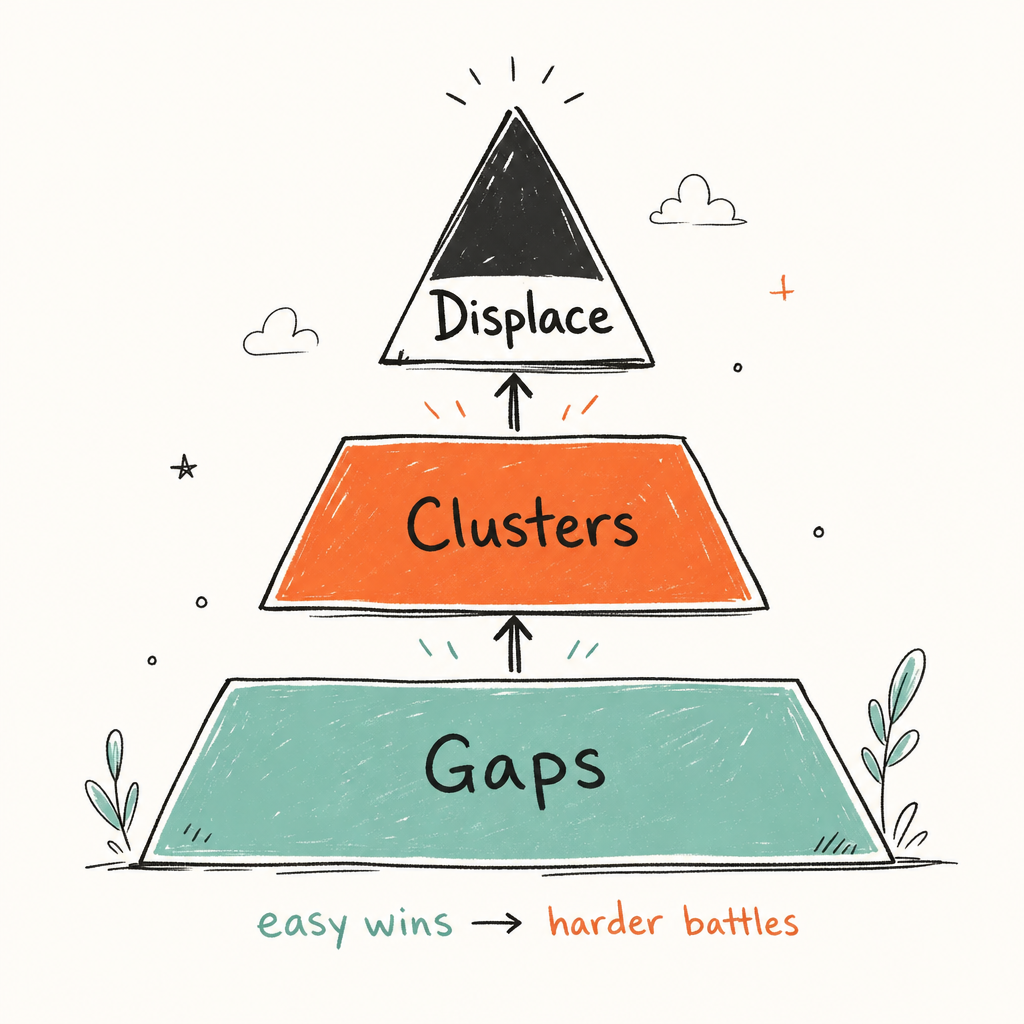
Build a competitive response plan by prioritizing prompts where you're absent but competitors are cited, creating targeted content clusters, and monitoring citation changes weekly.
Priority 1: Fill Absence Gaps
Focus first on prompts where competitors are cited and you're completely absent. It's easier to move from zero presence to a cited result than to displace a well-established competitor.
Priority 2: Build Content Clusters
Around the highest-value prompts, create 3-5 interconnected pages that establish topical authority. Example: one core page on "AI visibility for [industry]," supported by pages on measurement, tools, and case studies. One article rarely beats a cluster.
Priority 3: Monitor Weekly
AI citations shift faster than organic rankings. On Perplexity, a competitor can publish one strong piece and shift the answer set within days.
Recommended cadence:
- Monthly: Full competitive audit across all platforms
- Weekly: Spot-check top 10 priority prompts
- Real-time: Alert on brand mention changes
We track competitors across seven engines for brands that want ongoing coverage. See our competitor monitoring service or compare plans for tracking options.
How Do You Run Your First Competitive AI Audit This Week?
Run a lightweight competitive AI audit in under two hours by selecting three competitors, testing ten prompts, and scoring by platform. That first data pass gives you a real competitive baseline without waiting for tool procurement or budget approval.
Step 1, Pick 3 competitors. Choose the brands that appear most often when you ask ChatGPT or Perplexity "best [your category]." These are your AI search rivals, which may differ from your SEO rivals.
Step 2, Write 10 buyer-intent prompts. Pull from sales calls and demo questions. Good examples: "best [category] for [use case]," "[competitor name] vs alternatives," "how to solve [pain point your product addresses]."
Step 3, Run each prompt on ChatGPT and Perplexity. Copy the response. Note: which brands appear, in what order, and what language the model uses (positive, hedged, comparative).
Step 4, Score the results. For each prompt and each brand, assign: First mention = 3 points, Listed = 1 point, Absent = 0. Calculate each competitor's total. That's your baseline Brand Mention Prominence score.
Step 5, Identify your biggest gap. Find the prompts where competitors are cited and you're absent. Those are your Priority 1 content targets. One well-structured article per gap, published with strong E-E-A-T signals, can shift Perplexity citations within 2–4 weeks.
A manual audit takes roughly 90 minutes. Run it monthly and the competitive picture becomes a trend line instead of a one-time snapshot.
Frequently Asked Questions About AI Visibility Competitive Analysis
How often should you run a competitive AI visibility analysis?
Run a full competitive audit monthly at minimum, with weekly spot-checks on the top 10 priority prompts during active campaigns. AI citations change faster than organic rankings.
What tools can support AI competitive analysis?
Our prompt tracking covers 100-200 prompts across seven engines. Otterly and Peec AI cover narrower monitoring use cases. No single tool covers all seven major AI platforms equally well, so manual review stays necessary for nuanced analysis.
How long does it take to overtake a competitor in AI citations?
Initial gains often appear within 30-90 days, depending on gap size, platform freshness, and content volume. Perplexity responds fastest. ChatGPT shifts more slowly because training data and authority signals still matter.
Can you track competitors without expensive tools?
Yes. Manual prompt testing across AI platforms costs time, not money. Run 20-30 prompts each month and log results in a spreadsheet. At larger scale, automated tracking becomes necessary for consistent data.
How is AI visibility competitive analysis different from SEO competitive analysis?
SEO competitive analysis tracks keyword rankings and backlinks. AI visibility competitive analysis tracks citations, brand mentions, and prominence inside AI-generated answers. The two views often diverge. A brand ranking first on Google can still be absent from ChatGPT responses entirely.
What content types are most effective for gaining AI citations over competitors?
Original data, expert-authored how-to guides, and comparison content consistently earn higher citation rates. AirOps' 2026 research found that brands with clear E-E-A-T signals (author credentials, primary research, and verifiable claims) earn citations at 3–5x the rate of thin or unattributed content. Filling a specific topic gap your competitor has ignored, even with a single well-structured article, is usually faster than trying to displace them on a topic they already own.
How do you track citation changes after publishing new content?
Re-run your baseline prompt set on a two-week cycle for the first 60 days after publishing. Record citation presence and positioning per platform. Perplexity typically reflects new content fastest (2–5 days). ChatGPT web search mode follows in 1–2 weeks. Google AI Overviews may take 2–4 weeks depending on crawl frequency. A spreadsheet with columns for date, prompt, platform, brand cited, and prominence score is enough for a manual tracking loop.
Conclusion
Platform-by-platform analysis exposes gaps that aggregate SEO tools miss. Those gaps are the fastest route to share gains in AI search.
- AI competitive analysis must be platform-specific. Aggregate metrics hide critical gaps.
- Four metrics give you the full picture. Citation Share, AI Share of Voice, Prompt Coverage, and Brand Mention Prominence.
- Competitor weaknesses are your fastest path. Stale content, thin coverage, and missing platforms create openings.
- Weekly monitoring catches shifts early. AI citations move faster than organic rankings.
Start today: Pick your top 3 competitors. Run 10 buyer-intent prompts across ChatGPT and Perplexity. Score who gets cited and where.
Related Reading
- AI Visibility Reporting: What to Track and How to Prove ROI, how to turn competitive benchmark data into recurring reports that demonstrate progress to stakeholders
- AI Visibility at Scale: The Multi-Brand Enterprise Playbook, how to apply competitive analysis across an entire brand portfolio rather than a single product line
- Organic Traffic Decline 2026, why competitors gaining AI citations is directly connected to the traffic declines most brands are now experiencing
See where your brand appears in AI search
Scan ChatGPT, Perplexity, and Google AI across buyer-intent queries, instantly, no sign-up.
Find out if AI is sending buyers to your competitors.
We audit your AI visibility across ChatGPT, Perplexity, and Google AI –and show you exactly where you rank and what to fix.
“We went from 200 visitors/day to 1,900 visitors/day and 40% of demos are from AI search.”
Sumanyu Sharma · CEO, Hamming.ai
“Cintra helped me go from 3k to 7.5k daily traffic and doubled weekly orders in 1.5 months.”
Russ Coulon · Owner, UV Blocker
“We saw a lift from 3% to 13% visibility in the first 2 weeks, and organic traffic hit its highest ever.”
Ash Metry · Founder, Keywords.am
Related Articles
Organic Traffic Decline 2026: Why It's Dropping and How to Recover
Organic traffic decline 2026 is real. AI Overviews cut clicks 38% on triggered queries. Here's what's causing…
AI Visibility Reporting: What to Track, Who to Tell, and How to Prove ROI
AI visibility reporting requires different metrics and formats than SEO reports. Learn the five core metrics,…
Google Search Agents: What the I/O 2026 Announcement Means for Your Brand
Google search agents monitor topics 24/7 and push recommendations to 1B+ users. Learn what information agents…