AI Brand Monitoring: How to Track What AI Says About Your Brand
AI brand monitoring tracks what language models say about your brand. Learn how to build a query matrix, score AI responses across six platforms, and respond when monitoring reveals problems.
TL;DR
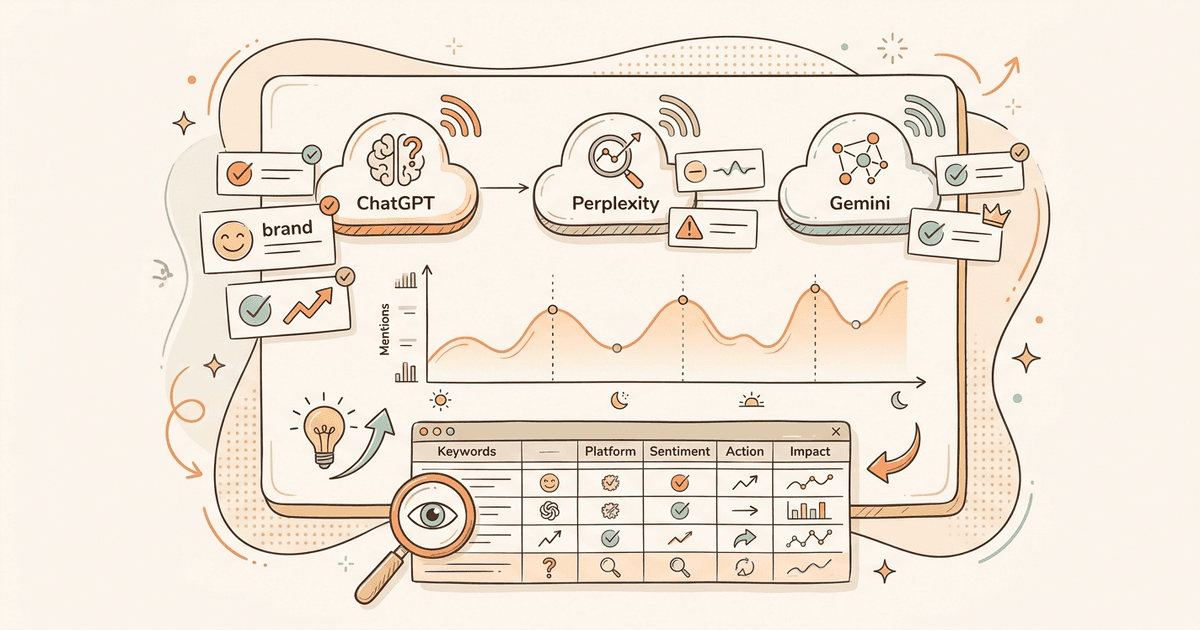
AI answers shift between every query, session, and platform. A single audit captures one moment, not reality. Build a 30-query matrix across branded, category, comparison, and problem-solution queries. Run it weekly (spot-checks), monthly (full audit), and quarterly (deep dive). Score responses on five dimensions: mention rate, sentiment nuance, accuracy, citation sources, and competitive share of voice. Map every finding to a specific action using the response playbook below.
There's less than a 1-in-100 chance ChatGPT will recommend the same brand list twice, even for the same question asked minutes apart (SparkToro, Jan 2026).
Only 16% of brands track their AI search performance systematically (McKinsey, Sep 2025). The other 84% run a one-time audit, feel good or bad about the results, and move on. They never know the picture changed the next day.
This guide walks through building an ongoing AI brand monitoring system: the query matrix, the platform-by-platform workflow, the scoring framework, and the response playbook for every scenario.
We built a measurement framework tracking the 4 metrics for AI visibility. We also wrote a playbook to fix wrong AI answers. Monitoring is the operational bridge connecting detection with correction.
What Is AI Brand Monitoring and How Does It Differ from SEO Tracking?
AI brand monitoring tracks what AI models say about your brand when users ask questions. It goes beyond whether your pages rank or people mention you on social media.
SEO tracking measures page positions in search results. Google shows your link at position four. That's a placement metric. AI brand monitoring measures what language models say about you. ChatGPT might say, "Brand X is good for beginners but lacks advanced features." These present entirely different challenges.
Social listening tracks human conversations about your brand. AI brand monitoring tracks statements generated by artificial intelligence, statements presented as fact to millions of users. Social listening evaluates what people say. AI monitoring evaluates what AI says on their behalf.
The gap matters. Users treat ChatGPT recommendations like expert advice. Brands with a strong off-site presence earn 6.5x more AI citations (AirOps, 2026). If you only track SEO ranks, you miss this entirely.
Understanding what AI visibility means raises the next question: why can't you just audit once and be done?
Why Are Point-in-Time AI Audits Not Enough?
See where you rank across all AI answer engines.
Enter your domain and we'll scan your citation rate across ChatGPT, Perplexity, and Google AI.
Prefer to talk? Book a free 30-min call
AI answers change between queries, sessions, and platforms. A single audit captures one moment, not the volatile reality your customers experience daily.
SparkToro tested 2,961 prompts across ChatGPT, Claude, and Google AI Overviews in January 2026. Fewer than 1 in 100 runs produced the same brand recommendation list. The results showed deep inconsistency. AI engines generate fresh responses every single time.
Even ordering is unstable. The chance of seeing the same list in the same order is closer to 1 in 1,000. Your brand might be first on Monday and fifth on Tuesday. A single audit misses this volatility entirely.
Each platform pulls from different sources. ChatGPT uses training data combined with web search. Perplexity uses real-time citations. Gemini leans on Google's index. A single audit can't capture this multi-platform fragmentation.
Only 16% of brands have moved beyond point-in-time audits to systematic tracking. Continuous monitoring is the only way to measure true visibility.
If every platform produces different answers, you need to know which ones to monitor and why.
Which AI Platforms Should You Monitor?
Monitor at least ChatGPT, Perplexity, and Google AI Overviews as your top three. Add Claude, Copilot, and Grok based on your specific target audience.
ChatGPT operates as a hybrid. It uses months-old training data and real-time web search. You need to monitor both modes. Your brand can appear correctly in web search mode but show outdated info in default mode.
Perplexity relies entirely on real-time web citations. It updates the fastest of all engines. If you publish corrective content, Perplexity picks it up in days. Think of it as your canary, if a fix works here first, it validates the approach.
Google AI Overviews pull directly from Google's index. They receive high traffic volume. Google synthesizes answers differently than standard blue links, so ranking well doesn't guarantee a good AI Overview mention.
Claude relies on Brave Search for web lookups. It's growing in B2B and developer audiences. Track Claude closely if you sell technical products.
Copilot uses a Bing-exclusive index. It matters for enterprise audiences where Microsoft products dominate daily workflows.
Grok holds an X data advantage. It incorporates real-time social signals. Monitor Grok if your brand generates significant social discussion.
| Platform | Source Basis | Update Speed | Priority |
|---|---|---|---|
| ChatGPT | Training + web search | Days (web) / Months (training) | Critical |
| Perplexity | Real-time web citations | Days | Critical |
| Google AI Overviews | Google index | 1-2 weeks | Critical |
| Claude | Brave Search | Days (web) | High |
| Copilot | Bing index | 1-2 weeks | Medium |
| Grok | X data + web | Days | Medium |
Now you know where to look. The next step is knowing what to ask.
How Do You Build a Query Matrix for AI Brand Monitoring?
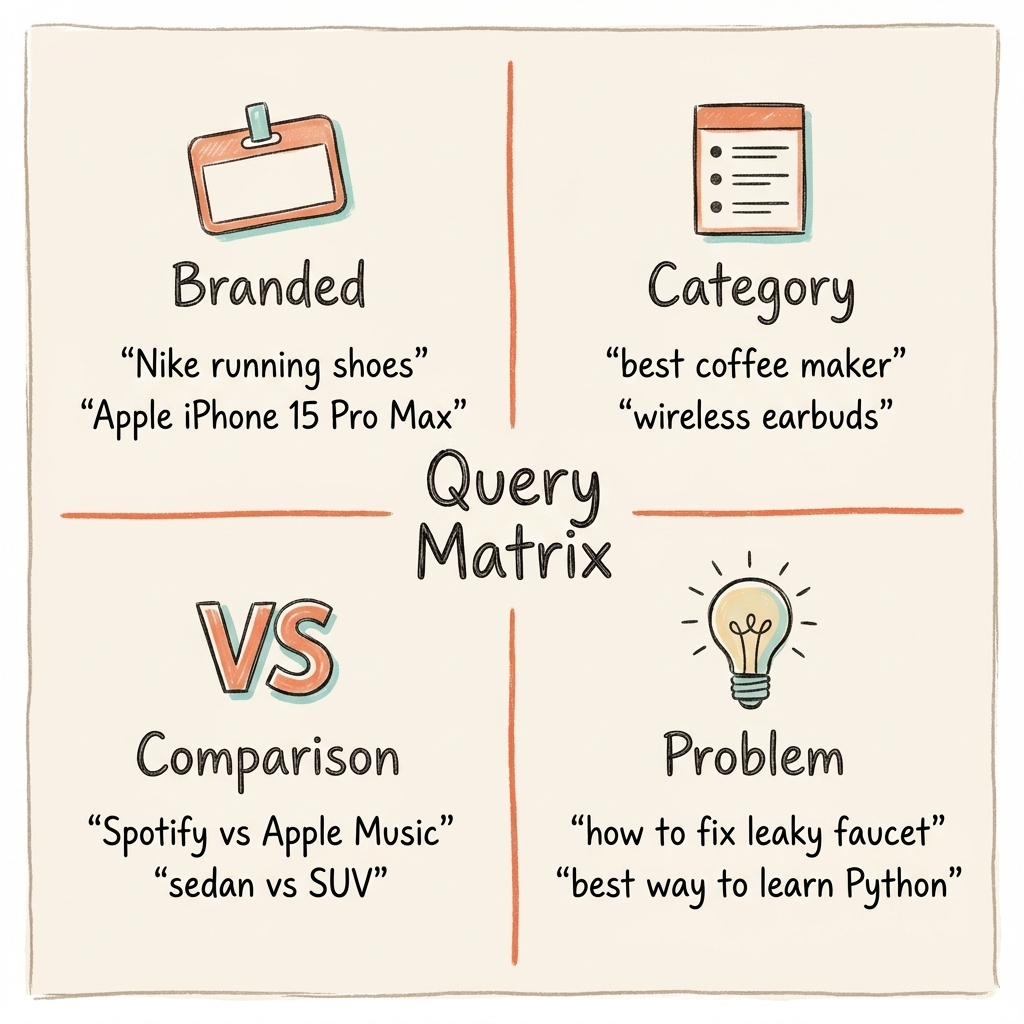
Build a query matrix across four categories, branded, category, comparison, and problem-solution. Run each across your priority platforms on a set schedule.
Branded Queries
These reveal how AI describes you to cold audiences. They check your baseline reputation.
- "What is [your brand]?"
- "Is [your brand] legit?"
- "How much does [your brand] cost?"
- "[Your brand] reviews"
Category Queries
These reveal whether AI includes you in recommendation lists. Prospects use these queries to discover vendors.
- "Best [product type] for [use case]"
- "Top [service category] providers"
- "Best [product type] in 2026"
Comparison Queries
These reveal how AI positions you relative to competitors. Buyers run these queries at the bottom of the funnel.
- "[Your brand] vs [Competitor]"
- "What's a cheaper alternative to [your brand]?"
- "How does [your brand] compare to [competitor]?"
Problem-Solution Queries
These reveal whether AI connects your brand to the problems you solve. Users ask these before they even know a category exists.
- "How to fix [pain point your product solves]"
- "Best way to [desired outcome]"
- "Why is [problem] happening?"
We typically use a 30-query matrix with clients. It covers all four categories across key use cases without drowning in noise. Start with 10-15 queries if you're building this for the first time.
With your matrix built, it's time to evaluate what you find.
How Do You Score and Interpret AI Brand Monitoring Results?
Score each AI response across five dimensions: mention presence, sentiment, accuracy, citation sources, and competitive context. Binary positive-or-negative ratings miss the signals that actually matter.
Mention Rate (AI Share of Voice)
Are you mentioned at all? In what percentage of relevant queries? Here's the calculation:
(Queries mentioning your brand / Total relevant queries monitored) x 100 = AI Share of Voice
Track this monthly. It's your absolute baseline.
Sentiment Nuance
Watch for hedging language. "Some users report issues with customer support" looks neutral but erodes trust. Look for conditional recommendations: "Good for beginners but not enterprise" limits your addressable market. Comparative framing like "cheaper but less reliable than Competitor X" positions you as a budget option regardless of reality.
These patterns are more damaging than outright negative mentions because they're subtle. Readers accept them without questioning.
Accuracy
Does the AI have your facts right? Check pricing, features, founding date, and key claims. Wrong facts presented confidently are the highest-priority fix. AI states incorrect information as truth. Users believe it instantly.
Citation Sources
When AI cites a source about you, trace the origin. Is it your owned content? A favorable third-party review? Or a competitor's comparison page framing you negatively? Brands with strong third-party presence earn 6.5x more AI citations. You need to know where your mentions originate.
Competitive Context
Track which competitors appear alongside you. Count their mentions across your category queries. Compare their total visibility to yours. This reveals who's winning the AI search battle in your space, and where you're losing ground.
Read our guide on how to measure AI visibility for the full 4-metric measurement framework. Scoring tells you what's happening. The next question is what to do about it.
The AI Brand Monitoring Response Playbook
Every monitoring finding maps to a specific response: amplify positive citations, fill neutral gaps with authoritative content, correct negatives with targeted publishing, and fix factual errors with structured data.
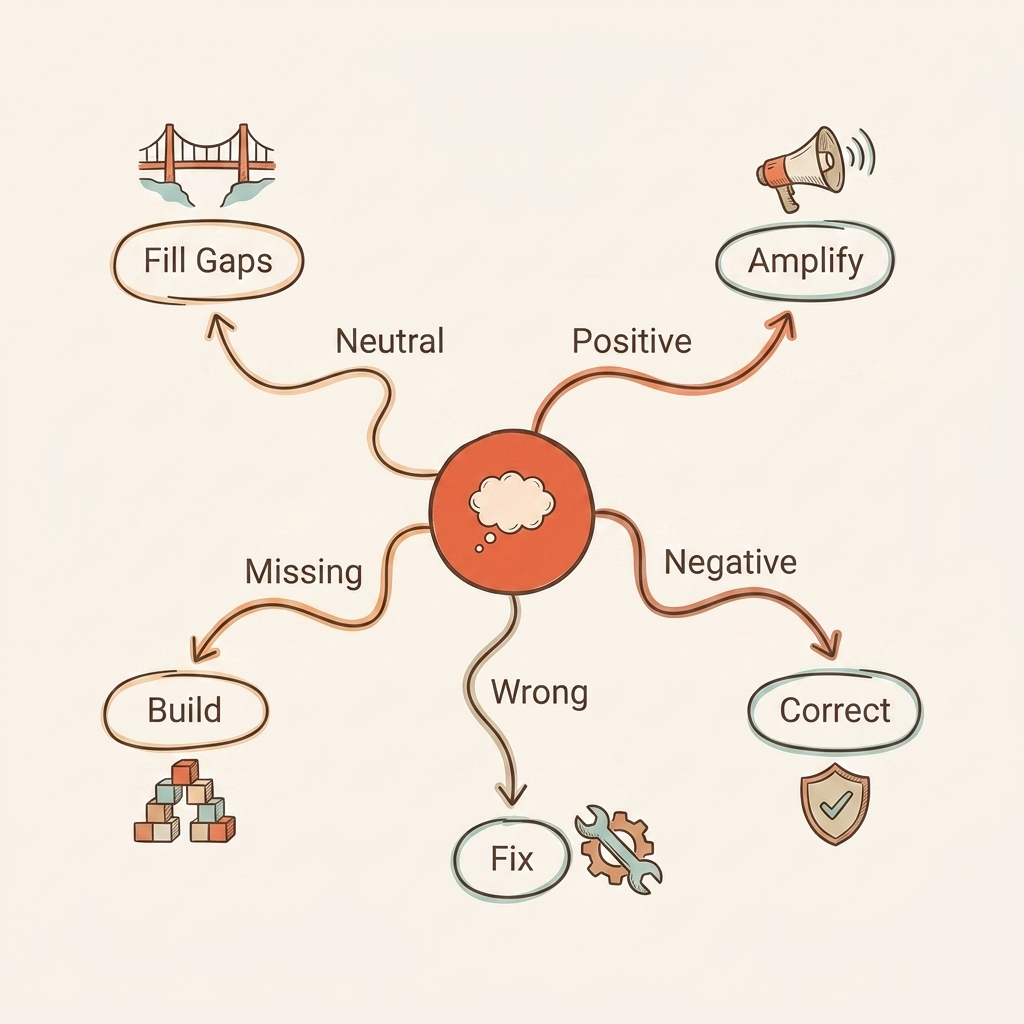
Mentioned positively: Double down on the citation sources. If a third-party review drives the positive mention, build more content on that platform. Share it on social. Reinforce what's already working.
Mentioned neutrally: Fill context gaps. AI gives neutral answers when it lacks strong signals, it hedges when it's unsure. Publish authoritative content that gives AI clear, unambiguous information to cite. Expert interviews and deep-dive case studies work well.
Mentioned negatively: Launch a targeted content correction campaign. Identify which sources the AI draws from. Improve those sources if you control them. Create competing content that outweighs them if you don't. A direct rebuttal on a high-authority domain is effective.
Not mentioned at all: This is a category authority gap. AI doesn't know you exist in this context. Build foundational presence: Wikipedia, major industry directories, authoritative third-party coverage. 85% of early-discovery brand mentions come from external domains (AirOps, 2026).
AI has the facts wrong: Follow the structured correction framework. Publish corrective content with clear factual statements, update your schema and structured data, and wait for re-crawl. We wrote a full playbook for this, read how to fix wrong AI answers about your brand.
For tools to help track this at scale, see the best AI visibility tools comparison. Acting on findings is half the loop. The other half is confirming the fix worked.
How Do You Close the Monitoring Loop?
Publish corrective content, wait for each platform's crawl cycle, re-run your monitoring queries, and confirm the fix took effect. This feedback loop doesn't stop.
The Detection-to-Verification Cycle
- Detect problem via monitoring queries
- Publish correction via the response playbook
- Wait for crawl/index cycle
- Re-run monitoring queries across platforms
- Confirm fix has propagated
- Monitor for regression in future audits
Re-Verification Timelines by Platform
Don't expect instant results everywhere. Each platform moves at a different pace:
- Perplexity: 2-5 days (real-time citations)
- ChatGPT web search mode: 1-2 weeks
- Google AI Overviews: 1-3 weeks
- ChatGPT training data: 3-6 months (requires the next training cut)
Recommended Monitoring Cadence
- Weekly: Spot-check 5-10 high-priority queries across your top 3 platforms. Focus on branded terms and any active correction campaigns.
- Monthly: Run the full matrix, all 30 queries, all platforms. Update your internal scorecard.
- Quarterly: Deep dive into competitive SOV trends. Map new query categories. Analyze platform behavior changes.
We run this loop daily for clients across every AI platform. If building this in-house feels like more than your team can sustain, that's the gap we fill. See how we handle ongoing monitoring at scale.
Frequently Asked Questions About AI Brand Monitoring
These are the questions we hear most from marketing teams setting up AI brand monitoring for the first time.
How often should I monitor my brand in AI search?
Weekly spot-checks on high-priority queries, monthly full audits across all platforms, and quarterly deep dives for trend analysis. The minimum viable cadence is monthly. Anything less leaves you exposed to shifts in AI sentiment you won't catch until it's too late.
What tools track AI brand mentions?
Otterly, SE Ranking AI Tracker, Peec AI, and Profound are the leading dedicated tools. Manual spot-checking works for small-scale monitoring on a budget. See our best AI visibility tools comparison for a detailed breakdown.
How do I measure share of voice in AI search?
Divide the number of queries where your brand is mentioned by the total relevant queries you monitor. Track this percentage monthly. A rising share of voice means your content strategy is working. A declining share means competitors are gaining ground.
Why doesn't my brand appear in AI recommendations even though I rank on Google?
Google rankings and AI citations rely on different signals. AI models weigh third-party authority, structured data, and content clarity, not just page position. Brands with a strong off-site presence earn 6.5x more AI citations. Ranking on Google is table stakes. AI visibility requires a separate strategy.
What is a good AI share of voice benchmark?
A citation rate of 20–30% in relevant branded and category queries is a strong baseline for most mid-sized brands. Category leaders typically hold 40–60% share across primary queries. If your brand appears in fewer than 10% of relevant category queries, foundational authority-building work should precede ongoing monitoring, otherwise the monitoring simply confirms absence without a clear fix path.
How do you track competitor sentiment in AI responses?
Run the same 30-query matrix for each competitor and apply the same five-dimension scoring framework. Track whether competitors receive conditional recommendations ("good for X but not enterprise"), hedging language ("some users report…"), or factual inaccuracies. Competitor weaknesses found this way are your fastest path to gaining AI share of voice, especially on freshness-sensitive platforms like Perplexity where a single strong piece of content can shift citations within days.
How do you build an AI brand monitoring setup without dedicated tooling?
Start with a 15-query manual matrix across ChatGPT and Perplexity. Run it monthly and log results in a shared spreadsheet: prompt, platform, whether your brand was mentioned, the exact phrasing used, and which competitors appeared. That baseline is enough to detect sentiment drift and major accuracy problems. Once the matrix exceeds 30 queries or three platforms, dedicated monitoring tools like Otterly, Peec AI, or Cintra's prompt tracker pay for themselves in saved time.
Conclusion
The AI search landscape is volatile. A single point-in-time audit is no longer sufficient.
- Build a structured query matrix covering branded, category, comparison, and problem-solution intent
- Score mentions across five dimensions, not just positive or negative
- Close the loop consistently: act on findings, verify the fix, monitor for regression
This process connects your entire organic strategy. First, you Measure, audit your baseline with the AI visibility measurement framework. Second, you Monitor, track changes continuously using the system in this guide. Third, you Correct, fix problems as they surface using the wrong AI answers playbook.
Your first step this week: Write down 10 queries your customers use when researching your category. Run them on ChatGPT and Perplexity. Record whether your brand appears, what it says, and which competitors show up. That's your monitoring baseline. Everything else builds from there.
We run this monitoring loop daily. Book a strategy call and we'll show you exactly what AI search says about your brand right now.
See where your brand appears in AI search
Scan ChatGPT, Perplexity, and Google AI across buyer-intent queries, instantly, no sign-up.
Find out if AI is sending buyers to your competitors.
We audit your AI visibility across ChatGPT, Perplexity, and Google AI –and show you exactly where you rank and what to fix.
“We went from 200 visitors/day to 1,900 visitors/day and 40% of demos are from AI search.”
Sumanyu Sharma · CEO, Hamming.ai
“Cintra helped me go from 3k to 7.5k daily traffic and doubled weekly orders in 1.5 months.”
Russ Coulon · Owner, UV Blocker
“We saw a lift from 3% to 13% visibility in the first 2 weeks, and organic traffic hit its highest ever.”
Ash Metry · Founder, Keywords.am
Related Articles
Organic Traffic Decline 2026: Why It's Dropping and How to Recover
Organic traffic decline 2026 is real. AI Overviews cut clicks 38% on triggered queries. Here's what's causing…
AI Visibility Reporting: What to Track, Who to Tell, and How to Prove ROI
AI visibility reporting requires different metrics and formats than SEO reports. Learn the five core metrics,…
AI Visibility Competitive Analysis: How to Find and Exploit Gaps in 2026
AI visibility competitive analysis across ChatGPT, Perplexity, and 5 other engines. Framework for tracking com…