Google AI Mode Link Updates: What Five Changes Mean for Your Brand's AI Visibility
Google AI Mode link updates add five new outbound link features. We analyze what changed on May 6, how each update affects brands beyond publishers, and the five steps to take now.
TL;DR
Google shipped five updates to AI Mode and AI Overviews on May 6, 2026 that expand outbound link visibility. Inline linking, hover previews, subscription labels, community perspectives, and curated exploration links give brands new citation surfaces. We break down what each change means for ecommerce, SaaS, and DTC brands specifically, compare Google's approach to ChatGPT, Perplexity, and Claude, and outline five steps to take now.
93% of Google AI Mode queries end without a single outbound click. That stat has defined the AI search conversation for months.
On May 6, 2026, Google announced five updates aimed at changing it. These aren't minor tweaks. They're the biggest shift in AI search link economics since AI Overviews launched. And the data backs up the urgency: Seer Interactive's 2026 research shows cited brands earn 120% more clicks per impression than uncited ones, while Ahrefs documented a 58% CTR reduction for top-ranking pages when AI Overviews appear.
Every existing analysis covers this from an SEO angle. We're taking a different approach. This is an AEO breakdown: what these five changes mean for brands trying to get cited and recommended by AI, not just ranked by Google.
What Are the Five Google AI Mode Link Updates?
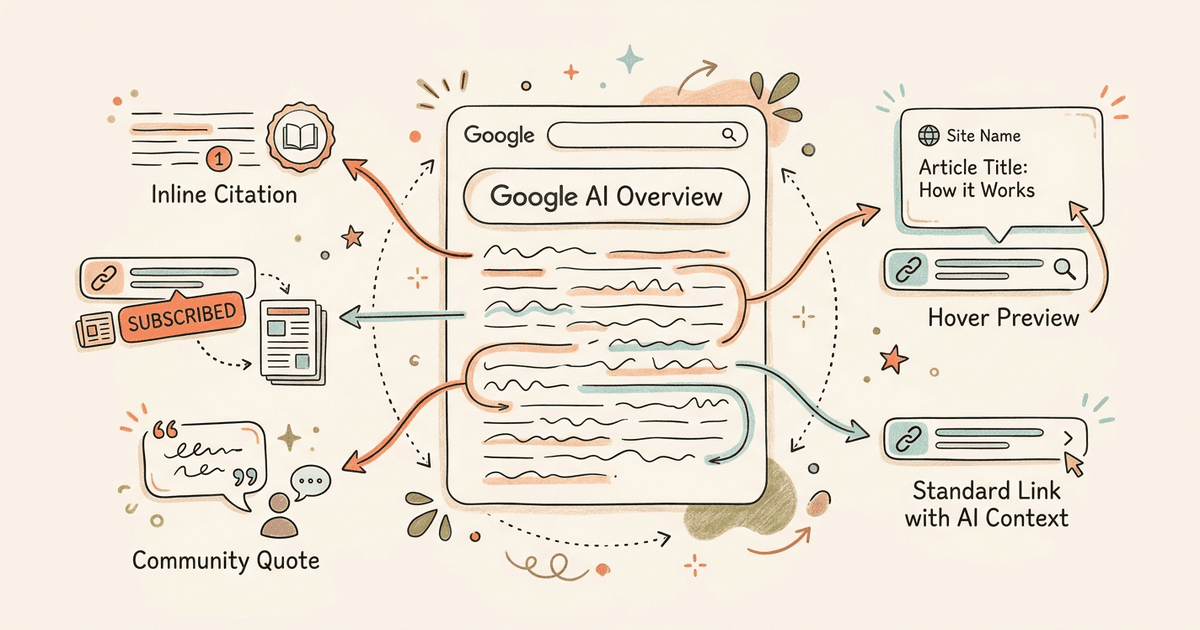
Google added Explore New Angles, Subscription Labels, First-Hand Perspectives, Inline Linking, and Desktop Hover Previews to AI Mode and AI Overviews on May 6, 2026.
Hema Budaraju, VP of Product Management for Search, announced all five in a single blog post. Here's what each one does and why it matters for your brand.
Explore New Angles
Curated article links now appear at the end of AI Mode responses. These aren't source citations. They're editorially selected deep-dive links covering different facets of the topic.
What qualifies a page to appear here? Depth, a unique angle, and topical authority. Generic overview content won't make the cut. Pages that cover a specific sub-topic with original data or expert analysis have the strongest shot.
Subscription Labels
Links from publications you subscribe to get highlighted with a "Subscribed" badge. This is the first personalized citation signal in AI search.
Google reported a "statistically significant uplift" in clicks for labeled links. For brands with newsletters or content subscriptions, this creates a direct path from subscriber loyalty to AI Mode visibility.
First-Hand Perspectives
AI responses now surface quotes and previews from real people. Reddit discussions, social media posts, forum threads, and community groups get pulled into AI Mode with creator attribution.
This is Google's E-E-A-T "Experience" dimension made explicit. It rewards authentic community participation over polished brand content. For brands with active Reddit or forum presence, this is a new citation channel.
Inline Linking
Links now appear directly next to the relevant claim or bullet point. Not buried in footnotes at the bottom. Not hidden behind a "Sources" dropdown.
This changes the citation visibility game entirely. A link placed next to a specific data point or recommendation carries more weight than one stacked in a list of 15 footnotes. Content structured around clear, source-backed assertions is more likely to earn these placements.
Desktop Hover Previews
On desktop, hovering over any link in AI Mode shows a preview: your site name and page title. Readers see your brand and your content framing before they click.
Title tags just became a conversion element in AI Mode. A compelling, descriptive title tag influences click-through in a way it never did before in AI-generated responses.
How Do These Updates Affect Non-News Brands?
See where you rank in Google AI answers.
Enter your domain and we'll scan your Google AI Overview citation rate across your highest-value queries.
Prefer to talk? Book a free 30-min call
Non-news brands gain new citation surfaces through inline links, community perspectives, and hover previews. Each update rewards a different content strategy.
Most coverage of these changes focuses on publishers and news sites. That misses the bigger picture. Ecommerce, SaaS, and DTC brands have distinct opportunities with each feature.
| Update | Ecommerce | SaaS | Publisher | Local Business |
|---|---|---|---|---|
| Explore New Angles | Medium: product guides with unique data | High: technical deep-dives | High: investigative pieces | Low: limited depth content |
| Subscription Labels | Medium: email subscriber base | High: newsletter-driven growth | High: paid subscriptions | Low: few subscriptions |
| First-Hand Perspectives | High: Reddit product reviews | High: user community discussions | Medium: reader comments | High: local forum activity |
| Inline Linking | High: product comparison data | High: technical documentation | High: cited research | Medium: local reference data |
| Hover Previews | High: branded title tags | High: descriptive page titles | High: headline quality | Medium: local brand recognition |
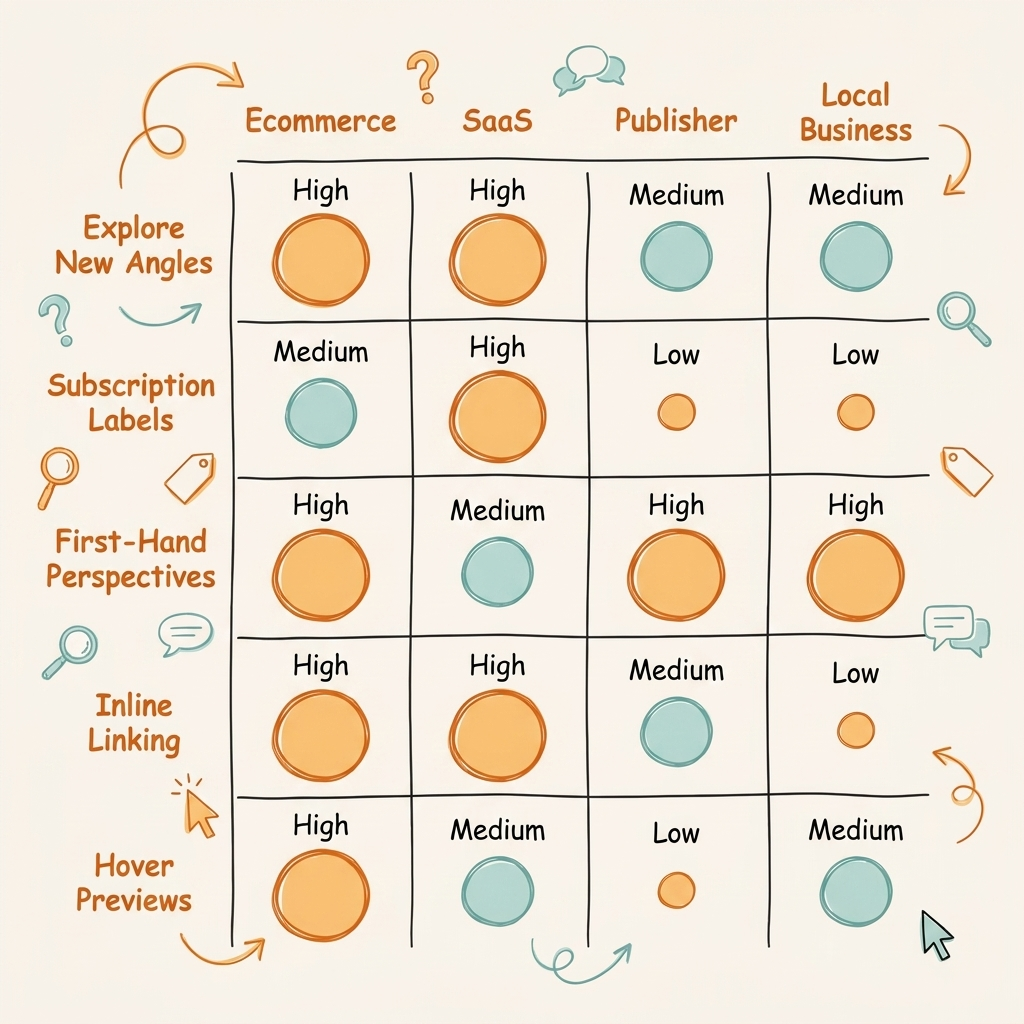
For ecommerce brands, the biggest wins come from Inline Linking and First-Hand Perspectives. Product comparison content with specific claims ("Brand X lasts 3x longer than Brand Y based on 2,000 user reviews") earns inline citations. And Reddit threads discussing your products now surface directly in AI Mode.
For SaaS brands, Explore New Angles and Inline Linking reward the content you're probably already creating: technical guides, API documentation, and benchmark studies. If your content covers a specific technical sub-topic with original data, it's a strong candidate for the Explore section.
For local businesses, First-Hand Perspectives is the standout. Local forum activity, community recommendations, and neighborhood-specific discussions now feed directly into AI responses. This is word-of-mouth, amplified by AI.
How Does Google's Link Approach Compare to Other AI Engines?
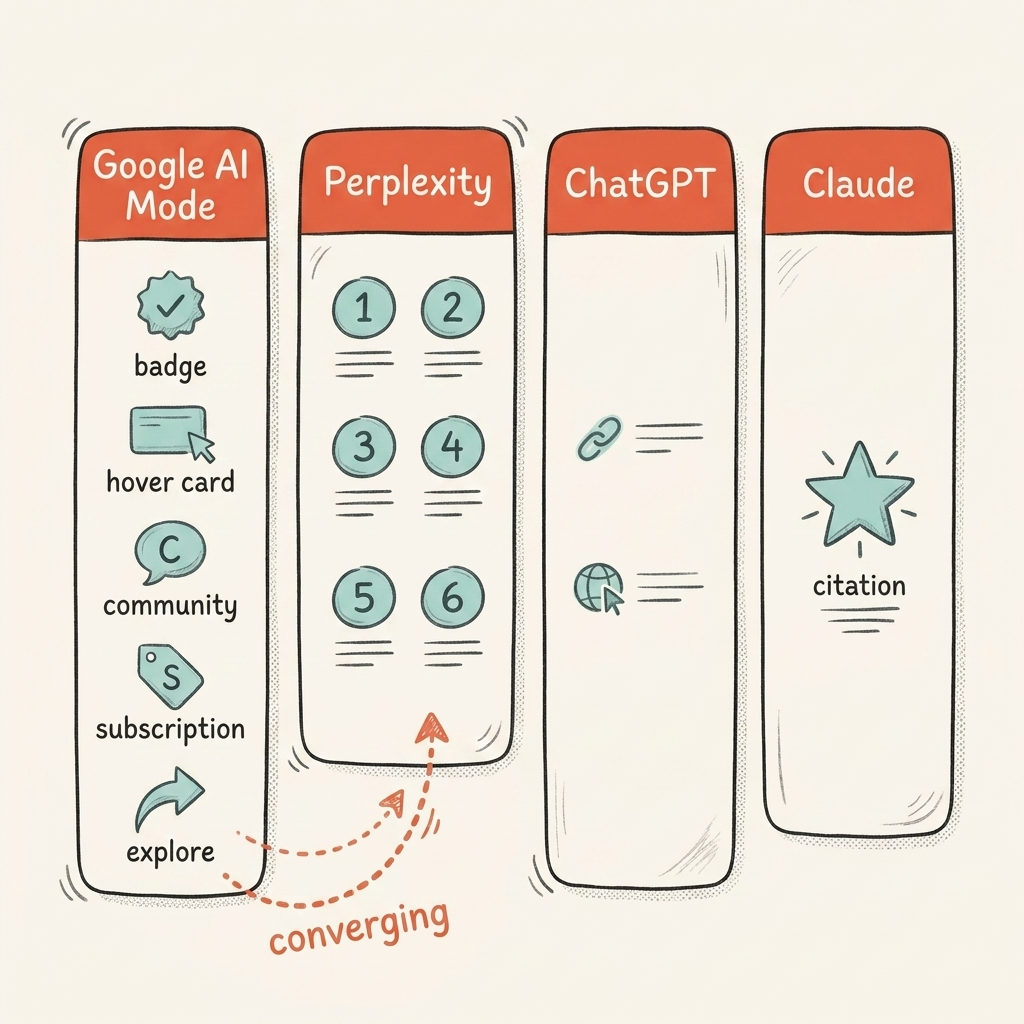
Google is converging toward Perplexity's always-cite model while ChatGPT and Claude remain more selective with outbound links.
These updates don't exist in a vacuum. Every major AI engine is figuring out its link strategy. Here's where they stand. For a deep dive on ChatGPT optimization specifically, we've published a separate guide.
Perplexity runs live web searches and cites 4-8 sources per answer with inline citations built into every response. In a 501-site benchmark, Perplexity accounted for 47% of all tracked citations. It's the most link-generous AI engine by a wide margin.
ChatGPT cites 2-4 sources when web browsing is active. Citations are less prominent. OpenAI's shopping features have introduced product links, creating a separate link economy for commercial queries. But for informational queries, link visibility remains low.
Claude cites the fewest sources but prioritizes quality. It favors well-reasoned, source-rich content with visible author credibility. No real-time web search by default means citations come from training data, not live retrieval.
Google's new position sits between Perplexity's aggressive citing and ChatGPT's selective approach. Inline Linking moves Google toward Perplexity's contextual citation model. But the Perspectives feature is unique. No other AI engine explicitly surfaces community content with creator attribution, as 9to5Google's analysis noted.
The takeaway: brands that optimize for AI visibility across all four engines will outperform those focused on Google alone. Each platform rewards slightly different signals.
What Should Brands Do Now to Benefit from These Changes?
Brands should audit existing AI Mode citations, optimize title tags for hover previews, activate community strategy, and front-load content for inline linking.
These five steps map directly to the five updates Google announced. Each one targets a specific new citation surface.
1. Audit Your Current AI Mode Citations
Check whether your brand currently appears in AI Mode results for your top 10 target queries. Note the format: Are you an inline link? A footnote citation? Absent entirely?
This baseline matters because you can't measure impact without it. Use AI visibility monitoring platforms or manual query testing to track citation presence weekly.
2. Optimize Title Tags for Hover Previews
Desktop Hover Previews show your site name and page title before anyone clicks. A vague title like "Blog Post | Brand Name" wastes this new real estate.
Before: "Product Guide - Our Blog" After: "2026 Running Shoe Comparison: 12 Models Tested for Durability and Comfort"
Descriptive, specific title tags with your brand name win the hover preview. Treat every title tag as a micro-pitch to an AI Mode user deciding whether to click.
3. Activate Community Strategy for Perspectives
First-Hand Perspectives rewards authentic community participation. Not astroturfing. Not brand accounts posting promotional content. Genuine contributions in relevant subreddits, forums, and social discussions.
If your team isn't active on Reddit and industry forums, start now. The brands with existing community footprints are the ones whose content will surface in Perspectives. We've written a full playbook for Reddit-based AI visibility that applies directly here.
4. Build Subscription Relationships
Subscription Labels create a loyalty loop. Users who subscribe to your newsletter or content see your links highlighted in AI Mode. That visibility reinforces the subscription. The subscription triggers more highlights.
For brands already running email newsletters, this is free visibility. For those who aren't, it's a new reason to build that subscriber base. The connection between email subscriptions and AI Mode citations didn't exist before May 6.
5. Front-Load Content for Inline Linking
Inline links appear next to specific claims. Content structured around clear assertions backed by data earns these placements. Vague, generic statements don't.
This maps directly to AEO content structure: lead each section with a direct answer, support it with specific data, and cite your sources. Content built for AI citation has always followed this pattern. Inline Linking makes the payoff visible.
Frequently Asked Questions About Google AI Mode Link Updates
These are the questions we hear most from brands tracking these AI Mode changes and planning their next move.
Do These Google AI Mode Link Updates Affect Mobile?
Desktop Hover Previews are desktop-only. The other four features work across devices. Mobile AI Mode users see inline links, community perspectives, subscription labels, and Explore New Angles. The hover preview gap means title tag optimization delivers the biggest lift on desktop, though strong titles still help mobile CTR.
Will AI Mode Now Send More Traffic Than AI Overviews?
AI Mode still generates zero clicks 93% of the time, while AI Overviews CTR has rebounded to 2.4% as of February 2026. AI Overviews reach 1.5 billion monthly users across 200+ countries. AI Mode has 75 million daily active users. The volume gap favors AI Overviews today. These updates may narrow it, but don't expect AI Mode to overtake Overviews for referral traffic soon.
How Do Brands Track AI Mode Referral Traffic?
Google Search Console doesn't separate AI Mode traffic yet. Track citation presence with manual query testing and AI visibility monitoring platforms. Use UTM parameters on content likely to earn AI Mode citations. Monitor branded query results weekly to spot changes as these features roll out.
Does This Mean SEO Matters More or Less for AI Mode?
Traditional ranking signals still influence which sources AI Mode cites. But these five updates add surfaces that go beyond SEO. The Perspectives feature rewards content that traditional SEO ignores entirely: forum posts, Reddit threads, social commentary. Subscription Labels reward audience relationships, not backlink profiles. The answer is both: SEO still matters for the base layer, and AI visibility strategy matters for the new surfaces on top.
What These Updates Signal for AI Visibility Strategy
Google just acknowledged that AI Mode's zero-click problem needed fixing. Five updates in a single announcement, all aimed at pushing more traffic out to the web.
Here's what sticks:
- New citation surfaces, not just more links. Inline linking, hover previews, community perspectives, and subscription labels each reward a different content strategy. Brands need to optimize across all of them, not just one.
- Non-publisher brands have the most to gain. Every competitor analysis focuses on news publishers. Ecommerce, SaaS, and DTC brands are the ones with untapped opportunity in Perspectives and Inline Linking.
- Google is converging toward citation-heavy AI search. The gap between Google's approach and Perplexity's always-cite model is narrowing. Brands that build for AI citation now are positioning for where all AI engines are heading.
Your next move: Run AI Mode queries for your top five target keywords. Note whether your brand appears and in what format. That 10-minute exercise gives you the baseline to measure whether these updates change your AI visibility.
For a full audit of your brand's visibility across AI Mode, AI Overviews, ChatGPT, Perplexity, and Claude, book a strategy call. We've been tracking AI Mode since launch. We'll show you exactly where you stand.
See where your brand appears in AI search
Scan ChatGPT, Perplexity, and Google AI across buyer-intent queries, instantly, no sign-up.
Find out if AI is sending buyers to your competitors.
We audit your AI visibility across ChatGPT, Perplexity, and Google AI –and show you exactly where you rank and what to fix.
“We went from 200 visitors/day to 1,900 visitors/day and 40% of demos are from AI search.”
Sumanyu Sharma · CEO, Hamming.ai
“Cintra helped me go from 3k to 7.5k daily traffic and doubled weekly orders in 1.5 months.”
Russ Coulon · Owner, UV Blocker
“We saw a lift from 3% to 13% visibility in the first 2 weeks, and organic traffic hit its highest ever.”
Ash Metry · Founder, Keywords.am
Related Articles
Organic Traffic Decline 2026: Why It's Dropping and How to Recover
Organic traffic decline 2026 is real. AI Overviews cut clicks 38% on triggered queries. Here's what's causing…
AI Visibility Reporting: What to Track, Who to Tell, and How to Prove ROI
AI visibility reporting requires different metrics and formats than SEO reports. Learn the five core metrics,…
AI Visibility Competitive Analysis: How to Find and Exploit Gaps in 2026
AI visibility competitive analysis across ChatGPT, Perplexity, and 5 other engines. Framework for tracking com…