Google AI Mode Optimization: How to Get Cited (2026 Guide)
Google AI Mode optimization needs a different approach than AI Overviews. Only 13.7% of sources overlap. Learn the 6-step framework to earn citations from 75M daily users.
In this article: TL;DR
- AI Mode citations rarely overlap with AI Overviews (13.7% match rate across 730K response pairs).
- AI Mode responses are roughly 4x longer than standard AI Overviews, mentioning 3.3 entities vs. 1.3.
- The system breaks queries into 8-12 parallel sub-searches (query fan-out), performing passage-level retrieval.
- 88% of cited pages rank outside the top-10 organic results (Moz, 40K queries).
- Google cites its own properties in 17.42% of responses, tripled from 5.7% in June 2025.
- Ads now appear in 25.5% of AI Mode results (BrightEdge).
- Optimization requires passage-level content architecture, not page-level keyword targeting.
75 million people use Google AI Mode every day. Only 13.7% of the sources it cites overlap with AI Overviews. If you've only optimized for AI Overviews, you're missing the bigger surface.
AI Mode is the largest AI search product by daily active users. It dwarfs ChatGPT search and Perplexity in sheer volume. Yet most brands have no dedicated Google AI Mode optimization strategy. They assume AI Overviews coverage handles it. It doesn't. AI Mode relies on entirely different retrieval mechanics.
This guide breaks down exactly how AI Mode selects sources. We cover the query fan-out system, the data behind where citations actually come from, and a clear 6-step framework to earn them.
What Makes Google AI Mode Different from AI Overviews?
AI Mode is a conversational search interface that generates 4x longer responses, cites completely different sources, and pulls 88% of its references from outside the organic top-10.
Ahrefs analyzed 730,000 response pairs. They found only a 13.7% citation overlap between AI Mode and AI Overviews. Most marketers treat them as the same product. The data proves they function as independent systems.
AI Mode builds comprehensive, multi-turn conversational responses. It generates text roughly 4x longer than standard AI Overviews. It also mentions 3.3 entities per response on average, compared to just 1.3 in AI Overviews. The system wants depth.
Despite citing different sources, the two products maintain an 86% semantic similarity rate. They deliver the same core facts. They just choose different domains to validate those facts.
Semrush tracked 69 million search sessions. They reported that 93% of AI Mode queries end without a click to an external site. The citation itself is the new click. Earning that citation puts your brand in the authoritative position.
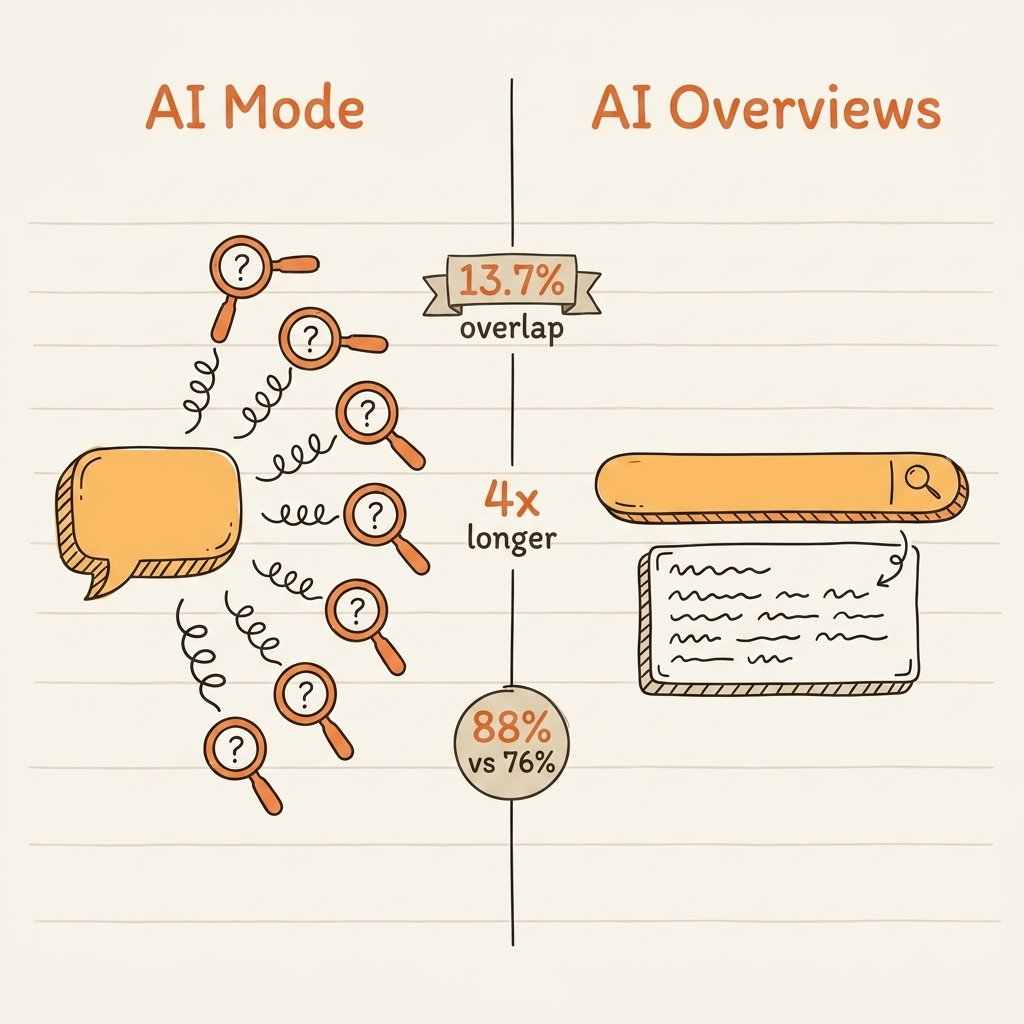
| Feature | AI Mode | AI Overviews |
|---|---|---|
| Format | Conversational, multi-turn | Snippet above results |
| Response length | ~800-1,200 words | ~200-300 words |
| Citation overlap | 13.7% shared sources | 13.7% shared sources |
| Source diversity | 88% from outside top-10 | 76% from top-10 |
| Zero-click rate | 93% | ~58% CTR reduction |
| Query types | Complex, multi-part | Informational, how-to |
| User interaction | Follow-up questions | One-shot |
For tactics specific to the snippet format, read our guide on AI Overviews optimization.
How Does AI Mode Select Sources? The Query Fan-Out Mechanic
See where you rank in Google AI answers.
Enter your domain and we'll scan your Google AI Overview citation rate across your highest-value queries.
Prefer to talk? Book a free 30-min call
AI Mode breaks every user query into 8-12 parallel sub-queries, each performing passage-level retrieval from different sources. That is why 88% of citations come from pages outside the organic top-10.
When a user asks AI Mode a question, the system does not perform a single search. It performs many. Google announced this parallel processing architecture at I/O 2025.
Imagine a user asks, "What is the best CRM for a 10-person startup with a $500 monthly budget?"
Standard search looks for pages matching that exact phrase. AI Mode splits it. It runs 8-12 sub-queries instantly:
- Sub-query 1: CRM pricing models under $500.
- Sub-query 2: Small business CRM ease of use.
- Sub-query 3: Startup CRM integration limits.
- Sub-query 4: Migration difficulty for 10-person teams.
Each sub-query executes passage-level retrieval. The system scans the web for specific paragraphs that answer that narrow question. It does not care about the overall page topic. It cares about the exact text block.
Moz analyzed 40,000 queries. They found 88% of pages cited by AI Mode do not rank in the top-10 organic results for the original prompt. The passage matters more than the page's overall ranking.
Brand authority still acts as a major filter. Ahrefs tracked 75,000 brands. They discovered a 0.466 correlation between brand search volume and AI Mode mentions. This correlation is stronger than what they found for AI Overviews (0.392). The system trusts recognized entities.
To build that authority, study entity SEO for AI search.
How Is Google's Self-Citation Trend Affecting AI Mode Visibility?
Google cites its own properties in 17.42% of AI Mode responses, tripled from 5.7% in June 2025. Travel and entertainment verticals face 49-53% self-citation rates.
SE Ranking studied 68,000 keywords and 1.3 million citations. They tracked Google's self-citation rate jumping from 5.7% to 17.42% in just eight months. Google is aggressively routing traffic to its own ecosystem.
The impact hits some industries harder than others. Travel queries see a 53% self-citation rate. Entertainment queries hit 49%. If you operate in these verticals, half your potential citations are already gone.
Google frequently cites YouTube, Google Maps, Google Shopping, and Google Finance. They surface video timestamps for "how-to" queries. They pull local data from Maps. They inject Shopping graphs for product comparisons.
The third-party citation pie is shrinking. Every month you wait, Google claims more.
| Industry | Google Self-Citation Rate |
|---|---|
| Travel | 53% |
| Entertainment | 49% |
| Tech | ~20% |
| Finance | ~18% |
| Overall average | 17.42% |
With Google claiming more citation real estate, the question becomes: what specific actions earn the remaining third-party citations?
6-Step Google AI Mode Optimization Framework
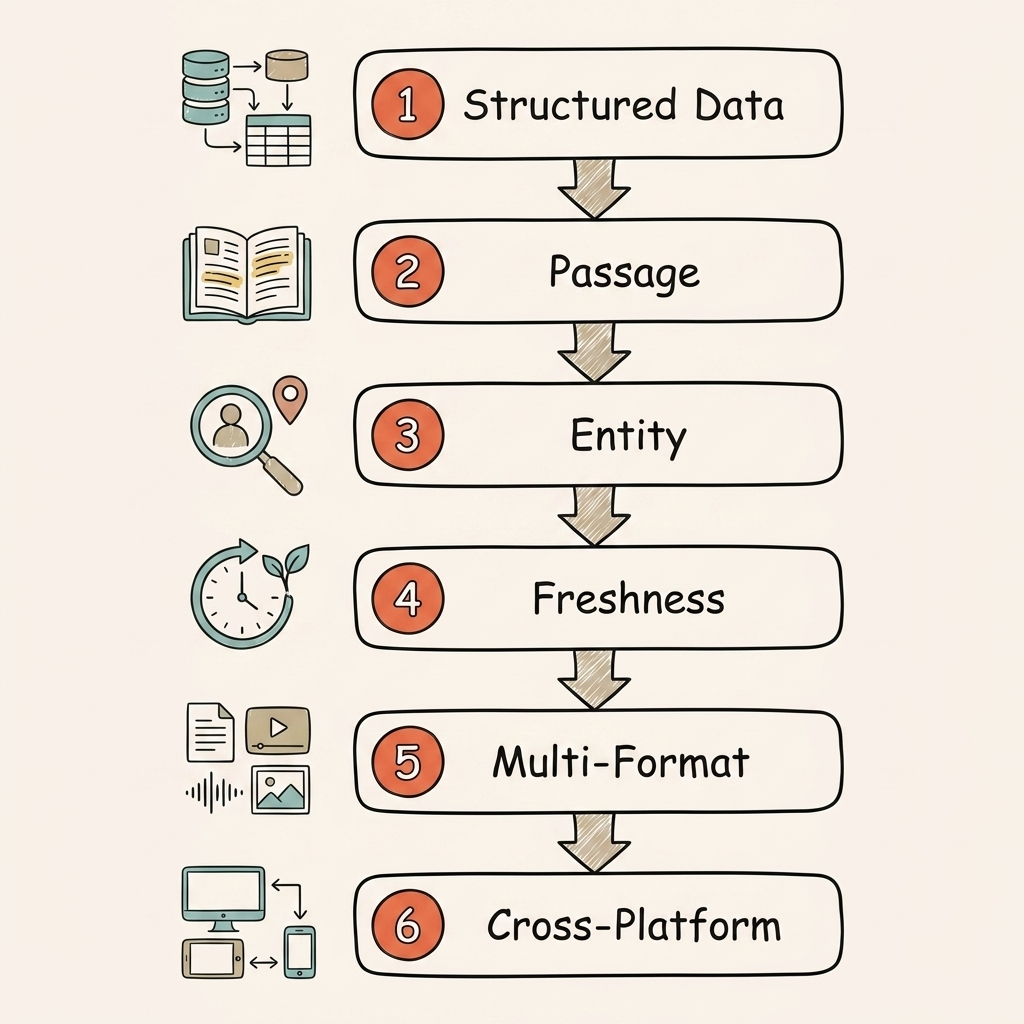
Optimize for AI Mode with structured data, passage-level content architecture, entity building, freshness signals, multi-format content, and cross-platform visibility.
Traditional SEO only gets you part of the way there. Earning citations in AI Mode requires a strategy built for conversational retrieval. Follow these six steps.
Step 1: Build a structured data foundation
Industry research shows roughly 65% of pages cited by AI Mode include structured data. The system needs machine-readable signals to parse content quickly during its parallel sub-queries.
Implement Product, FAQ, HowTo, and Article schema heavily. Mark up individual sections of your content. When AI Mode executes a sub-query for pricing, Product schema hands it the exact data format it wants. Don't rely on natural language processing alone.
Read our deep-dive on schema markup for AI visibility for implementation details.
Step 2: Architect passage-level content
Because AI Mode runs passage-level retrieval, your content structure must be modular. Long, flowing paragraphs fail. You need dense, standalone answer blocks.
Write every H2 and H3 as a specific question. Follow it immediately with a direct, 15-30 word answer. Don't include introductory fluff. The paragraph under the subhead must survive isolation. If the AI pulls that single paragraph, it must make sense without the surrounding text.
Before: "When considering the various pricing options available for our enterprise tier, it's important to look at user count, which starts at..."
After: "The enterprise tier costs $99 per user per month. It requires a minimum of 50 users and includes dedicated support."
Step 3: Build your brand entity
AI Mode prefers verified entities. Ahrefs showed a 0.466 correlation between brand search volume and AI Mode mentions. The system uses brand recognition as a trust proxy.
Establish consistent entity signals across the web. Maintain active profiles on Crunchbase and LinkedIn. Secure Wikipedia mentions if possible. Publish digital PR campaigns to earn high-authority press mentions. Keep your NAP (Name, Address, Phone) data identical everywhere.
Learn more about building these signals in our guide on what is AI visibility.
Step 4: Maintain freshness signals
AI Mode biases heavily toward recent data. Content updated within the last 30 days correlates with significantly higher citation rates. Stale content loses to fresh content, even if the older content has more backlinks.
Establish a strict update cadence. Run monthly stat refreshes. Audit and update your highest-value pages quarterly. Add current-year data points. Remove outdated references. Add a "Last Updated" timestamp and update the <lastmod> tag in your XML sitemap.
Step 5: Produce multi-format content
Google's self-citation trend proves format matters. AI Mode frequently cites YouTube videos, images, and audio sources.
Convert your top-performing text articles into multiple formats. Record video versions and upload them to YouTube with detailed chapters and timestamps. Design custom infographics and embed them with descriptive alt text. Provide the AI with the media type it decides the user needs.
Step 6: Build cross-platform visibility
AI engines train on each other. Being cited in ChatGPT and Perplexity reinforces your authority in Google AI Mode.
Make sure your entity and content are visible across all major generative engines. The mechanics differ slightly, but a strong showing on one platform creates compounding trust signals for the others.
Expand your strategy by learning how to get recommended by ChatGPT and how to get cited by Perplexity.
How Do Ads Work in Google AI Mode?
Google now shows ads in 25.5% of AI Mode results, with a new Direct Offers format for purchase-intent queries launched in February 2026.
According to BrightEdge, 25.5% of AI Mode results now contain ads. This number has climbed from single digits in late 2025. Google is aggressively monetizing the interface.
In February 2026, Google launched the Direct Offers format. This targets commercial and purchase-intent queries. Direct Offers inject visual product cards directly into the AI response: the product image, the price, and a prominent "Buy" button. Users can convert without leaving the chat interface.
You need a combined paid and organic strategy. Rely on the 6-step framework to earn organic citations for informational queries. Deploy Direct Offers and Search campaigns to capture commercial intent. The most visible brands dominate both surfaces.
How Do You Measure Google AI Mode Visibility?
Track AI Mode visibility through citation monitoring tools, GSC performance reports filtered for AI-referred traffic, and brand mention tracking across AI platforms.
Measurement requires new tools. Google Search Console (GSC) shows some AI-referred clicks, but the data remains limited. It doesn't cleanly separate AI Mode traffic from traditional organic clicks.
Third-party tracking fills the gap. We track AI Mode visibility across brands at Cintra, monitoring citation share, analyzing query fan-out patterns, and auditing structured data specific to AI search. Other platforms like SEMrush Copilot and the Ahrefs AI Visibility Report offer varied tracking features. Compare your options in our list of the best AI visibility tools.
Set realistic timelines. Brands that started optimizing in June 2025 only began seeing consistent citation patterns eight months later. This is a long game.
While waiting for citation volume to grow, track interim KPIs:
- Structured data validation score from Google Rich Results Test
- Brand search volume trend via GSC or Ahrefs
- Cross-platform citation count across ChatGPT, Perplexity, and AI Mode
- Content freshness audit score measuring percentage of pages updated in the last 30 days
Get the complete measurement framework in our AI visibility playbook.
Frequently Asked Questions About Google AI Mode Optimization
These are the most common questions brands ask about Google AI Mode optimization, covering availability, impact, and strategy.
How is Google AI Mode different from AI Overviews?
AI Mode is a conversational interface with multi-turn dialogue and 4x longer responses. AI Overviews are snippet-style summaries above search results. Only 13.7% of their citations overlap, which means optimizing for one doesn't cover the other.
Does AI Mode affect my website traffic?
93% of AI Mode queries end without a click. But earning a citation positions your brand as the recommended source. That drives downstream brand searches and direct visits, shifting the traffic pattern rather than eliminating it.
How long does it take to appear in AI Mode?
Brands that started optimizing in mid-2025 began seeing consistent citation patterns roughly 8 months later. Plan for a 6-12 month optimization horizon, with interim KPIs to track progress along the way.
Does schema markup help with AI Mode citations?
Yes. Industry research suggests roughly 65% of pages cited by AI Mode include structured data. Product, FAQ, HowTo, and Article schema are the most impactful types. Read our full schema markup for AI visibility guide.
Is Google AI Mode available outside the US?
AI Mode launched in the US and has expanded to additional markets throughout 2025-2026. Availability varies by region and language. Check Google's official announcements for the latest rollout schedule.
Conclusion
Google AI Mode optimization demands a fundamentally different content architecture than AI Overviews. As of April 2026, Google has expanded AI Mode to 15 additional markets beyond the US, and query volume has grown 34% quarter-over-quarter, reinforcing why brands that build AI Mode authority now gain compounding advantage.
- Separate your strategies. AI Mode and AI Overviews are not the same product. They require parallel, distinct optimization efforts.
- Embrace modular content. The query fan-out mechanic rewards passage-level answers. Stop writing long-winded introductions.
- Beat the self-citation trend. Google is claiming more citation real estate every month. The window to establish third-party authority is narrowing.
- Track the right metrics. Measurement is hard but necessary. Establish interim KPIs and prepare for an 8-month optimization horizon.
Audit your top 10 pages today. Check them for structured data compliance and passage-level answer architecture. Verify that each section answers one specific question completely.
Get the complete strategy in our AI visibility playbook, or view our pricing to let us handle the execution.
See where your brand appears in AI search
Scan ChatGPT, Perplexity, and Google AI across buyer-intent queries, instantly, no sign-up.
Find out if AI is sending buyers to your competitors.
We audit your AI visibility across ChatGPT, Perplexity, and Google AI –and show you exactly where you rank and what to fix.
“We went from 200 visitors/day to 1,900 visitors/day and 40% of demos are from AI search.”
Sumanyu Sharma · CEO, Hamming.ai
“Cintra helped me go from 3k to 7.5k daily traffic and doubled weekly orders in 1.5 months.”
Russ Coulon · Owner, UV Blocker
“We saw a lift from 3% to 13% visibility in the first 2 weeks, and organic traffic hit its highest ever.”
Ash Metry · Founder, Keywords.am
Related Articles
Product Feed Optimization AI Shopping Engines Actually Read (10-Point Audit)
Product feed optimization AI shopping engines need to recommend your products. Platform-by-platform feed requi…
How to Get Cited by Grok: The xAI Platform Optimization Guide
Learn how to get cited by Grok with a 6-step framework covering the X co-citation mechanic, robots.txt setup,…
AI Search Optimization Ecommerce: The Proven 5-Step Playbook for Getting Products Best Recommended by ChatGPT
AI search optimization ecommerce brands need is here: ChatGPT Shopping, Perplexity, and AI visibility strategi…