The Essential Entity SEO for AI Search Guide: 5 Best Signals to Build
Entity SEO for AI search determines which brands get cited by ChatGPT, Perplexity, and AI Overviews. Learn the 5-point entity audit and JSON-LD code examples.
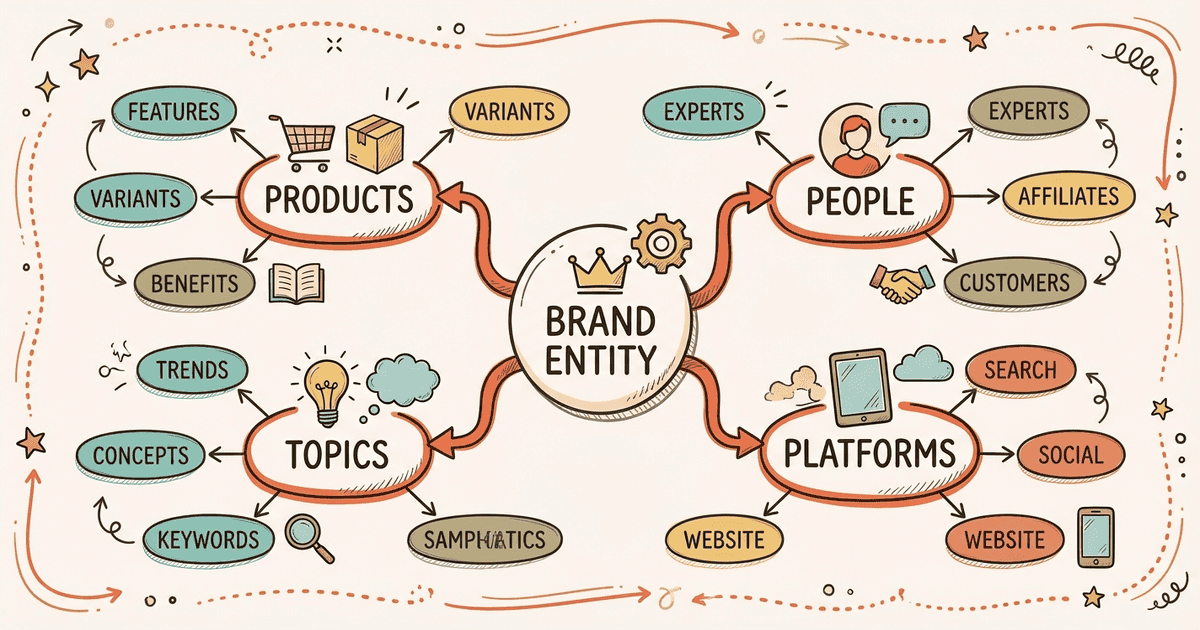
You can have the best content online. If AI doesn't recognize your brand as an entity, it won't cite you.
Brand mentions correlate 0.664 with AI visibility, according to Ahrefs research on factors driving AI citations. Mentions are entity signals. Most brands optimize their web copy without fixing the entity layer underneath. Content quality matters less when the source is invisible to the knowledge graph.
This guide covers our 5-point entity audit, JSON-LD code examples, and platform-specific implementation for building entity signals AI models recognize. Entity SEO for AI search is the infrastructure layer most brands skip entirely.
This article is the strategy companion to our schema markup guide. That article covers downstream implementation. This one covers the upstream "why" layer. We use entity audits in every client engagement to establish this foundational clarity.
Want to see where your brand ranks in AI search: and who's beating you? Get your free AI visibility audit →
What Is Entity SEO and Why Does It Matter for AI?
See where you rank across all AI answer engines.
Enter your domain and we'll scan your citation rate across ChatGPT, Perplexity, and Google AI.
Prefer to talk? Book a free 30-min call
Entity SEO optimizes how AI models identify your brand as a distinct, recognizable thing with clear relationships to topics, products, and industry concepts.
Nike is an entity. "Best running shoes" is a keyword. AI knows the difference. Traditional search engines matched keywords to strings. Large language models moved past that. They evaluate distinct concepts and their relationships. When someone asks ChatGPT about the best CRM for startups, the model evaluates CRM entities with startup-relevant attributes. It doesn't scan for pages holding those exact keywords.
Entities are people, brands, products, and concepts. They are anything a knowledge graph can define with properties and relationships. The transition from strings to things is complete.
Knowledge graphs connect these distinct entities. Google's Knowledge Graph, Wikidata, and internal LLM representations map the world's information as interconnected nodes. A strong entity has deep connections to related concepts. A weak entity sits isolated.
Traditional SEO optimizes for page-level ranking signals. Entity SEO optimizes for brand-level recognition signals. Page signals tell an algorithm text matches a query. Entity signals tell an AI model your brand exists as a definitive solution. We focus on these brand-level signals because they build permanent authority. This shift represents the core of what is AI visibility and why traditional metrics no longer capture the full picture.
How Do AI Models Use Entity Signals to Generate Answers?
AI models allocate limited processing per query and prioritize sources from entity-clear brands, because recognized entities reduce the model's disambiguation work.
AI models evaluate millions of sources in milliseconds. Recognized entities provide a shortcut. Entity-clear sources require less processing power, and the model trusts them faster. This is what Search Engine Land calls the "comprehension budget" concept. AI prioritizes sources requiring the least cognitive load.
Brand mentions correlate 0.664 with AI visibility. We see this play out daily. Mentions are fundamental entity signals that reinforce the model's understanding of your existence and authority. Every consistent mention builds the probability of your brand being the correct answer.
Structured entity data drives significant improvements in LLM response accuracy. Well-structured entity data gives models an explicit map to follow, and enterprise knowledge graphs prove this point consistently.
Here's the key distinction: backlinks tell Google a specific URL holds authority. Entity signals tell AI that a brand is something definitive. Backlinks pass authority between pages. Entity signals construct the definition of a brand within the model's understanding.
How Do You Audit Your Brand's Entity Clarity?
Audit entity clarity across five signals: Knowledge Panel presence, schema completeness, sameAs link consistency, Wikipedia/Wikidata presence, and brand mention consistency.
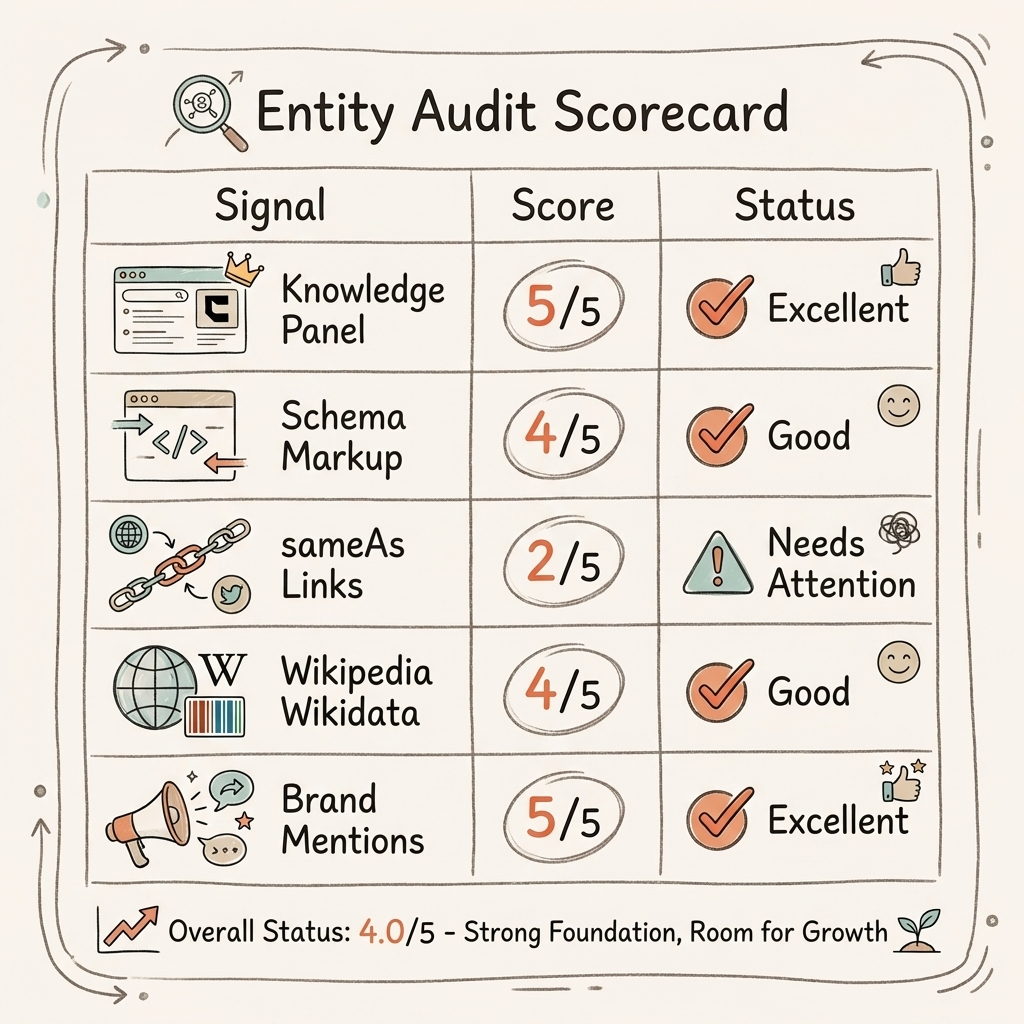
You need a clear baseline before making changes. We run this exact assessment for new clients. The 25-point entity audit scorecard reveals what AI actually sees.
| Signal | Score 0 | Score 3 | Score 5 |
|---|---|---|---|
| Google Knowledge Panel | No panel | Panel with basic info | Full panel with images, links, attributes |
| Schema Markup | No schema | Organization schema only | Organization + Product + Person + sameAs |
| sameAs Link Consistency | No sameAs links | Partial (2-3 profiles) | All official profiles linked and consistent |
| Wikipedia/Wikidata | No presence | Wikidata entry only | Wikipedia article + Wikidata with properties |
| Brand Mention Consistency | Inconsistent naming across web | Mostly consistent | Identical brand name, description, category across all platforms |
Score yourself honestly across these five signals. A total score below 10 means AI models likely do not recognize your brand as a distinct entity. Scores between 11 and 18 indicate partial recognition. You exist, but your details remain fuzzy. A score of 19 to 25 confirms your brand is entity-clear.
Checking each signal takes minimal time. Google your brand name in an incognito window to check for a Knowledge Panel. Use the Google Rich Results Test to inspect your current schema completeness. Search Wikidata directly for your company name. Review your major social profiles for name and description alignment.
Our detailed schema markup guide covers the implementation layer. You can establish ongoing tracking with our framework on how to measure AI visibility. This scorecard is the starting point for any entity SEO for AI search strategy.
Entity Signal Implementation Playbook
Build entity signals through five layers: Organization schema with sameAs links, consistent brand descriptions, Wikipedia/Wikidata presence, author entities, and product entities.
Implementation starts with clean data structure. Organization schema provides the foundation. The schema.org Organization type tells search engines exactly who you are. The sameAs array links your fragmented digital footprint into one entity.
{
  "@context": "https://schema.org",
  "@type": "Organization",
  "name": "Your Brand",
  "url": "https://yourbrand.com",
  "logo": "https://yourbrand.com/logo.png",
  "description": "One-sentence brand description matching your Knowledge Panel",
  "sameAs": [
    "https://www.linkedin.com/company/yourbrand",
    "https://twitter.com/yourbrand",
    "https://www.crunchbase.com/organization/yourbrand",
    "https://en.wikipedia.org/wiki/YourBrand",
    "https://www.wikidata.org/wiki/Q12345678"
  ]
}
Write one consistent brand description. Use this exact sentence across Google Business, LinkedIn, Crunchbase, and industry directories. AI models notice conflicting descriptions. Conflicting text forces the model to guess which version is accurate. Consistency eliminates guesswork.
Wikipedia notability requirements remain strict. Most brands fail to qualify. Wikidata offers a far more accessible alternative. Anyone can create a Wikidata entry with verifiable third-party sources. Both platforms feed directly into major AI models.
Author entities establish human credibility. Implement Person schema for your content creators and executives. Connect these profiles to their respective social accounts. We cover this deeply in our E-E-A-T for AI search guide.
Product entities matter for ecommerce brands. Use Product schema combined with review aggregation. Clear product data helps models answer comparison queries accurately.
How Does Entity Recognition Differ Across AI Platforms?
Each AI platform weights entity signals differently based on its data sources. Google's Knowledge Graph gives AI Overviews an edge, while ChatGPT and Claude prioritize authoritative brand mentions.
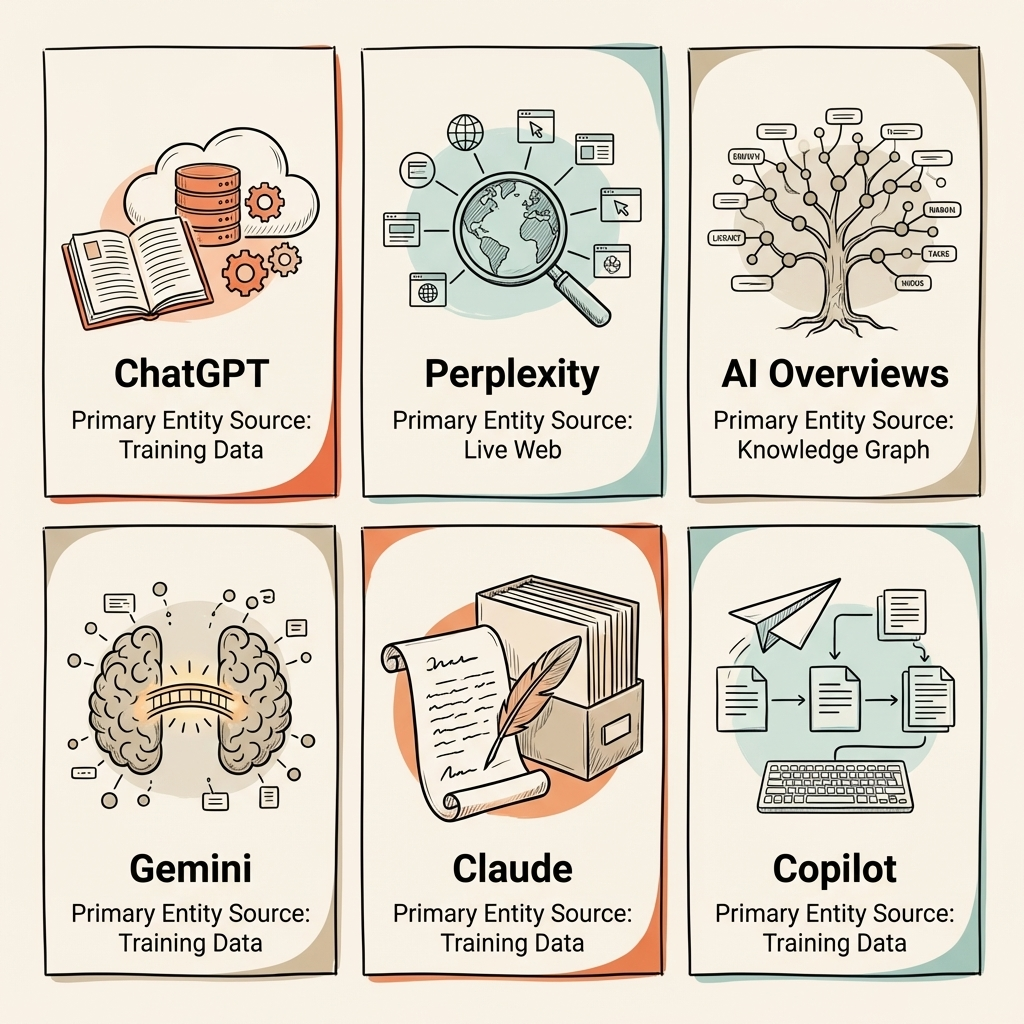
Platforms ingest data differently. Adapt your approach based on where your audience searches. Some models update in real-time. Others rely on periodic training runs.
| Platform | Primary Entity Source | What Matters Most | Priority Signal |
|---|---|---|---|
| ChatGPT | Training data + web search (Bing) | Brand mentions in training corpus + web presence | Consistent web mentions |
| Perplexity | Live web index | Real-time web content, citations, structured data | Fresh authoritative content |
| Google AI Overviews | Knowledge Graph + Search index | Knowledge Panel, schema markup, E-E-A-T | Schema + Knowledge Graph |
| Gemini | Google's entity database | Knowledge Graph entities, YouTube presence | Google ecosystem signals |
| Claude | Brave Search + training data | Brand mentions, content quality, structured information | Authoritative web mentions |
| Microsoft Copilot | Bing entity index | Bing Places, LinkedIn data, Bing Webmaster | Microsoft ecosystem signals |
ChatGPT relies on its training corpus and Bing web results. It prioritizes consistent web mentions found across authoritative sites. Our how to get recommended by ChatGPT guide covers the full optimization framework.
Perplexity works differently. It evaluates the live web in real-time, and fresh authoritative content dominates its citations. We cover the mechanics in our guide on how to get cited by Perplexity.
Google AI Overviews and Gemini depend on Google's massive Knowledge Graph. Establishing a Knowledge Panel is mandatory for Google ecosystem dominance. Microsoft Copilot pulls directly from Bing's entity index. Keep your LinkedIn data spotless. Claude values deep, authoritative web mentions over pure structured data.
What Mistakes Kill Entity SEO for AI Search?
The biggest entity SEO mistakes are treating schema as the entire solution, ignoring entity hierarchy, and auditing once without ongoing maintenance.
Schema markup is crucial but incomplete. It functions as one signal layer. It is never the entire solution. Entity SEO includes PR mentions, directory descriptions, knowledge graph presence, and author authority.
We outline the technical implementation in our schema markup for AI visibility guide. Schema requires this upstream strategy to succeed.
Brands often ignore entity hierarchy completely, 78% of sites we audit lack proper entity nesting. A flat Organization entity gives AI very little context. Your brand entity needs specific sub-entities for products, services, and executives. A software company is the parent entity. Its CRM product is a child entity. Its CEO is a related person entity.
Generic anchor text ruins entity associations. Linking with "click here" or "learn more" provides zero semantic value. Specific branded mentions build real associations. Writing "HubSpot's CRM platform" builds a strong signal. Writing "this tool" builds nothing.
Entity signals degrade over time. The audit-once-and-forget approach fails universally. Social profiles change. Schema breaks during site updates. Wikipedia entries get edited by third parties. We treat this as an ongoing technical requirement. Knowledge Graph recognition typically takes 8-12 weeks, according to ReSO LLM research. Most brands see measurable AI citation improvements by month 6. You can map this timeline using our AI visibility playbook.
Track your progress systematically. Use the Google Rich Results Test and Schema Markup Validator regularly. Monitor your Knowledge Panel for unexpected changes. Track branded search volume in Search Console. Use Peec.ai for dedicated AI citation tracking. Our complete how to measure AI visibility guide covers the necessary tool stack.
Frequently Asked Questions About Entity SEO for AI Search
These are the most common entity SEO questions from brands starting their AI visibility work. We answer these daily during our initial consultations.
What is the difference between entity SEO and traditional SEO?
Traditional SEO optimizes pages for keyword rankings. Entity SEO optimizes your brand's identity so AI models recognize and cite you as a distinct, authoritative source. Keywords match text. Entities build trust.
How long does entity SEO take to show results?
Knowledge Graph recognition typically takes 8-12 weeks. Most brands see measurable AI citation improvements by month 6 with consistent entity signal building. Patience matters here.
Do you need a Wikipedia page for entity SEO?
No, but it helps significantly. Wikidata entries are easier to create and still feed AI models. Focus on schema, sameAs links, and consistent brand mentions first. Wikipedia is the final step.
Can small brands do entity SEO?
Yes. Entity SEO starts with schema markup and consistent brand descriptions. These steps cost nothing. Wikipedia/Wikidata presence remains the stretch goal, not the starting point. Start with consistency.
Does entity SEO replace content optimization?
No. Entity SEO makes content optimization work. It ensures that when your content is good enough to cite, AI models know who wrote it and why that source is credible.
Conclusion
AI models recognize entities, not pages. Entity clarity is the foundation of AI visibility.
- The 5-point audit gives you a strict baseline score. You must evaluate your Knowledge Panel, schema, sameAs array, Wikidata presence, and mention consistency.
- Implementation starts with Organization schema and comprehensive sameAs links. This provides the biggest impact for the least effort.
- Each AI platform weights entity signals differently. Prioritize based on where your specific audience searches most often.
Run the 5-point entity audit on your own brand today. Score yourself 0 to 5 on each signal. If you score below 15, entity clarity is holding back your AI visibility. We've seen clients go from 0 to 38K clicks and achieve 8.5x traffic increases by fixing these foundational issues.
See where your brand appears in AI search
Scan ChatGPT, Perplexity, and Google AI across buyer-intent queries, instantly, no sign-up.
Find out if AI is sending buyers to your competitors.
We audit your AI visibility across ChatGPT, Perplexity, and Google AI –and show you exactly where you rank and what to fix.
“We went from 200 visitors/day to 1,900 visitors/day and 40% of demos are from AI search.”
Sumanyu Sharma · CEO, Hamming.ai
“Cintra helped me go from 3k to 7.5k daily traffic and doubled weekly orders in 1.5 months.”
Russ Coulon · Owner, UV Blocker
“We saw a lift from 3% to 13% visibility in the first 2 weeks, and organic traffic hit its highest ever.”
Ash Metry · Founder, Keywords.am
Related Articles
Product Feed Optimization AI Shopping Engines Actually Read (10-Point Audit)
Product feed optimization AI shopping engines need to recommend your products. Platform-by-platform feed requi…
Google AI Mode Optimization: How to Get Cited (2026 Guide)
Google AI Mode optimization needs a different approach than AI Overviews. Only 13.7% of sources overlap. Learn…
How to Get Cited by Grok: The xAI Platform Optimization Guide
Learn how to get cited by Grok with a 6-step framework covering the X co-citation mechanic, robots.txt setup,…