How to Get Cited by Grok: The xAI Platform Optimization Guide
Learn how to get cited by Grok with a 6-step framework covering the X co-citation mechanic, robots.txt setup, Bing indexing, and freshness signals.
TL;DR
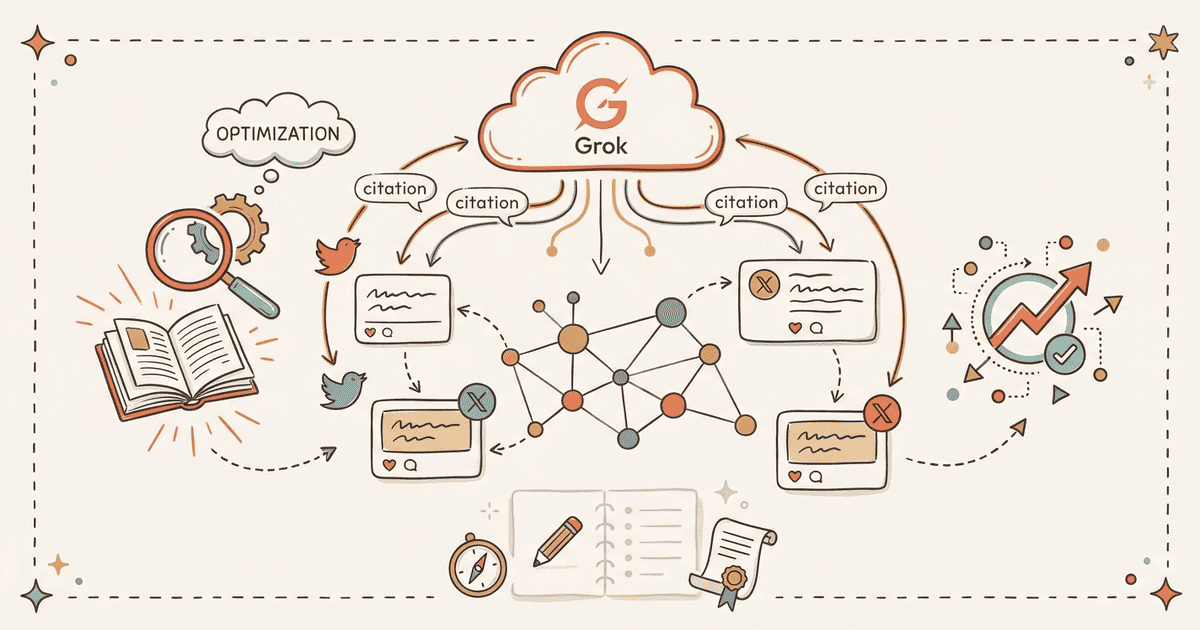
Knowing how to get cited by Grok is no longer optional, the platform claimed 17.8% of the U.S. chatbot market in under 12 months, cites ~24 sources per answer (more than double ChatGPT), and pulls from a three-tier system: live X posts, Bing-indexed web, then training data. Getting cited requires allowing GrokBot in robots.txt, mastering the X co-citation mechanic, submitting via Bing IndexNow, and keeping content fresh. No other AI platform has this architecture, which means no other platform responds to these tactics.
How to Get Cited by Grok: Why It Deserves Its Own Strategy
Grok is the fastest-growing AI search platform, and it uses a sourcing architecture no other AI engine replicates.
Grok captured 17.8% of the U.S. chatbot market in under 12 months. It started at 1.9% a year prior. By February 2026, the platform hit 298.6 million monthly visits and supports over 78 million monthly active users. That kind of growth trajectory demands attention, not a recycled ChatGPT playbook.
Most teams apply generic AI search tactics here and wonder why nothing moves. They won't get results. Grok runs on a fundamentally different architecture, driven by its deep integration with X (formerly Twitter). That connection changes how information gets validated and surfaced. It also creates an optimization opportunity that doesn't exist anywhere else.
We built this guide specifically around that difference. The six-step framework here covers what's unique to Grok: the three-tier sourcing hierarchy, the robots.txt prerequisite most brands miss, and the X co-citation mechanic that no competitor guide fully unpacks. To get cited by Grok consistently, you need to understand each of these layers, and apply them together. If you're already working through our ChatGPT guide and our Perplexity guide, think of this as the third pillar of a complete AI visibility strategy.
How Grok Selects Its Sources: The Three-Tier System
See where you rank across all AI answer engines.
Enter your domain and we'll scan your citation rate across ChatGPT, Perplexity, and Google AI.
Prefer to talk? Book a free 30-min call
Grok doesn't browse the web like Google. It retrieves information through a strict three-tier hierarchy, and understanding that order is the foundation of everything else in this guide.
Tier 1: Live X posts. When a user asks a question, Grok immediately scans the public X feed for matching conversations. This real-time stream is proprietary to xAI, no other AI engine has direct access to it. Grok looks for fresh context, recent opinions, and live discussion.
Tier 2: Bing-indexed web. This is the critical distinction most brands miss. Grok doesn't use Google's index. It uses Bing's. Teams that obsess over Google Search Console while ignoring Bing Webmaster Tools are leaving a major gap in their AI visibility coverage.
Tier 3: Training data. The static fallback. It updates slowly, lacks real-time nuance, and produces more generic answers. If Grok resorts to tier three for your topic, a competitor with fresher Bing content and active X presence will almost always win the citation.
The implication is simple: brands that aren't active on X and aren't properly indexed in Bing are invisible to Grok's top two retrieval tiers before a single piece of content gets evaluated. According to citation analysis from FogTrail, Grok averages ~24 citation URLs per response, well above every other major AI platform.
What Is the robots.txt Prerequisite for Grok?
Your robots.txt file is Grok's first gatekeeper. If GrokBot is blocked, no other optimization effort matters.
Grok uses documented user agents to crawl the web: GrokBot/1.0 and xAI-Grok/1.0. If your server blocks these, all the content work you do fails before it starts. Grok can't pull your pages into tier two web retrieval at all.
We regularly audit enterprise sites with completely locked AI crawler access. They're spending on content creation while the ingestion bots can't reach the pages. Check your file today. Here's what to add:
User-agent: GrokBot/1.0
Allow: /

User-agent: xAI-Grok/1.0
Allow: /
If these bots are blocked, you're stuck relying on tier one (X posts) and tier three (training data) only. You've locked yourself out of the most stable source of web citations before optimization even begins.
What Is the X/Twitter Co-Citation Mechanic?
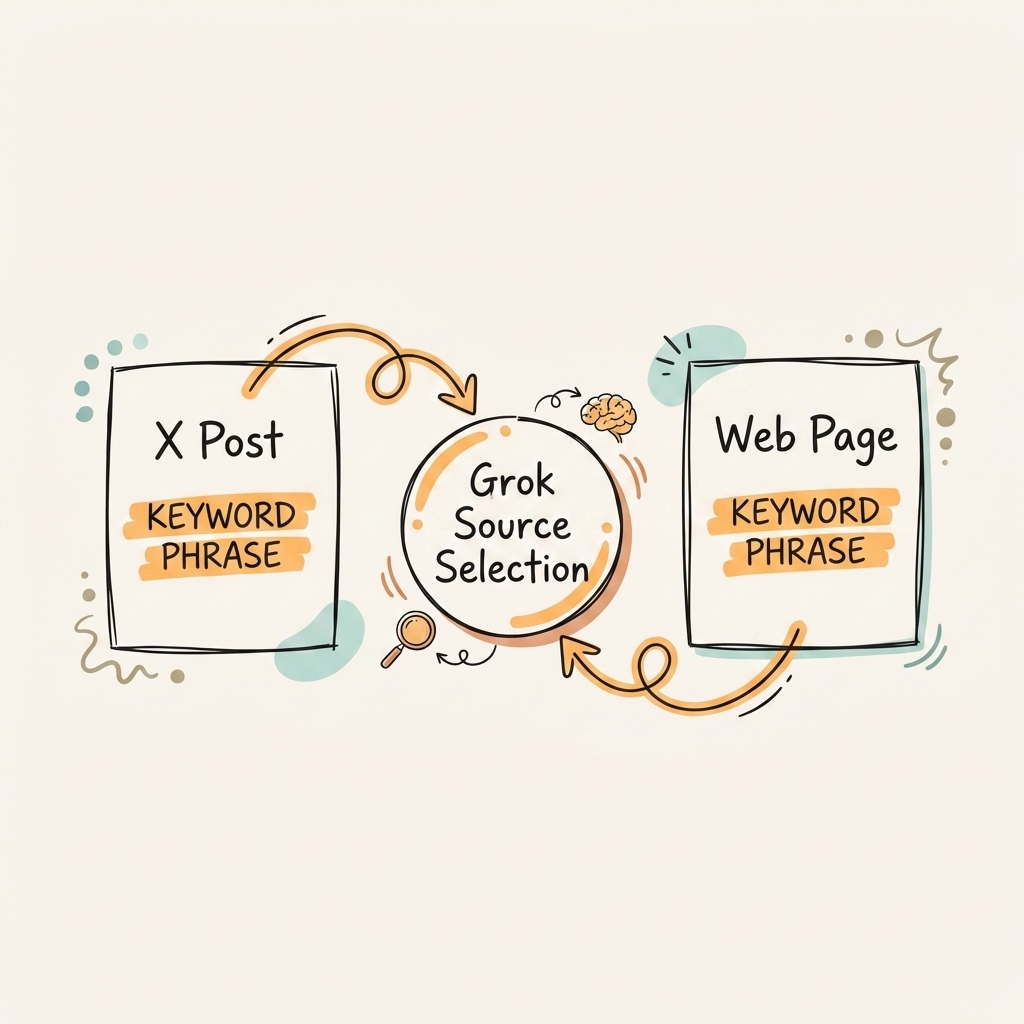
The X co-citation mechanic is Grok's unique signal: when an X post uses the same keywords as a web page, Grok treats both as reinforcing signals and boosts the page's citation probability.
When a user queries Grok, the engine runs parallel searches across both the Bing web index and the live X feed. It doesn't run them sequentially, it pulls from both simultaneously. This creates a language correlation mechanic that's unique to xAI's architecture.
Here's how it works: Grok notices when the phrasing in an X post matches the phrasing on a web page. When both sources use the same keyword phrase, the engine treats the overlap as a reinforcing signal. It infers that the web page carries real authority because active social conversations mirror its exact language. That correlation boosts your citation probability.
To trigger this deliberately, follow a simple routine every time you publish new content:
- Write an X post immediately after the page goes live
- Use the primary keyword phrase exactly as it appears in the article, don't paraphrase it
- Link directly to the new page in the post
That's it. Don't vary the language. The signal comes from the match. We run this routine for every piece of content at Cintra, and the citation lift is measurable within days. No other AI platform processes information this way.
How Do You Optimize Web Content for Grok?
Web content optimization for Grok requires Bing IndexNow submission, answer capsule structure, freshness signals, and strong E-E-A-T, in that priority order.
Bing IndexNow first. Speed is an asset here. Submit URLs through the IndexNow protocol immediately after publishing or updating a page. This cuts Bing's indexing lag from several days to a few hours. Faster indexing means faster availability for Grok's tier two retrieval.
Answer capsule structure. Lead every H2 section with a clear one-to-two sentence direct answer, then elaborate. Grok scans for concise information it can pull into a response. Long paragraphs that bury the key point get skipped. If you need a refresher on the foundational principles of AI-extractable content structure, see our ChatGPT optimization guide.
Content freshness signals. Grok weights recency more aggressively than ChatGPT does. Add a clear "Last updated" date to articles. Refresh statistics quarterly. Static pages lose citation value faster here than on any other platform.
E-E-A-T signals. Include author bios with real credentials. Use first-person examples that demonstrate actual experience. Link out to authoritative external sources. Grok values verified expertise and needs clear signals to identify it.
How Does Grok Handle Branded vs. Unbranded Queries?
Grok uses different logic for branded and unbranded queries. Unbranded queries require third-party validation; branded queries depend on entity clarity across your web presence and X profile.
Unbranded queries ("best AI visibility tools", "how to improve AI search rankings") pull from third-party validation. Grok rarely cites a company's own homepage for these. It looks for category authority, comparison pages, independent reviews, active Reddit threads, media coverage. Seeding these external platforms creates a validation network Grok treats as credible. To understand why entity authority matters across all AI platforms, read our breakdown of what is AI visibility.
Branded queries ("[brand name] review", "[brand name] pricing") work on entity clarity. Grok needs to understand exactly who you are. Make sure your brand name, product description, and positioning are identical across your website, your X profile, and third-party listings. Conflicting descriptions confuse Grok's extraction and cost you the citation.
If you're not sure which query types are most relevant to your brand, our AI visibility measurement guide covers how to audit your current citation landscape.
How Do You Measure Grok Citation Performance?
Grok citation tracking starts with manual audits, run 10 to 15 target queries, record every citation, and track citation rate change month over month.
Start with a manual audit. Run 10 to 15 target queries directly in Grok. Record every citation. Note which competitors appear and how consistently. Pay attention to citation volume, Grok averages 24 sources per answer. That's by design, not an anomaly. It provides more citation context than any other major platform.
Build a tracking spreadsheet. Map your core keywords against your Grok citation rate. Note the date, the query, and whether your domain appears. Run this audit monthly.
Benchmark your progress. Most brands see measurable citation movement within 6 to 8 weeks of consistent X posting paired with regular content updates. If you're not seeing movement by week 10, the likely culprits are robots.txt blocks, stale Bing indexing, or missing X activity.
For the full measurement methodology, including how to track across all seven major AI platforms, see our how to measure AI visibility guide.
Grok vs. Other Platforms: Comparison Table
Every AI platform requires a specific approach. This table shows where Grok sits relative to the platforms you're likely already optimizing for.
| Platform | Source Selection | Freshness Weight | Citations/Answer | Unique Signal |
|---|---|---|---|---|
| ChatGPT | Training + Bing | Moderate | ~10 | Large knowledge base |
| Perplexity | Real-time web | Very High | ~8 | Academic/Reddit sourcing |
| Grok | X + Bing + Training | High | ~24 | Live X feed integration |
| Claude | Training + web | Low-Moderate | ~10 | Long-form reasoning |
| Copilot | Bing | High | ~12 | Microsoft ecosystem |
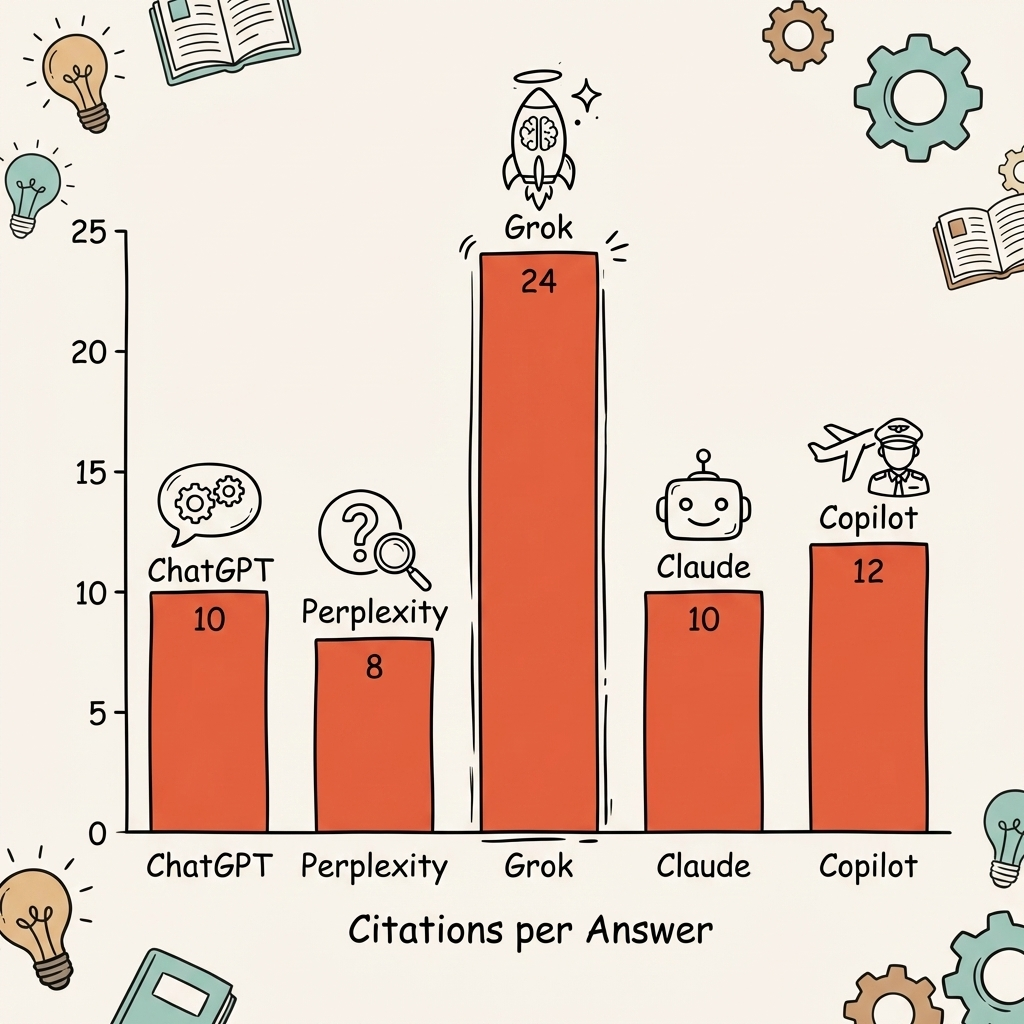
Grok's citation volume is its most distinctive feature. At ~24 sources per answer versus ~10 for ChatGPT, it provides more entry points for brand citations. According to Lumentir's multi-platform citation analysis, this gap is consistent across query types, not just informational searches. That higher volume, combined with the X mechanic, means early movers get an outsized share of Grok's citation pool before it fills up. For platform-by-platform tactics, see our Microsoft Copilot guide and Claude AI guide.
Frequently Asked Questions About Grok Citations
Can a new brand get cited by Grok?
Yes. Freshness and X activity let newer brands leapfrog established competitors. If an older company has stale content and no X presence, your freshly published, actively promoted pages will often win the citation, even without the domain authority advantage.
How long does optimization take?
Most brands see measurable citation change within 6 to 8 weeks. That timeline assumes consistent X posting paired with regular web content updates. The X co-citation mechanic responds faster than most organic search tactics.
Does X follower count matter?
No. Grok cares about content relevance and keyword correlation, not account size. A relevant post from a small account beats an irrelevant post from a large one every time.
Do we need X Premium to get Grok citations?
No. Grok crawls public posts regardless of subscriber status. Keep your focus on language correlation and indexing speed, those are the actual variables.
Will Grok ever use Google's index?
xAI built Grok to operate independently from Google's ecosystem. The Bing partnership is the foundation of its web retrieval tier. That's unlikely to change, so Bing optimization is a long-term requirement here, not a workaround.
Conclusion
Grok is a fundamentally different platform that needs a dedicated strategy. Repurposing old SEO tactics or copying your ChatGPT approach won't work. If you want to get cited by Grok, you need to treat it as a standalone discipline. As of April 2026, xAI has expanded Grok's availability to over 50 countries, and the platform now processes over 350 million monthly queries, a 17% increase since February 2026.
The six-step framework is straightforward: understand the three-tier sourcing system, allow GrokBot in your robots.txt, run the X co-citation mechanic for every piece of content, submit via Bing IndexNow, structure pages with answer capsules, and track citation rate monthly.
These aren't theoretical optimizations. We run this system daily for clients across industries. The citation lift is real, it's measurable, and it compounds as Grok's market share continues to grow.
Explore the full strategy in our AI visibility playbook. For platform-specific guides on the rest of the AI search ecosystem, we cover Perplexity, Claude, and Microsoft Copilot.
Ready to see where your brand stands today? View our pricing and start capturing the visibility your brand deserves.
See where your brand appears in AI search
Scan ChatGPT, Perplexity, and Google AI across buyer-intent queries, instantly, no sign-up.
Find out if AI is sending buyers to your competitors.
We audit your AI visibility across ChatGPT, Perplexity, and Google AI –and show you exactly where you rank and what to fix.
“We went from 200 visitors/day to 1,900 visitors/day and 40% of demos are from AI search.”
Sumanyu Sharma · CEO, Hamming.ai
“Cintra helped me go from 3k to 7.5k daily traffic and doubled weekly orders in 1.5 months.”
Russ Coulon · Owner, UV Blocker
“We saw a lift from 3% to 13% visibility in the first 2 weeks, and organic traffic hit its highest ever.”
Ash Metry · Founder, Keywords.am
Related Articles
Product Feed Optimization AI Shopping Engines Actually Read (10-Point Audit)
Product feed optimization AI shopping engines need to recommend your products. Platform-by-platform feed requi…
Google AI Mode Optimization: How to Get Cited (2026 Guide)
Google AI Mode optimization needs a different approach than AI Overviews. Only 13.7% of sources overlap. Learn…
AI Search Optimization Ecommerce: The Proven 5-Step Playbook for Getting Products Best Recommended by ChatGPT
AI search optimization ecommerce brands need is here: ChatGPT Shopping, Perplexity, and AI visibility strategi…