Product Feed Optimization AI Shopping Engines Actually Read (10-Point Audit)
Product feed optimization AI shopping engines need to recommend your products. Platform-by-platform feed requirements, 10-point audit checklist, and schema markup guide inside.

TL;DR
- AI shopping engines read structured feeds before they read product pages.
- ChatGPT Shopping processes 50M+ daily product queries and sources data from Google Shopping feeds through a direct pipeline.
- Explicit product attributes raise matching confidence to 95% versus 62% for vague descriptions.
- AI Overviews now appear in 55%+ of product-related Google searches.
- ChatGPT-recommended businesses average 4.3 stars, and 31% of consumers only use businesses with 4.5+ stars.
- A complete audit covers titles, descriptions, image quality, schema, inventory sync, review data, and cross-platform consistency.
Product feed optimization AI shopping engines rely on is the single biggest lever most ecommerce brands ignore. Stores with near-complete attribute coverage see 3-4x higher visibility in AI recommendations. Yet many teams still treat the product feed like an export file they set and forget.
AI shopping engines don't browse your homepage. ChatGPT Shopping, Perplexity Buy, and Google AI Shopping pull from structured product feeds, then decide whether your product deserves a recommendation. We've seen this firsthand: UV Blocker moved from 0 to 38K clicks and doubled weekly orders after feed and content optimization.
This guide covers the five feed attributes AI actually reads, platform-by-platform requirements, product schema that reduces pricing hallucinations, and a 10-point audit checklist you can run this week.
Why Are Product Feeds the New Homepage for AI Shopping?
AI shopping engines pull product data from structured feeds, not website pages. Your feed is the first and often only thing AI reads before making a recommendation.
ChatGPT Shopping sits at the center of this shift. Source code analysis revealed base64-encoded Google Shopping parameters inside ChatGPT, confirming a direct data pipeline from Google Shopping feeds into the shopping layer. That matters because ChatGPT Shopping handles 50M+ daily product queries.
AI Overviews now appear in 55%+ of product-related Google searches. A product with rich feed data can surface across both shopping and overview results. A sparse feed quietly disappears.
What Happens When a Buyer Asks AI for a Product?
When someone asks "best moisturizer for dry skin," AI scans the product title, description, GTIN, price, and availability before considering a recommendation. eFulfillmentService found that explicit attributes produce 95% matching confidence, while vague descriptions land at 62%. That gap pushes one product into the answer and leaves another behind.
For a platform-level primer on how ChatGPT Shopping works, see our ChatGPT Shopping guide. The pattern is simple: product feeds now function like the homepage for AI shopping because they're the cleanest machine-readable source in the stack.
What Are the Five Feed Attributes AI Models Actually Read?
See where you rank across all AI answer engines.
Enter your domain and we'll scan your citation rate across ChatGPT, Perplexity, and Google AI.
Prefer to talk? Book a free 30-min call
AI models evaluate five core feed attributes: natural-language titles, complete descriptions, granular product attributes, real-time inventory accuracy, and high-quality images.
1. Title Optimization
Title rewrites are the fastest win. Get Ryze reported 20-35% CTR improvement within four weeks after moving away from keyword stuffing and toward natural language ordering.
Compare these two titles:
- Before: "Blue Widget XL - Best Price Free Shipping"
- After: "Navy Blue Matte-Finish Widget, XL, for Outdoor Use"
The second version gives AI color, finish, size, and use case in one line. The first gives almost no semantic context.
2. Description Depth
Alhena.ai recommends including use-case language, material details, intended audience, and purpose in every product description. AI treats descriptions as context, not decoration.
A weak description says "sunscreen SPF 50." A stronger one says "lightweight daily sunscreen for outdoor runners with sweat-resistant wear." The second gives AI a reason to match the item to a real query.
3. Attribute Granularity
This is where many feeds fail. "Blue" is too broad. "Navy blue, matte finish, recycled poly blend" gives AI a better path to the right result. Products with explicit attributes get positioned first instead of eighth in recommendations.
4. Inventory Accuracy
Missing or stale stock data triggers MERCHANDISE_NOT_AVAILABLE errors, which damages reliability signals before a buyer even sees the product. Daily sync at minimum. Real-time is better.
5. Image Quality
Multiple image types (product, lifestyle, detail shots) outperform single-image listings. AI extracts attributes from product images using computer vision, but text attributes override when the two disagree. Minimum 800x800px, with the main image on a white background.
For a broader ecommerce AI search framework, see our AI search optimization for ecommerce playbook.
How Do Feed Requirements Differ Across AI Shopping Platforms?
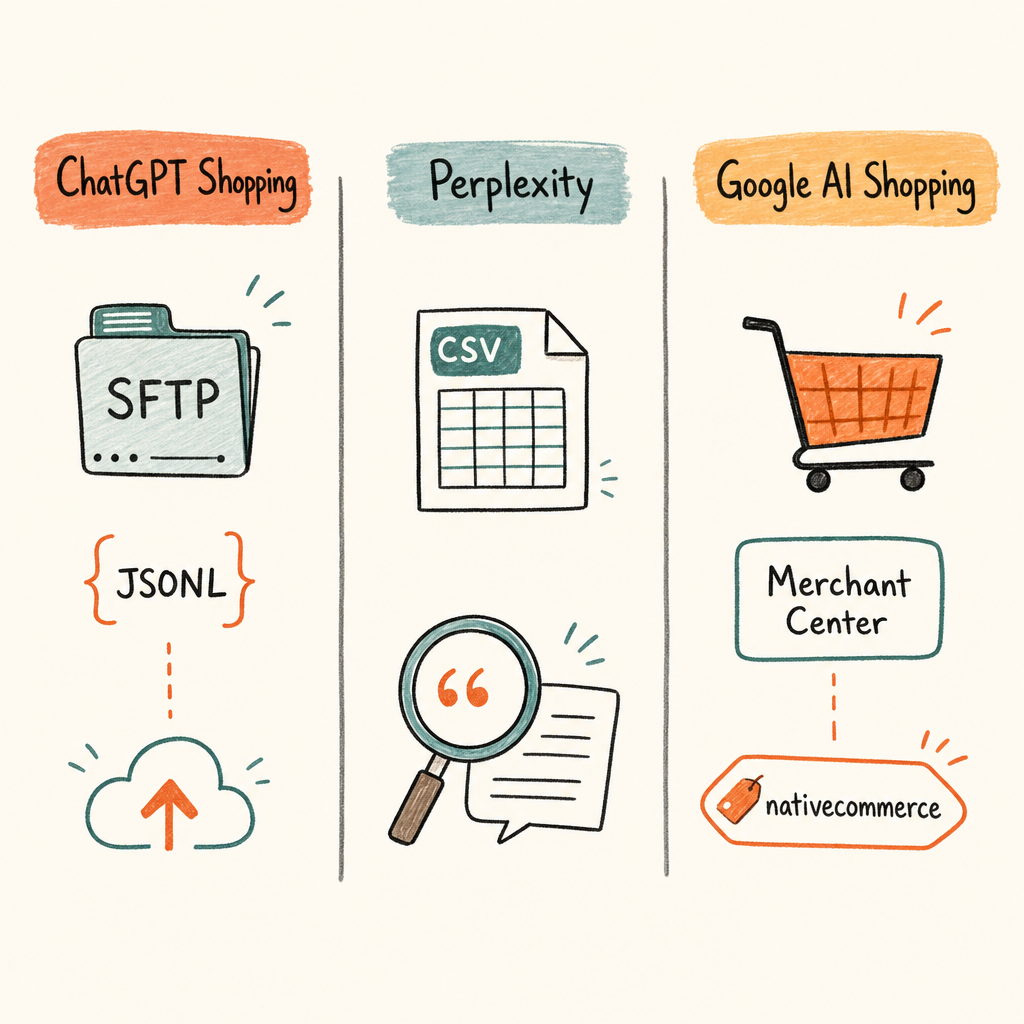
Each AI shopping platform has distinct feed specifications. ChatGPT uses SFTP push delivery, Perplexity accepts Google Merchant Center CSV format, and Google requires Merchant Center structured data with agentic commerce flags.
ChatGPT Shopping
ChatGPT Shopping accepts JSONL, CSV, TSV, and Parquet feeds with gzip and zstd compression. Merchants deliver feeds via SFTP to an endpoint that OpenAI provides during Merchant Program onboarding. This is a push model, not a passive dashboard upload.
Perplexity Buy
Perplexity takes CSV feeds that follow Google Merchant Center spec, but it also weighs third-party citations from Reddit and expert blogs alongside feed data. A strong feed alone won't be enough if your product has no presence in the communities Perplexity monitors. For details, see our Perplexity citation guide.
Google AI Shopping
Google AI Shopping relies on Merchant Center structured data and now requires a nativecommerce = true flag for agentic purchasing. This flag tells Gemini that your inventory is available for AI-facilitated transactions.
Platform Comparison Table
| Platform | Feed Format | Delivery Method | Key Differentiator |
|---|---|---|---|
| ChatGPT Shopping | JSONL, CSV, TSV, Parquet | SFTP push to OpenAI endpoint | Product cards with in-chat purchase |
| Perplexity Buy | CSV (Google MC spec) | Standard upload | Weighs third-party citations + feed data |
| Google AI Shopping | Merchant Center | Merchant Center dashboard | Requires nativecommerce flag for AI purchasing |
| Standard Merchant Center | XML/CSV | Dashboard upload | Baseline for all platforms |
Consistency still matters across all channels. The same GTIN, price, and availability need to match across ChatGPT, Perplexity, Google, and standard Merchant Center feeds. Otherwise, the model sees conflicting signals and picks a more stable competitor. This connects to the broader agentic commerce optimization trend, where shopping feeds behave like action feeds, not static catalogs.
What Product Schema Markup Gets Cited by AI?
Product, Offer, and AggregateRating schema types help AI extract and cite specific product attributes rather than generating them. This prevents pricing hallucinations and incorrect availability claims.
Product Schema
Product schema carries the product's name, brand, description, GTIN, image, and material. This is the foundation that connects your feed data to on-page structured data.
Offer Schema
Offer schema carries price, priceCurrency, availability, and priceValidUntil. Without it, AI may pull stale pricing from cached versions of the page, creating hallucinations that frustrate buyers and damage trust.
{
  "@context": "https://schema.org",
  "@type": "Product",
  "name": "Navy Blue Matte-Finish Widget",
  "brand": "Example Brand",
  "gtin": "1234567890123",
  "material": "Recycled poly blend",
  "offers": {
    "@type": "Offer",
    "price": "49.00",
    "priceCurrency": "USD",
    "availability": "https://schema.org/InStock",
    "priceValidUntil": "2026-12-31"
  }
}
AggregateRating and FAQ Schema
AggregateRating schema gives AI a structured way to see review strength. ChatGPT-recommended businesses average 4.3 stars, and products with 50+ reviews get recommended more frequently than thinly reviewed listings.
FAQ schema on product pages helps AI answer comparison queries that reference your product directly. For a deep dive on all schema types, see our schema markup for AI visibility guide.
Why Does AI Trust Products with More Reviews?
AI models weight user reviews heavily in product recommendations. ChatGPT references reviews in 58% of responses, and Perplexity references them in 100% of product answers.
The trust signal shows up in the averages. ChatGPT-recommended businesses average 4.3 stars, and 31% of consumers only use businesses with 4.5+ stars. Review data is part of the feed optimization conversation, not a separate reputation problem.
Volume and Freshness Thresholds
Volume matters. Velsof recommends 50+ reviews as the minimum credibility floor and 150+ reviews for maximum AI citation potential.
Freshness matters just as much. 74% of consumers only trust reviews from the last three months. A steady stream of 5-10 new reviews per month outperforms a large pile of old ones. AI platforms reflect this same preference toward recency.
Put Review Data in Your Feed
That's why review_count and average_rating fields belong in the feed itself. AI does better with explicit numbers than with vague praise. Structure the data so AI can cite specific customer experience metrics rather than generating generic summaries.
The 10-Point Product Feed Audit Checklist
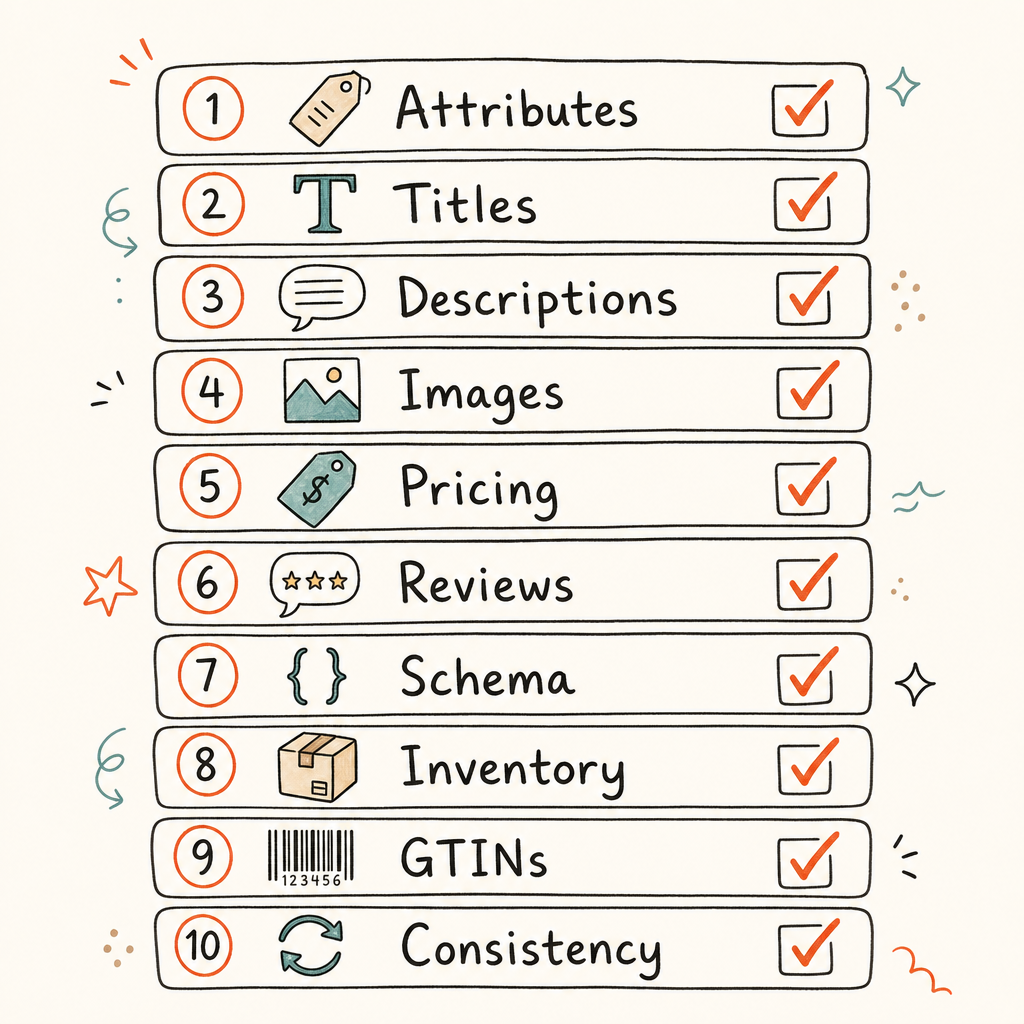
A complete product feed audit checks attribute completion, image quality, pricing accuracy, review data, schema coverage, inventory sync, and cross-platform consistency against pass/fail criteria.
Start with your top 20 products. That makes the audit manageable and exposes the biggest feed gaps fast. Here's the practical pass/fail scorecard we use with our ecommerce clients:
| # | Check | Pass | Fail |
|---|---|---|---|
| 1 | Attribute Completion Rate | 95%+ across title, description, GTIN, brand, price, availability, images | Below 80% |
| 2 | Title Quality | Natural language with 3+ attributes (color, size, material, use case) | Generic, truncated, or keyword-stuffed |
| 3 | Description Depth | 150+ characters with material, audience, intended use, and value | Under 80 characters or copied from manufacturer |
| 4 | Image Quality | 3+ images, main on white background, minimum 800x800px | Single image or below 500px |
| 5 | Pricing Accuracy | Feed price matches website price exactly | Any discrepancy |
| 6 | Review Data | 50+ reviews, 4.0+ rating, review_count and average_rating populated | No review data in feed |
| 7 | Schema Markup Coverage | Product, Offer, and AggregateRating schema present | Any missing schema type |
| 8 | Inventory Sync Frequency | Daily or real-time updates | Weekly or manual sync |
| 9 | GTIN/Barcode Coverage | 100% for all applicable products | Missing GTINs |
| 10 | Cross-Platform Consistency | Identical GTIN, price, availability across ChatGPT, Perplexity, and Google | Any mismatch |
The fastest wins in product feed optimization AI shopping visibility depends on usually sit in attributes, titles, and schema. For a broader implementation view, see our AI search optimization for ecommerce playbook.
Frequently Asked Questions About Product Feed Optimization AI Shopping
These are the questions ecommerce brands ask most about product feed optimization AI shopping engines require.
How often should I update my product feed for AI?
Daily at minimum. Real-time sync is ideal for inventory and pricing accuracy because AI engines check both before recommending a product. Stale inventory data causes MERCHANDISE_NOT_AVAILABLE errors that damage your reliability score with the platform.
Do I need different feeds for each AI platform?
Not entirely separate feeds, but platform-specific adjustments matter. ChatGPT uses SFTP push delivery while Perplexity and Google accept standard Merchant Center formats. Start with a strong Google Merchant Center feed as your baseline since ChatGPT pulls from it directly.
What happens when AI shows wrong pricing for my product?
Pricing hallucinations usually trace back to missing or stale Product and Offer schema. Adding priceValidUntil and syncing the feed daily prevents most pricing errors. For implementation steps, see our schema markup for AI visibility guide.
Can I optimize my product feed without a developer?
Yes. Most Shopify and WooCommerce feed apps handle attribute mapping, schema injection, and automated sync without custom code. The biggest early wins are content tasks: better titles, fuller descriptions, and more images.
Why do reviews matter so much in AI shopping?
Reviews give AI a trust signal it can cite. ChatGPT references reviews in 58% of responses, and Perplexity references them in all product answers. Products with 50+ reviews and 4.3+ average ratings get recommended more frequently.
Does a strong Google Shopping feed help with other AI platforms?
Yes. ChatGPT Shopping pulls from Google Shopping feeds through a direct pipeline, so a strong Google Merchant Center setup becomes a shared baseline. The cross-platform strategy aligns with our Perplexity citation guide.
Conclusion
Product feed optimization AI shopping platforms depend on is not a side task. It's the primary interface between your catalog and the engines that recommend products.
- Attribute completeness drives a 3-4x visibility advantage in AI recommendations.
- One feed doesn't fit all. ChatGPT, Perplexity, and Google each read the data differently.
- Reviews, schema, and inventory sync are the three most commonly missed optimizations.
- Start small. Audit your top 20 products this week, not the whole catalog.
We run this exact audit for ecommerce brands as part of our AI visibility service. See our plans or explore our ecommerce AI search playbook for the wider strategy.
Related Reading
- Perplexity Shopping in 2026: The Two-Track Playbook, how to pair product feed optimization with content authority building for Perplexity's premium shopper audience
- AI Search Advertising: The Complete 2026 Guide, how paid AI placements work alongside organic feed visibility across ChatGPT, Google AI Mode, and Perplexity
- AI Visibility Competitive Analysis, how to benchmark your catalog's AI presence against competitors on a platform-by-platform basis
See where your brand appears in AI search
Scan ChatGPT, Perplexity, and Google AI across buyer-intent queries, instantly, no sign-up.
Find out if AI is sending buyers to your competitors.
We audit your AI visibility across ChatGPT, Perplexity, and Google AI –and show you exactly where you rank and what to fix.
“We went from 200 visitors/day to 1,900 visitors/day and 40% of demos are from AI search.”
Sumanyu Sharma · CEO, Hamming.ai
“Cintra helped me go from 3k to 7.5k daily traffic and doubled weekly orders in 1.5 months.”
Russ Coulon · Owner, UV Blocker
“We saw a lift from 3% to 13% visibility in the first 2 weeks, and organic traffic hit its highest ever.”
Ash Metry · Founder, Keywords.am
Related Articles
Google AI Mode Optimization: How to Get Cited (2026 Guide)
Google AI Mode optimization needs a different approach than AI Overviews. Only 13.7% of sources overlap. Learn…
How to Get Cited by Grok: The xAI Platform Optimization Guide
Learn how to get cited by Grok with a 6-step framework covering the X co-citation mechanic, robots.txt setup,…
AI Search Optimization Ecommerce: The Proven 5-Step Playbook for Getting Products Best Recommended by ChatGPT
AI search optimization ecommerce brands need is here: ChatGPT Shopping, Perplexity, and AI visibility strategi…