Perplexity Shopping in 2026: The Two-Track Playbook for Ecommerce Brands
Perplexity shopping gives ecommerce brands access to the highest-value AI audience. Learn the two-track framework for product feeds and content authority.
TL;DR
Perplexity shopping gives ecommerce brands access to the most profitable AI audience: 57% higher AOV, zero merchant fees, and premium demographics. But feed optimization alone won't get you recommended. You need a two-track approach: product feed setup (Track 1) plus content authority building (Track 2). Track 2 works even without the Merchant Program.
The smallest AI shopping platform is also the most profitable. Perplexity has 45 million monthly users. ChatGPT boasts 900 million weekly users. But Perplexity shoppers spend 57% more per order. 80% hold college degrees. 65% earn above-average income. This creates a lucrative environment for direct-to-consumer brands.
Every competitor article covers product feeds. Nobody covers the content authority layer. That layer determines which brands Perplexity actually recommends. You can optimize your feed perfectly and still remain invisible. We see this daily. Brands gain acceptance into the Merchant Program but fail to appear in top three recommendations.
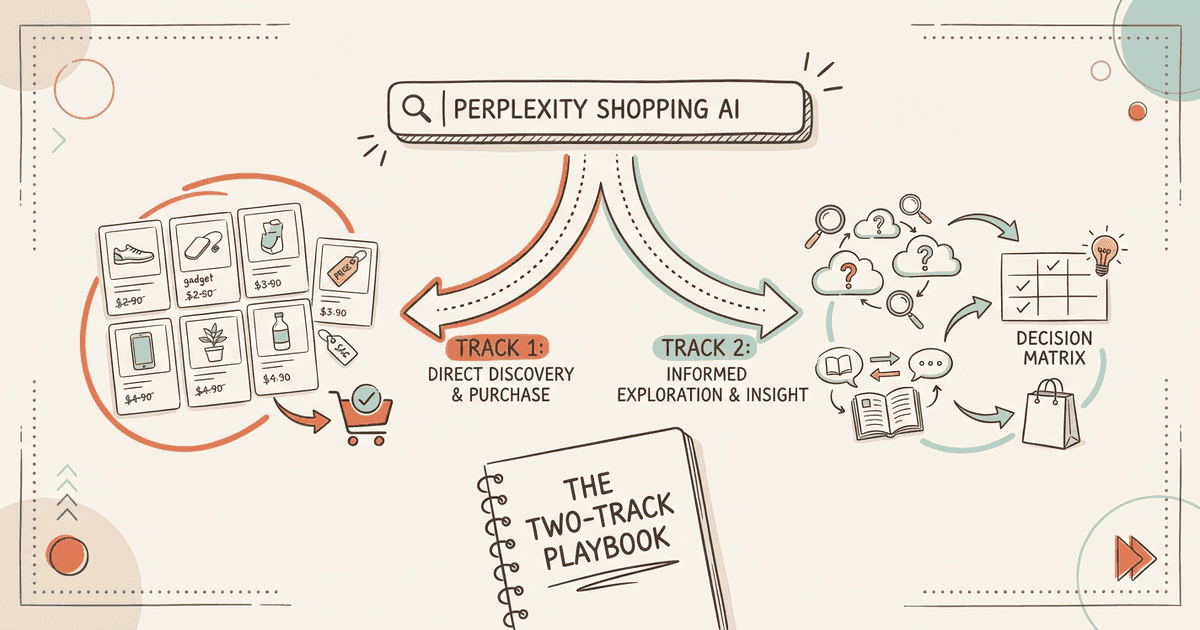
We solve this with a two-track framework. It combines product feed optimization with content authority building. It works whether or not you participate in the Merchant Program. This strategy pushes your products to the top of AI shopping results.
What Makes Perplexity Shoppers So Valuable for Ecommerce Brands?
Perplexity shoppers spend 57% more per order than other AI platform users, with 80% holding college degrees and 65% earning above-average income.
We track these metrics closely. Alhena reports a 57% higher average order value for this audience. These statistics reflect a premium user base that researches thoroughly before purchasing. This behavior aligns well with high-ticket ecommerce items.
Zero merchant fees change the unit economics entirely. You pay a 4% transaction fee on ChatGPT. Perplexity charges nothing. Consider a standard DTC brand. If your average order value is $100 and you process 1,000 monthly orders, you save $4,000 per month. That capital can be reinvested into customer acquisition or product development.
The market is moving toward AI shopping quickly. Adobe Analytics reported 693% year-over-year AI traffic growth to retail sites in 2025. Shoppers are leaving traditional search engines. They prefer the direct answers and curated recommendations that AI provides.
Quality matters just as much as volume. Adobe Analytics found a 31% higher conversion rate from AI-referred shoppers compared to traditional search. These users arrive with high commercial intent. They have already asked specific questions and received tailored recommendations. They are ready to buy. You can learn more about this broader shift in our guide on AI search optimization for ecommerce.
The Buy With Pro feature streamlines the purchasing journey. Shoppers enjoy one-click PayPal checkout. Perplexity displays detailed product cards with high-resolution images and accurate pricing. The Snap to Shop visual search tool lets users find products using their camera. This frictionless experience drives higher conversion rates. It removes the usual hurdles found in traditional ecommerce funnels. You can compare this checkout flow with other platforms in our detailed breakdown of ChatGPT Shopping.
How Does Perplexity's Shopping Algorithm Decide Which Products to Recommend?
See where you rank in Perplexity's answers.
Enter your domain and we'll scan your Perplexity citation rate across your highest-value queries.
Prefer to talk? Book a free 30-min call
Perplexity's shopping algorithm weighs three signals: product data quality from merchant feeds, structured data markup on product pages, and content authority from third-party sources.
Signal 1 focuses on product data quality. You supply this data through the Merchant Program feed. You upload a CSV file or use an SFTP connection. Perplexity requires specific fields to process your products. You must include GTINs, current pricing, availability status, and clear descriptions. High-quality images are also mandatory. This feed acts as your foundational entry ticket.
Signal 2 involves structured data markup. You implement Product schema using JSON-LD formatting. This code lives directly on your product pages. It highlights review aggregation and ensures pricing transparency. Perplexity crawls this data to verify the information in your feed. We explain this technical implementation fully in our guide on schema markup for AI visibility.
Signal 3 is content authority from third-party sources. This is the signal most brands miss. Perplexity analyzes editorial mentions across the web. It reads review sites, comparison articles, expert content, and community discussions. General search knowledge about a brand influences shopping recommendations directly. If Perplexity trusts your brand as an authoritative source, it recommends your products.
Alhena reports a 3.1x citation lift for products with comprehensive structured data and strong third-party validation. This combination proves your brand exists as a real entity in the broader ecosystem. Perplexity does not just trust what you say about yourself. It verifies your claims against what the rest of the internet says about you.
The Two-Track Framework: Product Feeds + Content Authority
The Two-Track Framework combines product feed optimization with content authority building to maximize visibility in Perplexity Shopping results, with or without the Merchant Program.
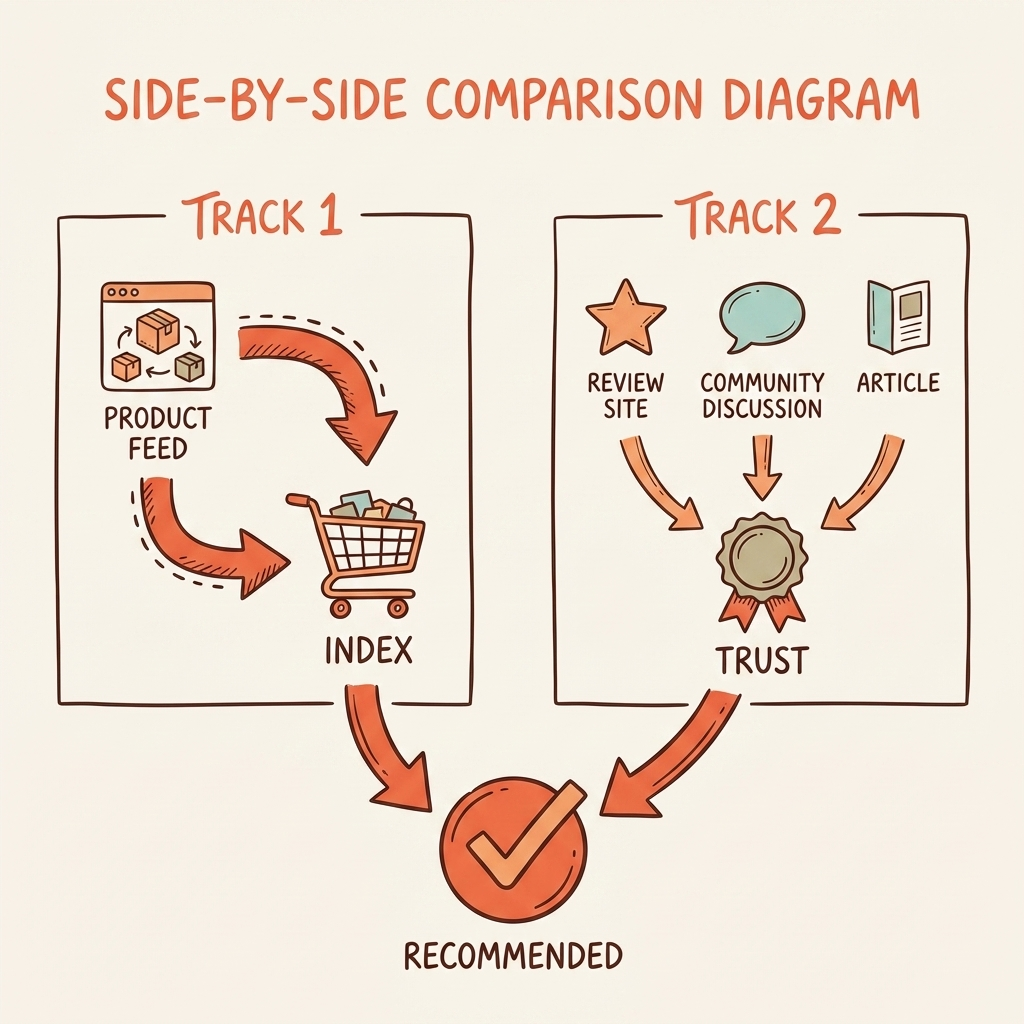
Track 1: Product Feed Optimization
You start with Merchant Program enrollment. The application process requires verified business details and takes 4 to 6 weeks for approval. Once accepted, you must supply clean product data. GTINs are a non-negotiable identifier. Write clear, factual descriptions without marketing fluff. Set competitive pricing. Use high-quality lifestyle images over plain white backgrounds.
Product schema markup demands precision. Implement JSON-LD with the @type Product declaration. Include offers, aggregateRating, and brand fields. One critical addition is the Intended Purpose field. This specific field helps Perplexity match products to nuanced query intents. It bridges the gap between what a product is and what a user wants to achieve.
Track 2: Content Authority Building
This is where most strategies fall short. Feeds get you into the index. Authority gets you into the recommendations.
You need editorial mentions in sources that Perplexity trusts. Industry publications, niche blogs, and authoritative digital magazines build your information ecosystem. We detail exactly how to achieve this in our piece on how to get cited by Perplexity.
Review site presence matters. Get featured on comparison platforms. Target Wirecutter or niche review blogs relevant to your category. Engage with YouTube reviewers that Perplexity frequently cites. These external validations carry significant weight in the recommendation algorithm.
Community engagement signals authentic interest. Perplexity crawls Reddit and Quora threads for genuine product opinions. You need a presence there. When someone asks "best wireless earbuds under $100" or "organic skincare for sensitive skin," your brand should appear in the conversation. Master this approach with our Reddit strategy for AI visibility.
Create expert content that references your brand. Publish guest posts and participate in expert roundups. These efforts build domain authority signals that compound over time.
Track 2 works even without the Merchant Program. Perplexity recommends products from brands it recognizes as authoritative outside the formal feed. We have seen brands dominate recommendations simply because their content authority was strong across the sources Perplexity indexes.
| Dimension | Track 1: Product Feeds | Track 2: Content Authority |
|---|---|---|
| What it does | Gets products into Perplexity's commerce index | Gets brand recognized as trustworthy |
| Merchant Program required? | Yes | No |
| Timeline to impact | 4-6 weeks after enrollment | 2-4 months of consistent execution |
| Effort type | Technical (one-time setup + maintenance) | Strategic (ongoing content + community) |
| Competitive moat | Low. Any competitor can match your feed. | High. Authority compounds over time. |
| Best for | Products with GTINs and competitive pricing | DTC brands, niche categories, premium products |
How Does Perplexity Shopping Compare to ChatGPT Shopping?
ChatGPT has volume with 900 million weekly users, while Perplexity offers premium demographics and zero fees. Most brands should run both platforms using different strategies.
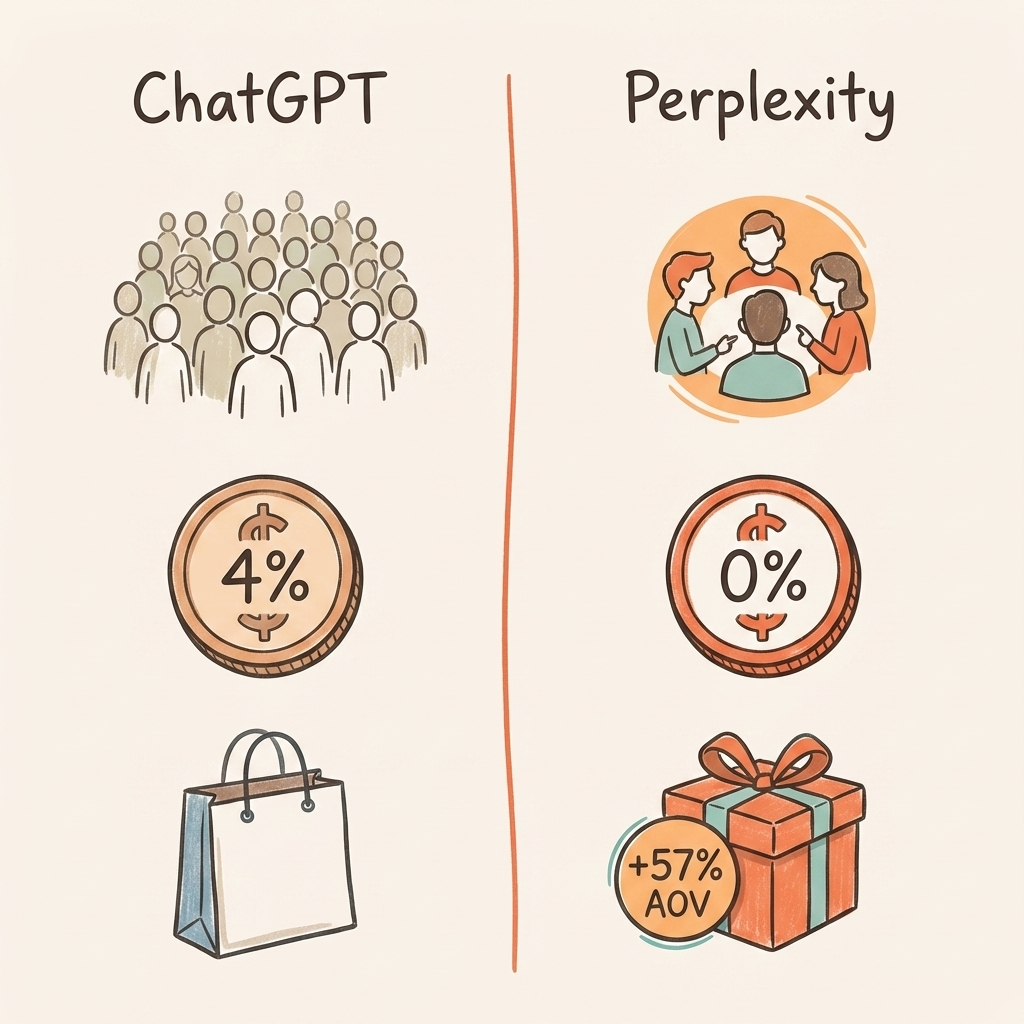
You must balance volume against value. ChatGPT provides reach. Perplexity delivers a smaller, higher-converting user base. We recommend a portfolio allocation approach. Do not choose just one. You need visibility across the entire AI ecosystem. We break down the ChatGPT side of this equation in our guide on ChatGPT Shopping.
The fee structures dictate different margin calculations. ChatGPT charges a 4% fee per transaction. Perplexity charges zero. Consider a $150 product. You pay $6 per sale on ChatGPT. You keep that $6 on Perplexity. This difference compounds at scale.
Product category fit determines your primary focus. Perplexity excels for premium, research-heavy purchases. Target organic skincare, DTC coffee subscriptions, or specialty electronics. Shoppers want detailed comparisons for these items. ChatGPT fits impulse buys and high-volume commodity products better. The large user base drives quick, low-consideration purchases effectively.
| Factor | ChatGPT Shopping | Perplexity Shopping |
|---|---|---|
| Monthly users | 900 million weekly | 45 million monthly |
| Product catalog | 22.5 million offers | Growing (Merchant Program) |
| Transaction fee | 4% | 0% |
| Shopper demographics | Mass market | 80% college-educated, 65% above-avg income |
| Average order value | Baseline | 57% higher |
| Best for | Volume, impulse buys, items under $50 | Premium, research-heavy, items over $75 |
| Content authority impact | Moderate | High (algorithm signal) |
How Do You Measure Perplexity Shopping ROI?
Measure Perplexity Shopping ROI by configuring GA4 to segment AI-referred traffic, tracking referral patterns from perplexity.ai, and establishing a baseline-intervention-measurement cadence.
You must identify the referrals accurately. Perplexity traffic appears as perplexity.ai in your standard referral reports. Configure Google Analytics 4 properly. Create a custom channel grouping for AI traffic. Group referrals from Perplexity, ChatGPT, Claude, and Gemini together. This isolates your AI search performance from traditional search engines.
Structure your UTM parameters with care. Use specific tags for Perplexity campaigns and landing pages. We recommend standardizing on utm_source=perplexity and utm_medium=ai_referral. This granular tracking reveals which products resonate with this specific audience.
Establish a baseline-intervention-measurement cadence. First, document your current AI referral traffic. Next, implement the two-track framework. Finally, measure the lift after 60 to 90 days. We use this methodology to prove ROI for our clients.
Track 2 measurement requires monitoring brand mention growth across the internet. You must track sources that Perplexity indexes. You need tools that track where AI models cite your brand. We handle this tracking for our partners. You can view how we structure these engagements on our pricing page.
Frequently Asked Questions About Perplexity Shopping
These are the most common questions ecommerce brands ask about optimizing for Perplexity Shopping, based on conversations with DTC brand owners and marketing teams.
Do I need the Merchant Program to appear in Perplexity Shopping?
No. Perplexity recommends products from brands with strong content authority even without formal Merchant Program enrollment, though the program gives you product cards and checkout integration.
Track 2 works independently. The Merchant Program adds Buy With Pro checkout capabilities. Perplexity's general search already recommends authoritative brands based on third-party validation and strong organic signals.
How long until products show after Merchant Program enrollment?
Expect 4 to 6 weeks from application to product visibility. This includes feed processing, data validation, and initial indexing time.
Feed quality dictates speed. Clean GTINs process faster. Complete descriptions and high-resolution images prevent manual review delays. You control this timeline through data accuracy.
What product categories perform best on Perplexity Shopping?
Premium and research-heavy categories perform best. Electronics, skincare, specialty food, and DTC brands win where shoppers compare options before purchasing.
Perplexity's educated, higher-income demographic favors thorough research. Commodity products with pure price competition perform better on ChatGPT. Match your product type to the platform audience.
How does Perplexity Shopping compare to Google Shopping?
Perplexity Shopping uses AI-curated recommendations rather than paid ad placements. Product authority matters more than ad spend.
Google Shopping relies on an auction model where you pay per click. Perplexity Shopping is merit-based. Product quality, data structure, and brand authority determine visibility. No CPC, no bidding.
Can Perplexity Shopping work for DTC brands not on Shopify?
Yes. Perplexity's Merchant Program accepts brands on any platform, including WooCommerce and BigCommerce, as long as you can supply a product feed.
The CSV feed format via SFTP is platform-agnostic. Track 2 focuses on content authority, which happens off-site. Your ecommerce platform choice does not limit your Perplexity visibility.
Is Perplexity Shopping worth it with only 45M monthly users?
Yes. The 57% higher average order value and zero transaction fees mean Perplexity Shopping generates more profit per visitor than larger platforms.
Revenue equals traffic times conversion times average order value. Higher conversion rates and elevated order values make the unit economics compelling even at lower traffic volumes.
Conclusion
Perplexity Shopping offers strong potential for DTC brands willing to adapt.
- Perplexity Shopping captures the most profitable AI shopping audience. You benefit from higher average order values, zero merchant fees, and premium demographics.
- Feed optimization gets you eligible. Content authority gets you recommended. You need both.
- Track 2 works even without the Merchant Program. Build authority in the external sources Perplexity trusts.
- The brands winning AI commerce run both tracks simultaneously. They never choose just one path.
Audit your brand's presence in Perplexity right now. Search five product queries in your category. Document which brands appear. If you are missing, you know which track to start with.
We build the content authority layer that makes your products the ones Perplexity recommends. Book a free strategy call and we will show you exactly where you stand.
Related Reading
- Product Feed Optimization for AI Shopping Engines, the 10-point audit for structuring catalog data so ChatGPT and Perplexity actually read it
- ChatGPT Deep Research Optimization, how to get cited in AI-generated research reports, which heavily influence purchase decisions
- AI Search Advertising: The Complete 2026 Guide, how paid and organic AI visibility work together to grow ecommerce revenue
See where your brand appears in AI search
Scan ChatGPT, Perplexity, and Google AI across buyer-intent queries, instantly, no sign-up.
Find out if AI is sending buyers to your competitors.
We audit your AI visibility across ChatGPT, Perplexity, and Google AI –and show you exactly where you rank and what to fix.
“We went from 200 visitors/day to 1,900 visitors/day and 40% of demos are from AI search.”
Sumanyu Sharma · CEO, Hamming.ai
“Cintra helped me go from 3k to 7.5k daily traffic and doubled weekly orders in 1.5 months.”
Russ Coulon · Owner, UV Blocker
“We saw a lift from 3% to 13% visibility in the first 2 weeks, and organic traffic hit its highest ever.”
Ash Metry · Founder, Keywords.am
Related Articles
Meta-ExternalAgent Took More Bandwidth Than 5 Crawlers Combined
Meta-ExternalAgent pulled 955 MB from cintra.run in 30 days, more than 5 AI and search crawlers combined. What…
Organic Traffic Decline 2026: Why It's Dropping and How to Recover
Organic traffic decline 2026 is real. AI Overviews cut clicks 38% on triggered queries. Here's what's causing…
AI Visibility Reporting: What to Track, Who to Tell, and How to Prove ROI
AI visibility reporting requires different metrics and formats than SEO reports. Learn the five core metrics,…