ChatGPT Deep Research Optimization: Get Cited in AI Reports
ChatGPT Deep Research optimization requires a different approach than standard ChatGPT. Learn the 5-step framework to get cited in multi-source AI reports.
TL;DR
- ChatGPT Deep Research browses hundreds of sources per report, regular ChatGPT cites 3-6. They need different optimization strategies.
- The February 2026 update added a "Sites" dropdown that lets users restrict research to trusted domains. Getting on those lists is the new citation play.
- Only 15% of pages ChatGPT retrieves actually get cited. Mid-tier sites (DA 20-80) earn 63.6% of all citations.
- Content updated within 30 days gets 3.2x more AI citations. Deep Research runs real-time retrieval, so stale pages get skipped.
- ChatGPT and Perplexity share only 11% domain overlap. You need platform-specific strategies, not one-size-fits-all GEO.
ChatGPT Deep Research browses hundreds of sources per report. Regular ChatGPT cites 3 to 6. If you've only optimized for ChatGPT conversations, you're missing the research surface where decision-makers actually make decisions.
Most brands treat ChatGPT as one surface. But Deep Research serves a completely different audience: analysts, executives, and corporate strategists. The format is a multi-page, exportable report. The scale involves hundreds of citations. These reports get exported to PDF, attached to board decks, and cited in strategy documents.
This guide covers how Deep Research works, what the February 2026 update changes for brands, and a 5-step ChatGPT Deep Research optimization framework for research-mode citations. For foundational platform advice, read about getting recommended by ChatGPT. To understand the broader landscape, explore what AI visibility means.
How Does ChatGPT Deep Research Actually Work?
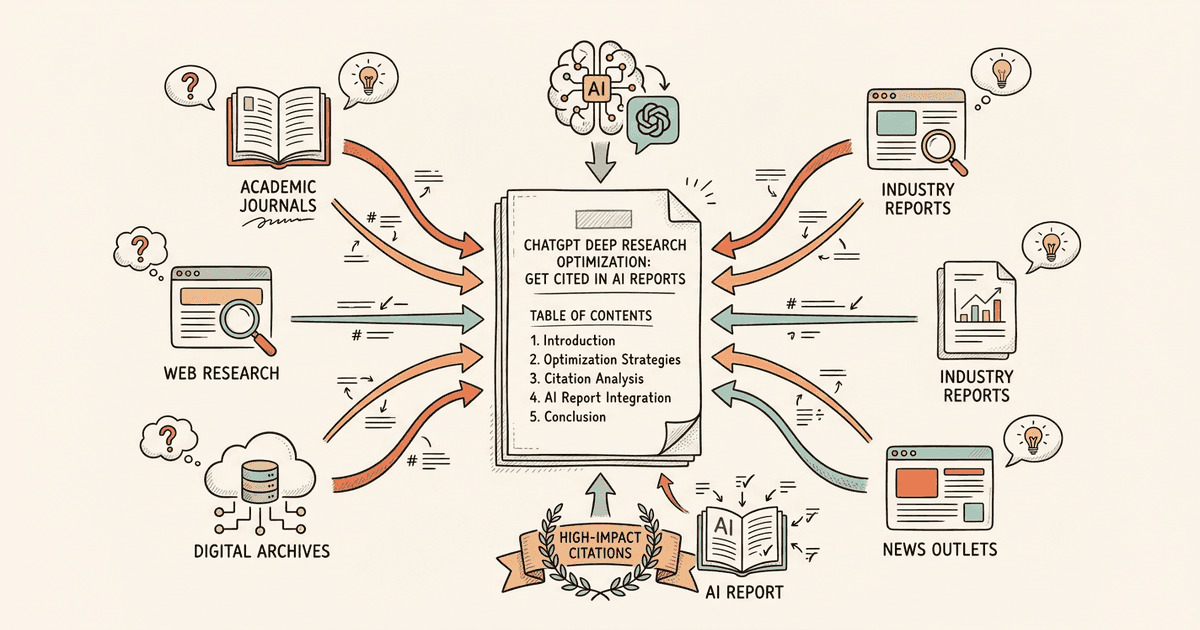
Deep Research runs an autonomous multi-step research cycle, proposing a plan, browsing hundreds of sources over 5-30 minutes, and generating a structured report with inline citations.
Here's how a session actually starts. A user submits a query. Deep Research proposes a detailed research plan, and the user approves or adjusts it before anything runs. It's collaborative and agentic, not instant.
The system then autonomously browses the web for 5 to 30 minutes using web_search, file_search, MCP servers, and a code interpreter. Multi-step reasoning lets it pivot based on what it finds. Being discovered at step 15 in the research chain matters. Your content can surface at any point, not just from the initial query.
As results come in, the agent formulates new queries, evaluates what it's found, throws out irrelevant pages, and drills deeper into promising domains. It won't write a single word of the final output until it's completed the entire research chain.
What comes out the other end is a structured report with a table of contents, inline citations, and proper section headings. Users can save it to a library, share a link, or export as PDF. The system is powered by GPT-5.2, upgraded from o3 in February 2026.
Standard ChatGPT optimization falls short here. The agentic workflow evaluates content differently than a simple semantic search. But a recent update made the gap even wider.
What Changed in the February 2026 Deep Research Update?
See where you rank in ChatGPT's answers.
Enter your domain and we'll scan your ChatGPT citation rate across your highest-value queries.
Prefer to talk? Book a free 30-min call
Three features launched: a "Sites" dropdown for trusted domains, MCP server integration for authenticated data sources, and real-time progress tracking with redirect capability.
The Sites dropdown lets users restrict Deep Research to specific trusted domains. Being on someone's curated list is a new form of AI citation. Think of it as the bookmarks of AI research, if your site is on the list, you get cited repeatedly. Users build custom domain lists and apply them to future research tasks. This creates a closed ecosystem where only approved domains get visibility.
MCP server integration connects enterprise data sources directly. Confluence, Notion, and internal databases become searchable. Think of MCP as giving Deep Research access to a company's private knowledge base. An analyst can command the agent to compare public pricing pages with internal RFP documents. The agent blends public and private data into one report.
Real-time progress tracking shows which queries execute, which sites get visited, and what data is extracted. Users can redirect the research mid-stream if the agent heads down an irrelevant path.
These features create optimization vectors that didn't exist before February 2026. Standard ChatGPT optimization can't account for user-curated trusted lists or authenticated enterprise data access.
What Gets Cited in Deep Research vs Regular ChatGPT?
Deep Research cites hundreds of sources per report in a structured, exportable format. Regular ChatGPT cites 3 to 6 sources in ephemeral conversation threads that vanish after the session.
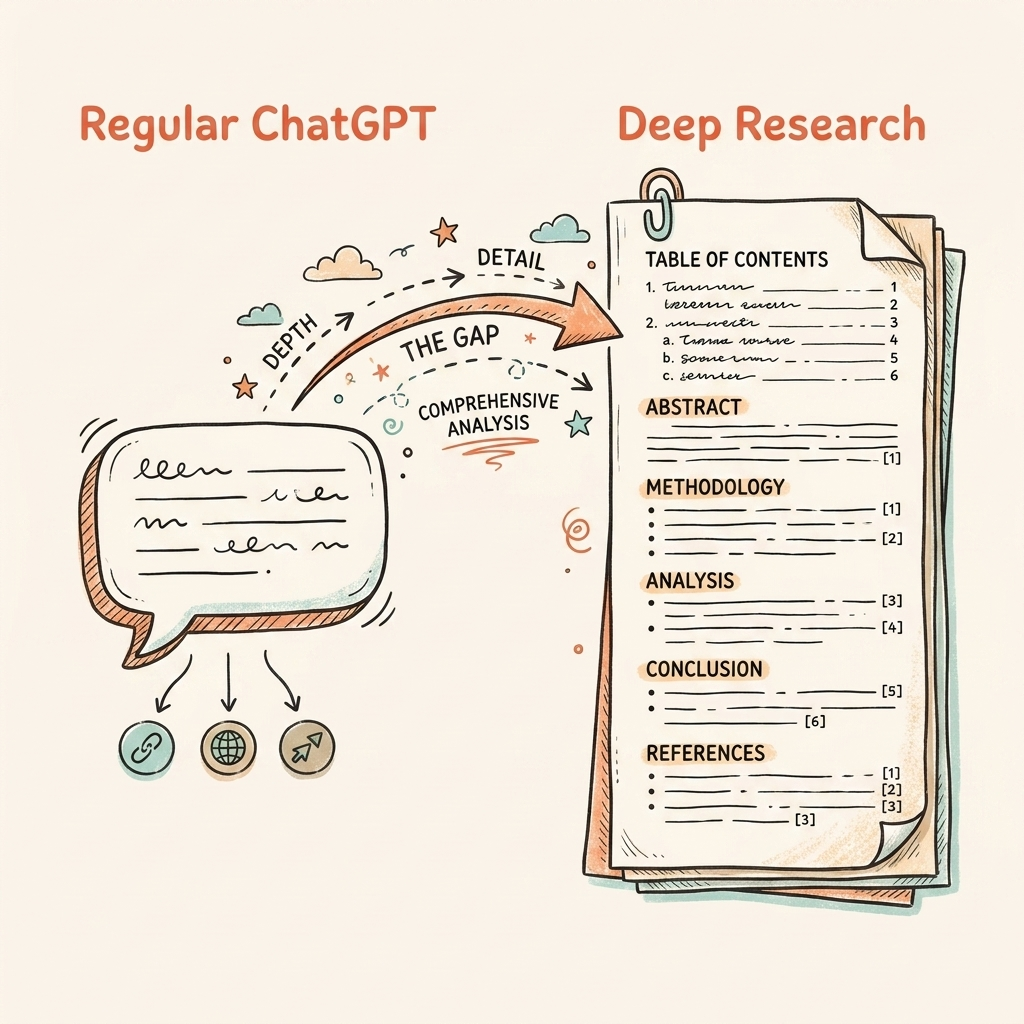
| Dimension | Regular ChatGPT | Deep Research |
|---|---|---|
| Sources per response | 3 to 6 citations | Hundreds of sources |
| Citation format | Inline links in chat | Numbered inline citations with TOC |
| Research duration | Instant (seconds) | 5 to 30 minutes |
| Report durability | Ephemeral conversation | Exportable PDF, saved to library |
| Audience | Casual users, quick lookups | Analysts, researchers, executives |
| Content expectation | Conversational, accessible | Analyst-grade, methodology-transparent |
| Discovery method | Single query match | Multi-step reasoning chain |
| Model | GPT-4o / GPT-5 | GPT-5.2 (specialized) |
Here's what makes Deep Research reports so valuable: they compound. They get cited in presentations, forwarded over email, attached to proposals. One mention in a Deep Research report can reach more decision-makers than dozens of regular ChatGPT citations ever will.
Only 18% of ChatGPT conversations trigger web searches at all, according to Profound's analysis of 730K conversations. Deep Research triggers web searches for every query. It's research-first by design.
Getting cited by Perplexity requires understanding platform mechanics. The same rule applies here, you must treat Deep Research as its own distinct channel.
How Do You Optimize Content for Deep Research Citations?
Optimize for Deep Research by creating analyst-grade content with original data, structuring for passage extraction, maintaining freshness, building topical authority, and becoming Sites-list worthy.
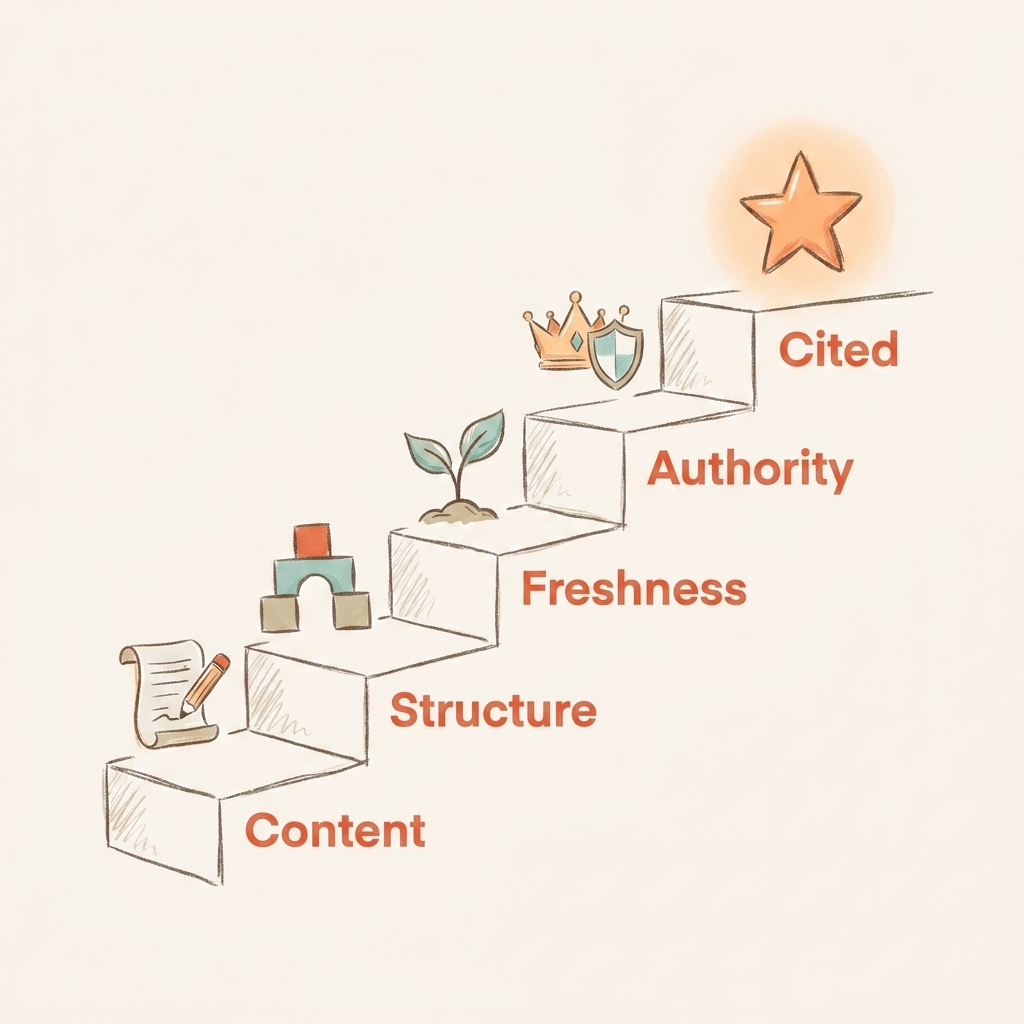
Step 1: Create Analyst-Grade Content
Deep Research users expect research-quality sources. Original data, methodology transparency, and statistical backing are non-negotiable. ZipTie data shows 72.4% of blog posts cited by ChatGPT contain identifiable answer capsules. These are structured, extractable passages.
Your content needs to read like something an analyst would actually put in a brief. Every claim needs a source. Closing the content quality gap in AI search means meeting real E-E-A-T for AI search standards. Tables and bullet points help. The easier you make the agent's job, the more likely it cites you.
Step 2: Structure for Passage Extraction
Deep Research queries different facets of a topic independently. Modular sections that answer specific sub-questions outperform long narrative blocks. AirOps data shows ChatGPT draws 44% of citations from the first third of articles.
Put the good stuff up top. Each H2 section should work as a standalone answer to a specific question. State your finding first, then back it up.
Step 3: Maintain a 30-Day Freshness Cadence
76.4% of ChatGPT's most-cited pages were updated within the last 30 days, per ZipTie's analysis. Deep Research performs real-time web retrieval, so stale content gets skipped.
Content updated within 30 days gets 3.2x more AI citations overall. Set a 30-day refresh cadence for your highest-value pages. A regular AI content audit keeps your material visible. Don't just change the publish date, add new statistics, update examples, and reflect current market data.
Step 4: Build Domain Authority in Your Niche
Mid-tier sites (DA 20-80) earn 63.6% of all ChatGPT citations, according to AirOps research. You don't need to be Wikipedia. But you need deep topical coverage.
Only 15% of pages ChatGPT retrieves actually get cited. The other 85% get evaluated and discarded. Authority isn't about aggregate DA score. It's about being the definitive source for your specific topic. Publish extensive content clusters around narrow subjects. The agent recognizes domains that thoroughly map a knowledge area.
Step 5: Become Sites-List Worthy
The Sites dropdown means users curate their own trusted source lists. Consistent quality and original data get you on those lists. Profound notes only 11% of domains overlap between ChatGPT and Perplexity citations. Platform-specific optimization matters.
Build the kind of site an analyst would bookmark. Kill the aggressive pop-ups. Make methodology pages easy to find. When a user adds your domain to their trusted list, you've locked in guaranteed visibility for every future research report they run.
How Does ChatGPT Deep Research Compare to Perplexity Deep Research?
ChatGPT Deep Research spends 5-30 minutes analyzing hundreds of sources with GPT-5.2. Perplexity Deep Research completes in 2-5 minutes with broader but shallower coverage and different source preferences.
| Dimension | ChatGPT Deep Research | Perplexity Deep Research |
|---|---|---|
| Speed | 5 to 30 minutes | 2 to 5 minutes |
| Depth | Hundreds of sources, multi-step reasoning | Broad coverage, faster synthesis |
| Model | GPT-5.2 | Proprietary (Sonar-based) |
| Source control | Sites dropdown + MCP servers | Collections + Focus modes |
| Top source preference | Wikipedia (47.9%) | Reddit (46.7%) |
| Citation format | Inline numbered citations | Inline numbered citations |
| Export | PDF, share link, library | Share link, Pages |
| Domain overlap | Only 11% of domains cited by both | , |
| Best for | Deep analysis, due diligence, strategy | Quick research, trend scanning |
The source hierarchies tell the story. Profound data shows ChatGPT pulling 47.9% from Wikipedia and institutional sources. Perplexity? It draws 46.7% from Reddit and community content. Completely different playbooks.
That's why getting cited by Perplexity requires a different content mix than what lands Deep Research citations.
Frequently Asked Questions About ChatGPT Deep Research Optimization
These are the most common questions brands ask about getting cited in ChatGPT Deep Research reports.
Does Deep Research use my website's data without permission?
It browses publicly available web pages, similar to how a search engine crawls. Nothing password-protected gets accessed unless someone explicitly connects it via MCP.
Your private data stays private unless a user deliberately sets up that connection.
How many sources does a typical Deep Research report cite?
Reports typically cite dozens to hundreds of sources, depending on topic complexity and research duration, with inline citations linking directly to each source URL.
Compare this to regular ChatGPT's 3 to 6 citations per conversation.
Can I track which pages get cited in Deep Research?
No direct notification system exists. Monitor referral traffic from chatgpt.com in your analytics and use AI visibility tools to measure citation frequency.
Tools like Wellows, ZipTie, and Profound track ChatGPT citations at scale.
Is Deep Research available to free ChatGPT users?
Deep Research is available to ChatGPT Plus, Team, Enterprise, and Edu users. Free users have limited or no access depending on current rollout phases.
The GPT-5.2 upgrade and Sites features are rolling out across paid tiers.
Does optimizing for regular ChatGPT also help with Deep Research?
To a degree. The basics carry over: content quality, freshness, authority signals. Those help everywhere. But Deep Research goes further. It rewards analyst-grade depth, passage-level structure, and the kind of credibility that earns a spot on someone's Sites list.
Think of regular ChatGPT optimization as the floor. Deep Research optimization is a different ceiling entirely.
Conclusion
- Deep Research is a distinct citation surface, not "ChatGPT but longer."
- The February 2026 Sites dropdown creates a new trusted source list vector with no existing playbook.
- Mid-tier sites earn 63.6% of ChatGPT citations. Topical authority matters more than domain score.
- Freshness is a primary signal. 76.4% of top-cited pages were updated in the last 30 days.
Your next step: Audit your top 5 pages for analyst-grade quality, passage extractability, and last-updated date. If any page hasn't been refreshed in 30+ days, update it this week.
We build AI visibility strategies that cover every citation surface, including Deep Research. See how we can help.
Related Reading
- Does llms.txt Actually Work?, real server-log data on what AI crawlers read vs. what drives actual citations
- AI Visibility Competitive Analysis, how to track which competitors are getting cited in Deep Research and identify the gaps you can fill
- Organic Traffic Decline 2026, why search clicks are falling and how Deep Research citations replace the traffic you are losing
See where your brand appears in AI search
Scan ChatGPT, Perplexity, and Google AI across buyer-intent queries, instantly, no sign-up.
Find out if AI is sending buyers to your competitors.
We audit your AI visibility across ChatGPT, Perplexity, and Google AI –and show you exactly where you rank and what to fix.
“We went from 200 visitors/day to 1,900 visitors/day and 40% of demos are from AI search.”
Sumanyu Sharma · CEO, Hamming.ai
“Cintra helped me go from 3k to 7.5k daily traffic and doubled weekly orders in 1.5 months.”
Russ Coulon · Owner, UV Blocker
“We saw a lift from 3% to 13% visibility in the first 2 weeks, and organic traffic hit its highest ever.”
Ash Metry · Founder, Keywords.am
Related Articles
Meta-ExternalAgent Took More Bandwidth Than 5 Crawlers Combined
Meta-ExternalAgent pulled 955 MB from cintra.run in 30 days, more than 5 AI and search crawlers combined. What…
Organic Traffic Decline 2026: Why It's Dropping and How to Recover
Organic traffic decline 2026 is real. AI Overviews cut clicks 38% on triggered queries. Here's what's causing…
AI Visibility Reporting: What to Track, Who to Tell, and How to Prove ROI
AI visibility reporting requires different metrics and formats than SEO reports. Learn the five core metrics,…