ChatGPT Shopping in 2026: What 22.5M Product Offers Reveal
ChatGPT shopping processes 50M daily queries. New research from 22.5M offers reveals which retailers dominate and what brands must do to get recommended.
TL;DR: The State of AI Shopping
- ChatGPT shopping processes 50 million product queries daily.
- The top 20 merchants control only about 40% of all product recommendations.
- Amazon is largely absent because it blocks OpenAI's crawlers.
- Product recommendations shuffle constantly across identical queries.
- Authoritative list mentions drive 41% of recommendation influence.
- Traditional SEO signals have near-zero impact on AI shopping visibility.
- Structured data markup is a strict technical prerequisite.
ChatGPT shopping processes 50 million queries every day across 900 million weekly active users. That's a retail channel bigger than most malls and marketplaces combined.
Most brands have zero visibility here. A fresh dataset of 22.5 million product offers reveals exactly why, and shows that everything brands assume about AI shopping is wrong.
This analysis breaks down which retailers dominate ChatGPT shopping, why the product carousel behaves nothing like search rankings, and what brands need to do differently to show up.
How Big Is ChatGPT Shopping in 2026?
The platform processes roughly 50 million product queries daily, backed by 900 million weekly active users and growing referral traffic to major retailers.
The scale of AI product discovery demands attention now. OpenAI reported 900 million weekly active users in February 2026. About two percent of all prompts are shopping-related, which translates to 50 million shopping queries every day. The AI search statistics guide pulls together 30+ verified data points on ChatGPT's growth, conversion rates, and citation behavior. Mastering AI search optimization for ecommerce starts with understanding this scale.
These numbers translate into real referral traffic. Walmart gets 20 percent of its referral traffic from ChatGPT. Etsy sees similar numbers, with over 20 percent of referrals coming from AI recommendations. Target captures about 15 percent of referral volume from the platform.
The growth trajectory matters even more. ChatGPT shopping traffic grew 1,079 percent through 2025, with average session volume per site jumping from 1,544 to 18,202. The shift from traditional search to AI discovery is picking up speed.
But where does all that shopping traffic actually go?
Which Retailers Dominate ChatGPT Shopping?
See where you rank in ChatGPT's answers.
Enter your domain and we'll scan your ChatGPT citation rate across your highest-value queries.
Prefer to talk? Book a free 30-min call
Walmart captures 8.78% of headline product offers and Target takes 4.93%, but the top 20 merchants combined control only about 40% of all recommendations.
Profound analyzed 22.5 million buy offers over ten days in March 2026, establishing "shopping offer rate" as a new metric. The data maps which domains capture recommendation slots.
Walmart leads with 8.78 percent of all headline, rank-one offers. Target follows at 4.93 percent of headline offers and 7.16 percent total presence across all recommendation carousels. Both retailers have adapted well for AI crawlers.
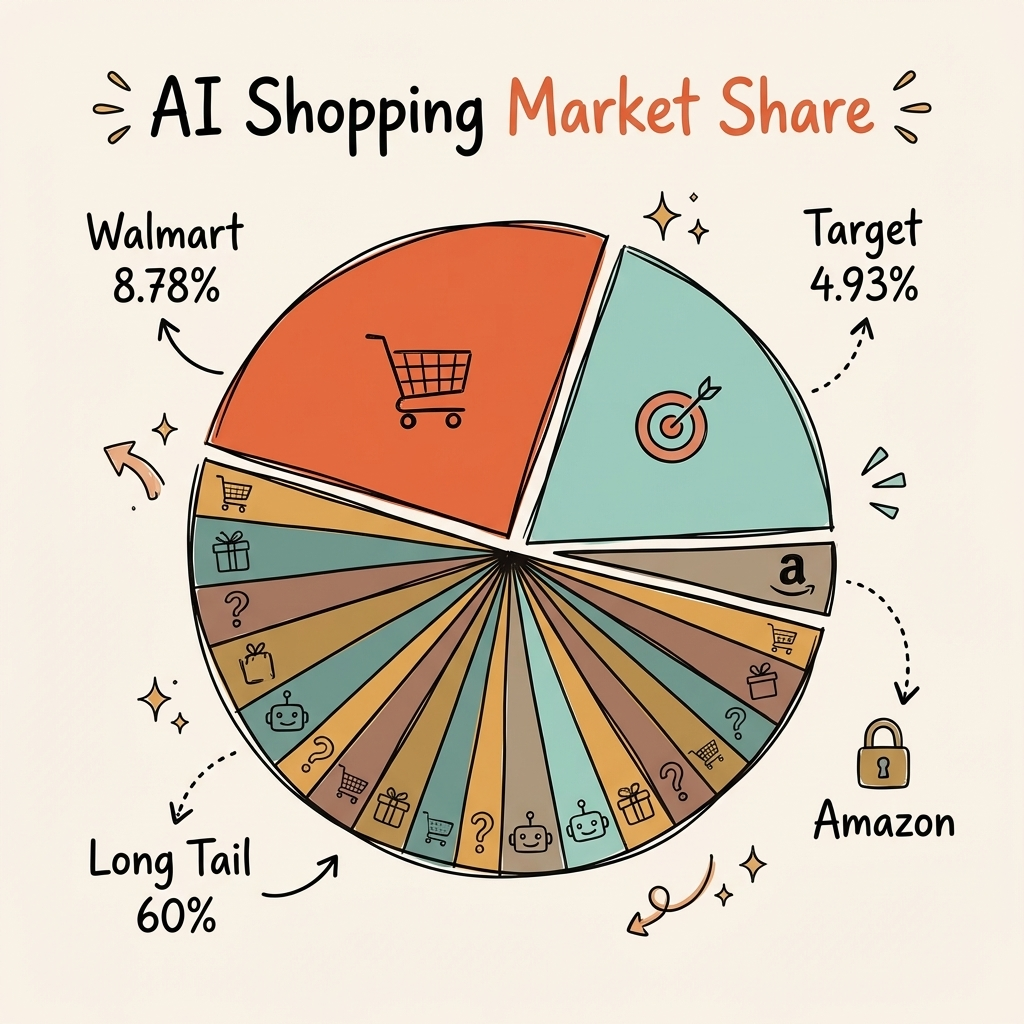
Amazon tells a different story. The world's largest e-commerce platform is underrepresented in AI shopping results because it blocks OpenAI's web crawler, OAI-SearchBot. That decision renders Amazon's catalog largely invisible in AI product discovery. It also creates a real opening for competitors who prioritize machine readability.
The most surprising finding? The top 20 merchants control only about 40 percent of all offers. The remaining 60 percent is spread across thousands of smaller retailers and direct-to-consumer brands.
| Retailer | Headline (Rank-1) Offers | Total Presence |
|---|---|---|
| Walmart | 8.78% | ~12% |
| Target | 4.93% | 7.16% |
| Amazon | Low (blocks OAI-SearchBot) | Declining |
| Top 20 combined | ~40% | ~40% |
| Long tail (thousands) | ~60% | ~60% |
These numbers tell part of the story. But they hide something even more surprising about how ChatGPT selects products.
Why Is ChatGPT Shopping a Shuffle, Not a Ranking?
AI product recommendations rotate across identical queries rather than ranking them. Roughly 95% of product titles appear in fewer than 30% of runs for the same prompt.
Brands assume AI shopping works like traditional search, where you climb a set of rankings. The Profound dataset completely breaks that mental model. The AI shopping interface operates as a constant shuffle. 95 percent of product titles appeared in fewer than 30 percent of runs for the exact same prompt. You can't lock down position one and hold it.
Only 0.5 percent of products achieved 70 percent or higher consistency across identical queries. The interface typically shows a median of five products per response, and 65 percent of queries return a tight carousel of four to six products. You're competing for a handful of spots that change every time. Understanding E-E-A-T for AI search helps explain why the rotation happens.
Traditional SEO signals have near-zero influence here. Building thousands of backlinks won't help products enter the carousel. Domain authority provides no moat against smaller competitors. The algorithms don't care about keyword density or site architecture, according to Onely's research on AI recommendation signals. The old playbooks don't apply.
If rankings don't matter, what actually determines whether a product enters the rotation?
What Makes ChatGPT Recommend One Product Over Another?
ChatGPT prioritizes authoritative list mentions (41% of influence), awards and accreditations (18%), and third-party reviews (16%) over traditional SEO signals.
Onely's research quantified the signals driving AI recommendations. Authoritative list mentions account for 41 percent of total recommendation influence. That means appearing in "best of" lists, expert roundups, and respected industry rankings. Awards and accreditations drive another 18 percent. Online reviews contribute 16 percent, with products needing at least 50 reviews at a 4.0 or higher rating on platforms like G2, Capterra, or Trustpilot.
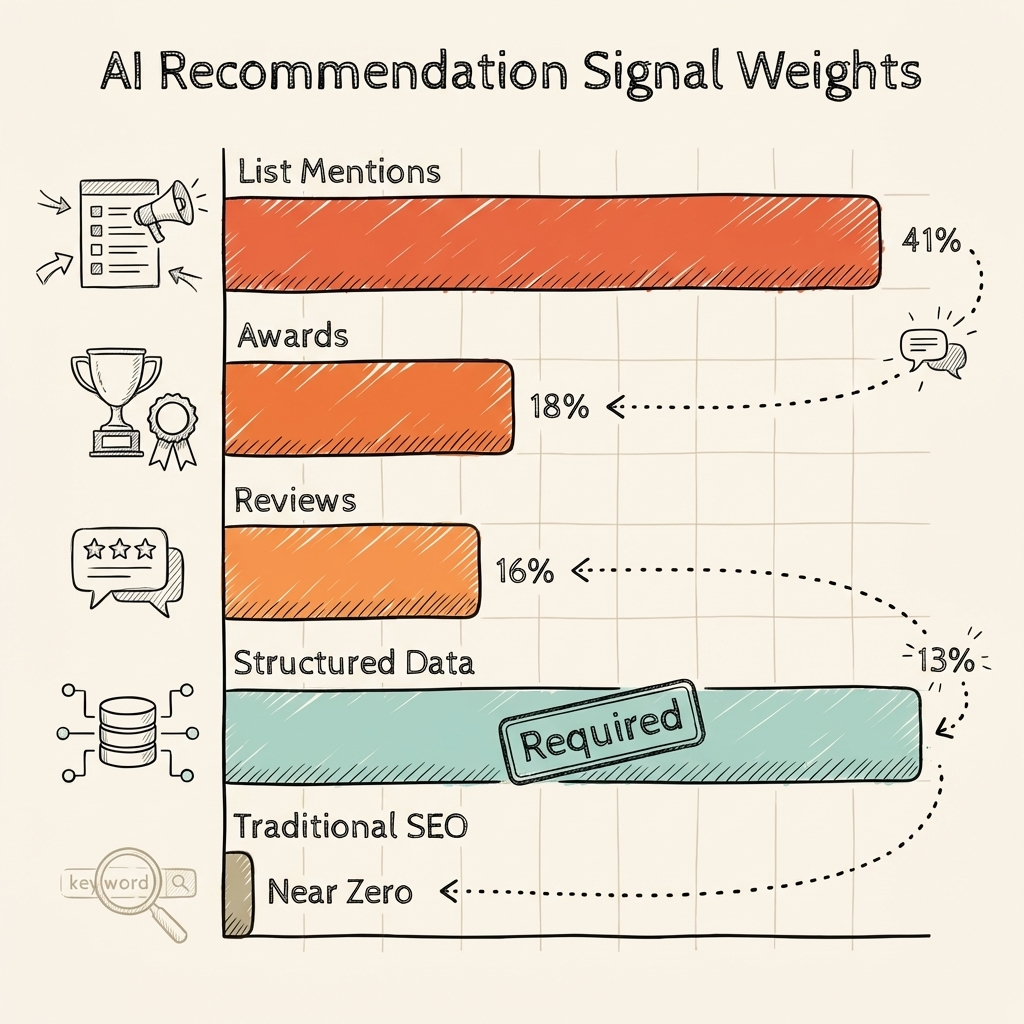
Technical prerequisites form the foundation. Brands must implement structured product data using schema.org/Product markup. This code declares brand, price, availability, ratings, and product variants. Machine-readability determines survival through the selection process. The guide on how to get recommended by ChatGPT covers the foundational markup in detail.
Content freshness acts as a multiplier on top of authority signals. 31 percent of AI citations come from content published in 2025. Content updated within 30 days receives 3.2 times more citations than older material. A product page published once and never touched won't perform for long.
| Signal | Influence Weight | What It Means |
|---|---|---|
| Authoritative list mentions | 41% | Appear in "best of" lists and expert roundups |
| Awards & accreditations | 18% | Industry recognition and certifications |
| Third-party reviews | 16% | 50+ reviews at 4.0+ on platforms like G2, Capterra |
| Structured product data | Required | schema.org/Product markup is a prerequisite |
| Content freshness | Multiplier | Updated content within 30 days gets 3.2x more citations |
| Traditional SEO (backlinks, DA) | Near-zero | Backlinks don't drive AI recommendations |
Understanding the signals is one thing. Acting on them is another. Here's what brands should do this quarter.
How Can Brands Get Into ChatGPT Shopping Results?
Brands need crawlable product pages, structured data markup, third-party authority signals, and a product feed strategy to appear in AI shopping results.
Step 1: Unblock OAI-SearchBot in your robots.txt. Amazon's visibility gap proves what happens when you block OpenAI's crawler. This is the single most urgent action any ecommerce brand can take today.
Step 2: Implement schema.org/Product structured data across every product page. Populate brand, price, availability, ratings, and variants fields. We help brands build the AI visibility that drives product recommendations through data monitoring, content strategy, and structured data optimization.
Step 3: Build third-party authority. Get products featured on independent "best of" lists and expert roundups. This is the highest-leverage activity at 41 percent of recommendation influence. Earn reviews on trusted platforms, and pursue relevant industry awards and accreditations.
Step 4: Submit product feeds via the Agentic Commerce Protocol (ACP). Major retailers are already connected through this open standard from OpenAI and Stripe. Shopify integration is rolling out, which will bring over a million merchants into the ecosystem. PayPal's ACP server will add tens of millions more.
Step 5: Monitor AI shopping visibility. Track how often your products appear across AI shopping queries. We show you exactly where you stand. The AI visibility playbook outlines how to track these metrics over time. Agentic observability is the new standard for digital growth.
The brands that move now will compound their advantage as AI-powered shopping scales.
Frequently Asked Questions About ChatGPT Shopping
These are the most common questions brands ask about AI-powered product discovery based on the latest data and platform updates.
Does ChatGPT Shopping charge brands for placement?
No. The platform has no ads, no sponsored placements, and no affiliate links. Product recommendations are entirely organic.
OpenAI states that recommendations aren't paid or artificially boosted. Third-party authority signals and structured data are the only real levers for visibility. You can't buy your way to the top of the carousel.
Can small brands compete with Walmart and Target in ChatGPT Shopping?
Yes. The top 20 retailers control only about 40% of offers, leaving 60% of the carousel for smaller and mid-market brands.
The shuffle dynamic means no single retailer locks out competitors. Brands with strong reviews, list mentions, and clean structured data regularly appear alongside major retailers.
Why doesn't Amazon show up more in ChatGPT Shopping?
Amazon blocks OpenAI's web crawler (OAI-SearchBot), which limits its product data availability for AI shopping recommendations.
This is one of the clearest examples of how technical crawlability directly impacts AI shopping visibility. Even the largest market share can't overcome a blocked crawler.
How does ChatGPT Shopping differ from Google Shopping?
Google Shopping ranks products by bids and relevance scores. the AI alternative rotates products in a shuffle pattern with no paid placement.
The carousel shows a median of five products per query, and 95 percent of products appear in fewer than 30 percent of runs for identical prompts. Traditional SEO and bidding strategies don't apply.
What is the Agentic Commerce Protocol (ACP)?
ACP is an open standard from OpenAI and Stripe that connects merchant product catalogs directly to ChatGPT for discovery.
Partners include Target, Sephora, Nordstrom, Best Buy, Wayfair, and Walmart. Shopify integration will bring over a million merchants into the ecosystem. Brands submit feeds via SFTP in Parquet or compressed formats.
Conclusion
AI-powered product discovery has moved past the experimental stage. The data paints a clear picture. April 2026 data from Profound confirms the carousel shuffle rate has stabilized: brands with consistent schema markup, fresh reviews, and authoritative list mentions now achieve 2.3x more recommendation appearances than brands relying on traditional SEO signals alone.
- 50 million queries daily. This is a real retail channel, not a feature demo.
- The carousel shuffles, it doesn't rank. Traditional SEO thinking doesn't apply here.
- Third-party authority drives 75 percent of recommendation influence. List mentions, reviews, and industry awards matter most.
- The technical bar is simple but mandatory. Unblock the OpenAI crawler and add structured data.
Check your robots.txt file for OAI-SearchBot today. If it's blocked, your catalog is invisible to 900 million users. See how visible your products are to AI shoppers with Cintra's visibility scanner.
See where your brand appears in AI search
Scan ChatGPT, Perplexity, and Google AI across buyer-intent queries, instantly, no sign-up.
Find out if AI is sending buyers to your competitors.
We audit your AI visibility across ChatGPT, Perplexity, and Google AI –and show you exactly where you rank and what to fix.
“We went from 200 visitors/day to 1,900 visitors/day and 40% of demos are from AI search.”
Sumanyu Sharma · CEO, Hamming.ai
“Cintra helped me go from 3k to 7.5k daily traffic and doubled weekly orders in 1.5 months.”
Russ Coulon · Owner, UV Blocker
“We saw a lift from 3% to 13% visibility in the first 2 weeks, and organic traffic hit its highest ever.”
Ash Metry · Founder, Keywords.am
Related Articles
Organic Traffic Decline 2026: Why It's Dropping and How to Recover
Organic traffic decline 2026 is real. AI Overviews cut clicks 38% on triggered queries. Here's what's causing…
AI Visibility Reporting: What to Track, Who to Tell, and How to Prove ROI
AI visibility reporting requires different metrics and formats than SEO reports. Learn the five core metrics,…
AI Visibility Competitive Analysis: How to Find and Exploit Gaps in 2026
AI visibility competitive analysis across ChatGPT, Perplexity, and 5 other engines. Framework for tracking com…