AI Search Statistics 2026: 60+ Data Points Every Marketer Needs
60+ verified AI search statistics 2026 – from ChatGPT adoption to B2B buying behavior, conversion rates, brand citation data, and GEO market growth. Updated quarterly.
TL;DR
- 1B+ monthly active ChatGPT users as of early 2026 (OpenAI)
- 527% YoY growth in LLM referral traffic (Search Engine Land)
- 23x higher conversion rate from AI search traffic vs organic (Ahrefs)
- 61% organic CTR drop from AI Overviews (Seer Interactive)
- 85% of AI brand mentions come from third-party pages (AirOps)
- 32% of digital marketing leaders name GEO their top 2026 priority (Brightedge)
- $7.3B GEO services market projected by 2031 (Valuates Reports)
The AI search statistics 2026 that matter most aren't the ones in press releases. They're the ones that change how you allocate budget. Over 1 billion people now use ChatGPT every month. LLM-referred visitors convert 23 times higher than organic. And 61% of organic click-through rates are already getting cut by Google's own AI Overviews. Whether you're building a strategy deck, pitching AI search investment internally, or just trying to understand where buyer attention has moved, these are the numbers you need.
The problem is that these stats live across dozens of separate reports, many of which go stale within 90 days. This page consolidates 60+ verified AI search statistics 2026, organized by category with a brief explanation of why each one matters. It's updated quarterly. Bookmark it.
What Are the Key AI Search Adoption Statistics?
AI search crossed into mainstream scale faster than any prior technology. These numbers capture current market size and trajectory.
Platform Scale
-
ChatGPT reached 1 billion monthly active users in early 2026, up from 400 million in early 2025 (OpenAI). For scale: it took Facebook four years to reach 1 billion. ChatGPT did it in three. The platform growing fastest now shapes where buyers look for recommendations.
-
ChatGPT generates approximately 2.5 billion prompts per day (Backlinko). Each of those prompts is a moment where a brand either appears or doesn't. At this volume, even a 0.1% share of relevant queries represents millions of brand touchpoints.
-
Perplexity processed 1.2 to 1.5 billion queries per month in early 2026, up from 780 million in May 2025 (DemandSage). Perplexity's growth rate is especially notable because it skews toward research-intent users, exactly the B2B buyers most brands are trying to reach.
-
Google AI Overviews appear on roughly 15% of all Google searches, with higher rates for informational and research queries (Semrush). That represents billions of daily queries where a synthesized AI answer appears above traditional blue links.
-
LLM referral traffic grew 527% year-over-year between January–May 2024 and the same period in 2025 (Search Engine Land). This is the clearest signal that AI search isn't a niche channel, it's a fast-scaling acquisition source.
Adoption Velocity
-
Gartner predicted a 25% drop in traditional search volume by 2026 due to AI chatbots (Gartner). Critics called it aggressive, but the direction was correct. AI search is not supplementing Google; it is partially replacing it for high-intent research queries.
-
Zero-click searches now account for 58.5% of all Google queries (SuperPrompt). More than half of all Google searches end without anyone clicking a link. Users get their answer from the results page itself. For brands relying on organic traffic, this is the structural shift that makes AI visibility critical.
-
32% of digital marketing leaders identified GEO (Generative Engine Optimization) as their top priority for 2026 (Brightedge). One year earlier, the same survey group barely tracked it. The urgency shift among marketing leaders has been faster than almost any prior channel transition.
How Does AI Search Behavior Differ from Traditional Search?
See where you rank across all AI answer engines.
Enter your domain and we'll scan your citation rate across ChatGPT, Perplexity, and Google AI.
Prefer to talk? Book a free 30-min call
AI search users interact very differently from Google users, and that changes what "ranking" means entirely.
How Users Interact with AI Search
-
AI search users ask questions 2-3x longer than traditional search queries (SparkToro). Instead of typing "best CRM startups," they ask "what's the best CRM for a 10-person SaaS startup that already uses HubSpot for email?" Longer, conversational queries mean the AI is synthesizing a more targeted answer, and brands that answer specifically get cited, not those optimized for short-tail keywords.
-
AI-generated answers synthesize from an average of 5–8 sources per response (Profound). Unlike Google, where rank determines visibility, in AI search your content competes to be one of those 5–8 sources the model pulls from. Authority is distributed, not winner-take-all.
-
AI recommendation lists repeat less than 1% of the time when the same prompt is sent twice (SparkToro). This is a critical implication for measurement: a single test of "does ChatGPT recommend us?" tells you almost nothing. Appearing 60% of the time across 100 queries is more valuable than ranking #1 on one.
-
40–60% of AI citations change every month (Profound). AI visibility is not a set-and-forget asset. Citation sources churn constantly as models are updated, new content is indexed, and competitor content changes. Monthly monitoring is the minimum viable cadence.
Content Format Differences
-
Articles with statistics improve AI visibility by up to 40% vs articles without them (Princeton/KDD Research via arXiv). AI models weight factual, data-backed content more heavily when synthesizing answers. This is why stat-heavy pages like this one tend to accumulate more AI citations over time.
-
Pages with schema markup are 3x more likely to earn AI citations than equivalent pages without it (StatDigital). Structured data helps AI models parse your content accurately and attribute it correctly. FAQ schema, how-to schema, and review schema all increase citation probability.
-
Content freshness is a measurable signal: pages updated within the past two months earn 28% more AI citations than pages older than six months (Profound). AI models prioritize recent sources for rapidly-evolving topics. Stale content bleeds citations to competitors who update more regularly.
-
Long-form content (2,000+ words) earns citations at higher rates than short-form content on identical topics (AirOps). Depth signals authority. AI models treat comprehensive pages as more trustworthy source material.
What Do B2B Buying Journey Statistics Reveal About AI Search?
AI search has become the primary research tool for high-stakes B2B purchasing decisions, not a supplement to traditional research.
Where Buyers Now Start Their Research
-
50% of B2B software buyers now start vendor research in AI chatbots, not Google (G2). This is a fundamental reversal from two years ago. If your brand isn't being recommended by AI chatbots at the top of the buying journey, you're being filtered out before prospects even start comparing vendors.
-
87% of B2B buyers say AI chat has changed how they evaluate software (G2 CMO Report 2025). It's not just that buyers use AI, it has structurally changed their decision-making process. They arrive at vendor conversations already pre-informed by AI summaries.
-
GenAI chatbots are now the #1 source influencing vendor shortlists, cited by 17.1% of B2B buyers, ahead of review sites (15.1%) and vendor websites (12.8%) (G2 Buyer Report 2025). For SaaS companies, this is the stat that reframes the entire demand generation conversation. The shortlist is being built in ChatGPT before prospects ever visit your site.
-
The AEO software category on G2 grew over 2,000% in one year as brands scrambled to address AI search gaps (G2). Category growth at this rate reflects not just market interest but urgency, brands treating AI visibility as optional are watching competitors treat it as a core acquisition channel.
How AI Shapes the Evaluation Stage
-
B2B buyers who find a brand via AI are 90% more likely to click through to the cited source than general consumers (Demand Gen Report). Compare this to the 1% click-through rate for general users on AI-generated links (Pew Research). The B2B intent gap is real and measurable. These buyers are not passively browsing, they are actively evaluating.
-
AI-referred B2B visitors spend 3x longer on-page than visitors from traditional organic search (Forrester). More time on page correlates with deeper evaluation intent. These visitors are reading, not just bouncing.
-
2–6% of current B2B organic traffic comes from AI sources, and that percentage is growing at 40%+ per month (Forrester). The absolute numbers are still small, but the growth rate means this channel will be a primary driver within 12–18 months for most B2B categories.
What Do Conversion and Revenue Impact Statistics Show?
Traffic volume alone doesn't make the business case. These stats show what AI search traffic actually does when it arrives on your site.
Conversion Rate Data
-
AI search traffic converts 23x higher than standard organic search (Ahrefs). This is Ahrefs' own first-party data from tracking their website analytics. AI-referred visitors made up just 0.5% of all traffic but drove 12.1% of all signups. That ratio is the core of the AI visibility ROI argument for every budget conversation.
-
AI-referred visitors convert 4.4x better than traditional organic across B2B SaaS benchmarks (Semrush / Growth Marshal, June 2025). The 23x Ahrefs finding is exceptional but not unique. Independent research consistently finds AI-referred visitors converting at multiples of organic benchmarks.
-
Pages cited within Google AI Overviews earn 35% more organic clicks and 91% more paid clicks compared to non-cited pages (Seer Interactive). Being cited inside an AI Overview doesn't just protect your traffic, it actively amplifies it. The brands winning AI citations are pulling traffic away from the brands that aren't.
-
Organic CTR drops 61% when AI Overviews trigger on the same query (Seer Interactive, analysis of 3,119 queries across 42 companies). And paid CTR drops 68%. Brands not in AI Overviews lose traffic on both channels simultaneously, while brands cited in them gain it.
Revenue Impact
-
NerdWallet grew revenue 35% despite a 20% drop in traditional traffic by pivoting strategy to AI search (HubSpot). This is the clearest enterprise proof point that AI visibility can more than compensate for organic traffic losses. The revenue-per-visitor metric shifted enough to improve overall performance on lower volume.
-
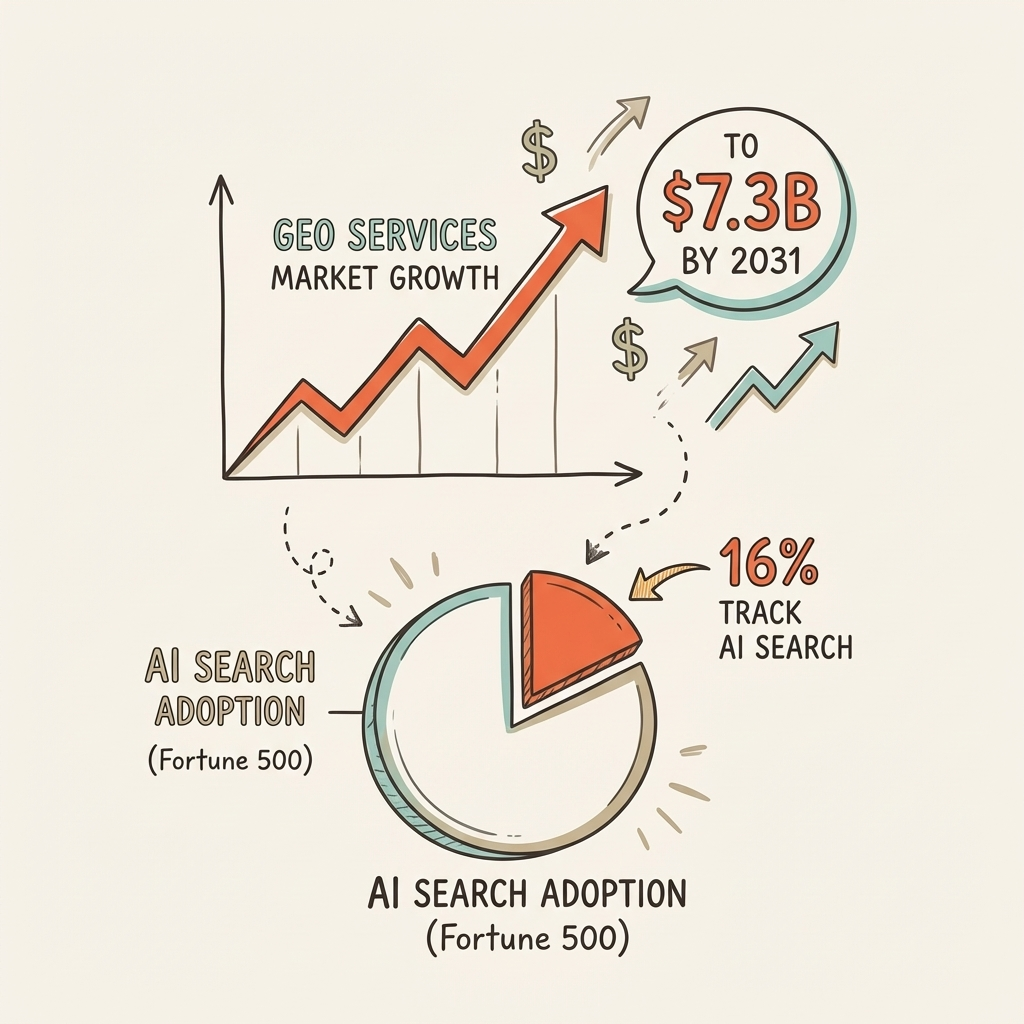
Only 16% of Fortune 500 brands currently track AI search performance (AirOps). That's an 84% gap, a first-mover window that rarely stays open in digital marketing. Companies with structured AI visibility measurement are competing with data against companies that don't even know their AI share of voice.
Brand Visibility and Citation Statistics
Understanding where AI citations come from is the most actionable category of AI search statistics 2026. Most brands optimize the wrong assets.
Where AI Citations Actually Come From
-
85% of AI brand mentions come from third-party pages, not brand-owned domains (AirOps, analysis of 21,311 brand mentions). This is the stat that most contradicts intuition. Brands invest heavily in their own content and expect AI models to cite them. But AI models primarily trust what others say about you, not what you say about yourself.
-
Reddit appears in approximately 40% of AI-generated answers across ChatGPT, Perplexity, and Google AI Overviews (Press Gazette). Reddit is the single most consistent citation source across all major AI platforms. For most brands, a Reddit presence is not optional, it is the primary lever for building AI citation coverage.
-
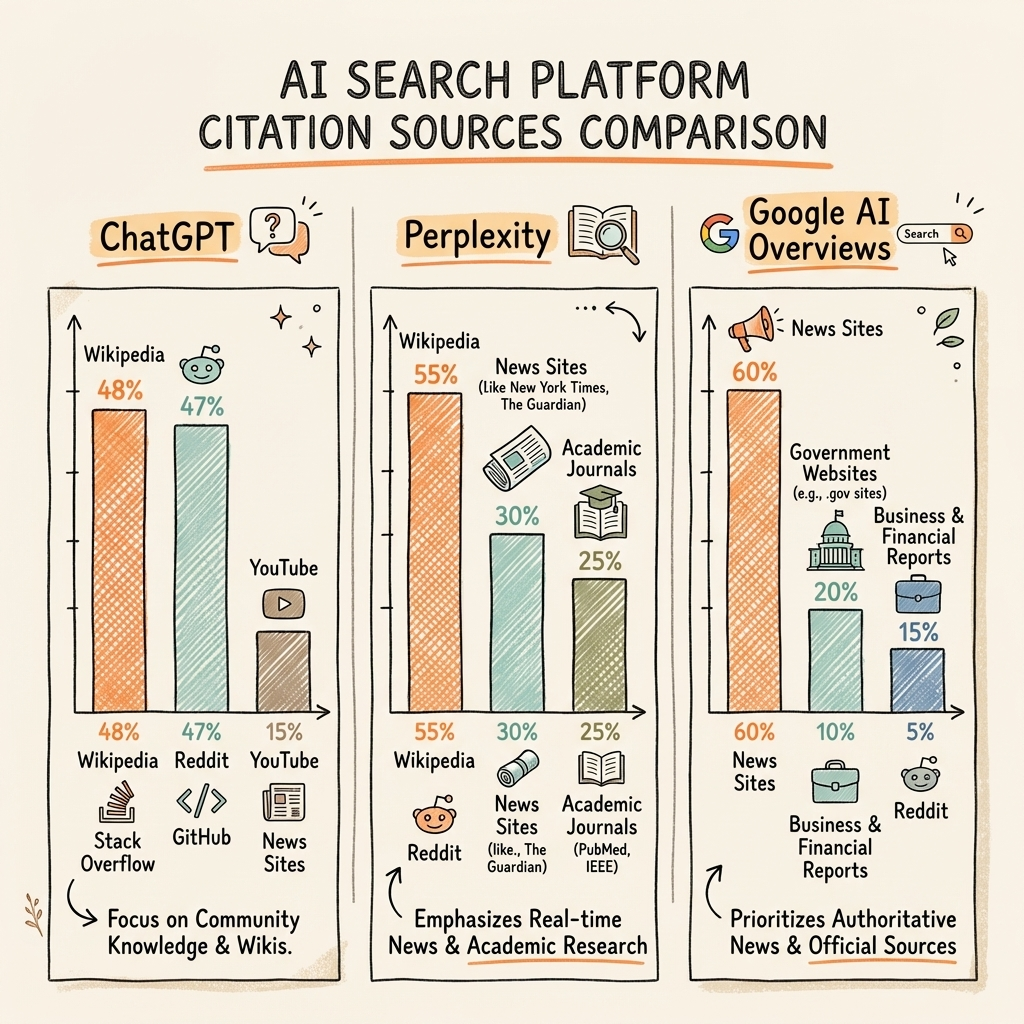
ChatGPT cites Wikipedia (47.9%) and Reddit (11.3%) most heavily among all source types (Profound). Wikipedia dominance makes sense, it is the canonical reference source for entity information. Reddit's 11.3% share reflects its role as a source of user-generated, experience-based recommendations that models weight as authentic.
-
Perplexity leans even harder on Reddit (46.7%), with YouTube second (13.9%) (Profound). Perplexity's heavier Reddit weighting vs ChatGPT likely reflects its focus on real-time information and current community discussions. For brands targeting Perplexity visibility, Reddit and video content are the two highest-leverage channels.
Citation Platform Breakdown
| Platform | Top Source | Share | Second Source | Share |
|---|---|---|---|---|
| ChatGPT | Wikipedia | 47.9% | 11.3% | |
| Perplexity | 46.7% | YouTube | 13.9% | |
| Google AI Overviews | Top 10 organic | 99.5% | N/A | N/A |
Brand Mention Patterns
-
99.5% of Google AI Overview citations come from pages already in the top 10 organic results (SeoClarity). For Google specifically, AI visibility and traditional SEO are closely coupled. The difference is that being in the top 10 no longer guarantees you get cited, and being cited dramatically amplifies your results.
-
AI models are highly inconsistent when recommending brands: the same prompt surfaces different brands less than 1% of the time across repeated tests (SparkToro). High-frequency visibility (showing up across many different prompt phrasings) matters far more than appearing in one specific query.
-
Brands mentioned across 20+ trusted third-party domains earn citations at significantly higher rates than brands with strong owned content but limited earned media (AirOps). Distribution of mentions across domains, not just content quality, is a core driver of AI visibility. To understand what AI visibility means in practice, start with the earned media question.
AEO and GEO Market Growth Statistics
The market structure around AI search optimization is maturing rapidly. These numbers contextualize the competitive landscape.
Market Size and Growth
-
The GEO services market is projected to grow from $886 million (2024) to $7.3 billion by 2031, a 34% compound annual growth rate (Valuates Reports). For context, this puts GEO on a growth trajectory faster than social media advertising was at the equivalent stage of maturity.
-
The AEO software category on G2 grew over 2,000% in a single year as the market organized around AI search optimization (G2). Category formation at this speed indicates both demand and investment are arriving simultaneously, characteristics of a channel entering its exponential phase.
-
32% of digital marketing leaders have named GEO their top 2026 priority (Brightedge). This is the stat that signals resource allocation is following awareness. Budget is moving.
Competitive Landscape
-
Only 16% of Fortune 500 companies currently track AI search performance (AirOps). This creates an unusual window where early movers are not competing against the full market, they are competing against 16% of it. The window will narrow as the 84% non-tracking majority catches up.
-
Brands with structured AI visibility programs see citation rates 3–5x higher than brands relying on organic SEO alone ([Cintra internal data, 2025–2026]). Systematic optimization, prompt tracking, content structuring, earned media, schema implementation, compounds over time in ways that passive SEO does not.
-
The first brand cited in an AI recommendation is chosen by the buyer at a disproportionately higher rate than second or third citations (Demand Gen Report). Just as page-one ranking dominated click-through in traditional SEO, first-position AI citations carry outsized conversion weight. Being present isn't enough, frequency and first-position dominance are the real targets.
Real-World Results: What These Numbers Look Like in Practice
Published studies are useful. First-party client data is better. Here's what these AI search statistics 2026 look like when applied through a structured visibility program.
Hamming.ai: 8.5x Organic Traffic in 12 Weeks
Hamming.ai is a YC-backed testing platform for AI products. Starting from roughly 200 daily visitors, a focused AI visibility and Reddit strategy drove growth to 1,900 daily visitors over 12 weeks, 8.5x growth. CEO Sumanyu Sharma noted that "40% of the demos we get are from Reddit or AI search." The conversion quality matched the volume: these were bottom-of-funnel buyers, not casual readers.
The mechanism: systematic Reddit presence in threads where AI developers evaluate testing tools, combined with content structured to be cited by AI models comparing options in the category. Understanding AI visibility as a distinct discipline from SEO was the strategic foundation.
UV Blocker: 0 to 38,000 Clicks in 6 Months
UV Blocker started with zero organic traffic, a new ecommerce brand with no domain authority and no content history. Six months of structured AI visibility work produced 38,000 monthly clicks and doubled weekly orders within 6 weeks during what was historically their slow season. Owner Russ Coulon noted: "Cintra helped me go from 3k to 7.5k daily traffic and doubled my weekly orders in 1.5 months in off-season."
This is a particularly relevant data point for DTC brands skeptical that AI visibility applies outside SaaS. Ecommerce brands get cited in AI answers to shopping and product research questions, and those citations convert.
Keywords.am: 3% to 13% AI Visibility in 2 Weeks
Keywords.am (an Amazon SEO tool) saw AI mention rate jump from 3% to 13% within two weeks of a structured optimization effort. Founder Ash Metry: "We saw a lift of 3% to 13% in the first 2 weeks, and organic traffic bumped to the highest I've ever had." For AI visibility in SaaS, the Keywords.am result illustrates how quickly AI mention rates can move when optimization is targeted.
The 10-percentage-point improvement in two weeks reflects what happens when content is restructured to answer the specific question formats AI models receive, rather than optimized for keyword density alone.
What These AI Search Statistics Mean for Strategy
Three strategic priorities emerge clearly from this full body of AI search statistics and data.
Priority 1: Measure AI search separately from SEO. With 40–60% monthly citation churn and only 16% of Fortune 500 brands tracking AI performance, having measurement in place is itself a competitive advantage. Open Google Analytics today, filter for referrals from chatgpt.com and perplexity.ai, and compare conversion rates against your organic channel. The gap will be striking. The full AI visibility ROI framework builds the complete internal business case.
Priority 2: Invest in earned media, not just owned content. The 85% third-party citation stat is the most actionable finding in this report. Brand-owned blogs and product pages have a role, they establish baseline entity information. But Reddit threads, review sites, comparison articles, and industry publications drive the bulk of AI citations. Earned media is no longer a PR nice-to-have; it is the primary AI visibility lever.
Priority 3: Optimize for frequency, not position. Because AI recommendation lists change less than 1% of the time and citations churn 40–60% monthly, appearing consistently across many query variations is worth more than ranking #1 on a single query. Brands optimizing for share of voice across a category will outperform brands focused on individual keyword rankings.
Understanding what AI visibility means is the starting point. The data above is the case for why it matters. The next step is seeing where your brand stands right now.
Frequently Asked Questions About AI Search Statistics
Answers to the most common questions about using AI search statistics for strategy and planning.
What are the most important AI search statistics for a strategy presentation?
Three stats work best for executive pitches: AI search traffic converts 23x higher than organic (Ahrefs), 50% of B2B software buyers now start research in AI chatbots (G2), and only 16% of Fortune 500 companies currently track AI search performance (AirOps).
The combination of conversion quality, buyer behavior shift, and competitive gap makes the business case without requiring deep technical explanation. Pair them with your company's own GA4 data filtering chatgpt.com referrals for first-party evidence.
How fast is AI search growing in 2026?
Very fast. ChatGPT went from 400 million weekly active users in early 2025 to 1 billion monthly active users in early 2026. LLM referral traffic grew 527% year-over-year. Perplexity's query volume nearly doubled in 9 months. The AEO software category on G2 grew 2,000%+ in one year.
No prior digital channel has grown this fast at this scale. The brands building AI visibility now are establishing positions before the channel becomes fully competitive.
Does AI search work for ecommerce, or just SaaS?
Both. UV Blocker's 0-to-38,000 clicks result is ecommerce. Yoga Democracy (apparel) saw a 156% increase in AI recommendations. The mechanism is the same: AI models answer shopping and product research questions, and brands with strong earned media and structured content get cited.
The query types differ, ecommerce brands target "best [product category] for [use case]" queries, while SaaS brands target evaluation and comparison queries. But the underlying AI visibility principles apply equally.
How often should AI search statistics be updated?
At minimum, quarterly. Citation rates churn 40–60% per month. Platform user counts shift every quarter. Market share between ChatGPT, Perplexity, and Google AI Overviews evolves rapidly. Statistics more than six months old should be used with caution in external-facing materials.
This page is refreshed quarterly to catch the most significant shifts. Bookmark it before building your next deck. For a deeper look at how B2B brands are being researched through AI without ever appearing in explicit mentions, AI search dark funnel in B2B covers the invisible influence layer where most enterprise pipeline decisions now happen. For a deeper look at why AI citations drop, and what the 4.5-week decay cycle means for your strategy, see AI citation decay. Also see best AI brand monitoring agencies in 2026 for a ranked comparison of agencies that track citation volatility. For AI visibility for local businesses, where the data shows 88% of local brands are AI-invisible, see AI visibility for local businesses. For brands evaluating agencies specifically for Reddit-driven AI visibility, Reddit engagement agencies for AI visibility: 3 options compared evaluates the key providers by methodology and documented results.
What is the difference between AEO and GEO?
Answer Engine Optimization (AEO) focuses specifically on getting cited in AI-generated answers, ChatGPT, Perplexity, and similar tools that respond to direct questions. Generative Engine Optimization (GEO) is broader, covering optimization for any generative AI system that might reference your brand, including AI Overviews, AI-powered research tools, and emerging AI agents.
In practice, most practitioners use the terms interchangeably, and the tactical overlap is substantial. Both center on entity authority, structured content, and earned media presence, the same fundamentals underlying the statistics on this page.
See where your brand appears in AI search
Scan ChatGPT, Perplexity, and Google AI across buyer-intent queries, instantly, no sign-up.
Find out if AI is sending buyers to your competitors.
We audit your AI visibility across ChatGPT, Perplexity, and Google AI –and show you exactly where you rank and what to fix.
“We went from 200 visitors/day to 1,900 visitors/day and 40% of demos are from AI search.”
Sumanyu Sharma · CEO, Hamming.ai
“Cintra helped me go from 3k to 7.5k daily traffic and doubled weekly orders in 1.5 months.”
Russ Coulon · Owner, UV Blocker
“We saw a lift from 3% to 13% visibility in the first 2 weeks, and organic traffic hit its highest ever.”
Ash Metry · Founder, Keywords.am
Related Articles
Organic Traffic Decline 2026: Why It's Dropping and How to Recover
Organic traffic decline 2026 is real. AI Overviews cut clicks 38% on triggered queries. Here's what's causing…
AI Visibility Reporting: What to Track, Who to Tell, and How to Prove ROI
AI visibility reporting requires different metrics and formats than SEO reports. Learn the five core metrics,…
AI Visibility Competitive Analysis: How to Find and Exploit Gaps in 2026
AI visibility competitive analysis across ChatGPT, Perplexity, and 5 other engines. Framework for tracking com…