AI Citation Decay: Why Your AI Visibility Drops Every 4.5 Weeks
AI citation decay erodes your brand's presence in AI answers with a 4.5-week half-life. Learn platform-specific decay rates, warning signs, and a recovery framework.
- What Is AI Citation Decay?
- Why Do AI Models Stop Citing Your Brand?
- How Fast Do Citations Decay Across AI Platforms?
- Does AI Citation Decay Vary by Industry?
- What Are the Warning Signs of AI Citation Decay?
- How Do You Recover from AI Citation Decay?
- How Do You Build Decay-Resistant AI Visibility?
- Frequently Asked Questions About AI Citation Decay
- Stop the Silent Drop
TL;DR
AI models replace source citations with a median half-life of 4.5 weeks. Only 20% of brands maintain their citations across five consecutive model runs. ChatGPT cycles out citations fastest at 3.4 weeks. Brands with earned media coverage extend their citation lifespan by 2.1x. Reversing AI citation decay requires substantive content refreshes, not just updated timestamps.
A median AI citation half-life of 4.5 weeks. That's what Stacker and Scrunch found across 3 million+ citation events and 120,000 domains. Your AI visibility has an expiration date.
Unlike traditional SEO rankings that fluctuate gradually with Search Console alerts, AI citation decay happens invisibly. Your organic traffic might hold steady while AI models quietly swap your brand for a competitor. The revenue impact hits long before you notice the drop.
This guide covers what AI citation decay is, why it happens, platform-specific rates, early warning signs, and a tested recovery framework to protect your AI visibility.
What Is AI Citation Decay?
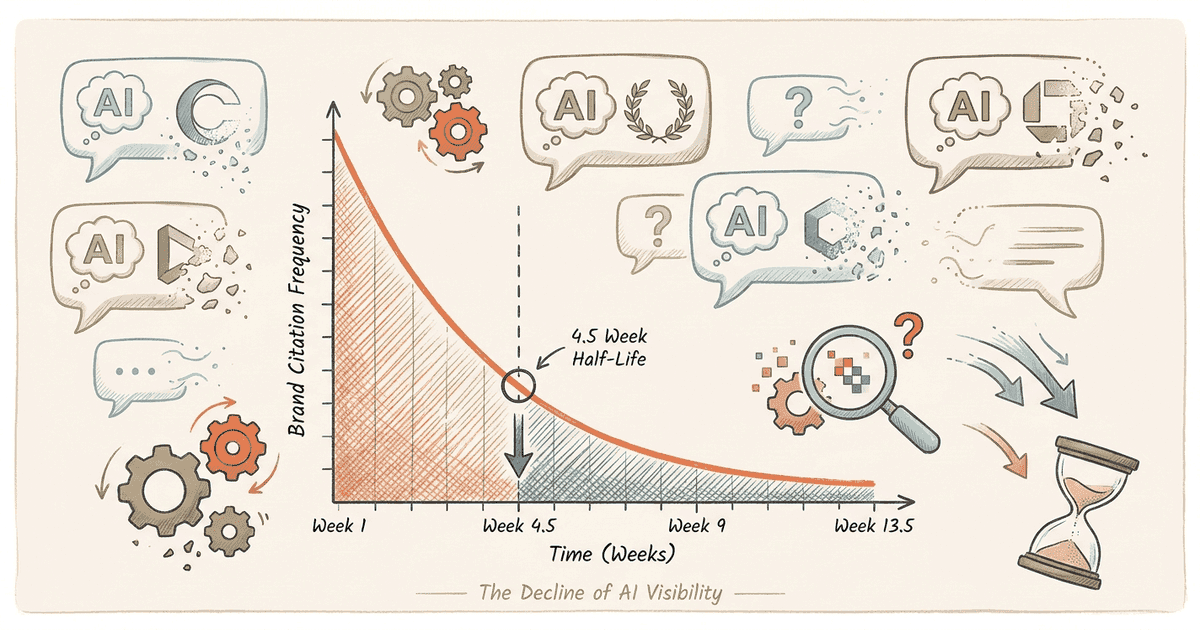
AI citation decay is the gradual decline in how often AI models cite and recommend your brand in their generated answers, measured as a half-life.
The mechanism differs from traditional search algorithms in one critical way. You get no warning when it starts. Google Search Console sends no alert. Ranking trackers miss the shift completely. Your website traffic can look healthy for months while generative engines stop recommending your products and highlight competitors instead. The silence makes the threat severe.
We see this pattern constantly in our monitoring. Brands work hard to secure placement in generative answers. They assume the job is done once they appear. But AirOps data reveals a harsh reality about persistence. Only 30% of brands retain their citations between consecutive model runs. Look further out and the numbers drop sharply. A mere 20% persist across five consecutive runs.
Stacker and Scrunch quantified this erosion across 3 million+ citation events and 120,000 domains. Their finding: a median half-life of 4.5 weeks. After about a month, AI models have replaced roughly half of your citations with other sources. Your established presence dissolves into the background while you focus on other campaigns.
Knowing decay exists raises a vital question: what actually causes it?
Why Do AI Models Stop Citing Your Brand?
See where you rank across all AI answer engines.
Enter your domain and we'll scan your citation rate across ChatGPT, Perplexity, and Google AI.
Prefer to talk? Book a free 30-min call
Three forces drive AI citation decay: competitive content displacement, freshness signal erosion, and reinforcement loop collapse. The world moved. You didn't break.
Competitive content displacement happens when the market catches up. AI models constantly re-evaluate their source pool. Suppose you wrote the definitive guide on inventory forecasting. A competitor publishes a newer guide with better data tables and sharper formatting. The AI model notices the superior structure, demotes your page, and elevates the competitor. You did nothing wrong. The competitive landscape shifted.
Freshness signal erosion accelerates the process. Generative engines aggressively prioritize recent information. Ahrefs analyzed 17 million citation events and discovered that AI-cited content is 25.7% fresher than organic search results on average. Google might forgive a two-year-old post if it has strong authority. AI models won't. As your content ages without substantive updates, it falls below the freshness threshold and drops out of the citation pool.
Reinforcement loop collapse removes the final safety net. Prominent content stays visible because other sites link to it and reference it. When those earned media mentions stop flowing, external signals fade. The AI stops seeing proof of your ongoing relevance. Brands with active editorial distribution achieve a ~10-week half-life, 2.1x longer than brands relying on static content alone. Building backlinks for AI visibility keeps citations alive.
These causes hit differently depending on the platform.
How Fast Do Citations Decay Across AI Platforms?
Citation decay rates vary by platform. ChatGPT turns over fastest at 3.4 weeks, while Perplexity holds citations longest at 5.7 weeks.
The Stacker and Scrunch data provides a clear timeline for this erosion. Every engine processes new information at its own speed. Understanding these platform-specific half-lives helps you time content updates accurately.
| AI Platform | Citation Half-Life | Relative Speed |
|---|---|---|
| ChatGPT | 3.4 weeks | Fastest turnover |
| Google AI Mode | 4.3 weeks | Above median |
| AI Overviews | 4.7 weeks | Near median |
| Gemini | 4.6 weeks | Near median |
| Perplexity | 5.7 weeks | Slowest turnover |
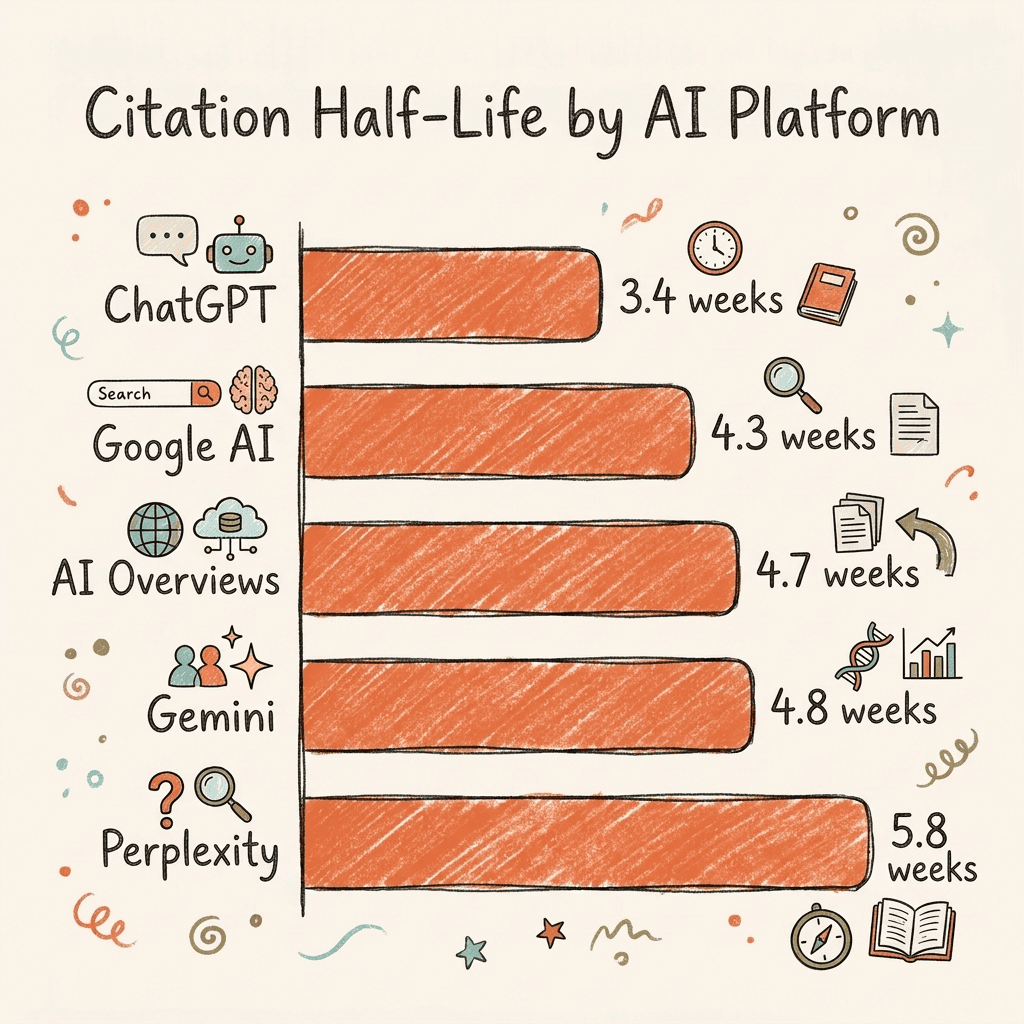
Notice the wide spread. ChatGPT churns through sources fast. A brand can lose placement in under a month. Perplexity values established authority and retains sources significantly longer. This variance creates a complex management challenge.
We've tracked brands watching their Gemini citations hold steady while their ChatGPT presence vanished entirely in a single month. A single brand can gain visibility on one platform while losing it on another at the exact same time. Monitoring only one engine gives you a dangerously incomplete picture.
Editorial distribution provides the strongest shield. Brands securing regular earned media coverage extend their citation half-life to approximately 10 weeks (a 2.1x multiplier). That's the difference between updating content every month versus every quarter.
Beyond platforms, your specific industry dictates the speed of the treadmill.
Does AI Citation Decay Vary by Industry?
Yes. SaaS citations decay faster than ecommerce, and healthcare content holds citations longest, driven by content velocity and competitive density in each vertical.
SaaS: Fastest Decay
Software companies experience the steepest decay curves. High content velocity means competitive displacement happens daily. New comparison guides, feature announcements, and teardowns constantly shuffle the citation pool. Across our client portfolio, we see SaaS feature comparison posts that dominate AI answers in January disappear entirely by March.
Ecommerce: Seasonal Cycles
Ecommerce faces moderate decay with predictable patterns. Seasonal content refreshes create natural turnover points. Product-focused pages decay much faster than broad buying guides. A guide to winter jackets loses relevance as spring approaches. We see ecommerce brands successfully managing this by mapping update schedules to retail calendars.
Healthcare: Slow but Sticky
Healthcare enjoys the slowest decay curve. Clinical authority signals persist longer because medical facts change slowly. Models hesitate to replace authoritative medical sources with newer, less proven content. The trade-off: when decay finally hits a healthcare brand, recovery takes longer due to those same high trust thresholds.
Regardless of vertical, recency remains king. Seer Interactive found that nearly 65% of AI bot hits target content published within the past year. Older content faces a structural disadvantage no matter your industry.
Spotting the warning signs early makes recovery possible.
What Are the Warning Signs of AI Citation Decay?
Five signals indicate AI citation decay: declining citation frequency, shorter brand snippets, competitor displacement, narrowing query coverage, and sentiment shifts.
You need to know what a drop looks like before it hits your bottom line. Here are the specific indicators to watch for when you measure AI visibility.
-
Declining citation frequency, Your brand appears in fewer AI-generated answers week over week. The overall volume of recommendations shrinks steadily. This is the most obvious metric, but it usually lags behind the others.
-
Shorter brand snippets, AI models mention you briefly in passing instead of featuring detailed recommendations. You go from a dedicated paragraph explaining your value to a comma-separated list of options.
-
Competitor displacement, Specific prompt clusters that previously cited your site now cite direct competitors. Your historical strongholds fall to newer content.
-
Narrowing query coverage, You get cited for fewer query variations, losing long-tail coverage first and maintaining only core branded terms. The breadth of your visibility shrinks inward.
-
Sentiment shifts, AI models shift from actively recommending your brand as the best choice to merely mentioning it as one option among many. The tone changes from endorsement to neutral listing.
Catching these signs early prevents a total visibility collapse. Once you spot decay, here's how to reverse it.
How Do You Recover from AI Citation Decay?
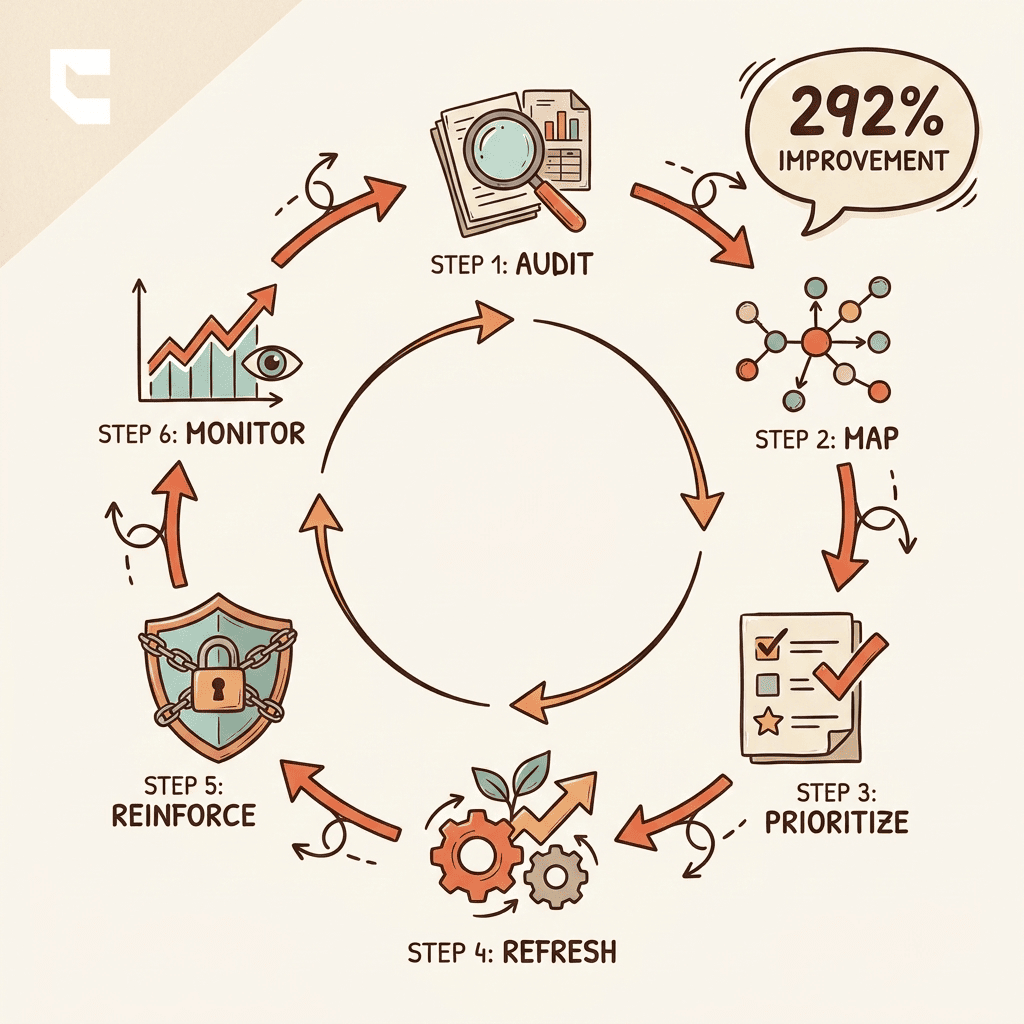
Recovery requires a six-step framework: audit your AI presence, map decay causes, prioritize by revenue, execute substantive refreshes, build reinforcement loops, and monitor monthly.
The worst response to citation loss is panic publishing. A systematic approach rebuilds presence far more efficiently.
-
Audit current AI presence, Check your status across all platforms, not just one. Run a full AI content audit to map exactly where you lost ground and where you remain strong. Look at ChatGPT, Perplexity, Gemini, and AI Overviews together.
-
Map decay causes, Determine why you lost the citation. Is it freshness erosion, competitive displacement, or reinforcement collapse? A freshness problem requires a content update. Competitive displacement may require a complete rewrite.
-
Prioritize by revenue impact, Not all decaying content matters equally. Don't waste time updating top-of-funnel glossaries if your high-converting product pages are losing citations. Start with pages that drive pipeline.
-
Execute substantive refreshes, Cosmetic date changes don't work. You need structured content refreshes, add new data, revise outdated sections, and format for extraction. Practitioner evidence across 200+ pages shows substantive updates drive a 292% citation improvement.
-
Build reinforcement loops, Earned media coverage extends citation half-life by 2.1x. Digital PR, third-party mentions, and community engagement create durable signals that make refreshed content stick.
-
Monitor on 30-day cycles, AI citation decay operates on 4-5 week cycles. We run 30-day monitoring cycles across all seven AI engines for our clients. Monthly checks catch decay before it compounds.
Recovery works when you're systematic about it. But prevention is always cheaper.
How Do You Build Decay-Resistant AI Visibility?
Decay-resistant visibility requires a maintenance cadence, citation-ready content structure, cross-platform distribution, and continuous earned media reinforcement.
Treat your AI visibility as a living system. It needs regular feeding and structured maintenance to survive.
Content Maintenance Cadence
Different content types need different update schedules:
- High-decay content (product comparisons, tool lists): refresh every 4-6 weeks
- Medium-decay content (how-to guides, strategy pieces): refresh every 8-12 weeks
- Low-decay content (original research, foundational definitions): refresh every 16-20 weeks
Schedule the work in advance so your team knows exactly what to update each month.
Citation-Ready Content Structure
Structure content so AI models can extract clear answers easily. Include quantitative claims, comparison tables, and definitive statements that AI models naturally prefer to cite. Our AI visibility playbook covers the exact formatting rules for making content extraction-ready.
The Reinforcement Multiplier
Brands with ongoing earned media achieve 2.1x citation durability. Cross-platform distribution across Reddit, LinkedIn, and industry publications creates multi-source reinforcement. The goal: make your brand un-ignorable across the data AI models draw from.
This is what we build for every client. A system that compounds rather than decays.
Frequently Asked Questions About AI Citation Decay
These are the most common questions we hear from brands experiencing AI citation decay.
What is AI citation half-life?
AI citation half-life is the time it takes for roughly half of a brand's AI citations to be replaced. The median is 4.5 weeks across all platforms.
Stacker and Scrunch measured this across 3 million+ citation events. Platform-specific rates range from 3.4 weeks on ChatGPT to 5.7 weeks on Perplexity.
How often should I update content for AI visibility?
High-decay content like product comparisons needs refreshing every 4-6 weeks. Strategy guides can go 8-12 weeks. Original research holds for 16-20 weeks.
The key is substantive updates: adding new data, restructuring sections, incorporating recent developments. Changing the published date alone doesn't move the needle.
Is AI visibility decay permanent?
No. Research shows 57% of brands that disappeared from AI citations later resurfaced. Recovery depends on diagnosing the cause and executing targeted content refreshes.
Permanent loss happens when competitors outclass your content and you don't respond. Active maintenance prevents it.
Which AI platform has the fastest citation turnover?
ChatGPT has the fastest citation turnover with a 3.4-week half-life. Perplexity has the slowest at 5.7 weeks.
This means ChatGPT-focused visibility strategies require more frequent refresh cycles than Perplexity-focused ones.
Stop the Silent Drop
AI citation decay isn't a bug. It's how AI models are designed to work. The 4.5-week half-life means visibility requires a maintenance discipline, not a one-time build.
Start with an AI content audit to see where you stand. Identify which citations have decayed and map out why it happened.
We monitor AI visibility across seven engines for brands in SaaS, ecommerce, and healthcare. If your citations are declining (or you want to make sure they don't), see our plans.
See where your brand appears in AI search
Scan ChatGPT, Perplexity, and Google AI across buyer-intent queries, instantly, no sign-up.
Find out if AI is sending buyers to your competitors.
We audit your AI visibility across ChatGPT, Perplexity, and Google AI –and show you exactly where you rank and what to fix.
“We went from 200 visitors/day to 1,900 visitors/day and 40% of demos are from AI search.”
Sumanyu Sharma · CEO, Hamming.ai
“Cintra helped me go from 3k to 7.5k daily traffic and doubled weekly orders in 1.5 months.”
Russ Coulon · Owner, UV Blocker
“We saw a lift from 3% to 13% visibility in the first 2 weeks, and organic traffic hit its highest ever.”
Ash Metry · Founder, Keywords.am
Related Articles
How to Build an AI Agent-Friendly Website: The Complete 2026 Playbook
An AI agent-friendly website goes beyond accessibility. Learn the full 2026 stack: Google's checklist, WebMCP,…
Meta-ExternalAgent Took More Bandwidth Than 5 Crawlers Combined
Meta-ExternalAgent pulled 955 MB from cintra.run in 30 days, more than 5 AI and search crawlers combined. What…
Product Feed Optimization AI Shopping Engines Actually Read (10-Point Audit)
Product feed optimization AI shopping engines need to recommend your products. Platform-by-platform feed requi…