The Ultimate Backlinks for AI Visibility Guide: 7 Best Strategies That Work
Backlinks for AI visibility work differently than traditional SEO. See what 1,000-domain studies reveal about link quality, brand mentions, and AI citations.
TL;DR
Backlinks still matter for AI search, but quality and type matter more than quantity. Semrush found a 0.65 correlation between link quality and AI mentions. Ahrefs found brand mentions are 3x stronger than backlinks for AI Overviews. Both are right because they measure different facets of the same authority signal. The winning formula: earned media links + community links (Reddit, Quora) + resource links from authoritative guides. Don't expect overnight results, link building compounds over weeks and months.
Two major 2025 studies reached opposite conclusions. Semrush analyzed 1,000 domains and found link quality correlates 0.65 with AI mentions, the strongest signal they measured. Then Ahrefs studied 75,000 brands and found brand mentions are three times stronger than backlinks for AI Overviews.
Both findings are correct. Backlinks and brand mentions don't compete, they're complementary signals. The real question isn't whether backlinks for AI visibility still matter. It's which links matter, on which platforms, and why.
This guide synthesizes findings from Semrush, Ahrefs, SE Ranking, and Salt.agency into a unified framework. You'll learn which link types drive AI visibility on each platform and how to stop wasting budget on tactics that modern AI engines ignore.
Want to see where your brand ranks in AI search: and who's beating you? Get your free AI visibility audit →
How Do AI Engines Actually Use Backlinks?
See where you rank across all AI answer engines.
Enter your domain and we'll scan your citation rate across ChatGPT, Perplexity, and Google AI.
Prefer to talk? Book a free 30-min call
AI engines use backlinks as one of several authority signals during retrieval, weighing source credibility alongside brand mentions, content freshness, and entity recognition.
Modern AI engines use Retrieval-Augmented Generation (RAG). The process follows a sequence: the user enters a query, the engine retrieves relevant sources from its index, ranks them by authority and relevance, synthesizes the top results into an answer, and generates citations.
Backlinks enter during retrieval and ranking. They signal source authority and help the system decide which sources are trustworthy enough to cite. Without these authority signals, your content won't be retrieved and won't appear in AI answers.
This differs from traditional PageRank. Google used links to pass ranking equity between pages. AI models use links to validate entity strength, brand prominence, and topical relevance. They care about whether a source is credible right now, not just how many links point to it.
Different Retrieval Stacks
Each AI platform uses a different index. Perplexity crawls the live web directly. ChatGPT relies on Bing's index. Gemini uses Google's index. Claude pulls from Brave Search. Your link building strategy needs to account for these distinct ecosystems.
What Does the Research Say About Backlinks and AI Citations?
Multiple studies confirm backlinks correlate with AI visibility, but link quality matters far more than quantity, and brand mentions amplify the effect.
The data comes from three major studies conducted throughout 2025. Together, they reveal how modern AI models process source authority.
Semrush: 1,000 Domains (Oct 2025)
The Semrush backlinks and AI search study uncovered several findings that rewrite link building rules:
- Link quality showed a 0.65 Pearson correlation with AI mentions, the strongest signal in their study
- Nofollow and follow links had nearly identical correlations (~0.34 each). AI engines don't discriminate by link attribute
- Image links outperformed text links (0.415 vs 0.334 correlation). Deep visual integration signals stronger editorial endorsement
- Top-cited pages had 2.8x more unique referring domains than less visible pages. Domain diversity is critical
These are important AI search statistics that reshape how marketers should think about link building.
Ahrefs: 75,000 Brands (2025)
Ahrefs focused on Google's AI Overviews ecosystem:
- Brand mentions proved 3x stronger than backlinks for AI Overviews visibility
- But brand mentions and backlinks aren't independent. Quality links create brand mentions over time. When a major publication links to your site, people talk about your brand. The link sparks the mention. They're two facets of the same authority signal.
SE Ranking: Content Freshness and Link Diversity
SE Ranking's research on AI citations reinforces two key patterns:
- Content updated within 2-3 months gets cited more often. Pages updated recently average significantly more AI citations than older pages, a signal that freshness and active link building go hand in hand
- Domain diversity matters. Sites with broad, diverse backlink profiles consistently outperform those relying on a handful of referring domains
Salt.agency also observed clear patterns: content cited by AI models tends to have more editorial backlinks from topically relevant domains. Niche authority beats general authority.
The 3-Part Link Building Framework for AI Visibility
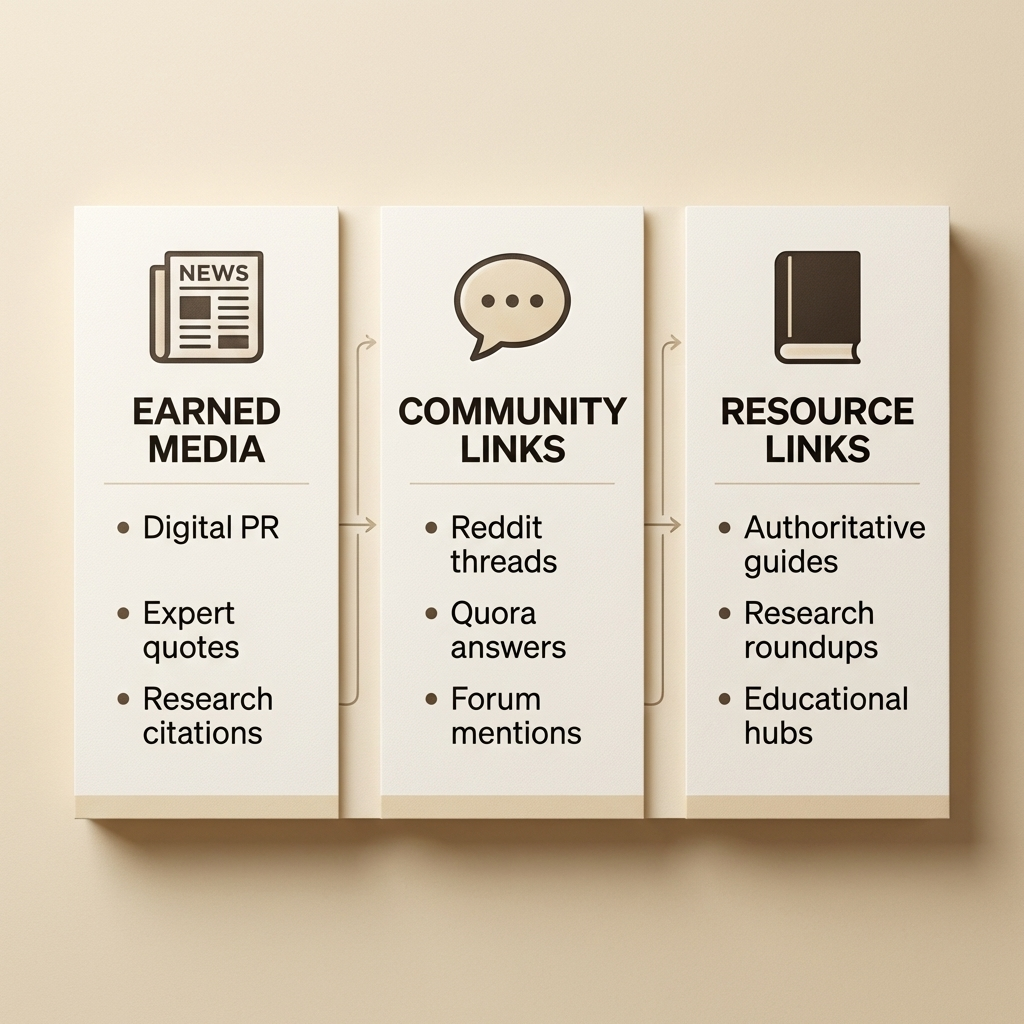
Effective backlinks for AI visibility combine three categories: earned media links for entity signals, community links from Reddit and Quora, and resource links from authoritative guides.
Part 1: Earned Media Links (Entity Building)
Earned media means digital PR, expert quotes in industry publications, original research citations, and editorial features. These build the entity signals AI models require. They prove your brand is a real authority in your sector.
They establish strong E-E-A-T for AI search. When an AI engine sees a major business journal linking to your data, it trusts your answers. You become a verified entity the AI will retrieve for complex industry queries.
Part 2: Community Links (AI-Indexed Platforms)
Community links come from genuine human discussions, Reddit threads, Quora answers, and niche forum contributions where people mention your brand with actual context.
Perplexity and ChatGPT actively index Reddit. Google AI Overviews surfaces Reddit content in generated answers. A strong Reddit strategy for AI visibility places your brand directly in the retrieval path. The AI sees real humans validating your product and learns to recommend it.
Part 3: Resource Links (RAG Retrieval)
Resource links live inside authoritative guides, research roundups, and educational hubs. These pages are the ones AI models are most likely to retrieve during synthesis.
Being linked from a well-cited resource means the AI discovers your brand when it pulls that resource. Proper schema markup for AI visibility on your own resources further helps AI engines parse your value.
Link Types vs AI Platforms
| Link Type | ChatGPT | Perplexity | Gemini | AI Overviews | Claude | Copilot |
|---|---|---|---|---|---|---|
| Earned Media | High | High | Medium | High | Medium | Medium |
| Community (Reddit/Quora) | High | Very High | Medium | High | Medium | Medium |
| Resource/Editorial | Medium | High | Low | High | Medium | Medium |
| Directory/PBN | None | None | None | None | None | None |
How Do Backlink Signals Differ Across AI Platforms?
Each AI platform weights backlink signals differently based on its retrieval stack, Perplexity relies on them heavily, Gemini barely at all, and the rest fall in between.
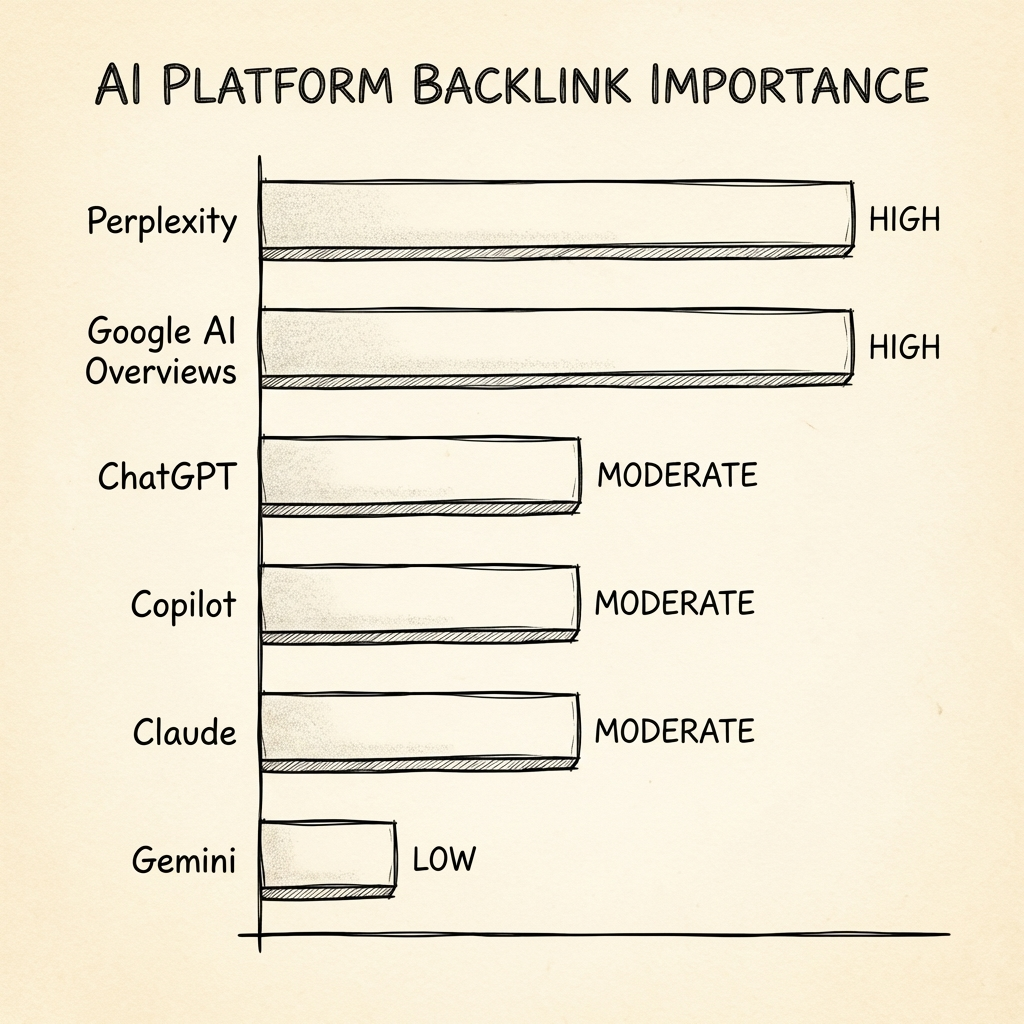
Perplexity shows the highest backlink correlation. It indexes the live web directly and continuously. More high-quality backlinks mean your site is more likely to be retrieved. This is the strongest platform for link-driven visibility.
ChatGPT shows moderate correlation. It uses Bing's web index alongside content partnerships. Links matter for discovery, but content quality and freshness weigh heavily. A fresh article with zero links can beat an old article with fifty.
Google AI Overviews shows high correlation because it inherits authority signals from organic search. If backlinks help you rank in Google, they help you appear in AI Overviews.
Gemini shows surprisingly low backlink correlation per Semrush data. It relies on Google's Knowledge Graph and entity recognition more than raw link signals.
Claude depends on Brave Search. It shows moderate backlink influence. Community signals from Reddit carry more weight than traditional editorial links.
Copilot depends on Bing's index and behaves similarly to ChatGPT. Microsoft's partnership ecosystem also influences source selection.
What Link Building Tactics Waste Budget in AI Search?
Private blog networks, mass directory submissions, and low-quality guest posts provide near-zero AI visibility benefit because AI models evaluate source quality differently than PageRank.
Stop building PBN links for AI search. AI models detect artificial link patterns easily. The Semrush data shows PBNs have zero correlation with AI citations, in fact, 92% of PBN-heavy domains saw no AI mentions at all. They're a waste of budget.
Mass directory submissions operate on quantity without quality. AI retrieval systems don't weight low-effort directories. A link from a generic business directory provides zero topical context and zero entity validation.
Low-quality guest posts on irrelevant sites don't build entity signals. If you sell enterprise software, a link from a generic lifestyle blog hurts your topical authority. The AI sees the mismatch.
Link exchanges and reciprocal schemes also fail. AI models look for genuine editorial endorsement patterns, not reciprocal trades. Two sites linking to each other in footers provides zero semantic value. Focus your budget on the three framework pillars instead.
How Do You Measure Backlink Impact on AI Visibility?
Track backlink impact on AI visibility by monitoring citation frequency changes, branded mention growth, and AI search referral traffic over a multi-month window after link campaigns launch.
Track citation frequency. Use AI visibility monitoring tools to track how often AI models cite your brand across platforms. Knowing how to measure AI visibility is the only way to prove ROI on link building.
Track branded mentions. Don't just track links, track text mentions. The Ahrefs data shows brand mentions amplify backlink signals. As your quality links grow, brand mentions should grow alongside them. If you build fifty links but nobody mentions your brand, those links are probably low quality.
Set timeline expectations. Link building compounds over time. AI models need to crawl new sources, re-index content, and re-evaluate authority signals before your citations improve. Industry data suggests a 60% increase in AI citation rates after 3 months of consistent quality link building. Set expectations with your team, this is a multi-month investment, not a quick win.
Connect the dots. Compare your backlink acquisition timeline with AI citation rate changes. When earned media links go live, watch for the corresponding citation bump in subsequent months. Track referral traffic from ChatGPT and Perplexity domains in your analytics.
Frequently Asked Questions About Backlinks for AI Visibility
These are the questions we hear most from brands evaluating their link building strategy for AI search.
Do nofollow links help with AI search?
Yes. Semrush data shows nofollow and follow links have nearly identical correlation with AI mentions (~0.34 Pearson each). AI engines evaluate source authority holistically. They don't rely on PageRank follow/nofollow distinctions. A nofollow link from a trusted publication is still a strong authority signal.
Should I stop building backlinks and focus on brand mentions instead?
No, do both. Ahrefs found brand mentions are 3x stronger than backlinks for AI Overviews. But backlinks and brand mentions are complementary signals. Quality backlinks generate brand mentions over time. You can't easily manufacture natural brand mentions without editorial link building and digital PR.
How long before backlinks affect AI citations?
Link building is a compounding investment. AI models need time to re-crawl sources, re-evaluate authority signals, and update retrieval rankings. Plan for a multi-month timeline before you see measurable citation improvements.
Do image links matter more than text links for AI?
Yes. Semrush found image links have a 0.415 correlation compared to 0.334 for text links. Images in editorial content signal deeper integration, which AI models interpret as stronger endorsement.
Which AI platform cares most about backlinks?
Perplexity shows the strongest backlink correlation because it indexes the live web directly. Google AI Overviews also shows high correlation since it inherits authority signals from organic search.
Conclusion
Backlinks remain effective for driving AI visibility. But the old rules of mass link building no longer apply.
- Backlinks still matter, but quality and link type matter more than raw quantity
- The winning formula: earned media + community links + resource links
- Platforms differ: Perplexity cares the most about links. Gemini cares the least
- Brand mentions amplify backlinks. They're complementary forces, not competing signals
- Link building compounds over months, don't expect overnight AI citation impact
We run backlink campaigns for brands as part of a full-stack AI visibility strategy, 50 outreach opportunities per month paired with GEO-optimized content and Reddit engagement. Our approach builds the entity signals that AI engines trust. See our results to learn how we help brands get recommended by AI search.
See where your brand appears in AI search
Scan ChatGPT, Perplexity, and Google AI across buyer-intent queries, instantly, no sign-up.
Find out if AI is sending buyers to your competitors.
We audit your AI visibility across ChatGPT, Perplexity, and Google AI –and show you exactly where you rank and what to fix.
“We went from 200 visitors/day to 1,900 visitors/day and 40% of demos are from AI search.”
Sumanyu Sharma · CEO, Hamming.ai
“Cintra helped me go from 3k to 7.5k daily traffic and doubled weekly orders in 1.5 months.”
Russ Coulon · Owner, UV Blocker
“We saw a lift from 3% to 13% visibility in the first 2 weeks, and organic traffic hit its highest ever.”
Ash Metry · Founder, Keywords.am
Related Articles
Organic Traffic Decline 2026: Why It's Dropping and How to Recover
Organic traffic decline 2026 is real. AI Overviews cut clicks 38% on triggered queries. Here's what's causing…
AI Visibility Reporting: What to Track, Who to Tell, and How to Prove ROI
AI visibility reporting requires different metrics and formats than SEO reports. Learn the five core metrics,…
AI Visibility Competitive Analysis: How to Find and Exploit Gaps in 2026
AI visibility competitive analysis across ChatGPT, Perplexity, and 5 other engines. Framework for tracking com…