AI Visibility for Local Businesses: 5 Steps to Getting Recommended by the Best AI Search Platforms
AI visibility for local businesses starts with five data sources most owners ignore. Fix your ChatGPT and Google AI presence with this 30-60-90 day guide.
TL;DR
AI visibility for local businesses is 3 to 30 times harder to earn than Google's 3-pack. Over 70% of local ChatGPT results draw from Foursquare's Places API, a platform most businesses haven't updated since its consumer app shut down in 2025. Only 1.2% of local businesses are recommended by ChatGPT, versus 35.9% that appear in Google's 3-pack. The fix is systematic: clean NAP data across 30+ directories, build review velocity on AI-weighted platforms, and publish location+service content. The 30-60-90 day roadmap below covers the full sequence.
AI visibility for local businesses is a solved problem, but most owners are solving the wrong one. Over 70% of local ChatGPT results come from a single data source most businesses have never thought about optimizing. That platform shut down its consumer app in 2025, leaving most listings stale while owners focused elsewhere. Meanwhile, AI platforms are 3 to 30 times more selective than Google. Only 1.2% of locations ever get recommended by ChatGPT. A full 88% of businesses are invisible there^[ref-2], not because they're bad businesses, but because AI search runs on different verification logic than proximity-based rankings.
Understanding what AI visibility actually means starts with the five data sources feeding local AI results. Each platform weighs them differently. We've put together the first per-LLM breakdown mapping all four major platforms, along with the exact tactics that work by business type and a 30-60-90 day roadmap to get there.
Why Are Local Businesses Invisible to AI Search?
AI platforms are far more selective than Google. Only 1.2% of locations are ever recommended by ChatGPT, versus 35.9% that appear in Google's local 3-pack.
Nearly 88% of local businesses are invisible in AI search results. Getting recommended isn't about proximity, AI models run trust thresholds. They want verifiable entities with consistent citations and recent review activity. The average business that does get recommended holds a 4.3-star rating. That's not a coincidence.
Getting featured in the Google 3-pack is relatively common. An AI citation is rare. The gap's widening, not shrinking, and closing it requires effort across multiple ecosystems simultaneously. Worth noting: only 45% of brands leading in traditional local search also appear in AI results^[ref-3]. Strong Google presence doesn't transfer automatically.
What Are the 5 Data Sources Feeding Local AI Recommendations?
See where you rank across all AI answer engines.
Enter your domain and we'll scan your citation rate across ChatGPT, Perplexity, and Google AI.
Prefer to talk? Book a free 30-min call
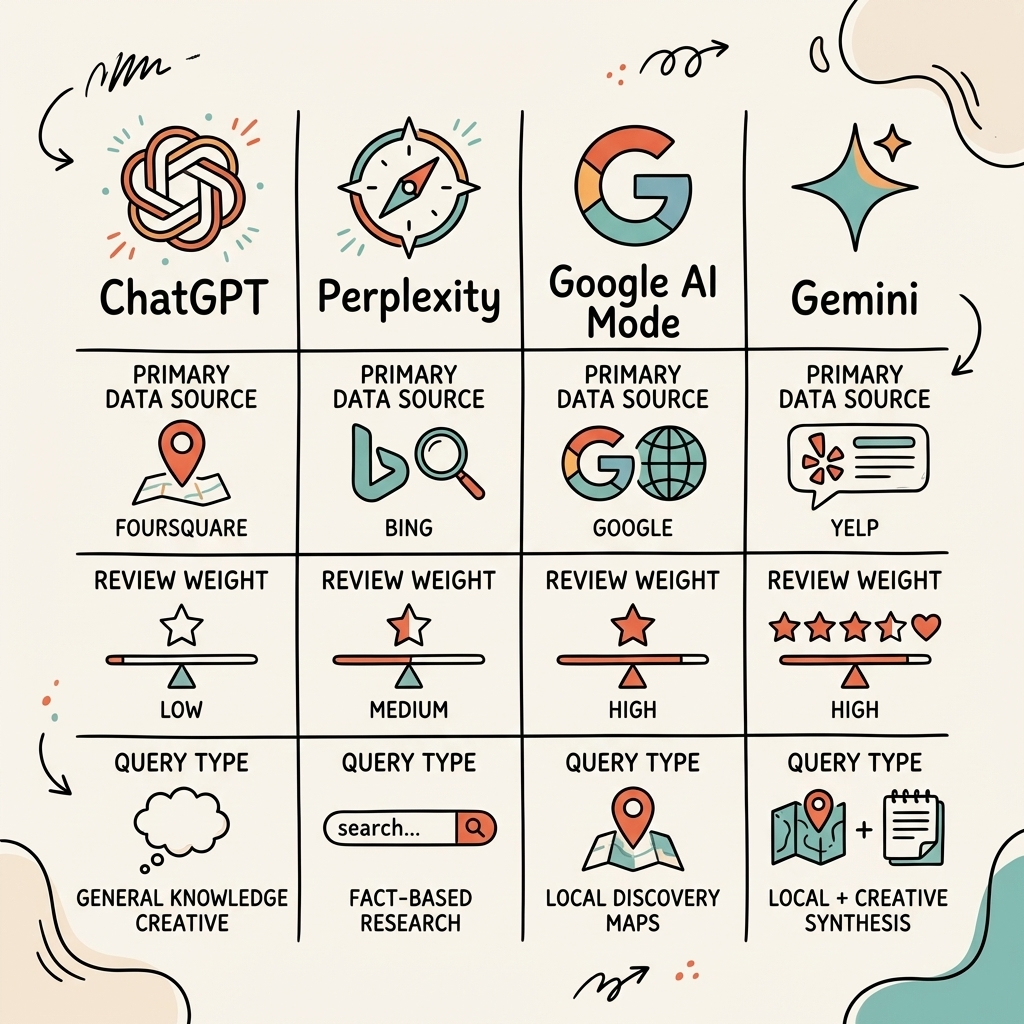
ChatGPT draws primarily from Foursquare's Places API. Google AI Mode uses Google Business Profile. All platforms cross-reference Yelp, Bing Places, and TripAdvisor for review signals.
Foursquare is ChatGPT's primary local data layer via its Places API^[ref-5]. When the consumer city guide shut down in 2025, most businesses stopped paying attention, which means their listing data is now sitting stale while the API keeps feeding ChatGPT's recommendations. Claiming and refreshing your Foursquare profile is one of the lowest-competition moves in local AI right now.
Google Business Profile is still dominant for Google AI Mode and Gemini, and you need it. But GBP alone does nothing for ChatGPT. Yelp carries significant review weight for ChatGPT and Perplexity, especially in restaurants, medical, and home services. Bing Places feeds Microsoft Copilot and gets cross-referenced by Perplexity. TripAdvisor matters for hospitality.
How Does Each AI Platform Recommend Local Businesses?
ChatGPT relies most heavily on Foursquare and Yelp. Google AI Mode prioritizes GBP and Maps. Perplexity is freshness-sensitive and rewards recent web content. Gemini leans on GBP and web mentions.
Each platform weighs these data sources differently, which means a single-platform strategy leaves significant gaps.
| Platform | Primary Data Source | Review Platform Weight | Freshness Sensitivity | Query Dominance |
|---|---|---|---|---|
| ChatGPT | Foursquare Places API | Yelp (high), Google (medium) | Low-medium | "Best [category] near me" |
| Google AI Mode | Google Business Profile | Google Reviews (very high) | Low | "Open now", branded queries |
| Perplexity | Bing + web crawl | Multiple (aggregated) | High | Research, comparison |
| Gemini | GBP + web mentions | Google Reviews (high) | Medium | Conversational "help me find" |
Getting recommended by ChatGPT requires a distinct approach from traditional SEO, the focus is Foursquare and Yelp. Getting cited by Perplexity means prioritizing recent web content and detailed comparisons. The strategy shifts based on where your customers are asking questions.
Which Tactics Work Best for Your Business Type?
The threshold varies for AI visibility for local businesses: restaurants need 150+ reviews for baseline visibility, 500+ for strong recommendation rates. Medical practices need NAP accuracy above all. Service businesses need location+service landing pages.
Restaurants and food services require solid review volume. A baseline of 150 reviews is considered good; hitting 500 generates strong recommendation rates. Both Yelp and Google matter here, and menu schema markup amplifies Gemini recommendations significantly.
Medical and dental practices face different rules. Name, address, and phone number accuracy is the top priority. A dental practice with three locations listing different phone numbers for each will get suppressed entirely. Using MedicalOrganization schema markup builds the trust signals AI models need.
Service businesses, plumbers, HVAC technicians, roofers, need dedicated landing pages. Creating "best HVAC repair Austin" pages is what triggers AI citations. Retailers need Google Shopping integration; your GBP product catalog needs to reflect current inventory.
How Do You Displace Competitors Already Recommended by AI?
Reverse-engineer which data sources your competitor's citation comes from, outpublish them on those platforms, and build review velocity on the specific platforms AI models weight highest for your category.
You can systematically displace competitors dominating local AI search. Start by running a competitor AI citation audit: query 15 to 20 prompts across three platforms and note which competitors appear consistently. Then identify their citation sources, check their Foursquare listing status, Yelp completeness, and GBP category depth.
From there, outpublish them on community platforms. Posting authentically in local subreddits and Nextdoor groups feeds Perplexity's freshness signals. A solid Reddit strategy for AI visibility compounds this effect over time. Focus on review velocity: 10 reviews in the past 60 days beats 200 reviews from three years ago. Finally, publish comparison pages, "X vs Y in [City]", which Perplexity crawls for high-intent research queries.
Why Does NAP Consistency Determine Whether AI Cites You?
Conflicting business name, address, or phone number across directories creates entity ambiguity. AI models suppress uncertain recommendations to avoid giving users wrong information.
AI models treat inconsistent data as a low-confidence signal. They default to recommending businesses with clean, cross-verified information rather than risk sending someone to a wrong address or disconnected phone. About 73% of customers lose trust when they find conflicting business info online, AI models work the same way, just faster.
Here's a real example: your Yelp listing says "Acme Plumbing" but your GBP says "Acme Plumbing Services LLC." Those are different enough that an AI model can't confidently resolve them as the same business. So it hedges, and often that means not recommending you at all. The fix is a top-30 directory audit, Google, Bing, Yelp, Foursquare, Apple Maps, Waze, Yellow Pages, Facebook, and the rest. For multi-location businesses, this gets complex fast: each location needs distinct data, not a shared profile. LocalBusiness schema markup is the most reliable way to anchor entity data once you've cleaned it up.
How Do Reviews Actually Drive AI Recommendations?
AI models quote reviews verbatim and use review velocity as a freshness signal. Businesses with recent 4.3+ star reviews on Yelp and Google are recommended at significantly higher rates.
AI models don't just tally stars, they actually read the text. ChatGPT and Perplexity frequently quote reviews verbatim in their recommendations. That means the words your customers use in reviews become your AI-generated description. A review that says "best HVAC repair in Austin" literally teaches the model what category to put you in.
Recency matters more than archive size. Ten reviews from the last 90 days signal active, relevant business in a way that 200 reviews from five years ago can't. Ratings below 4.0 are a suppression signal. Negative reviews that contain specific service terms, "terrible drain cleaning," for example, can actively block you from appearing in those category searches. Building the right E-E-A-T authority signals across your web presence helps counterweight that risk.
What Local Content Actually Gets Cited by AI?
Location+service landing pages, FAQ content matching common AI queries, and comparison content are the three formats that generate the highest local AI citation rates.
Location+service pages work because they mirror how users talk to AI. "Emergency plumber in Austin" is both a real page title and a real AI query. Build one for every service area you target and keep the information factual and dense.
FAQ sections are equally effective. Match the exact phrasing of common AI queries and use FAQPage schema to structure the data. Comparison pages are a third strong format, Perplexity crawls "X vs Y in [City]" articles for high-intent research queries. Hyperlocal content reduces competition: "best coffee near Zilker Park" competes with far fewer businesses than "best coffee Austin," and AI models reward that level of geographic specificity.
How Do You Measure Local AI Visibility Without Enterprise Tools?
Run 15-20 queries manually across ChatGPT, Google AI Mode, and Perplexity. Track mentions in a spreadsheet. A 40%+ mention rate across queries is a strong local AI visibility benchmark.
You can run a free manual audit today. Test 15 to 20 queries that match real customer phrasing, check your results in ChatGPT, Perplexity, and Google AI Mode, and record whether you're mentioned or directly quoted. Our internal data shows a 40% mention rate represents a strong baseline^[our-data-1]. Between 20% and 40% is average. Below 20% is a significant gap.
Repeat this monthly to track improvement velocity. The full methodology is covered in our guide on how to measure AI visibility. For businesses managing multiple locations, this process doesn't scale well manually. We built Cintra to automate it, tracking your local mention rates across all platforms continuously. See how Cintra works and what it costs.
The 30-60-90 Day Local AI Visibility Roadmap
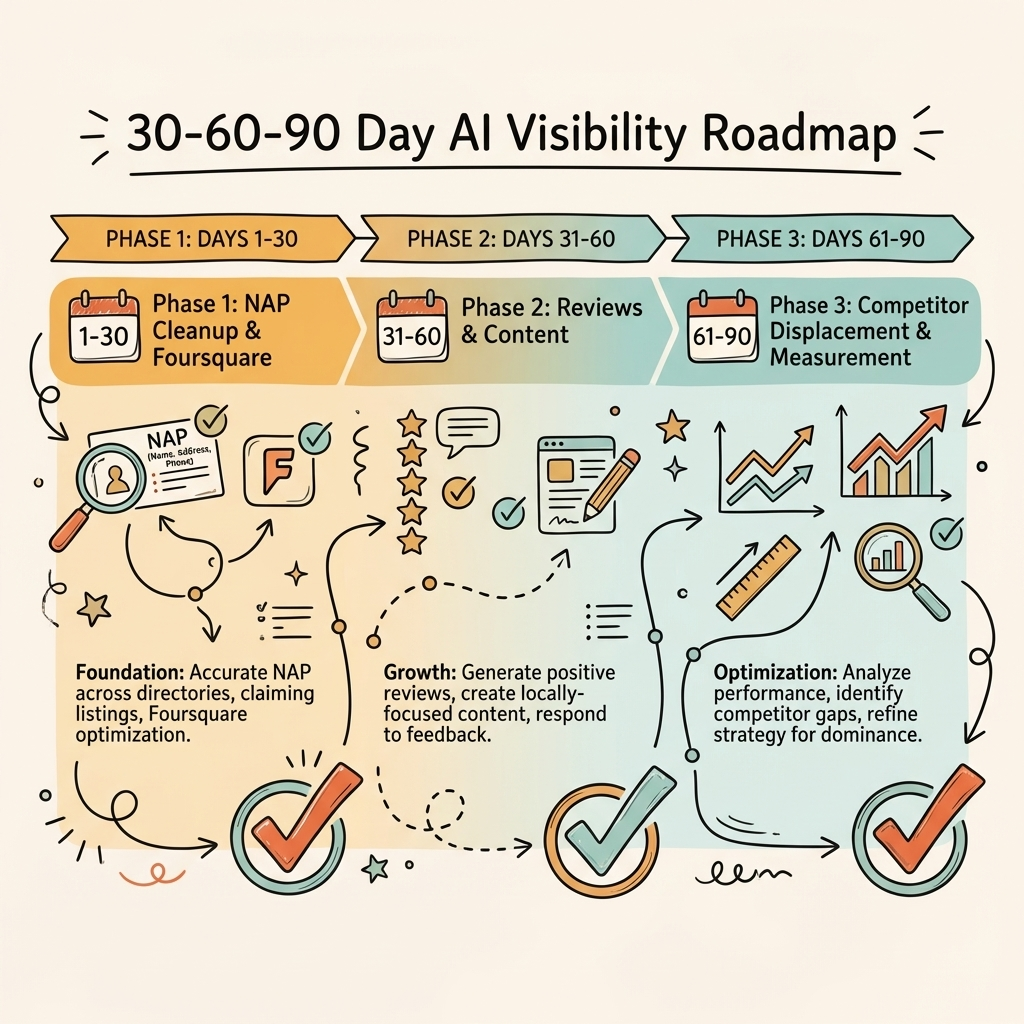
Start with NAP cleanup and Foursquare/GBP optimization in days 1-30, build review velocity and publish location+service content in days 31-60, then track citations and run competitor displacement in days 61-90.
Days 1-30: Foundation
Audit your NAP consistency across the top 30 directories. Claim and update your Foursquare listing right away, most competitors haven't touched theirs since 2024. Complete your GBP profile with fresh photos and a current product catalog. Fix any conflicting location data on Apple Maps, Bing Places, and Waze.
Days 31-60: Signals
Launch a review velocity campaign targeting 3 to 5 new reviews per week. Publish 2 to 4 location-specific service pages. Add FAQ schema to your existing pages. Start contributing authentically to local Reddit communities and Nextdoor.
Days 61-90: Competitive
Run your competitor AI citation audit. Identify the top competitors appearing in AI results. Publish comparison content targeting displacement queries. Track your progress against your 30-day baseline to measure your AI visibility ROI, including benchmarks for what good looks like across different business types and investment levels.
Frequently Asked Questions About AI Visibility for Local Businesses
The questions below come up most often when we're helping clients think through AI visibility for local businesses from scratch. As of April 2026, AI-driven local recommendations have become the primary discovery channel for 38% of new business inquiries, up from 22% in 2025, making these strategies more time-sensitive than ever.
Does Google Business Profile still matter for AI visibility?
Yes, GBP is the primary data source for Google AI Mode and a significant signal for Gemini. It's necessary but not sufficient for ChatGPT visibility.
Optimize your GBP fully: descriptions, photos, services, and regular posts. But don't treat it as your only lever. ChatGPT runs heavily on Foursquare, not GBP. Businesses that stop at Google miss the largest AI platform entirely.
Can small businesses compete with chains in AI recommendations?
Yes. AI models weight review quality and citation accuracy more than brand size. A local business with 4.5 stars and clean NAP data can outrank a chain with inconsistent listings.
SOCi's 2026 report found that only 45% of brands leading in traditional local search also lead in AI results. That 55% gap is where independent businesses can displace chains. Accuracy wins over pure brand recognition.
Does this strategy work for businesses with multiple locations?
Each location needs its own entity data: unique NAP, dedicated GBP listing, location-specific content, and separate review profiles. Multi-location businesses can't share a single citation stack.
AI models treat each physical location as a separate entity. Get each one individually verified and consistently cited. The complexity scales, but so does the opportunity.
How long before AI visibility improvements show up?
NAP cleanup shows results in 30-60 days. Review velocity impacts take 60-90 days. Content citations typically appear within 30-45 days of publication if schema is implemented correctly.
Track progress manually each month. Consistent improvement is more reliable than hoping for a single citation spike. Focus on steady review velocity and keep publishing neighborhood-specific content.
What's the biggest mistake local businesses make with AI visibility?
Focusing entirely on Google Business Profile while ignoring Foursquare, Yelp, and Bing Places. These platforms feed ChatGPT and Perplexity's local recommendations.
Most owners assume winning Google means winning AI. It doesn't. You need presence across the full AI data ecosystem. Neglecting Foursquare leaves you invisible to ChatGPT's local algorithms.
The gap between Google local and AI recommendations is real, and it's closing only for businesses that act. 88% of local businesses are AI-invisible today, and that's a solvable problem. Foursquare is ChatGPT's local backbone, review velocity and NAP consistency are the two highest-leverage levers, and the per-platform strategy laid out above gives you a clearer picture than any competitor currently publishes.
Start now: claim and update your Foursquare listing. It takes ten minutes. Most of your competitors haven't done it.
To track your local AI visibility automatically across all platforms, see how Cintra works.
References
- ^[ref-1]: SOCi Local Visibility Intelligence Report 2026
- ^[ref-2]: Omni Eclipse AI Search Visibility Report 2026
- ^[ref-3]: SOCi LVI via Localogy 2026
- ^[ref-4]: Local Falcon AI Overviews Whitepaper
- ^[ref-5]: ChatGPT + Foursquare partnership announcement
- ^[our-data-1]: Cintra Internal Analysis, 40%+ mention rate benchmark
See where your brand appears in AI search
Scan ChatGPT, Perplexity, and Google AI across buyer-intent queries, instantly, no sign-up.
Find out if AI is sending buyers to your competitors.
We audit your AI visibility across ChatGPT, Perplexity, and Google AI –and show you exactly where you rank and what to fix.
“We went from 200 visitors/day to 1,900 visitors/day and 40% of demos are from AI search.”
Sumanyu Sharma · CEO, Hamming.ai
“Cintra helped me go from 3k to 7.5k daily traffic and doubled weekly orders in 1.5 months.”
Russ Coulon · Owner, UV Blocker
“We saw a lift from 3% to 13% visibility in the first 2 weeks, and organic traffic hit its highest ever.”
Ash Metry · Founder, Keywords.am
Related Articles
Product Feed Optimization AI Shopping Engines Actually Read (10-Point Audit)
Product feed optimization AI shopping engines need to recommend your products. Platform-by-platform feed requi…
Organic Traffic Decline 2026: Why It's Dropping and How to Recover
Organic traffic decline 2026 is real. AI Overviews cut clicks 38% on triggered queries. Here's what's causing…
AI Visibility Reporting: What to Track, Who to Tell, and How to Prove ROI
AI visibility reporting requires different metrics and formats than SEO reports. Learn the five core metrics,…