AI Visibility for SaaS: The Complete B2B Playbook to Get Recommended by AI Search
AI visibility for SaaS companies is now a pipeline problem. Learn the 5-part framework that took Hamming.ai from 200 to 1,900 visitors/day and drove 40% of demos from AI channels – in 12 weeks.
TL;DR
- Buyer Shift: Over half of B2B buyers now start vendor research in an AI chatbot, up 71% in four months.
- Different Signals: AI visibility for SaaS requires specific entity signals (G2, Capterra, Product Hunt) that generic GEO guides ignore.
- Five-Part Framework: Answer-first technical content, directory entity clarity, developer community validation, structured data, and comparison content.
- Proof: Hamming.ai achieved 8.5x traffic and 40% of demos from AI channels in 12 weeks.
- Measurable: Track AI visibility through prompt audits, citation share of voice, and pipeline attribution.
Half of B2B buyers now start vendor research in an AI chatbot, up 71% in just four months, according to G2's Software Buyer Behavior Report. AI visibility for SaaS is no longer a marketing experiment. When a VP of Engineering asks ChatGPT "best API testing tool for voice agents," your product either appears in that answer or it doesn't exist. The shortlist forms before your sales team ever enters the picture.
Traditional SEO content ranks on Google but rarely gets recommended by AI. The signals are fundamentally different. For SaaS, reviews on G2 and Capterra, technical documentation, GitHub discussions, and developer community threads carry significant weight. This is a distinct discipline, not a variation of generic generative engine optimization (GEO).
This guide covers the SaaS-specific AI visibility playbook: which AI engines matter for your buyers, tactical steps for entity optimization and FAQ pages, how to build Reddit and community presence that drives citations, and a real case study from Hamming.ai, a YC-backed SaaS that went from 200 to 1,900 visitors per day with 40% of demos from AI channels, all in 12 weeks. Generic AI visibility guides treat every business the same. SaaS has unique entity signals, unique query types, and a multi-stakeholder buyer journey where AI shapes the shortlist long before sales is involved.
Why Is AI Visibility for SaaS Companies a Pipeline Problem?
B2B buyers adopt AI search at three times the rate of consumers, making AI visibility a pipeline problem.
Ninety percent of organizations already use generative AI in purchasing decisions, according to Forrester.
The mechanics are simple. A quarter of B2B buyers say generative AI has overtaken traditional search for vendor research entirely. When buyers ask AI chatbots for recommendations, they receive a synthesized answer, usually two to four vendors, and move forward. The rest of the market effectively doesn't exist in that moment.
AI search visitors convert 4.4x higher than traditional organic traffic. Ahrefs data shows AI search traffic drove 12.1% of signups while representing only 0.5% of sessions, a 23x conversion advantage. For SaaS, this means more qualified demos, faster sales cycles, and shorter time-to-revenue from inbound.
The SaaS shortlist now forms inside AI before sales gets involved. An engineer asks ChatGPT for recommendations. A VP of Marketing asks Perplexity for comparisons. A procurement lead uses AI Overviews to narrow the field. All three bring AI-generated answers to the buying committee. If your brand isn't in those answers, you never make the shortlist, regardless of how good your product is. For the full business case, see AI visibility ROI: the data behind the channel.
Which AI Engines Matter for SaaS Buyers?
See where you rank across all AI answer engines.
Enter your domain and we'll scan your citation rate across ChatGPT, Perplexity, and Google AI.
Prefer to talk? Book a free 30-min call
Not every AI platform matters equally for SaaS. Understanding where your buyers spend their time determines where to focus your optimization effort.
ChatGPT is the most widely used AI platform across all buyer personas. For SaaS, it surfaces strongly for category queries ("best project management tool for remote teams"), comparison queries ("[tool A] vs [tool B]"), and integration queries ("best CRM that integrates with Salesforce"). ChatGPT relies heavily on training data plus web browsing. For SaaS, G2 and Capterra profiles, Wikipedia entries for notable products, and well-structured documentation drive recommendations. Training data refreshes every 60–180 days, but the web browsing plugin pulls real-time results.
Perplexity uses real-time search with Reddit and community sources weighted heavily. For SaaS, this is critical. If your product has active Reddit threads, HackerNews discussions, or Stack Overflow answers, Perplexity surfaces that content within 2–4 weeks. Perplexity rewards recency. SaaS companies that publish frequently and stay active in developer communities see faster visibility gains here than on any other platform.
Google AI Overviews blend traditional SEO signals with structured data. SaaS companies with strong organic rankings and schema markup have an advantage. AI Overviews favor source diversity, brands appearing across multiple independent sources rank higher. A 4–8 week lag from optimization to visibility is typical.
Gemini and Claude are growing adoption vectors, particularly for developer and technical audiences who use these tools inside their workflows. While lower volume than ChatGPT or Perplexity today, developer-focused SaaS should ensure strong documentation and GitHub presence to capture these citations early.
For a side-by-side breakdown of which tools to use for tracking visibility across each of these platforms, see the best AI visibility tools guide.
Why SaaS Specifically Benefits from AI Visibility
SaaS companies have structural advantages in AI visibility that physical product brands and service businesses lack. Understanding these advantages explains why the ROI compounds faster for SaaS.
Buyers are already in AI tools. Developers and technical buyers live inside ChatGPT, Perplexity, and GitHub Copilot. They're doing research there daily, not just casually browsing. When they need a new tool, they ask AI first. This makes SaaS the natural beneficiary of the AI search shift.
The content you already have is citable. Technical documentation, API guides, integration tutorials, and changelog pages, the content SaaS companies already publish, are exactly what AI models want to cite. This content is specific, factual, and structured. It answers real implementation questions. Consumer brands need to create this type of content from scratch. SaaS companies already have it.
Third-party signals exist and compound. G2 reviews, Capterra listings, Product Hunt launches, GitHub stars, HackerNews discussions, these are the trust signals AI platforms use to evaluate SaaS authority. Each one you accumulate strengthens your entity in AI models. A product with 500 G2 reviews and active Reddit threads has a dramatically different AI visibility profile than a product with none.
The comparison query is native to SaaS. Buyers naturally search "Salesforce vs HubSpot" or "best project management tool for engineers." These high-intent comparison queries are among the most commonly answered by AI platforms. SaaS companies that publish structured comparison content, feature tables, honest alternatives pages, capture this traffic in ways that consumer brands never can.
Multi-stakeholder buying creates multiple citation opportunities. The average B2B deal involves 6–10 stakeholders across different roles. Each stakeholder independently researches using AI. That's six to ten separate opportunities to appear in AI recommendations during a single deal cycle. One good citation in ChatGPT could influence multiple people on the same buying committee without you ever knowing.
How Is SaaS AI Visibility Different from Ecommerce?
SaaS AI visibility requires different entity signals, different query types, and different third-party validation sources than ecommerce or DTC brands.
AI learns what your SaaS product is by pulling from G2 profiles, Capterra pages, GitHub repos, and your API documentation. That's a completely different universe from Amazon listings or consumer product reviews. If your description says one thing on G2 and something different on Capterra, you're fragmenting your own entity. AI platforms aggregate across sources, so inconsistency creates noise about what your product actually does.
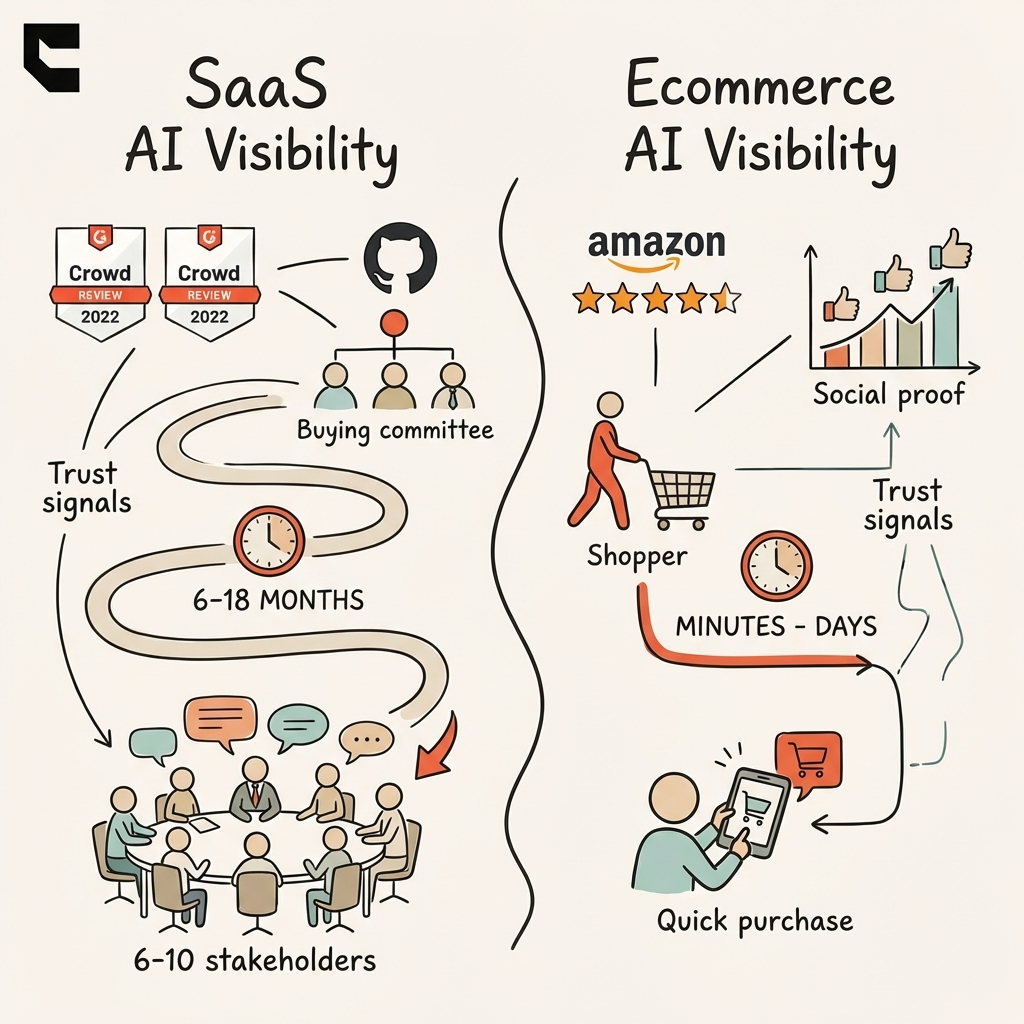
Query types also differ. SaaS buyers ask comparison queries ("[tool A] vs [tool B]"), integration queries ("best CRM that integrates with Slack"), and pricing queries. Ecommerce buyers ask product queries. The SaaS buyer journey is also longer: 6–18 month consideration cycles with 6–10 stakeholders, versus an ecommerce impulse purchase.
Third-party validation works differently too. Developer communities, Reddit, HackerNews, Stack Overflow, and industry Slack groups, carry more weight for SaaS than general consumer reviews. Those developer conversations are the trust signals AI platforms actually care about for B2B software.
| Factor | SaaS / B2B | Ecommerce / DTC |
|---|---|---|
| Primary entity signals | G2, Capterra, Product Hunt, Crunchbase | Amazon, Google Shopping, review sites |
| Key query types | Comparison, integration, pricing | Product search, "best X under $Y" |
| Buyer journey | 6–18 months, 6–10 stakeholders | Minutes to days, 1 buyer |
| Third-party validation | Reddit, HackerNews, Stack Overflow, industry Slack | Reddit, YouTube, Instagram, TikTok |
| Content that gets cited | Technical docs, integration guides, comparison pages | Product descriptions, buying guides |
| Decision influencers | Engineers, VPs, procurement | Individual consumer |
The Five-Part SaaS AI Visibility Framework
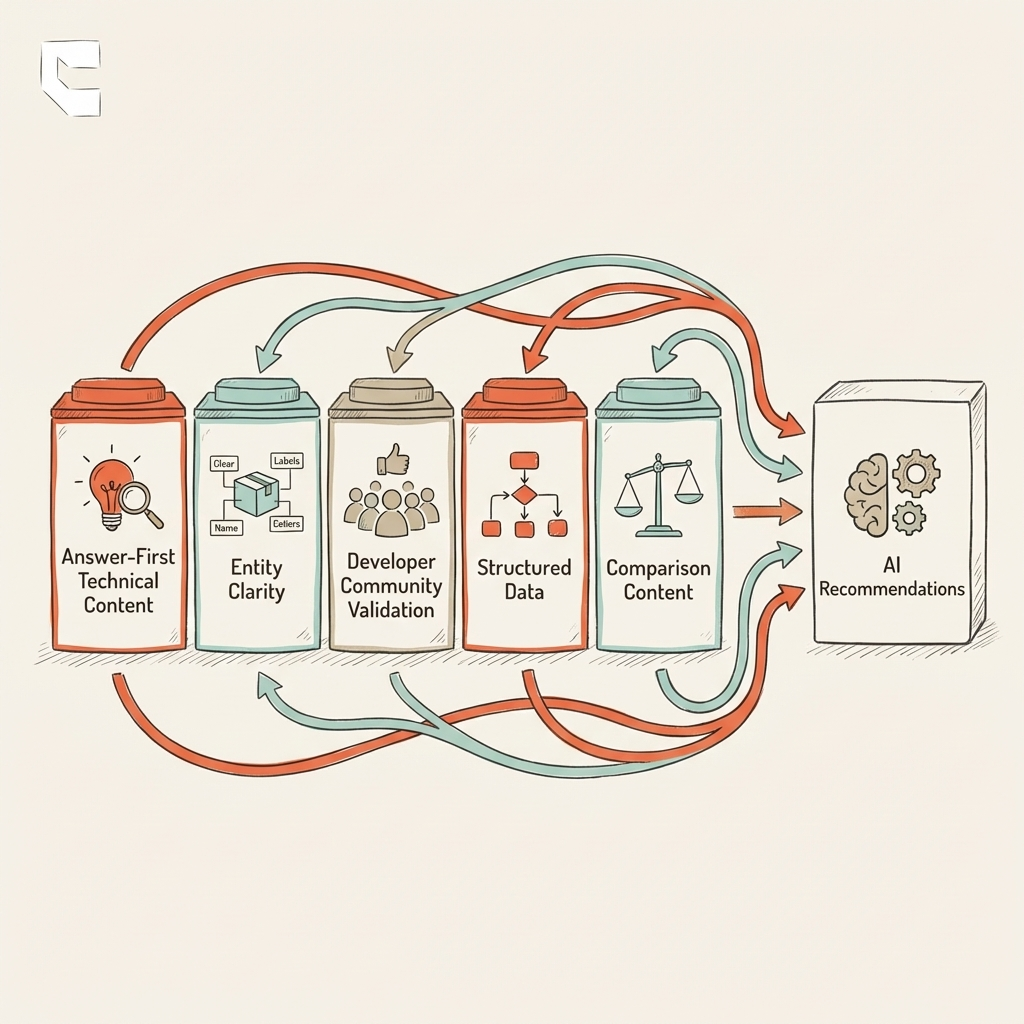
The SaaS AI visibility framework has five parts: answer-first technical content, entity clarity on SaaS directories, developer community validation, structured data, and comparison content.
Answer-First Technical Content
SaaS buyers ask implementation questions: "how to set up SSO with Okta," "best API rate limiting strategy," "how to migrate from [competitor] to [your tool]." Technical docs and integration guides are the most citable SaaS content type, because AI platforms want answers, not introductions. Lead with the direct answer in the first two sentences, then expand. This answer-capsule pattern should appear in every page you publish: documentation, blog posts, and landing pages alike.
Pages that answer a specific question in the first paragraph consistently outperform pages that bury the answer in the third section. AI models pull the most direct, confident answer available. If your competitor's documentation is clearer on "how to set up X," they get the citation, not you.
Entity Clarity Across SaaS Directories
Your G2 profile, Capterra listing, Product Hunt page, Crunchbase entry, and LinkedIn company page all feed into how AI understands your brand. Most teams miss this: if your description says one thing on G2 and something different on Capterra, you're fragmenting your own entity. Keep naming, category tags, descriptions, and use-case language consistent everywhere.
The key directories for SaaS entity signals, in order of AI citation weight:
- G2, The most-cited SaaS directory across ChatGPT and Perplexity. Keep your category, description, and feature tags current.
- Capterra, Critical for SMB and mid-market SaaS. Ensure consistent product descriptions.
- Product Hunt, Strong signal for early-stage and developer-focused SaaS. Active discussion threads are especially citable.
- Crunchbase, Funding and company data used by AI to establish entity legitimacy.
- GitHub, For developer tools, GitHub stars, discussions, and readme quality are direct citation signals.
Run a quarterly entity audit: copy your description from each directory into a single doc and check for inconsistencies. If AI sees five different versions of what your product does, it hedges or skips you.
Third-Party Validation in Developer Communities
Reddit (r/SaaS, r/startups, niche subreddits), HackerNews, Stack Overflow, and industry Slack groups are where SaaS credibility lives. Eighty-five percent of brand mentions in AI search come from third-party sources, not your own website.
Developer communities are the SaaS equivalent of consumer review sites, but they're more trusted by AI platforms because the discussions are organic, detailed, and technical. A 30-comment HackerNews thread about your product gives AI more signal than ten blog posts you wrote yourself.
The playbook: identify the 3–5 subreddits and forums where your buyers spend time. Participate genuinely, answer questions in your category, share original research, be helpful before you're promotional. The goal is not to spam your product name into threads. It's to build a presence that generates authentic organic mentions. Those organic mentions become AI citations.
Structured Data for SaaS
SoftwareApplication schema, FAQ schema, and comparison tables are table stakes. Pages with FAQ schema see 28% higher AI citation rates, according to BrightEdge. Every SaaS product page should implement SoftwareApplication, FAQPage, and HowTo schemas.
FAQ schema is particularly powerful. It creates discrete, machine-readable question-answer pairs that AI models can extract directly. A product page with 6–8 well-structured FAQs on implementation, pricing, and comparisons is dramatically more citable than a page without them.
Comparison Content AI Can Extract
"Vs" pages, feature matrices, and pricing comparisons target the most commercial SaaS query type. AI platforms specifically look for structured comparison data to answer "[tool A] vs [tool B]" queries. Feature matrices in HTML tables work best, they're machine-readable, and AI can pull comparison data directly from them.
For each major competitor, publish a dedicated comparison page. Lead with a one-paragraph honest summary of how you differ, then include a feature table. Don't make it one-sided. AI models distrust content that reads like a promotional brochure. Acknowledge where the competitor is stronger for specific use cases, and clearly articulate where you win.
Tactical Steps: Entity Optimization, FAQ Pages, and Community Presence
These three tactics deliver the highest return on effort for most SaaS teams getting started with AI visibility.
Step 1: Audit and Standardize Your Entity
Run a full entity audit before creating any new content. Query ChatGPT, Perplexity, and Google AI Overviews with prompts like "what is [your product]?" and "who makes [your product category]?" Observe how each platform describes you. Note inconsistencies.
Then audit each directory listing: G2, Capterra, Crunchbase, Product Hunt, LinkedIn. Pull your product description from each into a single document. Standardize the core message: what your product does, who it's for, and what makes it different. Update every listing to match. This alone can improve AI citation accuracy within 4–8 weeks.
Step 2: Add FAQ Sections to Every Key Page
FAQ sections are the fastest content change with the highest citation impact. For every important product or category page:
- Write 5–8 questions your buyers actually ask (check support tickets, sales call transcripts, Reddit threads)
- Lead each answer with a direct, one-sentence response
- Implement FAQPage schema markup behind each FAQ block
Good FAQ questions for SaaS include: how much does [product] cost, how does [product] compare to [competitor], what integrations does [product] support, how long does [product] take to implement, and is [product] SOC 2 compliant. These are the queries buyers ask AI, and the FAQ answers become the content AI cites.
Step 3: Build a Systematic Community Presence
Identify your top 5 subreddits, 2–3 HackerNews domains (Show HN, Ask HN, comments), and any niche forums or Slack groups where your buyers are active. Assign one team member 2–3 hours per week specifically for community participation.
The cadence that works:
- Weekly: Answer 3–5 questions in relevant threads where your product is genuinely a good fit. Don't self-promote, just be useful.
- Monthly: Share one piece of original research or a genuinely interesting perspective. This is the content that generates organic threads.
- Quarterly: Run a transparent case study or behind-the-scenes post about how your product solved a hard problem. Real specifics generate the most engagement and the most citations.
Perplexity updates its citations from Reddit within 2–4 weeks of active discussion. Consistent community presence produces compounding returns, the more genuine discussions exist about your product, the more citations accumulate.
Step 4: Publish Answer-First Content on High-Volume B2B Queries
Map the questions your buyers ask AI before they request a demo. Common SaaS categories include:
- "How do I [solve a problem your product solves]?", Implementation queries
- "Best [category] for [specific use case]?", Recommendation queries
- "[Your product] vs [competitor]?", Comparison queries
- "Is [your product] worth it?", Evaluation queries
For each high-volume query type, publish a dedicated page that leads with the direct answer. The first 100 words should answer the question. The rest of the page adds depth, context, and supporting evidence. This structure is what AI models pull from.
How Did Hamming.ai Achieve 8.5x Traffic in 12 Weeks?
Hamming.ai grew from 200 to 1,900 daily visitors in 12 weeks, with 40% of demos from AI and Reddit channels.
This YC-backed AI voice testing platform achieved 8.5x organic traffic using the SaaS-specific AI visibility playbook.
Hamming.ai builds software for testing AI voice agents. Their buyers are technical: engineers and product managers at companies deploying voice AI. These buyers research solutions in AI chatbots and developer forums before ever reaching a sales page. A buyer journey typical of most SaaS companies.
Before the AI visibility campaign, Hamming.ai had an excellent product and near-zero AI search presence. ChatGPT, Perplexity, and Google AI Overviews didn't recommend them for any meaningful queries. They were invisible in the channel where their buyers were increasingly spending time.
The SaaS-specific playbook executed across four areas simultaneously:
Technical content built for AI citation. Hamming.ai published implementation guides answering the specific questions their buyers asked AI: "how to test AI voice agents," "best practices for voice agent quality assurance," "how to set up automated testing for LLM voice apps." Each piece led with a direct answer and included structured data markup. This gave AI platforms specific, citable content that didn't exist before.
Reddit presence in the right communities. Hamming.ai's team engaged in r/SaaS, r/artificial, and specialized voice AI forums. Not promotional posts, genuine answers to questions about voice agent testing, common failure modes, and quality benchmarks. Within weeks, organic threads mentioned Hamming.ai in discussions that Perplexity started indexing.
Entity consistency across directories. Product Hunt, Crunchbase, and Y Combinator's company directory all received updated, consistent descriptions. The core entity message, "AI voice agent testing platform", was standardized across every listing.
Comparison content against alternatives. Dedicated pages comparing Hamming.ai to adjacent tools captured the comparison query traffic that represented high buying intent.
The results: 200 to 1,900 visitors per day in 12 weeks, an 8.5x increase. Forty percent of demos now originate from Reddit or AI search. As CEO Sumanyu Sharma described it: "We went from 200 visitors/day to 1,900 visitors/day and 40% of the demos we get are from Reddit or AI search."
The compounding effect matters here. Each Reddit mention created more citations. More citations drove more organic mentions. Each organic mention reinforced the AI's entity understanding of Hamming.ai. That flywheel is especially powerful for SaaS because developer communities actively share tool recommendations with peers.
How to Measure AI Visibility for SaaS
SaaS AI visibility is measured through prompt audits for B2B queries, citation share of voice against competitors, and pipeline attribution from AI referral traffic.
Prompt Audit for SaaS
Build a list of 20–30 queries your buyers actually ask AI. Include all four types:
- Comparison queries: "[your tool] vs [competitor]"
- Category queries: "best [category] for [use case]"
- Integration queries: "best [tool] that works with [platform]"
- Implementation queries: "how to [solve problem your product solves]"
Run each query across ChatGPT, Perplexity, and Google AI Overviews. Record: does your brand appear? Is it cited with a link? What is the context and sentiment? Repeat monthly to track changes in recommendation frequency.
This audit takes about 2–3 hours and gives you a clear baseline. Teams without this data are optimizing blind.
Citation Share of Voice
Share of voice tracks how often your brand appears versus competitors in AI responses to your target queries. For SaaS, focus on category and comparison queries where purchase intent is highest.
Run 20 prompts per query type. Record every brand that appears. Calculate each brand's appearance rate as a percentage of total prompts. That's share of voice. If you appear in 8 of 20 relevant prompts, you have 40% share of voice for that query type.
Share of voice in AI recommendations correlates directly with pipeline share. Brands that dominate AI recommendations in their category consistently outperform on inbound demo volume.
Pipeline Attribution
Track referral traffic from ChatGPT, Perplexity, and AI Overviews through to demo requests and closed deals. In GA4, create a segment filtering for referral traffic from known AI sources. These sessions show a markedly different conversion rate, typically 4–10x the baseline, confirming the pipeline value.
Add UTM parameters to any links in AI-indexed content to attribute correctly. Account for indirect attribution: AI often influences the buyer without being the last click. Post-demo surveys asking "how did you first hear about us?" frequently surface AI search as an influence point even when the last click was direct.
For the complete measurement framework, see how to measure AI visibility.
Leading Indicators to Track Weekly
While pipeline attribution is the ultimate metric, these weekly signals indicate whether AI visibility is building:
- Number of Reddit/HackerNews mentions (organic)
- G2 and Capterra review velocity
- Branded search volume in Google Search Console
- ChatGPT and Perplexity referral sessions in GA4
Branded search lift is a particularly useful signal. When AI mentions your brand in recommendations, users often then search your brand name on Google. An uptick in branded search correlating with AI optimization work is a reliable secondary indicator that citations are increasing.
Frequently Asked Questions About AI Visibility for SaaS
These are the most common questions SaaS teams ask when starting with AI visibility optimization.
How long does SaaS AI visibility take to show results?
Most SaaS companies see Perplexity visibility within 2–4 weeks, Google AI Overviews in 4–8 weeks, and ChatGPT training data impact in 60–180 days. Reddit-driven results can appear within days. Results vary by existing domain authority and content volume. SaaS companies with strong G2 presence and active developer communities see faster timelines. Entity standardization, ensuring consistent descriptions across G2, Capterra, and Crunchbase, is the single fastest-impact change most teams can make.
Does AI visibility work for enterprise SaaS with long sales cycles?
Enterprise SaaS actually benefits the most. AI shapes the vendor shortlist months before procurement kicks off, and multiple stakeholders are all independently researching in AI chatbots. The longer the sales cycle, the more touchpoints exist where AI recommendations can influence the buying committee. A team evaluating ERP systems over six months will encounter AI search dozens of times across different stakeholders. Being present in those recommendations consistently is more valuable than any single paid touchpoint.
What about technical or developer-focused audiences?
Technical audiences are the most active AI search users. Developers and engineers already live inside ChatGPT and Perplexity. They research there daily, not just casually. For developer-focused SaaS, the entity signals that matter most live on Stack Overflow, in GitHub discussions, and across HackerNews threads. GitHub readme quality, documentation depth, and Stack Overflow answer presence are all direct inputs into how AI models evaluate and recommend developer tools.
Can a SaaS startup compete with established vendors in AI search?
Startups with real community traction and solid technical content regularly beat established vendors in AI recommendations. AI platforms care more about recent, authentic discussions than brand size. Hamming.ai did it in 12 weeks against established voice testing platforms. Freshness and community engagement count for more than brand recognition in AI search, which is the opposite of traditional SEO where domain authority compounds over years and is hard to displace.
How does AI visibility fit with existing SaaS marketing (SEO, paid, PLG)?
AI visibility complements every existing channel. It strengthens SEO by adding structured citability. It reduces paid ad dependency by building organic recommendations that persist. It supports product-led growth by making the product discoverable through technical implementation queries. The content you create for AI visibility, technical guides, FAQ pages, comparison content, also performs well in traditional search. These are not competing investments. AI visibility is an accelerant that makes every existing content piece work harder.
What's the first thing a SaaS team should do to improve AI visibility?
Conclusion
- B2B buyers research in AI at 3x the rate of consumers. SaaS companies invisible in AI search are invisible to their buyers before the sales conversation even starts.
- SaaS AI visibility requires different signals than ecommerce: G2/Capterra entities, developer community validation, comparison content, and technical documentation.
- The five-part framework, answer-first content, entity clarity, community validation, structured data, and comparison pages, is repeatable and measurable.
- The framework works: Hamming.ai achieved 8.5x traffic and 40% of demo pipeline from AI channels in 12 weeks.
- Results are measurable through prompt audits, citation share of voice, and pipeline attribution.
Run a prompt audit today. Ask ChatGPT and Perplexity the top 10 queries your buyers use. See where you appear and where competitors dominate. Then standardize your entity across directories, it's the fastest, highest-leverage change most SaaS teams can make.
For SaaS companies evaluating a managed AI visibility program, Cintra's SaaS AI visibility capability details the deliverables, timeline, and methodology behind our B2B SaaS programs. For a comprehensive review of the best AI SEO tools for B2B SaaS specifically, covering which tools are built for SaaS buyer journeys, that guide reviews the top options by use case. For SaaS companies evaluating which agency to work with, best AI visibility agency for SaaS startups ranks options by their documented B2B SaaS citation methodology. To understand how to get cited by Grok, the xAI platform gaining traction with B2B enterprise buyers, that guide covers the Grok-specific optimization approach.
See where your brand appears in AI search
Scan ChatGPT, Perplexity, and Google AI across buyer-intent queries, instantly, no sign-up.
Find out if AI is sending buyers to your competitors.
We audit your AI visibility across ChatGPT, Perplexity, and Google AI –and show you exactly where you rank and what to fix.
“We went from 200 visitors/day to 1,900 visitors/day and 40% of demos are from AI search.”
Sumanyu Sharma · CEO, Hamming.ai
“Cintra helped me go from 3k to 7.5k daily traffic and doubled weekly orders in 1.5 months.”
Russ Coulon · Owner, UV Blocker
“We saw a lift from 3% to 13% visibility in the first 2 weeks, and organic traffic hit its highest ever.”
Ash Metry · Founder, Keywords.am
Related Articles
Organic Traffic Decline 2026: Why It's Dropping and How to Recover
Organic traffic decline 2026 is real. AI Overviews cut clicks 38% on triggered queries. Here's what's causing…
AI Visibility Reporting: What to Track, Who to Tell, and How to Prove ROI
AI visibility reporting requires different metrics and formats than SEO reports. Learn the five core metrics,…
AI Visibility Competitive Analysis: How to Find and Exploit Gaps in 2026
AI visibility competitive analysis across ChatGPT, Perplexity, and 5 other engines. Framework for tracking com…