Agentic Commerce Optimization: 7 Proven Steps to Stop Losing to AI Agents
Agentic commerce optimization prepares ecommerce brands for AI shopping agents. Practical checklist, protocol comparison, and real case study inside.
TL;DR
- AI shopping agents autonomously select and purchase products today.
- UCP, ACP, and WebMCP define how merchants interface with agents.
- Agents evaluate structured data completeness and ignore marketing fluff.
- Missing GTINs or real-time availability disqualify products entirely.
- Trust signals from Reddit and YouTube strongly influence agent selection.
- Brands optimizing for AI search have completed most of the technical groundwork.
- Test readiness now by asking ChatGPT for product recommendations.
McKinsey projects AI shopping agents will orchestrate $1 trillion in US retail revenue by 2030. That shift is not hypothetical. Google launched the Universal Commerce Protocol in January 2026. ChatGPT already features instant checkout.
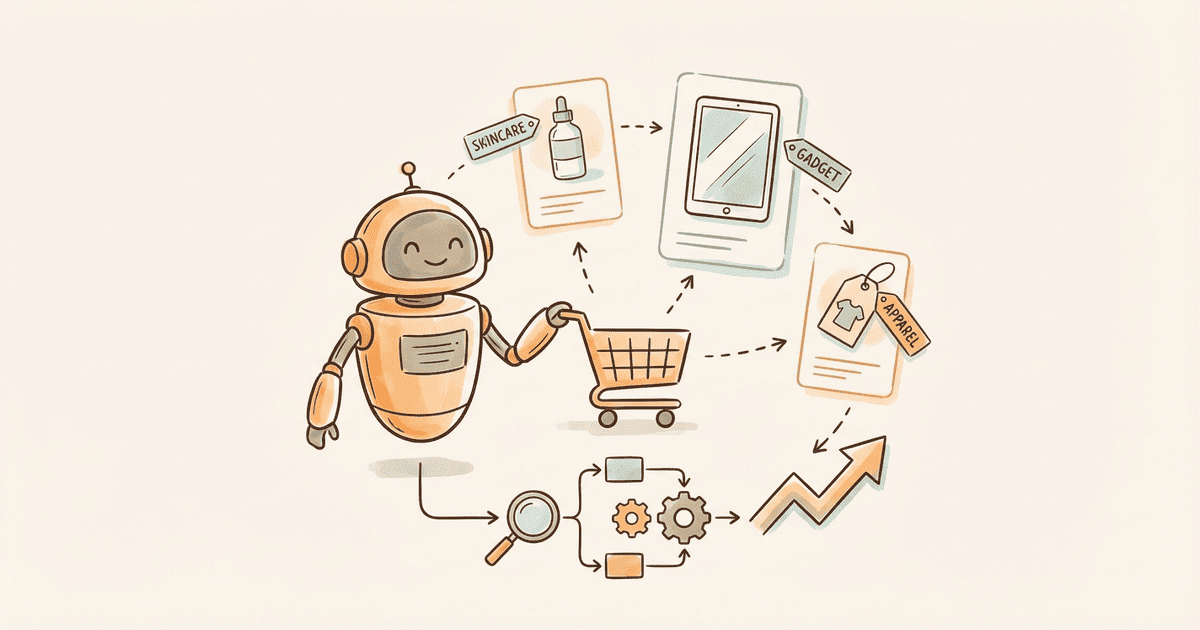
Agentic commerce optimization addresses this gap. Most ecommerce brands optimize exclusively for human shoppers, but AI agents evaluate products differently. They parse structured data, check third-party mentions, and prioritize factual accuracy. Brands ignoring this shift will become invisible to the agents mediating purchases.
What Is Agentic Commerce and Why Should Ecommerce Brands Care?
Agentic commerce is a model where AI agents discover, evaluate, and purchase products on behalf of consumers, and McKinsey forecasts it will reach $1 trillion in US retail by 2030.
This model goes far beyond chatbots. Agents act as purchasing representatives, evaluating options against constraints and handling checkout autonomously. Shoppers are already delegating research to these digital assistants. Salesforce data reveals that AI assistant traffic grew 119% year-over-year in the first half of 2025.
Conversion rates from AI channels are 700% higher than social media. Google launched UCP in January 2026. OpenAI released ACP in September 2025. ChatGPT features instant checkout with Etsy and Shopify merchants.
Understanding what AI visibility is provides the baseline for everything that follows.
How Do AI Shopping Agents Choose Products?
See where you rank across all AI answer engines.
Enter your domain and we'll scan your citation rate across ChatGPT, Perplexity, and Google AI.
Prefer to talk? Book a free 30-min call
AI shopping agents evaluate products through a five-stage pipeline: intent parsing, data extraction, multi-factor comparison, selection, and transaction, prioritizing structured data and third-party validation over marketing copy.
The agent pipeline works systematically:
- Parse user intent from the original request
- Extract product data via structured markup and feeds
- Run multi-factor comparison of specs, pricing, verified reviews, and availability
- Select based on factual fit, not brand perception
- Execute the transaction autonomously via protocol
This shift means brands need to rethink their zero-click search strategy for autonomous agents.
Human buyers respond to emotional copy, brand aesthetics, and lifestyle imagery. Agents evaluate data completeness, mention frequency, and specification match. Seer Interactive found that 42% of customers abandon purchases due to insufficient product information. Agents don't abandon. They reject poorly documented products outright.
Here's the difference in plain terms. "Best sunscreen ever" means nothing to an agent. "SPF 50+, broad spectrum, 3oz, reef-safe, 4.7 stars across 2,400 reviews" gets a product selected.
What Are the Key Agentic Commerce Protocols?
Three protocols define agentic commerce today: Google UCP covers the full shopping lifecycle, OpenAI ACP enables instant checkout in ChatGPT, and WebMCP lets agents interact with websites as structured tools.
Google UCP (January 2026)
Google's Universal Commerce Protocol covers six capabilities: product discovery, cart management, identity linking, checkout, order management, and vertical-specific features. Launch partners include Shopify, Etsy, Wayfair, Target, and Walmart. UCP powers checkout directly within Google AI Mode and the Gemini app.
OpenAI ACP (September 2025)
OpenAI developed the Agentic Commerce Protocol alongside Stripe. ACP focuses on the transaction layer, powering instant checkout inside ChatGPT. The protocol uses a Shared Payment Token for security. It's live with Etsy sellers and expanding to Shopify merchants like Glossier and Vuori.
WebMCP (February 2026)
Google introduced WebMCP in February 2026, letting site owners expose their properties as structured tools for AI agents. Cloudflare supports this with Markdown for Agents, delivering an 80% token reduction. WebMCP is available in Chrome 146 Canary with a full launch expected mid-2026.
| Protocol | Launched | Developer | Scope | Key Partners |
|---|---|---|---|---|
| UCP | Jan 2026 | Full commerce lifecycle | Shopify, Etsy, Wayfair, Target, Walmart | |
| ACP | Sep 2025 | OpenAI + Stripe | Checkout + payment | Etsy, Shopify, Glossier, Vuori |
| WebMCP | Feb 2026 | Site-agent interaction | Cloudflare, Chrome |
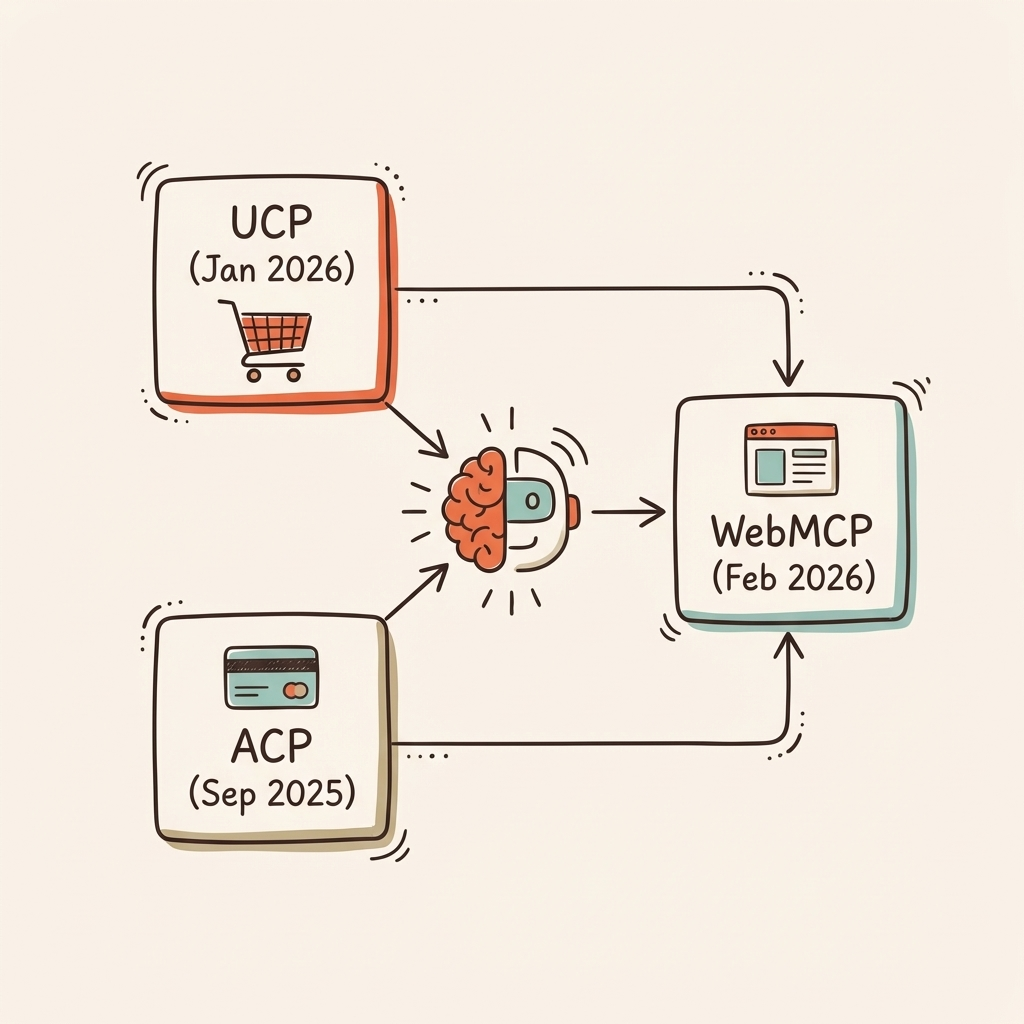
Proper schema markup for AI visibility ensures your data meets these protocol standards.
Why Is AI Visibility the Foundation for Agentic Commerce?
AI visibility optimization, including structured data, entity authority, and third-party mentions, provides the exact foundation that AI shopping agents require to discover, evaluate, and select products.
Agentic commerce optimization is not a brand-new discipline. It's AI visibility applied to the transaction layer. The signals that get brands cited by ChatGPT and Perplexity are the same signals agents use to select products for purchase.
Here's how the work maps directly:
- Product schema markup translates into agent-readable product data
- Third-party mentions on Reddit and YouTube generate trust signals agents evaluate during comparison
- Conversational product content creates specifications agents can parse
- Entity authority builds brand recognition across AI systems
Brands already executing AI visibility optimization have 60 to 70 percent of the agentic commerce foundation in place. The remaining gap is protocol integration: feeds, APIs, and real-time inventory. We see this connection clearly in our ecommerce AI search optimization work and in the measurable ROI of AI visibility, which documents how these investments translate to revenue. For the data behind how AI shopping traffic converts, the AI search statistics page includes platform-specific citation and conversion benchmarks.
The Agentic Commerce Readiness Checklist
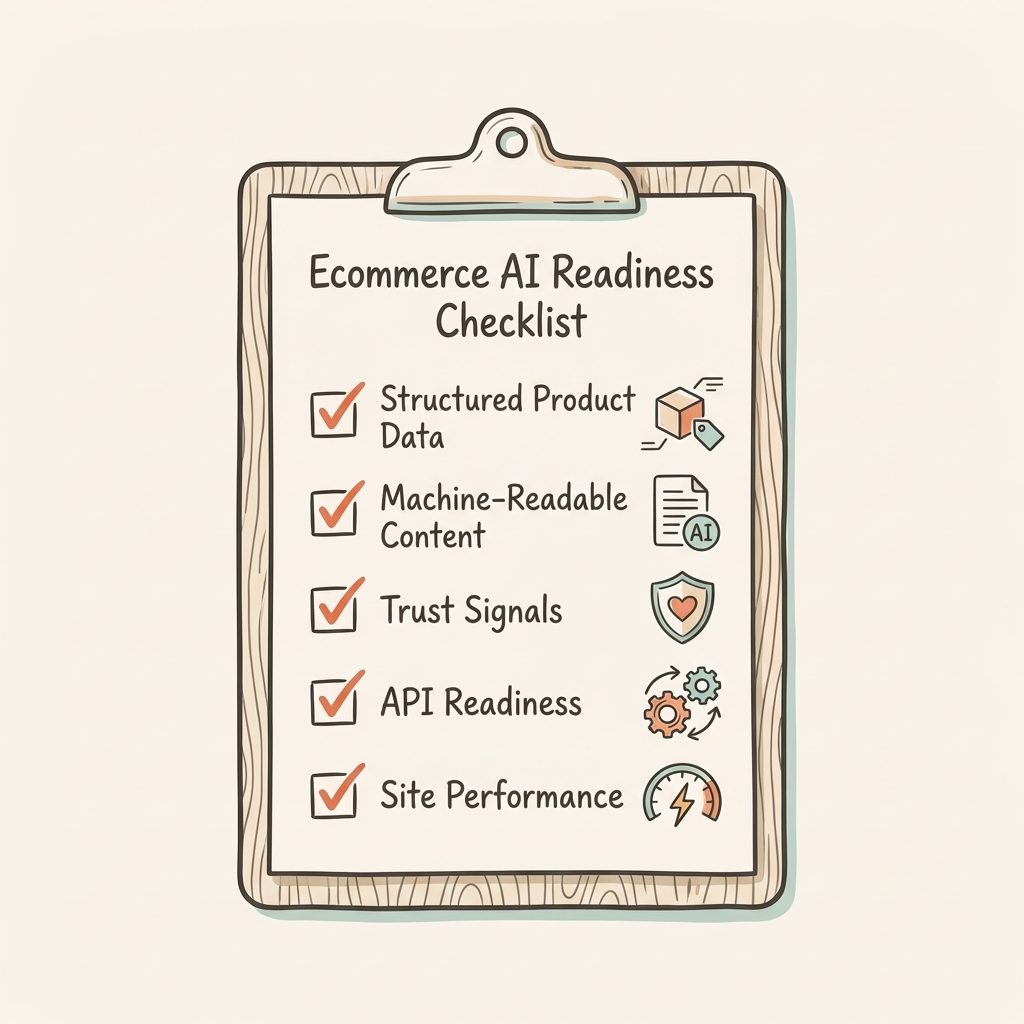
A thorough agentic commerce optimization audit covers five areas: structured product data, machine-readable content, third-party trust signals, API and feed readiness, and site performance for agents.
1. Structured Product Data
Your site needs complete product schema: valid GTIN, price, availability, brand, and reviews. A missing GTIN alone can disqualify products from agent selection. Use the Google Rich Results Test to verify. For deeper guidance, see our schema markup for AI visibility guide.
2. Machine-Readable Content
Product pages must feature factual specifications, not persuasive marketing copy. Agents parse "SPF 50+, broad spectrum, reef-safe" with ease. They can't process "the ultimate sun protection experience." Rewrite content so an agent can extract raw specs without reading prose.
3. Third-Party Trust Signals
Agents cross-reference multiple external sources before recommending products. They check Google reviews, Reddit mentions, YouTube reviews, and expert citations. Test this yourself: search your brand name in ChatGPT and see what comes back.
4. API and Feed Readiness
Your Google Merchant Center feed must reflect real-time inventory. Product feed accuracy is non-negotiable. UCP requires structured return policies and consumer safety warnings. Ensure your feeds sync without errors.
5. Site Speed and Crawlability
Agents operate on strict time budgets. They need sub-three-second page loads, predictable URL structures, and no JavaScript-only product data. Seer Interactive found agents completed a standard task in 2:09 on a fast retail site versus 4:11 on a slower competitor.
| Area | Key Requirements | Quick Test |
|---|---|---|
| Structured Data | Product schema, GTIN, offers, reviews | Run Google Rich Results Test |
| Content | Factual specs, attributes, comparison data | Can an agent extract specs without reading prose? |
| Trust Signals | Reviews, Reddit/YouTube mentions, expert citations | Search "[brand] + [product]" in ChatGPT |
| Feeds & APIs | Merchant Center, real-time inventory, return policies | Check Merchant Center for errors |
| Site Performance | Sub-3s load, predictable URLs, crawlable data | Test with Lighthouse + structured data validator |
How Did AI Visibility Drive 38K Clicks and Double Orders?
UV Blocker grew from zero to 38,000 organic clicks and doubled weekly orders in 1.5 months by implementing the structured data and third-party mention strategy that agentic commerce requires.
UV Blocker is an ecommerce sun protection brand that started with almost zero organic presence in AI systems. We implemented a comprehensive AI visibility strategy: structured product data, conversational product content, and targeted third-party mention building.
The results speak for themselves:
- 0 to 38,000 organic clicks in six months
- Daily traffic surged from 3,000 to 7,500 unique visitors
- Doubled weekly orders in 1.5 months during off-season
Founder Russ Coulon put it directly: "Cintra helped me go from 3k to 7.5k daily traffic and doubled my weekly orders in 1.5 months in off-season."
Every element of this playbook connects to agentic commerce readiness. The structured data, factual product specs, and validated third-party mentions are exactly what AI shopping agents need to discover and select products. The strategy that drives AI search results for ecommerce today prepares brands for agent-mediated commerce tomorrow.
What Should Ecommerce Brands Do This Quarter?
Start with a structured data audit and Merchant Center feed review this week, then build machine-readable product content and third-party mentions over the next 30 days.
Week 1: Technical Audit
Run a structured data validator against your top 20 products. Check Google Merchant Center for feed errors. Test your baseline by asking ChatGPT to describe your core products. If the AI hallucinates details, your structured data is failing.
Weeks 2-3: Content Optimization
Rewrite your highest-value product pages. Focus on surfacing factual specifications that agents can parse and index. Add comparison data, ingredient lists, and detailed spec tables. Remove vague marketing language that agents can't process.
Week 4: Trust Signals and Feeds
Ensure review aggregation is pushing data to platforms. Check Reddit and YouTube for brand mentions and correct inaccuracies. Submit an updated product feed to Merchant Center with structured return policies, as UCP requires this.
The 30-Second Test
Ask ChatGPT: "What is the best [your product category]?" Does your brand appear? If not, the foundations need work.
Frequently Asked Questions About Agentic Commerce Optimization
These are the most common questions ecommerce brand owners ask about preparing for AI shopping agents.
What is agentic commerce?
Agentic commerce is a model where AI agents autonomously discover, evaluate, compare, and purchase products on behalf of consumers without requiring human intervention at each step.
How do AI shopping agents choose products?
AI shopping agents parse structured product data, cross-reference third-party reviews and mentions, evaluate specification match against user intent, and select based on factual accuracy rather than persuasive marketing.
What is Google UCP?
Google's Universal Commerce Protocol is an open-source standard launched January 2026 that enables AI agents to handle the full commerce lifecycle, from product discovery through checkout and order management.
Will AI agents replace online shopping?
AI agents won't replace shopping but will increasingly mediate it. McKinsey projects agents will orchestrate $1 trillion in US retail by 2030, meaning brands must optimize for agent selection alongside human browsers.
What structured data do I need for agentic commerce?
Product schema markup including name, GTIN, price, availability, brand, aggregate reviews, and detailed specifications. Missing GTINs or incomplete offers data can disqualify products from agent consideration.
Conclusion
Agentic commerce is live today, not a 2030 prediction.
- AI visibility forms the foundation for agent readiness
- Brands optimizing for AI search have already completed 60 to 70 percent of the required preparation
- Starting with structured data and machine-readable content delivers compounding quick wins
- The same playbook that drives AI citations today prepares brands for AI purchases tomorrow
Take action now. Ask ChatGPT, "What is the best [your product category]?" If your brand doesn't appear, start with the readiness checklist above.
See where your brand appears in AI search
Scan ChatGPT, Perplexity, and Google AI across buyer-intent queries, instantly, no sign-up.
Find out if AI is sending buyers to your competitors.
We audit your AI visibility across ChatGPT, Perplexity, and Google AI –and show you exactly where you rank and what to fix.
“We went from 200 visitors/day to 1,900 visitors/day and 40% of demos are from AI search.”
Sumanyu Sharma · CEO, Hamming.ai
“Cintra helped me go from 3k to 7.5k daily traffic and doubled weekly orders in 1.5 months.”
Russ Coulon · Owner, UV Blocker
“We saw a lift from 3% to 13% visibility in the first 2 weeks, and organic traffic hit its highest ever.”
Ash Metry · Founder, Keywords.am
Related Articles
Organic Traffic Decline 2026: Why It's Dropping and How to Recover
Organic traffic decline 2026 is real. AI Overviews cut clicks 38% on triggered queries. Here's what's causing…
AI Visibility Reporting: What to Track, Who to Tell, and How to Prove ROI
AI visibility reporting requires different metrics and formats than SEO reports. Learn the five core metrics,…
AI Visibility Competitive Analysis: How to Find and Exploit Gaps in 2026
AI visibility competitive analysis across ChatGPT, Perplexity, and 5 other engines. Framework for tracking com…