Topical Authority AI Search: 5 Keys to Content Clusters
Topical authority is the strongest predictor of AI citations. Learn how content clusters with interconnected pages get cited by ChatGPT, Perplexity, and AI Overviews.
TL;DR
AI citations no longer track Google rankings. Topical authority (the depth of your interconnected content on a topic) is the strongest citation predictor. Build a pillar page plus 5-8 cluster pages, link them bidirectionally with descriptive anchor text, and you give LLMs the topical depth signal they need to cite you across ChatGPT, Perplexity, Gemini, and AI Overviews.
Only 38% of pages cited in AI Overviews also rank in Google's top 10. Seven months earlier, that number was 76%. Rankings and citations are separating fast.
Brands still publishing standalone articles optimized for Google are invisible to AI. Topical authority AI search is the new citation signal: how comprehensively you cover a subject across interconnected content determines whether LLMs cite you.
This guide covers how LLMs evaluate topical authority, why content clusters outperform standalone pages, and how to build a minimum viable cluster that earns citations across every major AI platform. We built our own AI visibility cluster (90+ articles and counting) on these principles, so this isn't theory. It's what we do daily for clients.
What Is Topical Authority AI Search, and Why Does It Override Rankings?
AI citations no longer follow Google rankings. Only 38% of AI Overview citations come from top-10 pages, and 80% of ChatGPT citations don't rank in Google's top 100 at all.
Ranking signals still matter, but they don't control citation outcomes the way they used to. Ahrefs found that overlap between AI Overview citations and Google's top 10 dropped from 76% to 38% after Google's Gemini 3 upgrade in January 2026, based on 863K keywords and 4M AI Overview URLs analyzed. A separate Ahrefs analysis found only 12% of AI-cited URLs rank in Google's top 10 for the original prompt. That points to a fundamentally different evaluation model. For more on what this shift means, see our guide on what is AI visibility.
Position.digital's 2026 statistics show the gap is wider on some platforms. Eighty percent of ChatGPT and Perplexity citations don't appear in Google's top 100 at all. Cross-platform overlap sits at only 10% to 15%. Traditional authority metrics are on the sidelines. ZipTie.dev found domain authority explains less than 4% of AI citation variance (r² = 0.032). Both Search Engine Journal and BrightEdge tracked the same trend.
If rankings and domain authority don't predict citations, topic coverage does. That's the real shift.
How Do LLMs Actually Evaluate Topical Authority?
See where you rank across all AI answer engines.
Enter your domain and we'll scan your citation rate across ChatGPT, Perplexity, and Google AI.
Prefer to talk? Book a free 30-min call
LLMs reward sources that cover a subject comprehensively across multiple pages. Topical authority is the strongest citation predictor, and it beats domain authority by a wide margin.
ZipTie.dev reports topical authority correlation at r=0.41, while domain authority sits at r²=0.032 and backlinks at r²=0.038. Connected coverage matters more than a single strong domain signal. A page with rich entity coverage and a surrounding cluster gives the model more reasons to trust the source. Entity SEO for AI search explains the entity layer that sits underneath topical authority. Entities help define what the topic is actually about.
Here's the most counterintuitive finding. Pages ranking #6 to #10 with strong topical authority get cited 2.3x more than #1-ranked pages with weak topical authority. Position doesn't matter as much as depth.
E-E-A-T still matters, but as a gate. ZipTie.dev found 96% of AI Overview citations come from sources with strong E-E-A-T signals. Once a source clears that threshold, topical depth becomes the separator. E-E-A-T for AI search covers that trust layer in more detail.
The mechanism is simple. When a retrieval system finds several pages from the same domain covering different facets of a subject, citation confidence rises. It isn't about one perfect article. It's about the full map.
What Is the Pillar-Cluster Model for AI Search?
The pillar-cluster model connects one broad pillar page to detailed cluster pages, creating the interconnected coverage LLMs read as topical authority.
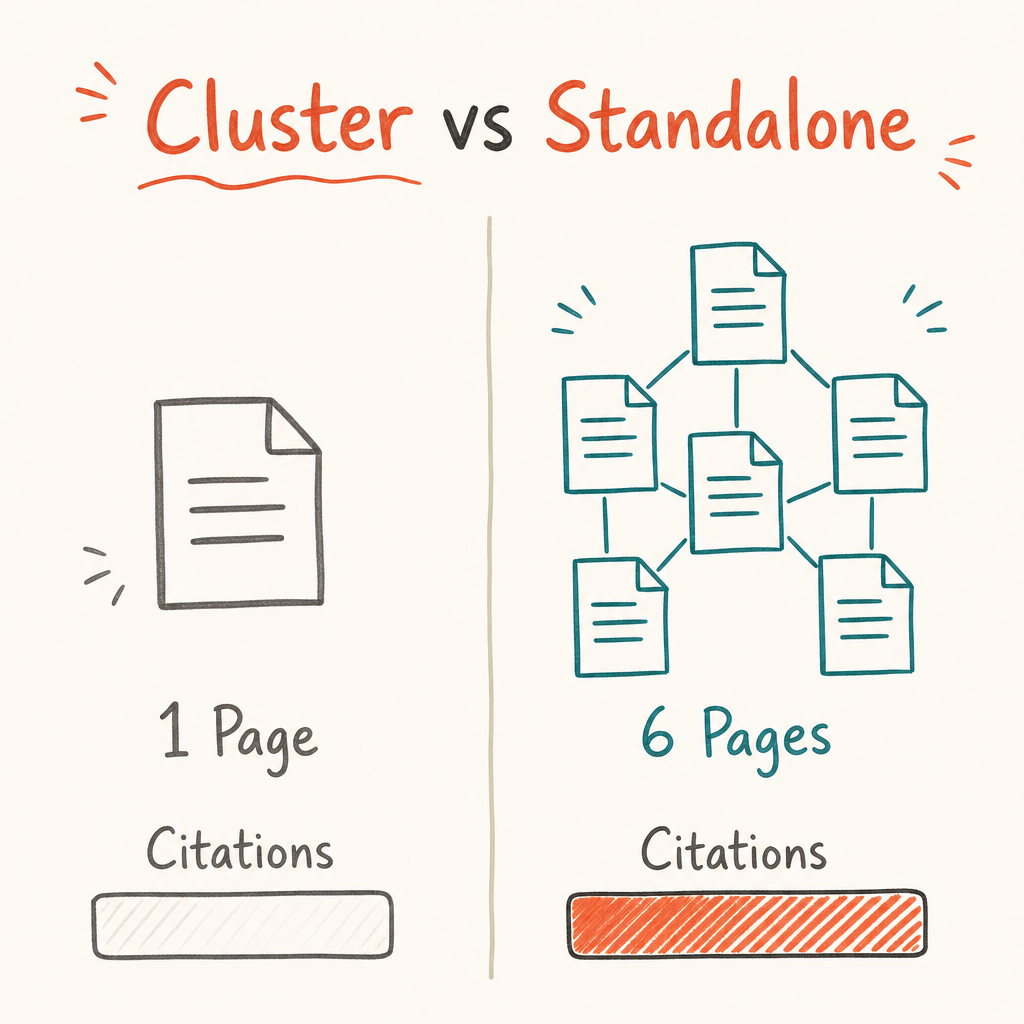
A pillar page answers the broadest question in the topic. For an AI visibility program, that pillar might be what is AI visibility. It should be the general page a reader or model can cite for a wide prompt.
Cluster pages own narrower subtopics. For the same topic, those might include schema markup for AI visibility, backlinks for AI visibility, entity SEO for AI search, and E-E-A-T for AI search. Each page should add distinct information, not repeat the pillar in a thinner form.
The link architecture has to live in body text. Sidebar modules and footer widgets do little for semantic signaling. A link saying "see schema markup for AI visibility for structured data examples" sends a clearer topic cue than "related post." Bidirectional linking matters too. The pillar links to each cluster, and each cluster links back. Mesh topology goes one step further by connecting related cluster pages where it makes sense.
Hub-and-spoke works for smaller sets. Mesh works better once the cluster gets larger. Our AI visibility blog now spans 90+ interconnected articles, showing how a broad topic can sustain a deep mesh over time.
| Element | Purpose | AI Citation Role |
|---|---|---|
| Pillar page | Broadest topic coverage | Primary citation target for general queries |
| Cluster pages (5-8) | Subtopic depth | Cited for specific questions; reinforce pillar authority |
| Internal links (bidirectional) | Semantic connection | Creates pathways LLMs traverse to assess coverage |
| Schema markup | Structured data | Helps AI parse topic relationships between pages |
| Anchor text | Topic signaling | Tells LLMs what each linked page is about |
How Many Pages Does a Topic Cluster Need?
Five to eight interconnected pages is the minimum threshold for citation advantage, though topic complexity changes the number.
That range gives LLMs enough surface area to see genuine coverage. Below it, a site looks like a single-page publisher with a few extras. Content with 15 or more connected named entities shows 4.8x higher selection probability by AI engines. Entity density matters as much as page count.
Five thorough pages beat fifteen thin ones. A narrow topic, like schema markup for AI, might only need three to five pages. A broad topic like AI visibility can support 30 or more. We've tested this directly. Our AI visibility cluster started small and now spans 90+ articles because the topic is that broad. Each new piece we publish strengthens the cluster signal.
That's where an AI content audit becomes useful. It shows which subtopics already exist, which links are missing, and which gaps stop the cluster from looking complete.
How Does Internal Linking Boost AI Citations?
Contextual body-text links create semantic pathways that LLMs follow when evaluating topical authority. Link placement and anchor text matter more than link volume.
The surrounding sentence gives the model context. A link in a paragraph about trust signals makes "backlinks for AI visibility" look relevant in a way a footer widget cannot. Good anchor text is descriptive: "entity SEO for AI search" or "schema markup for AI visibility." Weak anchor text says "click here" or "read more." The first set tells the model what the page covers. The second says nothing.
Bidirectional Links Are the Backbone
Every cluster page should point back to the pillar, and the pillar should point out to each cluster. Cross-links between cluster pages add more routes for the model to interpret the topic map. We connect each new article to at least 3-4 existing pieces before publishing. That's a non-negotiable part of our workflow.
Orphaned Pages Are the #1 Failure Mode
A new article that never links into the cluster doesn't strengthen the authority signal. This is the single most common failure we see in client audits. The content exists, but it sits outside the web.
Internal structure does the heavy lifting, but broader trust signals help. Backlinks for AI visibility covers the off-site layer that complements the cluster rather than replaces it.
How Does Topical Authority Differ Across AI Platforms?
Each AI platform evaluates topical authority differently. ChatGPT favors breadth and entity coverage, Perplexity weights recency, and Gemini leans on Google-indexed authority signals.
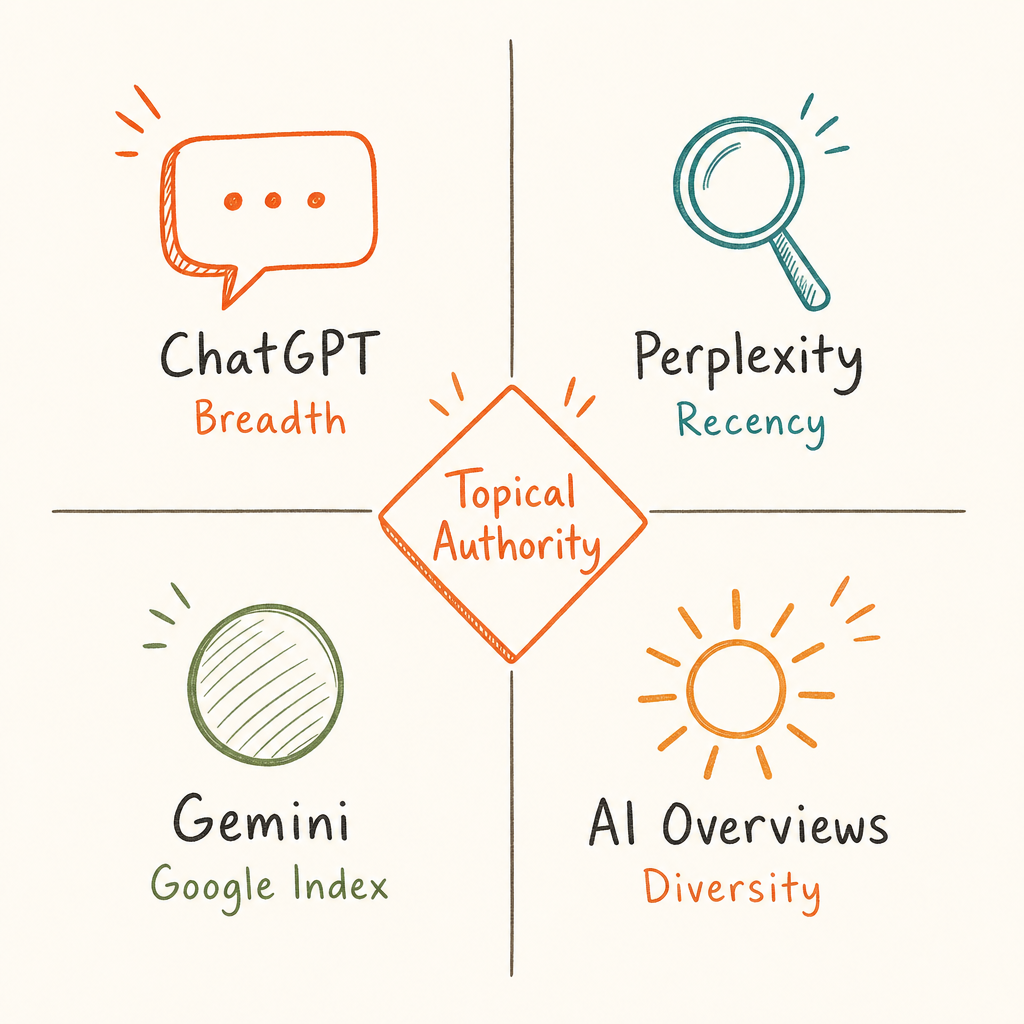
ChatGPT tends to reward wide coverage. A domain with many connected pages on a topic gives the retrieval system more places to pull from. We've seen clients' citation counts jump after publishing their fifth or sixth cluster page on a single topic.
Perplexity behaves differently. Fresh cluster pages and recent data carry more weight, so update cadence matters more here than on slower-moving platforms. Keep your cluster pages current.
Gemini and AI Overviews still sit closer to Google's index. Crawl frequency, backlinks, and traditional authority signals remain relevant, but the 38% overlap figure shows even that world is diversifying away from pure rankings. Cross-platform overlap of only 10% to 15% means the same page rarely wins everywhere for the same query.
That variation matters. A cluster approach gives each platform multiple pages to choose from. One engine may cite the pillar. Another may cite a fresh subtopic page. Breadth creates options.
How Do You Measure Topical Authority Progress?
Track citation frequency per topic cluster, new queries triggering your domain, share of voice within the topic, and internal link equity flow across cluster pages.
Citation frequency is the baseline. Count how often each cluster page appears in AI answers for target prompts. Month-over-month growth signals the cluster is gaining authority. We track this for every client engagement using AI visibility monitoring tools. How to measure AI visibility covers the mechanics in detail.
New query triggers matter too. A brand that starts showing up for related prompts it never directly targeted is seeing topical authority generalize. That's stronger evidence than a single citation on a narrow keyword.
Share of voice is the North Star metric. It shows what share of AI answers in a topic mention your brand versus competitors. If crawl tools reveal broken links or orphaned pages, the cluster signal fragments. Fix those first.
What Mistakes Kill Content Cluster Citation Potential?
The most common cluster failures are thin pages with no information gain, orphaned content with no internal links, and publishing speed prioritized over depth.
Thin pages repeat the pillar in different words. The fix: each cluster page has to introduce new data, a distinct use case, or a deeper explanation.
Orphaned pages sit outside the cluster and never contribute to the broader signal. A published article with zero internal links is invisible to the topical authority calculation.
Speed over depth hurts. Publishing 20 thin articles in a month won't beat five thorough ones. LLMs detect shallow coverage. We've seen brands waste months of output because they chose velocity over substance.
Ignoring the pillar creates drift. The central page has to evolve as the cluster grows. Link new cluster pages back to it and update the pillar to reference them.
Over-optimized anchor text looks forced. When every link uses the exact same phrase, the pattern becomes obvious. Vary the wording naturally while keeping the topic clear.
An audit catches these problems early. AI content audit walks through the process step by step.
Frequently Asked Questions About Topical Authority in AI Search
These are the questions we hear most from brands building content clusters for AI visibility.
How long does it take to build topical authority for AI?
Most brands see measurable citation improvement within 8 to 12 weeks of publishing a minimum viable cluster of 5 to 8 interconnected pages. Existing content can shorten that timeline. Brands with some coverage already can retrofit a cluster faster than starting from zero.
Can small brands compete with large sites through topical authority?
Yes. Topical authority rewards depth of coverage, not domain size. A focused brand covering a niche comprehensively can outperform a large site with shallow coverage. Pages ranking #6 to #10 with strong topical authority get cited 2.3x more than #1-ranked pages with weak topical authority. Size matters less than focus.
Does topical authority matter equally across all AI platforms?
All major AI platforms reward topical depth, but they weight it differently. ChatGPT emphasizes breadth, Perplexity emphasizes recency, and Gemini leans on Google-indexed signals. Cross-platform overlap is only 10% to 15%, which means clusters with diverse pages get cited more consistently than sites relying on one strong page.
How many internal links should each cluster page have?
Each cluster page should link to 2 to 4 other pages within the cluster, including the pillar page, using descriptive anchor text embedded in body paragraphs. Volume matters less than relevance. A link in a contextually relevant paragraph sends a stronger signal than ten links in a sidebar widget.
Conclusion
Rankings and AI citations are decoupling. Topical depth, not position alone, drives the strongest citation outcomes.
A minimum viable cluster of 5 to 8 interconnected pages gives LLMs the coverage they need to recognize authority. Bidirectional internal links, descriptive anchor text, and distinct subtopic pages turn that coverage into a readable structure. Each platform weights signals differently, so breadth gives your brand more chances to be cited across ChatGPT, Perplexity, Gemini, and AI Overviews.
The next step is practical. Audit one topic, map the gaps, and build the cluster deliberately. Our AI content audit guide is the fastest place to start.
If you want a team that builds and executes these clusters (not just advises on them), check out our results to see what structured AI visibility work produces.
See where your brand appears in AI search
Scan ChatGPT, Perplexity, and Google AI across buyer-intent queries, instantly, no sign-up.
Find out if AI is sending buyers to your competitors.
We audit your AI visibility across ChatGPT, Perplexity, and Google AI –and show you exactly where you rank and what to fix.
“We went from 200 visitors/day to 1,900 visitors/day and 40% of demos are from AI search.”
Sumanyu Sharma · CEO, Hamming.ai
“Cintra helped me go from 3k to 7.5k daily traffic and doubled weekly orders in 1.5 months.”
Russ Coulon · Owner, UV Blocker
“We saw a lift from 3% to 13% visibility in the first 2 weeks, and organic traffic hit its highest ever.”
Ash Metry · Founder, Keywords.am
Related Articles
Organic Traffic Decline 2026: Why It's Dropping and How to Recover
Organic traffic decline 2026 is real. AI Overviews cut clicks 38% on triggered queries. Here's what's causing…
AI Visibility Reporting: What to Track, Who to Tell, and How to Prove ROI
AI visibility reporting requires different metrics and formats than SEO reports. Learn the five core metrics,…
AI Visibility Competitive Analysis: How to Find and Exploit Gaps in 2026
AI visibility competitive analysis across ChatGPT, Perplexity, and 5 other engines. Framework for tracking com…