Gauge Review: Is This Mid-Market AEO Platform Worth It? (2026)
Zero independent reviews of Gauge exist anywhere online. Every mention is either Gauge's own marketing or a brief note in a tool roundup. We fix that today.

TL;DR
- Gauge is a capable mid-market AEO platform with solid multi-engine monitoring and gap-based content generation.
- It requires an in-house team to act on its insights. It monitors; it doesn't execute.
- Best fit: mid-market teams with writers who need AI citation intelligence. Not a fit for solo founders or brands needing full-service execution.
Every Gauge review online is either Gauge's own marketing or a throwaway line in a tool roundup. No one who actually uses AEO platforms daily has written an honest Gauge review, until now.
Gauge is the Y Combinator-backed AEO platform marketing aggressively against Profound and Peec. Mid-market teams need a clear Gauge review before committing $99 or $599 per month to another software subscription. AI search is replacing traditional discovery. You need to be the brand getting recommended. We break down Gauge's pricing, test the content engine, evaluate monitoring capabilities, and tell you exactly who it fits, and who it doesn't.
We use AEO tools daily to monitor our clients' visibility across all major engines. We do not sell Gauge. This Gauge review is written from a practitioner perspective, not a press release.
What Is Gauge and Who Built It?
Gauge is a Y Combinator-backed AEO platform (S24 batch, $500K seed) that monitors AI visibility across six engines and generates content to improve citations.
Founded in 2024, the company is led by Caelean Barnes and CTO Evan Doyle. Barnes brings deep technical credibility as a former founding engineer at Carta, Noble.AI, and Standard Metrics. A tight team of about six people builds the product in San Francisco. Building reliable scrapers for AI engines requires serious engineering talent, and this team appears capable of maintaining stable connections.
Gauge emerged from the Y Combinator Summer 2024 batch with $500,000 in seed funding. This financial footprint is radically smaller than Profound's $58 million or Peec's $29 million war chest. The funding gap matters because it shapes the product scope. Gauge focuses tightly on the mid-market rather than sprawling, complex enterprise deployments.
The platform monitors AI visibility across ChatGPT, Google AI Overviews, AI Mode, Gemini, Perplexity, and Microsoft Copilot. This multi-engine coverage forms the core value proposition for growing brands. Claude and Grok remain Enterprise-only features, which forces mid-market buyers to accept blind spots in two fast-growing engines.
The team is credible and the vision is clear. The harder question is whether the price points deliver real value.
What Does Gauge Cost and What Do You Get?
See where you rank across all AI answer engines.
Enter your domain and we'll scan your citation rate across ChatGPT, Perplexity, and Google AI.
Prefer to talk? Book a free 30-min call
Gauge costs $99/mo for Starter (ChatGPT only, 100 prompts), $599/mo for Growth (6 engines, 600 prompts, 18 articles), or custom Enterprise pricing.
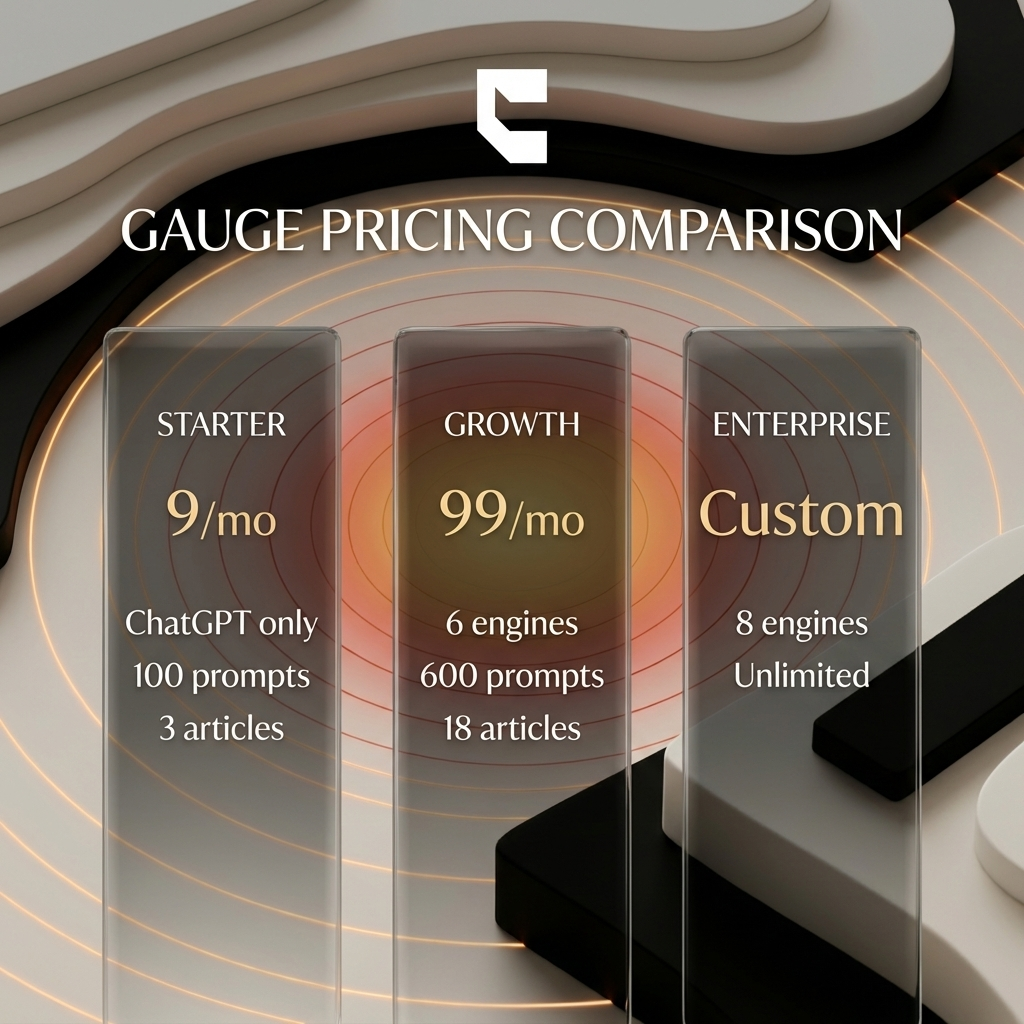
The Starter tier at $99 per month gives you 100 daily prompts and three AI-generated articles per month across three seats. Support is email-only. The biggest constraint here isn't price, it's engine coverage. Starter locks you to ChatGPT exclusively. You miss critical signals from Perplexity, Gemini, and Google AI Overviews entirely.
The Growth tier at $599 per month is where real value begins. Coverage expands to six AI engines, volume jumps to 600 prompts daily, and you receive 18 AI-generated articles per month across ten seats. Email and chat support are included, along with data export features. You can verify Gauge's current pricing directly on their site. To put this in perspective, Profound Lite costs $499 per month but limits you to 100 daily prompts, Gauge Growth delivers 6x the volume for a slightly higher price.
One thing to watch: 600 prompts disappear fast when you track multiple products across geographies. A single keyword checked across six engines consumes six prompts. Track 20 core keywords daily across all six engines and you burn 120 prompts before lunch. Prompt budgeting is a real skill here.
Enterprise pricing requires custom negotiation and annual contracts. It adds Claude and Grok monitoring, removes article limits, grants unlimited seats, and assigns a dedicated specialist. Locking Claude and Grok behind Enterprise is a meaningful limitation. Claude is increasingly the preferred tool for complex B2B research. Missing it means you can't see how decision-makers encounter your brand. Grok dominates real-time Twitter-driven narratives, if trending topics matter to your brand, that gap is painful.
| Feature | Starter ($99/mo) | Growth ($599/mo) | Enterprise (Custom) |
|---|---|---|---|
| Daily Prompts | 100 | 600 | Custom |
| AI Engines | ChatGPT only | 6 engines | 8 engines (+ Claude, Grok) |
| Articles/Month | 3 | 18 | Unlimited |
| Seats | 3 | 10 | Unlimited |
| Support | Email + Chat | Dedicated specialist |
Pricing is transparent. Whether the features behind it actually move visibility is a different question.
Does the Content Engine Actually Work?
Gauge's content engine generates articles based on AI citation gaps, not templates. The output is a strong first draft but rarely publishable without editing.
The content engine identifies specific gaps where competitors earn citations but your brand doesn't. It then drafts articles optimized for those exact citation opportunities. The gap-identification logic is genuinely clever, you stop guessing what topics will move the needle and start targeting the precise queries where ChatGPT already wants to cite an external source.
Gauge structures this process into a four-step workflow: gap identification, content drafting, team review, and impact tracking. The review step is non-negotiable. Gauge explicitly acknowledges human editing is required before publication. When the draft is ready, it surfaces in an integrated editor where your team must inject brand voice, add proprietary data, and rewrite robotic phrasing. The platform functions as an aggressive outliner: it assembles the necessary facts, then leaves the storytelling to you.
Eighteen articles per month at the Growth tier sounds ambitious. The real question is whether the output quality justifies the workflow. AI-generated content optimized for an "AI citation format" still demands human expertise, a distinct voice, and real editorial judgment. If you want to understand why raw AI writing falls short of ranking consistently, read our analysis on the content quality gap in AI search.
Compare that against executing manually. A human strategist must analyze competitor citations across multiple engines, pinpoint gaps, write the articles, and track impact by hand. Gauge automates the analysis. It does not automate quality. Saving the analysis hours is genuinely valuable. Treating the generated draft as finished copy is where teams go wrong.
How Good Is Gauge's AI Visibility Monitoring?
Gauge monitors mention rates and citation rates across six AI engines with competitor benchmarking. Coverage is solid for the price but lacks depth compared to enterprise platforms.
The platform tracks two metrics that matter most: mention rate (how often your brand appears in AI answers) and citation rate (how often your URL is linked directly). Mentions build awareness. Citations drive traffic. Both matter for AI visibility strategy.
Citations behave differently across engines. ChatGPT often requires explicit prompting to cite a source, pulling primarily from Bing results. Perplexity cites aggressively by default, anchoring almost every claim with a footnote. Google AI Overviews blends organic ranking signals with generative synthesis. Gauge normalizes these differences into a single dashboard. The interface is clean and modern, navigation splits intuitively between citation tracking and gap analysis, so you can quickly identify which rival owns the conversation for your top commercial queries.
Six-engine coverage at Growth (ChatGPT, AI Overviews, AI Mode, Gemini, Perplexity, Copilot) is competitive at $599 per month. Missing Claude and Grok is a real gap, but this coverage still outperforms Semrush's basic three-engine tracking. It falls short of Peec's ten-plus engines and Profound's wider analytics scope.
Competitor analysis shows exactly how rivals appear in AI responses versus your brand, and that intelligence feeds directly into the content engine to close visibility gaps.
Gauge cites impressive case study numbers on its site: Standard Metrics reportedly doubled AI visibility from 9.4% to 23.8% in two weeks; another unnamed client saw a 416% boost in under 30 days. These are Gauge's own claims, not independently verified data.
White-glove onboarding is included at all tiers, a genuine edge over Profound and Peec, which gate premium support behind expensive enterprise plans. If you are learning how to interpret these metrics for the first time, read our guide on how to measure AI visibility.
The monitoring is competent. But competent monitoring only creates value if someone acts on it.
Who Should Use Gauge (and Who Should Not)?
Gauge fits mid-market teams wanting AEO monitoring plus content ideas at an accessible price. It does not fit brands that need execution or enterprise-grade analytics.
Use Gauge if you have a budget of $100 to $600 per month and want monitoring paired with basic content suggestions. It works well when an in-house team stands ready to act on insights. It provides multi-engine coverage without forcing you into an enterprise contract. Agencies may also find Gauge useful as a white-label reporting solution, though seat limits at lower tiers can constrain larger teams. Export functions at higher tiers let you pipe data into Tableau or Looker via CSV or API.
The clearest use case: a mid-market SaaS company with a content manager and two staff writers who know AI search matters but can't identify what to write. Gauge tells them exactly which topics will generate citations. The clearest misfit: a solo founder who buys Gauge, sees zero visibility, then realizes they have no time to produce the 18 suggested articles. For that person, it's a dashboard full of guilt, not growth.
Skip Gauge if you need execution, not insight. If you need someone to write, publish, build citations, and manage community signals, a monitoring dashboard won't move the needle. Skip it too if you need Claude or Grok data without paying enterprise fees. Brands with millions of SKUs, deep technical optimization requirements, or multi-language ambitions will outgrow Gauge fast. Read more on the operational differences in our breakdown of DIY vs agency AI visibility.
This is the fundamental limitation of every monitoring platform, not just Gauge: the tool tells you what to fix. It doesn't fix it. If your team lacks capacity to act on the insights, the data sits idle. That applies equally to Peec and Profound.
How Does Gauge Compare to Peec, Profound, and Cintra?
Gauge offers the best mid-market value for monitoring plus content. Peec leads in global coverage. Profound leads in data depth. Cintra delivers execution.
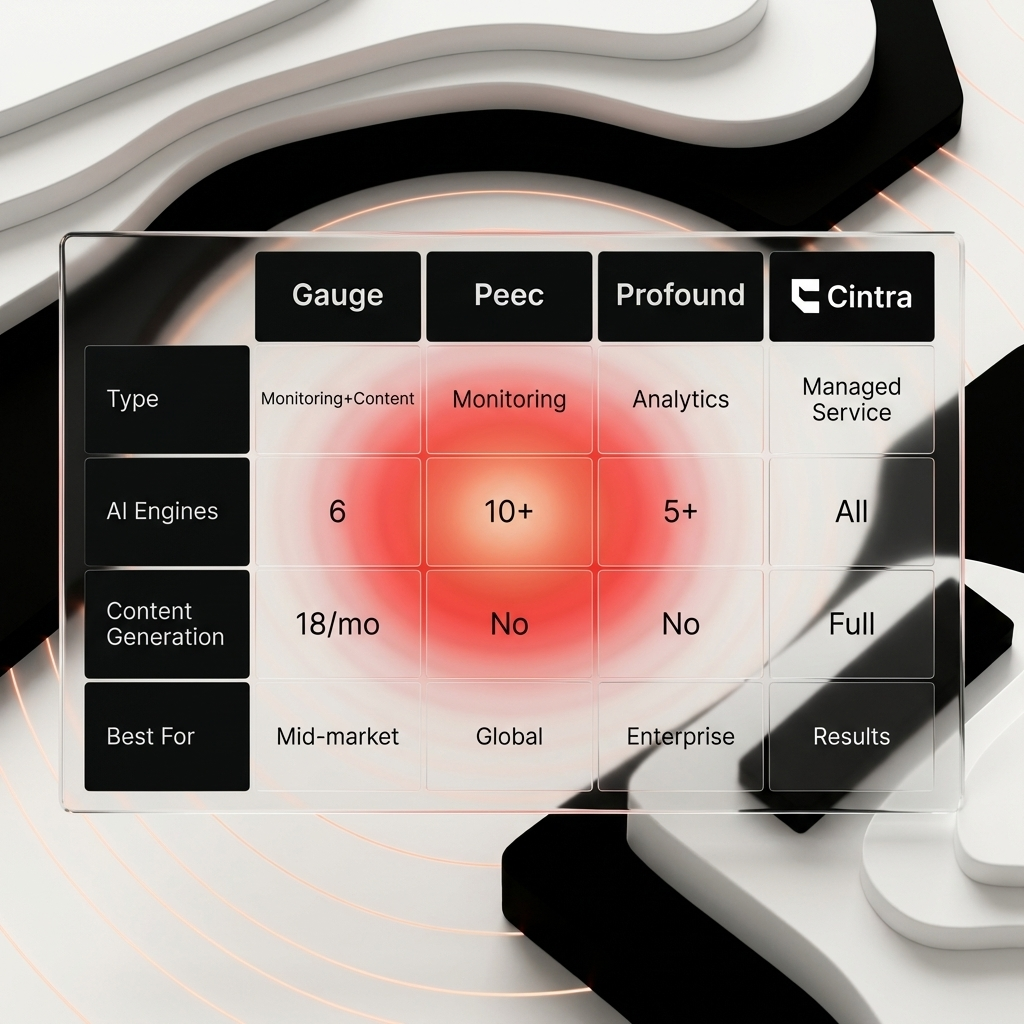
| Feature | Gauge ($599/mo) | Peec AI | Profound ($499+/mo) | Cintra ($2K-$4K/mo) |
|---|---|---|---|---|
| Type | Monitoring + content | Monitoring | Monitoring + analytics | Managed service |
| AI Engines | 6 | 10+ | 5+ | All major |
| Content Generation | 18 articles/mo | No | No | Full execution |
| Daily Prompts | 600 | Varies | 100 (Lite) | N/A |
| Languages | English | 115+ | English | English + targeted |
| Best For | Mid-market teams | Global brands | Enterprise analytics | Brands wanting results |
Against Peec, Gauge adds content generation while Peec offers wider engine coverage, tracking over 10 engines including Claude, and supports 115+ languages. Peec costs more at scale due to its flexible but unpredictable per-prompt pricing (EUR 3.56 per prompt).
Against Profound, the prompt math favors Gauge decisively. Profound Lite at $499 per month caps you at 100 daily prompts. Gauge Growth delivers 600 for $100 more. Profound's strengths are enterprise-grade analytics and credibility, Sequoia-backed, $58M in funding, clients like Ramp, MongoDB, and DocuSign. If you need depth over volume, Profound wins. If you need value, Gauge wins.
Against Cintra, the comparison shifts categories. Gauge monitors and suggests. Cintra executes. The tools can work together: use Gauge for daily monitoring, then lean on a managed service for the content, citations, and community work that actually move the number. Review the full market in our guide to the best AI visibility tools.
Frequently Asked Questions About Gauge AEO
Is Gauge Worth the Starter Price?
The $99 Starter tier is limited to ChatGPT only with 100 daily prompts. It is useful for testing but too narrow for serious AEO monitoring.
Most brands need multi-engine coverage. If you are serious about AEO, the Growth tier at $599/mo is where the real value starts.
Can Gauge Replace an AEO Agency?
No. Gauge monitors and suggests content but does not execute. An agency writes, publishes, builds citations, and manages community signals.
Gauge is a tool that empowers your in-house team. If you lack an in-house team, a monitoring tool alone will not move the needle.
How Does the Content Engine Compare to Human Writers?
Gauge's content engine provides data-informed drafts but the output requires editing for brand voice, depth, and editorial quality before publishing.
Think of it as a research assistant, not a ghostwriter. The gap analysis is the real value. The generated articles are starting points.
Does Gauge Monitor Claude and Grok?
Claude and Grok monitoring are gated behind the Enterprise tier with custom pricing. Starter and Growth plans do not include them.
This is a notable limitation for the mid-market tiers. Claude and Perplexity are growing rapidly as product discovery tools.
Is Gauge Better Than Profound for Small Teams?
Yes, for most small teams. Gauge offers 6x more daily prompts at a comparable price point and includes content generation that Profound lacks.
Profound's strength is enterprise-grade analytics and credibility (Sequoia-backed, $58M funding). If you need depth over breadth, Profound wins. If you need value, Gauge wins.
Gauge Review: Final Verdict
Gauge fills a real gap in the mid-market AEO space. Essential monitoring plus content suggestions at $99 to $599 per month, that's a proposition no other platform in this category matches cleanly.
The content engine is clever where it counts: targeting exact queries where citations are already happening and your brand isn't in the room. The drafts it produces need work. But the intelligence behind those drafts is genuinely useful for teams who would otherwise spend hours doing that analysis manually.
Six-engine monitoring at Growth is competitive for the price. Claude and Grok being Enterprise-locked is a real drawback, but tracking Perplexity, Gemini, and AI Overviews gives you more than enough signal to start optimizing.
The question isn't whether Gauge is a good product. It is. The question is whether you have a team ready to act on what it finds.
Search for your brand in ChatGPT and Perplexity right now. If you're invisible, you know the problem exists. Then decide: do you need a dashboard to track it, or a team to fix it? The answer determines whether Gauge is your next tool, or whether you need something more.
We help brands move from invisible to recommended. See our results or get a free AI visibility assessment.
See where your brand appears in AI search
Scan ChatGPT, Perplexity, and Google AI across buyer-intent queries, instantly, no sign-up.
Find out if AI is sending buyers to your competitors.
We audit your AI visibility across ChatGPT, Perplexity, and Google AI –and show you exactly where you rank and what to fix.
“We went from 200 visitors/day to 1,900 visitors/day and 40% of demos are from AI search.”
Sumanyu Sharma · CEO, Hamming.ai
“Cintra helped me go from 3k to 7.5k daily traffic and doubled weekly orders in 1.5 months.”
Russ Coulon · Owner, UV Blocker
“We saw a lift from 3% to 13% visibility in the first 2 weeks, and organic traffic hit its highest ever.”
Ash Metry · Founder, Keywords.am
Related Articles
AISO Review: Is This the Best AI Search Optimization Tool for 2026?
AISO tracks real ChatGPT, Gemini, and Claude conversations from an opt-in panel of 5M+ users. This AISO review…
Complete Athena HQ Review: The Best AI Visibility Platform at $295/Month? (2026)
This Athena HQ review covers everything you need to know: pricing that runs out faster than advertised, 8-engi…
Kalicube Pro Review: The Best Honest Guide to Entity SEO for AI Visibility (2026)
Kalicube Pro doesn't track AI mention rates or generate content briefs. It trains Google's Knowledge Graph to…