Best AI Visibility Agencies for Ecommerce (2026)
The 7 best AI visibility agencies for ecommerce in 2026, ranked on DTC case studies, ChatGPT Shopping expertise, product schema, and content velocity.
TL;DR
- ChatGPT processes 50 million shopping queries daily. AI search is now a primary ecommerce discovery channel.
- Ecommerce AI visibility requires product feed optimization, ChatGPT Shopping schema, and DTC community strategy that generic AEO agencies don't provide.
- We ranked 7 agencies on five ecommerce-specific criteria: DTC case studies, shopping platform coverage, product schema expertise, content velocity, and pricing.
- Cintra ranks #1 with the only verified ecommerce case study showing revenue data: UV Blocker went from zero to 38K clicks in 6 months, doubling weekly orders in the off-season.
- Entry point: $1,500/month for DIY programs, $4,000/month for specialist done-for-you AI visibility.
ChatGPT processes 50 million shopping queries every day. 84 million Americans ask it shopping questions every week. Ecommerce brands that show up in those answers convert at 23x the rate of traditional search traffic. The agencies helping ecommerce brands capture that traffic are not the same agencies doing generic blog SEO. They're a specialized breed that understands product feeds, ChatGPT Shopping schema, and DTC community signals. This list ranks the 7 best AI visibility agencies for ecommerce in 2026, evaluated on ecommerce-specific criteria.
Why Ecommerce AI Visibility Is Different From Regular AEO
Ecommerce AI visibility requires product feed optimization, ChatGPT Shopping schema, and DTC community strategy that generic AEO agencies don't provide.
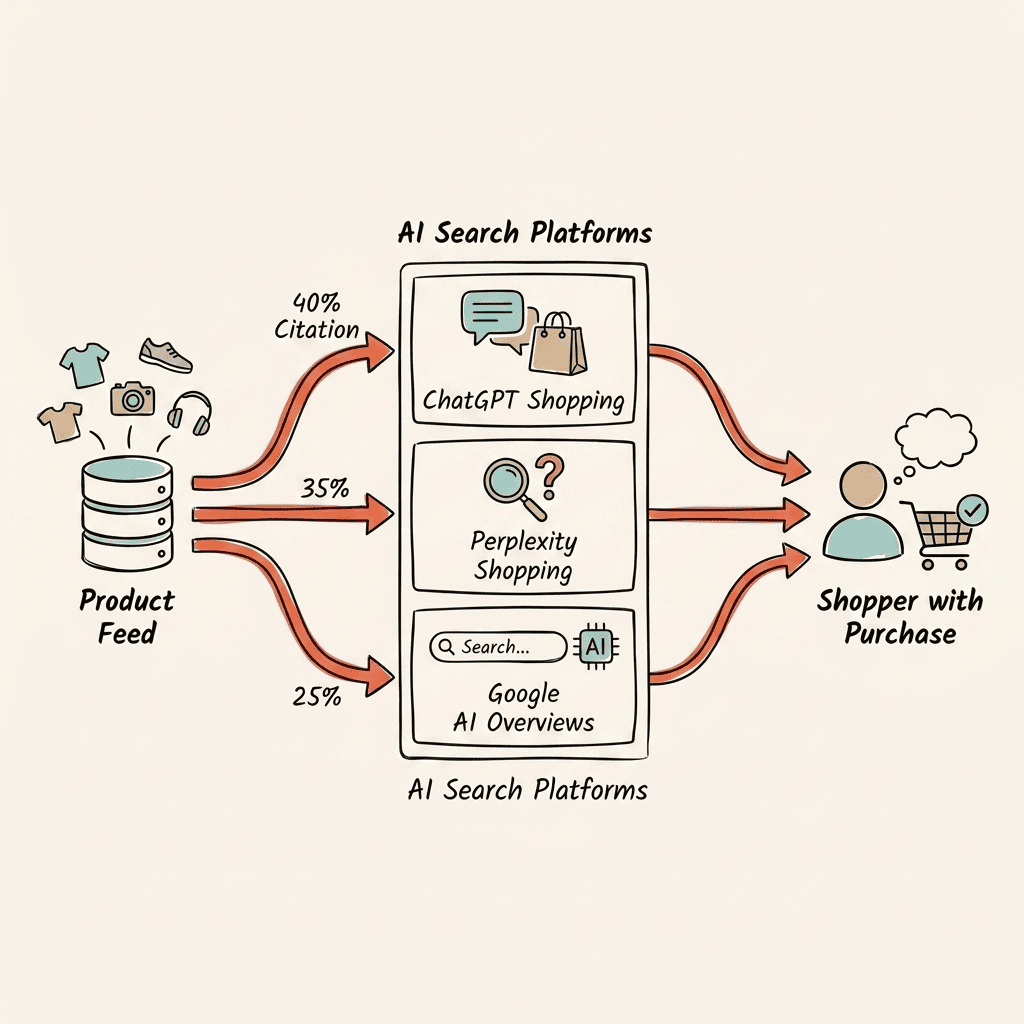
ChatGPT Shopping launched in November 2025. BrightEdge data shows ChatGPT cites retailers 36% of the time in shopping queries, compared to just 4% for Google AI Overviews. That's 9x more retailer citations on the platform most buyers now use first. Search Engine Land reports the average AI shopping query runs 25 words, versus 6 words on Google. Users ask: "what's the best SPF umbrella for beach days under $50?" Not just "SPF umbrella." Product content that answers these conversational queries gets cited. Spec sheets don't.
OpenAI's Instant Checkout is now live with Shopify merchants. AI isn't just a discovery channel anymore. It's a purchasing channel.
Generic AEO agencies optimize informational blog posts. Ecommerce brands need five things that generic agencies don't deliver: product feed optimization for Google Shopping (the source ChatGPT Shopping pulls from), conversational product descriptions that answer 25-word queries, third-party review seeding on Reddit and YouTube (85% of AI brand mentions come from third-party sources), Product/Review/Offer schema markup, and a strategy that accounts for the architectural differences between ChatGPT Shopping and Perplexity Shopping.
How We Evaluated These 7 Agencies
See where you rank across all AI answer engines.
Enter your domain and we'll scan your citation rate across ChatGPT, Perplexity, and Google AI.
Prefer to talk? Book a free 30-min call
We evaluated each agency on five ecommerce-specific criteria: DTC case studies with revenue data, shopping platform coverage, product schema expertise, community strategy, and pricing.
| Criterion | What We Looked For | Why It Matters for Ecommerce |
|---|---|---|
| DTC Case Studies | Named brands, revenue metrics, order data | Traffic is vanity; results prove competence |
| Platform Coverage | ChatGPT Shopping, Perplexity Shopping, AI Overviews | Ecommerce discovery happens on shopping-specific AI features |
| Schema Expertise | Product, Review, Offer schema | Required for AI to surface product recommendations |
| Community Strategy | Reddit, review sites, YouTube seeding | Third-party signals drive 85% of AI product recommendations |
| Pricing | Published rates, ecommerce tiers | Brands need clear ROI math before signing |
We looked for named brands with specific revenue and order metrics. Traffic numbers without order data tell you nothing about AI visibility quality. We checked whether the agency has an explicit methodology for ChatGPT Shopping and Perplexity Shopping, not just Google AI Overviews. And we weighed community strategy heavily: an ecommerce AI visibility program without Reddit and review seeding leaves the biggest citation lever untouched.
The 7 Best AI Visibility Agencies for Ecommerce in 2026
The 7 best AI visibility agencies for ecommerce are Cintra, Stryde, AEO Engine, Victorious, Single Grain, NP Digital, and Incrementors, ranked on ecommerce-specific criteria.
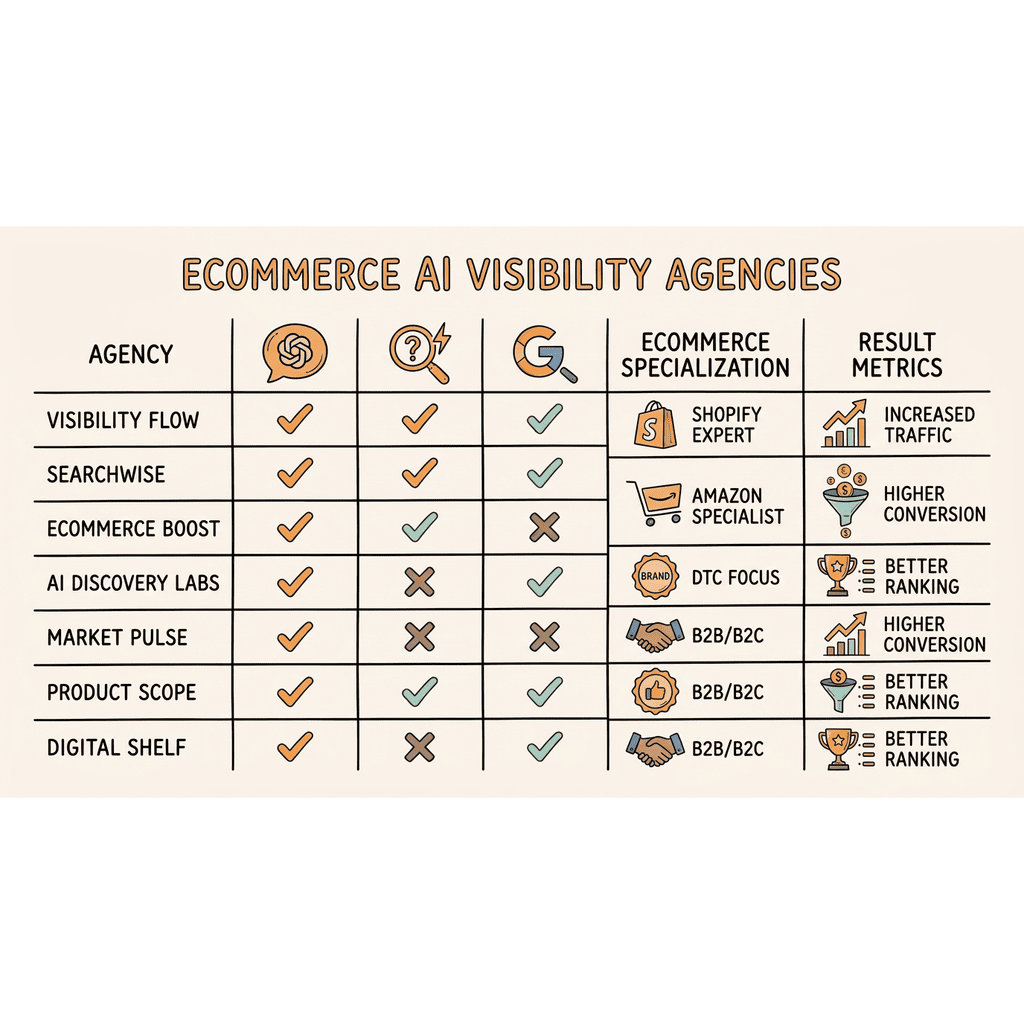
| Agency | Best For | Starting Price |
|---|---|---|
| Cintra | 7-figure DTC and new ecommerce brands | $2,000/mo |
| Stryde | D2C brands $1M to $15M revenue | Custom |
| AEO Engine | Small-to-mid ecommerce brands | $1,597/mo |
| Victorious | Enterprise ecommerce | $5,000+/mo |
| Single Grain | VC-backed DTC startups | Custom |
| NP Digital | Mid-market ecommerce | Custom |
| Incrementors | Brands needing fast AI placements | $1,500+/mo |
1. Cintra: Best Overall for Ecommerce AI Visibility
We're the only agency with a verified ecommerce AI visibility case study showing revenue data, not just traffic.
Our work with UV Blocker is the clearest proof point in the market. UV Blocker was a new sun protection brand with zero organic presence and zero AI citations. Within 6 months, we drove 38,000 organic clicks. Daily traffic grew from 3,000 to 7,500. We doubled their weekly orders in 1.5 months during their off-season, which is the hardest time to move product in a seasonal category.
The model behind those results isn't replicable at a traditional agency. Traditional agencies cap out at 10 pieces of content per month, limited by headcount. We run an agent-native model: Leon, our AI strategist, executes continuously rather than delivering a monthly report. Human strategy sets the direction. AI execution delivers 50x the output. We cover all 7 major platforms, run DTC-specific community seeding on Reddit, and optimize product feeds and schema from day one.
Best for: 7-figure ecommerce brands and new DTC brands serious about AI search as a primary acquisition channel.
Pricing: $2,000/mo (DIY with playbooks), $4,000/mo (Done For You), Enterprise custom.
Case study: UV Blocker: 0 to 38K organic clicks in 6 months, 3K to 7.5K daily traffic, 2x weekly orders in 1.5 months off-season. See all results.
2. Stryde: Best for D2C Brands $1M to $15M
Stryde has worked exclusively with product-based D2C brands for 13 years. That's their entire business. In 2025, they added "AI Optimization (AEO/GEO)" as a core service alongside their established SEO and paid search offerings.
Their strengths are real: certified Shopify, BigCommerce, and Klaviyo partner, with 20+ years of combined search marketing experience focused on categories including baby/kids, fashion, home goods, sporting goods, and travel products. If your tech stack is already Shopify, their technical familiarity is an asset.
The limitation is that their AEO offering is newer. They don't yet publish documented AI citation metrics or multi-platform citation tracking data for ecommerce clients. For brands that want a proven ecommerce-native partner with a long track record in the category but are willing to be early adopters of their AI visibility service, Stryde is a strong option.
Best for: D2C brands on Shopify or BigCommerce, $1M to $15M revenue, that want ecommerce-native execution.
Pricing: Custom.
3. AEO Engine: Best Budget Option for Ecommerce
AEO Engine offers the most accessible pricing in the market for ecommerce AI visibility. Their Growth plan starts at $1,597/month, and their Aggressive plan is $2,997/month.
They have public ecommerce testimonials: DI ORO kitchenware reported tripling their organic search in 3 months and getting found via ChatGPT. Gourmend Foods cited "smart, high quality results lifting notoriety in both Search and AI results." Their service set covers structured data and schema implementation, entity optimization, Reddit and Quora seeding, LLM-ready content, and citation monitoring across ChatGPT, Perplexity, Gemini, and Copilot.
The gap is specificity: they don't publish detailed case studies with revenue metrics or order data. For ecommerce brands in the $500K to $5M range that need an affordable entry into AI visibility without a multi-thousand dollar commitment, AEO Engine is worth evaluating.
Best for: Small-to-mid ecommerce brands that need budget-accessible AI visibility with real schema and community work.
Pricing: $1,597 to $2,997/mo.
4. Victorious: Best for Enterprise Ecommerce
Victorious publishes more specific case study data than most agencies on this list. One published result: 5,856 AI Overview citations generated for a single client. Another: a 139% conversion lift tied to AEO-driven traffic changes. For enterprise buyers who need auditable proof before committing, that specificity matters.
Their delivery model provides a dedicated team per account: strategist, content lead, and technical specialist. Their methodology is particularly strong on Google AI Overviews, with less documented coverage of ChatGPT Shopping and Perplexity Shopping specifically.
Enterprise pricing and a Google-dominant approach make Victorious less practical for most mid-market ecommerce brands. For brands at $50M+ revenue competing in categories where Google AI Overviews is the primary buyer touchpoint, they're a credible option.
Best for: Enterprise ecommerce brands that need auditable AEO results and a dedicated full-service team.
Pricing: $5,000+/mo.
5. Single Grain: Best for VC-Backed DTC Startups
Single Grain bundles AEO with paid acquisition, traditional SEO, and conversion rate optimization under one roof. For Series A to C DTC startups that can't manage multiple specialist agency relationships, that integration reduces coordination overhead.
Their AEO content capabilities draw on a strong content marketing heritage. The limitation is technical depth: entity graph optimization, product schema implementation, and multi-LLM citation tracking are not core to their methodology, which was built around performance marketing and SEO before AEO became a distinct category.
In competitive ecommerce categories where citation velocity matters, a generalist approach may not move fast enough. But for startups where the primary need is consistent AI-readable content and they're already working with Single Grain on paid channels, the integrated model is practical.
Best for: VC-backed DTC startups needing AEO embedded in a broader growth marketing engagement.
Pricing: Custom.
6. NP Digital: Best for Mid-Market Ecommerce with Global Reach
NP Digital, founded by Neil Patel, converted their ecommerce SEO expertise into an AEO practice over the last two years. Their strength is scale: global reach, multi-market campaign management, and data-driven content production at volume.
If your ecommerce brand sells across multiple countries and needs a partner with regional capability, NP Digital has the infrastructure. Their gap is ecommerce AI visibility specificity: they don't publish documented ChatGPT Shopping case studies or multi-platform citation tracking data for ecommerce clients.
Best for: Mid-market ecommerce brands ($5M to $50M) that need AEO integrated with existing SEO/content investment and multi-market execution.
Pricing: Custom.
7. Incrementors: Best for Speed-to-Placement
Incrementors markets 70% to 90% answer engine placement rates within 30 to 90 days. Their 365+ Google reviews and 1,200+ Upwork reviews reflect operational scale and consistent delivery. Their specialty is zero-click answer optimization: featured snippets, Q&A blocks, and structured answer formats that AI Overviews and Bing AI surface quickly.
The speed advantage is real. Zero-click formatting is more tractable than full entity optimization. The limitation is durability: their public methodology doesn't include the entity graph and product schema work that sustains AI citations as models update their retrieval preferences. Fast placements without entity authority tend to erode.
Best for: Ecommerce brands that need visible AI placements quickly and have budget constraints.
Pricing: $1,500+/mo.
What Ecommerce AI Visibility Looks Like in Practice
An ecommerce AI visibility program combines product feeds, ChatGPT Shopping schema, review seeding, and conversational content. Here's the UV Blocker case study.
UV Blocker started with zero organic presence and zero AI citations. They sell sun protection umbrellas and outdoor gear, a seasonal category where competing on traditional Google rankings would take years. The AI visibility route was faster and more defensible.
The 5-step ecommerce AI visibility playbook we applied covered: writing conversational product descriptions to answer 25-word AI queries, building an authentic Reddit community presence in relevant outdoor and health subreddits, implementing Product/Review/Offer schema markup precisely, optimizing their Google Shopping feed so ChatGPT Shopping had clean data to pull from, and seeding third-party mentions on review sites and YouTube.
Within 6 months: 0 to 38,000 organic clicks. Daily traffic from 3,000 to 7,500. Weekly orders doubled in 1.5 months, during their seasonal off-season. The primary driver was appearing in ChatGPT and Perplexity when buyers asked "best UV protection umbrella for beach days" and related queries.
How to Choose the Right Agency for Your Ecommerce Brand
Choosing the right AI visibility agency for ecommerce comes down to three questions: documented case studies with revenue data, ChatGPT Shopping coverage, and product-level schema expertise.
Ask for named brands and specific order metrics first. Traffic without order data tells you nothing about conversion quality. Then verify their platform methodology: if an agency can't explain how ChatGPT Shopping retrieves product data differently from Perplexity Shopping, they're guessing. Finally, test their schema knowledge: real ecommerce AI visibility requires Product, Review, and Offer schema, not just blog article formatting.
Red flags to walk away from:
- Blog content only (no product schema, no feed optimization)
- No Reddit or community strategy (ignores 85% of AI citation sources)
- Google AI Overviews only (misses ChatGPT Shopping's 9x higher retailer citation rate)
- No named ecommerce case studies
| Brand Stage | Monthly Budget | Recommended Approach |
|---|---|---|
| New brand, under $1M | $1,500 to $2,500 | DIY with playbooks or entry-level agency |
| Growth brand, $1M to $5M | $2,500 to $5,000 | Done-for-you with ecommerce specialist |
| Scale brand, $5M to $20M | $5,000 to $10,000 | Full-service with product schema and community |
| Enterprise, $20M+ | $10,000+ | Multi-platform, multi-market, dedicated team |
Learn more about how to choose an AI visibility agency and the five criteria that separate real practitioners from rebranded SEO shops. Or check the broader best AEO agencies list for comparison.
Frequently Asked Questions
What is the difference between ecommerce SEO and ecommerce AI visibility?
Ecommerce SEO optimizes product pages for Google Shopping rankings. AI visibility optimizes for ChatGPT Shopping recommendations, Perplexity Shopping answers, and AI Overview citations. These platforms have different retrieval architectures and require product feed adjustments, schema markups, and community signals that traditional SEO ignores.
How long does AI visibility for ecommerce take to show results?
Ecommerce brands typically see initial AI citations within 4 to 8 weeks for content optimizations. Product-level schema and feed changes can show up in ChatGPT Shopping results in 6 to 12 weeks. UV Blocker went from zero to meaningful traffic in 6 months, with orders doubling in the first 1.5 months once citations began registering. Yext Research shows AI citation rates change 40 to 60% monthly, which means you can move the needle faster here than in traditional SEO.
Does AI visibility work for new ecommerce brands with no domain authority?
Yes. UV Blocker had zero organic presence when we started. AI models evaluate conversational content quality and third-party mentions, not just domain authority. A new brand can get AI citations faster than traditional SEO rankings because it's building authority in a newer, less entrenched landscape.
What should an ecommerce AI visibility agency actually deliver?
Beyond blog content: product schema implementation, Google Shopping feed optimization, Reddit and review community strategy, ChatGPT Shopping monitoring, citation tracking by prompt, and monthly reporting that isolates AI-sourced traffic from total traffic.
See where your brand appears in AI search
Scan ChatGPT, Perplexity, and Google AI across buyer-intent queries, instantly, no sign-up.
Find out if AI is sending buyers to your competitors.
We audit your AI visibility across ChatGPT, Perplexity, and Google AI –and show you exactly where you rank and what to fix.
“We went from 200 visitors/day to 1,900 visitors/day and 40% of demos are from AI search.”
Sumanyu Sharma · CEO, Hamming.ai
“Cintra helped me go from 3k to 7.5k daily traffic and doubled weekly orders in 1.5 months.”
Russ Coulon · Owner, UV Blocker
“We saw a lift from 3% to 13% visibility in the first 2 weeks, and organic traffic hit its highest ever.”
Ash Metry · Founder, Keywords.am
Related Articles
Meta-ExternalAgent Took More Bandwidth Than 5 Crawlers Combined
Meta-ExternalAgent pulled 955 MB from cintra.run in 30 days, more than 5 AI and search crawlers combined. What…
Organic Traffic Decline 2026: Why It's Dropping and How to Recover
Organic traffic decline 2026 is real. AI Overviews cut clicks 38% on triggered queries. Here's what's causing…
AI Visibility Reporting: What to Track, Who to Tell, and How to Prove ROI
AI visibility reporting requires different metrics and formats than SEO reports. Learn the five core metrics,…