How to Get Recommended by ChatGPT as a Shopify Store (9% to 32%)
How to get recommended by ChatGPT as a Shopify store: product pages, Shopify Catalog, third-party lists, Reddit and reviews, with UV Blocker's 9% to 32% climb.
November 22, 202613 min read
To get a Shopify store recommended by ChatGPT, make sure ChatGPT can read your catalog and pages, then get the store named on the lists, review sites and Reddit threads it trusts. Shopify handles the first part for most stores. The second part is where recommendations are won.
That second part is where most Shopify founders stall. They rewrite a few product descriptions, install an app, ask ChatGPT for "the best [product] for [need]" and still see three competitors and a Walmart link. With 900 million weekly users asking ChatGPT questions, according to TechCrunch, being left out of that answer is a real cost.
It can change, even for a seasonal brand. UV Blocker, a sun protection store on Shopify, moved from 9% to 32% on AI search during its off-season. Its owner, Russ Coulon, put it this way:
"Cintra helped me go from 3k to 7.5k daily traffic and doubled my weekly orders in 1.5 months in off-season, most of it from the 9% to 32% move on AI search."
This guide covers what ChatGPT reads about a Shopify store, the checks that make a store visible, how to write product and collection pages it can quote, how third-party mentions get a store named, and how UV Blocker did it. For brands outside Shopify, Cintra's general guide to getting recommended by ChatGPT covers the wider playbook. Disclosure: Cintra is an AI search agency, worked with UV Blocker, and wrote this article.
Table of contents
- What Does ChatGPT Look at Before It Recommends a Shopify Store?
- Is Your Shopify Store Visible to ChatGPT at All?
- How Should You Write Product and Collection Pages So ChatGPT Can Quote Them?
- How Do Third-Party Lists, Reviews and Reddit Get a Store Named?
- How Did UV Blocker Go From 9% to 32% in ChatGPT and AI Search?
- How Do You Know If ChatGPT Is Starting to Recommend Your Store?
- Frequently Asked Questions About How to Get Recommended by ChatGPT
- What Should a Shopify Founder Do First?
What Does ChatGPT Look at Before It Recommends a Shopify Store?
ChatGPT combines what it learned in training with live web search. For shopping, it reads Shopify Catalog data, the store's own pages, and third-party lists, reviews and Reddit threads.
Training data is ChatGPT's memory, and a store can't change it quickly. Live search is different. ChatGPT searches the web, reads pages and cites them, so a mention published this month can show up in answers within weeks.
For Shopify stores there is a third input. Shopify shares eligible products with ChatGPT through Shopify Catalog, and the Shopify Help Center says this is active by default for eligible stores. That gives ChatGPT product names, prices and availability.
Why the store's own pages are not enough
Product data tells ChatGPT what a store sells. It doesn't tell ChatGPT which store to recommend. For that, ChatGPT leans on what other sites say:
- AirOps, which sells AI search software, says 85% of the 21,000+ brand mentions it analysed came from third-party sources (AirOps). Treat that as vendor research.
- In Profound's study of about 680 million citations, Wikipedia made up 7.8% of ChatGPT's citations, Reddit 1.8%, and Forbes and G2 1.1% each (Profound).
- In Cintra's own audit of 180 buying questions for nine consumer brands (16 October 2026), the brand was named in only 42 answers (23%).
So the first question is a basic one: can ChatGPT see the store at all?
Is Your Shopify Store Visible to ChatGPT at All?
See where you rank in ChatGPT's answers.
Enter your domain and we'll scan your ChatGPT citation rate across your highest-value queries.
Prefer to talk? Book a free 30-min call
Check three things: Shopify Catalog access is on under Sales channels > Agentic, your store policies are complete, and nothing blocks OAI-SearchBot from crawling your pages.
This is the first step in how to get recommended by ChatGPT, and most stores pass it without doing anything. Some fail on a missing policy or a security setting nobody remembers turning on. Run through this list once:
-
Check the Agentic section. In the Shopify admin, open Sales channels > Agentic and confirm ChatGPT is listed with Shopify Catalog access on. There is no separate ChatGPT sales channel to install.
-
Meet the eligibility rules. Shopify requires that the store sells to customers in the United States (the store itself can be based elsewhere), that products are eligible for Shopify Catalog, that the Agentic Storefronts terms are accepted, and that the Terms of service, Privacy policy and Return and refund policy are filled in under Settings > Policies.
-
Let OAI-SearchBot in. OpenAI's crawler documentation says OAI-SearchBot is the crawler behind ChatGPT search, and sites that block it aren't shown in ChatGPT search answers. Check robots.txt and any bot-protection app or CDN rule. Changes take about 24 hours to apply. GPTBot is a separate crawler for model training.
-
Claim the business profile (optional). The ChatGPT Business app in the Shopify admin lets a store claim its profile and manage its description and contact details in ChatGPT Business Hub.
-
Put legal disclosures early. Shopify asks merchants to place any required legal disclosures within the first 6,000 characters of a product description.
Selling on ChatGPT carries no extra fees beyond standard payment processing, and shoppers check out on the store's own checkout.
Being in Shopify Catalog puts a store in the pool. It doesn't make ChatGPT pick it. The pages decide whether there is anything worth quoting.
How Should You Write Product and Collection Pages So ChatGPT Can Quote Them?
Answer the buyer's question in the first sentence, give specs and proof a model can quote, and mark up products with Product, Offer and AggregateRating schema.
A product description that opens with a slogan gives ChatGPT nothing to repeat. One that opens with what the product is, who it's for and the spec that matters gives it a sentence it can use.
Product pages
- Lead with the answer. "A UPF 50+ walking umbrella for people who burn in midday sun" beats "Shade, reimagined."
- Put specs and test data in plain text. UV Blocker's buyers asked about UPF ratings and materials, so those facts belong on the page in words, not only in an image.
- Show price and stock. In Cintra's audit, when ChatGPT found a brand's own prices, it quoted them in the recommendation.
- Keep reviews on the page. They feed the ratings that structured data reports.
Collection pages
Most Shopify collection pages are a grid of products with no text. Add a short intro (100 to 200 words) that answers the category question a buyer asks, such as which umbrella suits daily walks. That is the page ChatGPT can cite for a "best X for Y" prompt.
Structured data and supporting content
UV Blocker added Product, Offer and AggregateRating schema across all its product and collection pages. Cintra's guide to schema markup for AI visibility explains each type. It also published guides answering buyer questions and linked them to the products.
| Where ChatGPT looks | What it needs from a Shopify store | First fix |
|---|---|---|
| Shopify Catalog | Eligible products, complete policies, US selling | Check Sales channels > Agentic |
| Product pages | A direct first sentence, specs, price, reviews | Rewrite the top 10 sellers' opening lines |
| Collection pages | An answer to the category question | Add a 100-200 word intro to top collections |
| Structured data | Product, Offer, AggregateRating | Validate schema on product and collection templates |
| Third-party lists and reviews | The store named next to competitors | List the roundups ChatGPT cites for your top prompts |
| Honest mentions in threads where buyers ask | Answer 2-3 live threads where the product fits |
Even with perfect pages, a store can lose to a roundup that names three competitors and leaves it out.
How Do Third-Party Lists, Reviews and Reddit Get a Store Named?
ChatGPT recommends the brands many independent sources agree on. Getting into the roundups, review sites and Reddit threads it already cites is usually the biggest lever.
Consensus is the pattern. A store that only praises itself on its own site rarely gets named, however good its copy is.
Lists and roundups
Run the store's top buyer prompts in ChatGPT and write down every source it cites. Those lists, buying guides and retailer pages are the shortlist to pitch, each with a real reason to include the store (a spec, a test result, a price point). Retailers can speak for a brand too: in Cintra's audit, one brand named in none of its 20 answers saw ChatGPT cite Home Depot in 6 and Walmart in 4, never the brand's own site. Cintra's breakdown of what 22.5M ChatGPT shopping offers reveal shows how list mentions shape product picks.
Reviews
Reviews matter in two places: on the store, where they feed AggregateRating, and on independent review sites. For one beverage brand in Cintra's audit, a single review site was cited in 15 of 20 answers. Whatever that site says is close to what ChatGPT says.
Join only the threads where the product genuinely answers the question. Disclose any affiliation where a community requires it, follow each subreddit's rules, and never post promotional spam. UV Blocker took part in sun protection and skincare discussions this way. Cintra's Reddit strategy for AI visibility covers how to do it without getting banned.
Links
Earned links from relevant sites add to the signal. For UV Blocker, that meant links from health and outdoor sites.
Here's what all of this looked like for one Shopify brand, in its slow season.
How Did UV Blocker Go From 9% to 32% in ChatGPT and AI Search?
UV Blocker fixed its product and collection pages, published buyer-question content, joined Reddit threads and earned links. Its AI search visibility rose from 9% to 32%.
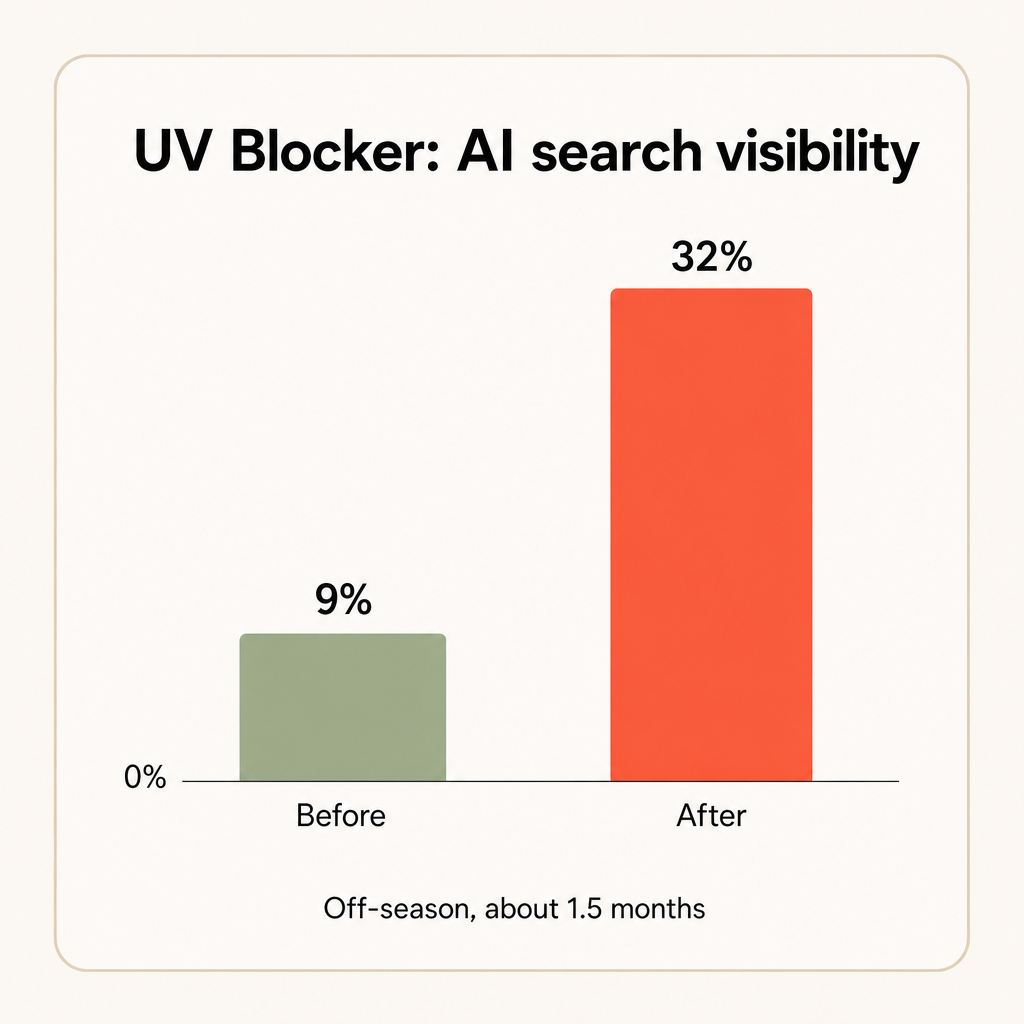
UV Blocker sells sun protection direct to consumers on Shopify. It competes with long-established brands, and its category is seasonal: demand drops in winter. The UV-Blocker case study has the full story.
The work ran in four streams:
-
Structured data: Product, Offer and AggregateRating schema across every product and collection page.
-
Buyer-question content: 30 to 40 pieces a month on UPF ratings, materials and sun protection, each answering a specific question and linking to the products.
-
Reddit: taking part in sun protection and skincare communities where the product answered the question.
-
Links: earning links from health and outdoor sites.
The result, in Russ Coulon's words: "Cintra helped me go from 3k to 7.5k daily traffic and doubled my weekly orders in 1.5 months in off-season, most of it from the 9% to 32% move on AI search."
The off-season part matters. Sun protection sells less in winter, so the growth didn't ride a seasonal wave. Buyers asking ChatGPT and other AI engines what to buy found UV Blocker in the answer. The first citation movement showed up within about 45 days, and the larger traffic gains came from around month three.
UV Blocker's path is a useful template for how to get recommended by ChatGPT as a Shopify store: fix what the store controls, then earn what it doesn't. The next question is how to tell whether that work is moving.
How Do You Know If ChatGPT Is Starting to Recommend Your Store?
Track a fixed set of buyer prompts every week, run each several times, and count how often your store is named and cited, rather than trusting one answer.
ChatGPT's answers change from run to run, by account and by country. One screenshot proves nothing either way. A rate across many runs does.
- Pick 10 to 20 prompts buyers actually ask: "best X for Y", "X vs Y", "is X worth it".
- Run each prompt several times (Cintra's general guide uses 10 runs per prompt) and record how often the store is named, where it appears, and which sources are cited.
- Watch AI referral sessions in analytics, such as visits from chatgpt.com, next to the mention rate.
- Expect weeks, then months. Most Cintra clients see measurable citation gains within 6 to 8 weeks, with organic traffic compounding at around three months, much like UV Blocker.
Frequently Asked Questions About How to Get Recommended by ChatGPT
These are the questions Shopify founders ask most often about ChatGPT, Shopify Catalog, crawlers and Reddit, each answered in a few lines.
Do I need a ChatGPT app or sales channel on Shopify?
No. Shopify shares eligible products with ChatGPT through Shopify Catalog by default, and there is no separate ChatGPT sales channel to install.
The ChatGPT Business app is optional. It lets a store claim its business profile and manage its description and contact details.
Does selling on ChatGPT cost Shopify merchants anything?
Shopify says there are no fees for selling in ChatGPT beyond standard payment processing. Shoppers complete the purchase on the store's own checkout.
Can a store outside the US be recommended by ChatGPT?
Shopify Catalog selling on ChatGPT requires a store that sells to US customers, though the store can be based elsewhere. Web recommendations still depend on pages and mentions.
A store outside that program can still be cited through its own pages and third-party mentions, since ChatGPT search reads the open web.
How long does it take to get recommended by ChatGPT?
Expect first citation movement within weeks and compounding gains around month three. UV Blocker saw citations move within about 45 days.
Will blocking GPTBot keep my store out of ChatGPT?
No. GPTBot collects training data. OAI-SearchBot is the crawler that decides whether ChatGPT search can show a site, so that is the one to allow.
Is it allowed to post about my own store on Reddit?
Only where the product genuinely answers the question, the subreddit's rules allow it, and any affiliation is disclosed. Promotional spam gets removed and hurts the brand.
What Should a Shopify Founder Do First?
Shopify already hands ChatGPT the catalog. The work that decides recommendations is making pages quotable and earning third-party mentions, then measuring a rate rather than one answer.
- Shopify covers the feed. Check that the store qualifies, then move on to the pages.
- Pages must be quotable. Direct first sentences, specs in words, prices, reviews and schema.
- Third parties decide who gets named. Lists, review sites, retailers and Reddit carry more weight than the store's own copy.
- Measure rates, not screenshots. Track the same prompts every week.
A 10-minute start: open Sales channels > Agentic and confirm ChatGPT access, then ask ChatGPT the store's top buyer prompt and write down every source it cites. That list is the plan.
See where your brand appears in AI search
Free tool. Scan ChatGPT, Perplexity, and Google AI across buyer-intent queries, instantly, no sign-up.
Find out if AI is sending buyers to your competitors
We audit your AI visibility across ChatGPT, Perplexity, and Google AI, and show you exactly where you rank and what to fix.
Get my free AI audit“We went from 200 visitors/day to 1,900 visitors/day and 40% of demos are from AI search.”
Sumanyu SharmaCEO, Hamming.ai
Related articles

AI Strategy11 min read
Is a GEO Agency Worth It? Cost, Timeline, Month 1 vs Month 6
Is a GEO agency worth it for an ecommerce brand? An honest look at the cost vs 2-3 in-house hires, what weeks…

AI Strategy14 min read
How to Pick an AI SEO Agency: 10 US Options (2026)
Choosing an AI SEO agency? 10 US agencies compared on focus, fit and published pricing, plus a 7-question chec…
AI Strategy15 min read
7 GEO Agencies for DTC Brands, Compared (2026)
Looking for a GEO agency for DTC brands? 7 agencies compared on done-for-you work, DTC proof, pricing model an…