LinkedIn Optimization for AI Search: The Data-Backed Playbook
LinkedIn optimization for AI search backed by 89K URL data. Learn what content gets cited by ChatGPT, Perplexity, and Google AI Mode.
TL;DR
LinkedIn is the #2 most-cited domain in AI search, appearing in 11% of all AI responses. AI cites original content (95% of citations), not reshares. Profile citations dropped 19.4pp while posts and articles grew. Perplexity favors Company Pages (59%), ChatGPT favors individual profiles (59%). Post 5+ times per month, structure for extraction, and build a cross-platform amplification loop.
89,000 LinkedIn URLs. 325,000 prompts. Three independent studies published in March 2026 all reached the same conclusion: LinkedIn is the #2 most-cited domain in AI search.
Most brands treat LinkedIn as a social channel. They optimize for likes and shares. But AI search engines don't count reactions. They extract and cite content based on entirely different signals.
This playbook synthesizes data from Semrush, LinkedIn, and Profound to show exactly what gets cited. We break down how each AI platform treats LinkedIn differently and provide a six-step framework for LinkedIn optimization for AI search.
Why Is LinkedIn the #2 Most-Cited Domain in AI Search?
LinkedIn appears in 11% of all AI-generated responses, making it the second most-cited domain behind Wikipedia across ChatGPT, Google AI Mode, and Perplexity.
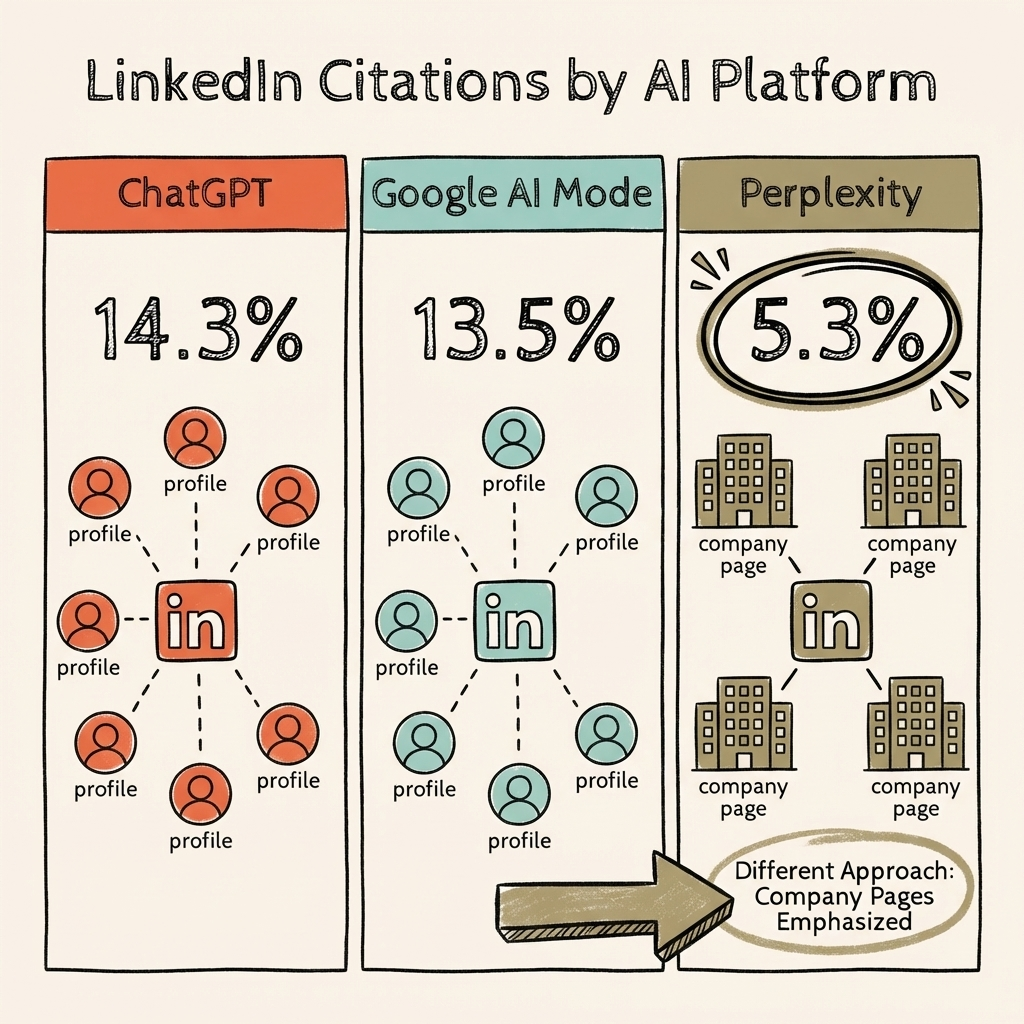
Semrush analyzed 89,000 unique LinkedIn URLs cited across 325,000 prompts in January and February 2026. The data shows a clear hierarchy. ChatGPT cites LinkedIn at 14.3%. Google AI Mode comes in at 13.5%. Perplexity trails at 5.3%.
These aren't passing mentions. Semantic similarity scores between 0.57 and 0.60 tell us AI doesn't just link to LinkedIn. It paraphrases LinkedIn content directly into its answers, mirroring the original language and sentence structure. Those scores sit higher than both Reddit and Quora. The models trust LinkedIn's professional context.
The trajectory is accelerating. LinkedIn jumped from #11 to #5 on ChatGPT between November 2025 and February 2026. That kind of velocity signals a structural shift in how AI models source professional information. You cannot ignore a domain capturing 14.3% of ChatGPT's citation volume. Learn more about how to get recommended by ChatGPT.
Platform Citation Rates
| Platform | LinkedIn Citation Rate | Primary LinkedIn Content Type |
|---|---|---|
| ChatGPT | 14.3% | Individual profiles + posts |
| Google AI Mode | 13.5% | Individual profiles + posts |
| Perplexity | 5.3% | Company Pages (59%) |
Understanding these baseline numbers is the first step in any LinkedIn optimization for AI search strategy. Read our guide on how to get cited by Perplexity to see how these dynamics play out differently across platforms.
What Type of LinkedIn Content Gets Cited by AI?
See where you rank across all AI answer engines.
Enter your domain and we'll scan your citation rate across ChatGPT, Perplexity, and Google AI.
Prefer to talk? Book a free 30-min call
Original long-form articles and posts dominate AI citations, while reshared content accounts for only 5% of cited URLs. AI now cites what you write, not who you are.
A full 95% of cited LinkedIn content is original. Only 5% comes from reshares. If you want citations, you have to publish fresh insights and contribute net-new information to the professional ecosystem.
LinkedIn's own data recommends articles between 800 and 1,200 words. Semrush confirms this sweet spot sits within a broader 500 to 2,000-word range. For shorter posts, aim for 200 to 300 words. Posts support your frequency signals. Articles support your depth and authority signals.
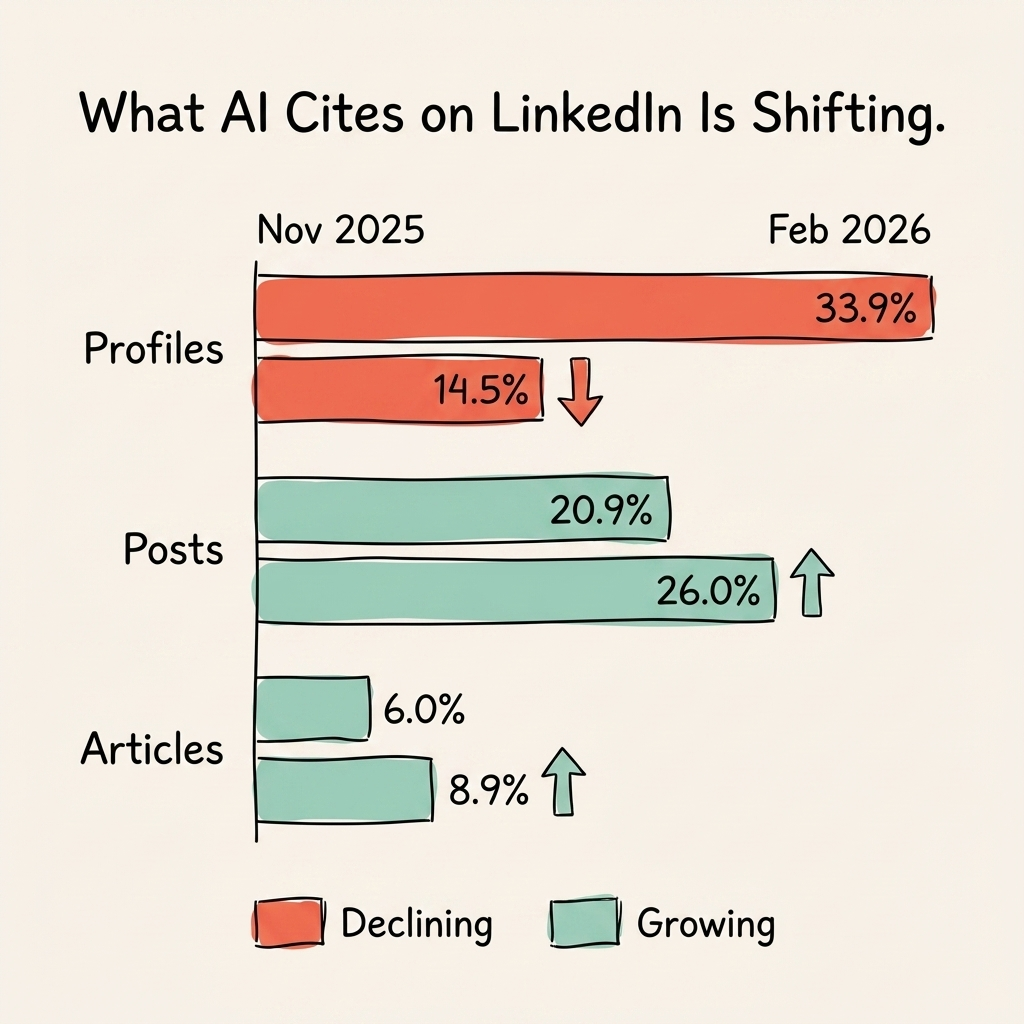
Profound tracked citations from November 2025 to February 2026. Their data reveals a structural shift in how AI evaluates LinkedIn:
- Profile citations dropped from 33.9% to 14.5% (-19.4 percentage points)
- Posts grew from 20.9% to 26.0% (+5.1pp)
- Long-form articles grew from 6.0% to 8.9% (+2.9pp)
AI used to cite who you are. Now it cites what you write.
To secure these citation spots, you need to send the right author credibility signals. That means building E-E-A-T for AI search. AI wants experience and expertise. It looks for verifiable professional credentials attached to high-quality content.
Does Going Viral on LinkedIn Help AI Visibility?
No. The median cited LinkedIn post has only 15 to 25 reactions. AI search engines prioritize consistent, knowledgeable voices over viral one-offs.
LinkedIn's VP of Marketing framed it well: success on the platform requires credibility over virality. AI models ignore the hype. They don't care about the post that got 5,000 likes because of a catchy photo. They look for signals of consistent expertise.
Semrush found that 75% of cited authors post at least five times per month. This is your minimum threshold, not a stretch goal. Consistency feeds the AI crawlers and signals an active, engaged professional presence. You don't need 100,000 followers to get noticed. Around 3,000 followers correlates with citation likelihood. You just need enough of an audience to signal expertise.
Engagement matters, but comments matter most. A baseline of 10+ comments per post builds AI signal better than passive likes. Comments contain follow-up questions and detailed answers. This creates a dense cluster of semantic relevance that AI extracts from both the original post and the resulting discussion.
Focus on educational content. AI models favor definitive statements, frameworks, and data over opinion or hot takes. AI mirrors language that teaches. It ignores language that entertains. For a deeper understanding of these mechanics, read what is AI visibility.
How Do Different AI Platforms Cite LinkedIn Content?
Perplexity favors Company Pages for 59% of its LinkedIn citations, while ChatGPT and Google AI Mode favor individual profiles at 59%. Brands need both strategies.
Perplexity relies heavily on Company Pages. They account for 59% of its LinkedIn citations. Its retrieval-augmented approach favors structured, authoritative company content, making it the top target for B2B brands with strong corporate pages. Perplexity looks for official documentation, company announcements, and verified corporate data.
ChatGPT and Google AI Mode take the opposite approach. They cite individual profiles 59% of the time. This rewards thought leaders and subject matter experts. They look for personal experience, expertise, and the human element behind professional insight.
Across all platforms, long-form articles, newsletters, and posts account for 60% of all LinkedIn citations. Articles provide deep citations. Posts provide frequency signals. You have to feed Perplexity with corporate authority and ChatGPT with individual expertise. A single-threaded approach won't cut it.
We've mapped citation behavior across all six major AI platforms. You can learn how to get recommended by ChatGPT and discover how to get cited by Perplexity in our detailed breakdowns.
The LinkedIn AI Visibility Playbook: 6 Steps
Build LinkedIn AI visibility through six steps: audit your baseline, set posting cadence, choose content formats, structure for extraction, amplify cross-platform, and monitor monthly.
Executing this strategy requires discipline. You can't treat LinkedIn optimization for AI search as an afterthought to your social media calendar. Brands that build reliable citation pipelines treat this process like an editorial operation.
1. Audit your current LinkedIn AI citation baseline
Search your brand name and key topics in ChatGPT, Perplexity, and Google AI Mode. Document which LinkedIn content currently gets cited. You need the right measurement framework and the right AI visibility tools to establish your starting point.
2. Establish posting cadence (5+ posts/month minimum)
Remember the 75% stat. Five posts a month is a non-negotiable floor. Consistency proves to AI models that you are an active participant in your industry. If you post randomly, the crawlers stop prioritizing your profile.
3. Choose your content format split
Use articles for depth and citation weight. Keep them between 800 and 1,200 words. Use posts for frequency and engagement signals at 200 to 300 words. We recommend starting with two articles and eight to ten posts per month. This split satisfies both depth requirements and frequency algorithms.
4. Structure content for AI extraction
Use clear H2s in articles. Include specific data points and numbers. Make definitive statements that AI can quote directly. Avoid hedge language like "might" or "could potentially." Remember the 0.57-0.60 semantic similarity scores. AI mirrors the exact language you use. Give it clean, authoritative text to extract.
5. Build cross-platform amplification
Create a LinkedIn-to-blog-to-Reddit-to-Quora loop. Publish original thought leadership on LinkedIn. Expand it into full guides on your blog. Summarize key points on Reddit and Quora. Each platform reinforces the others. This Reddit strategy for AI visibility builds a powerful amplification loop that signals authority across every AI model.
6. Monitor AI citations monthly
Track which LinkedIn posts and articles appear in AI responses. Adjust topics and formats based on what gets cited. AI models update constantly. Your strategy needs to adapt to new crawling behaviors and citation preferences.
When Should You Publish on LinkedIn vs. Your Blog?
Publish original thought leadership and hot takes on LinkedIn for faster AI citation pickup. Publish comprehensive guides on your blog for deeper SEO control and conversion paths.
Platform selection dictates your results. Publishing full guides directly on social networks limits your long-term return on investment. Waiting months for search engines to index a short take wastes its immediate impact. You need to align the format with the distribution channel.
LinkedIn offers clear advantages for speed and authority. AI indexes LinkedIn aggressively, so you get faster citation pickup compared to a standard website. You also build professional authority signals and social proof from immediate engagement. When you have a time-sensitive insight or a provocative data point, LinkedIn is the optimal launchpad.
Your blog serves a different purpose. It houses deeper content that crosses the 2,000-word mark. You maintain full SEO control over URL structure, metadata, and internal linking. Most importantly, you own the conversion path: email capture, demos, consultations. You own the content entirely.
We use a specific cross-post strategy. Publish the core insight on LinkedIn first. Generate discussion and gather feedback. Then expand that insight into a full guide on your blog. Link between the two assets. A short LinkedIn post about AI citation data becomes a full 2,500-word playbook on your site. Read more about integrating these channels in our guide on what is AI visibility.
LinkedIn vs. Blog Publishing Decision Framework
| Factor | Your Blog | |
|---|---|---|
| AI citation speed | Faster (indexed frequently) | Slower (depends on crawl) |
| Content depth | 800-1,200 words | 2,000+ words |
| Conversion path | Limited (profile visit) | Full (CTAs, forms, demos) |
| Social proof | Visible (reactions, comments) | Limited |
| Content ownership | Platform-dependent | Full ownership |
| Best for | Thought leadership, data insights | Comprehensive guides, comparisons |
Frequently Asked Questions About LinkedIn Optimization for AI Search
These are the most common questions we hear from brands building their LinkedIn AI visibility strategy. Each answer draws on data from the three major 2026 studies.
Does LinkedIn content appear in ChatGPT answers?
Yes. LinkedIn appears in 14.3% of ChatGPT responses, making it one of the top-cited domains. ChatGPT favors individual profiles and original posts over Company Pages. See our ChatGPT optimization guide for the full strategy.
Do I need a large LinkedIn following for AI visibility?
Not huge, but meaningful. Around 3,000+ followers and 10+ comments per post correlate with citation likelihood. Consistency matters more than virality.
LinkedIn articles vs. posts: which gets more AI citations?
Articles get more citations per piece with 800 to 1,200 words of citable content. Posts contribute frequency signals. Use both: aim for 2 articles and 8 to 10 posts per month.
How do I track if my LinkedIn content gets cited by AI?
Search your name, brand, and key topics in ChatGPT, Perplexity, and Google AI Mode. Monitor monthly. See our guide to measuring AI visibility and AI visibility tools.
Should I post the same content on LinkedIn and my blog?
Not identical content. Publish the core insight as a LinkedIn post or article, then expand into a comprehensive guide on your blog. Cross-link between them for maximum AI coverage.
Conclusion
LinkedIn is a structural AI visibility channel, not just a social network. A full 11% of all AI responses cite LinkedIn content. A February 2026 update to LinkedIn's indexing agreement with Google now ensures new LinkedIn articles and posts are indexed within 24 to 48 hours, dramatically shortening the path from publication to AI citation pickup.
AI citation signals require consistency, original content, and educational depth. They have nothing in common with social media metrics like viral reach or passive likes. Different AI platforms cite different LinkedIn content types. Perplexity favors Company Pages. ChatGPT favors personal profiles. You need both to capture the full picture.
Search your brand name in ChatGPT and Perplexity today. Note which LinkedIn content gets cited. That's your baseline.
See where your brand appears in AI search
Scan ChatGPT, Perplexity, and Google AI across buyer-intent queries, instantly, no sign-up.
Find out if AI is sending buyers to your competitors.
We audit your AI visibility across ChatGPT, Perplexity, and Google AI –and show you exactly where you rank and what to fix.
“We went from 200 visitors/day to 1,900 visitors/day and 40% of demos are from AI search.”
Sumanyu Sharma · CEO, Hamming.ai
“Cintra helped me go from 3k to 7.5k daily traffic and doubled weekly orders in 1.5 months.”
Russ Coulon · Owner, UV Blocker
“We saw a lift from 3% to 13% visibility in the first 2 weeks, and organic traffic hit its highest ever.”
Ash Metry · Founder, Keywords.am
Related Articles
AI Visibility for Beauty Brands: The DTC Founder's Playbook
AI visibility for beauty brands drives 5.36% conversion rates, 2x the ecommerce average. The DTC playbook for…
AI Visibility for Restaurants: Why 83% Are Invisible (And How to Fix It)
83% of restaurants are invisible in AI search. Learn the 5 signals AI uses to recommend restaurants and a prov…
Product Feed Optimization AI Shopping Engines Actually Read (10-Point Audit)
Product feed optimization AI shopping engines need to recommend your products. Platform-by-platform feed requi…