AI Visibility for Restaurants: Why 83% Are Invisible (And How to Fix It)
83% of restaurants are invisible in AI search. Learn the 5 signals AI uses to recommend restaurants and a proven playbook to get cited by ChatGPT, Perplexity, and AI Overviews.
TL;DR
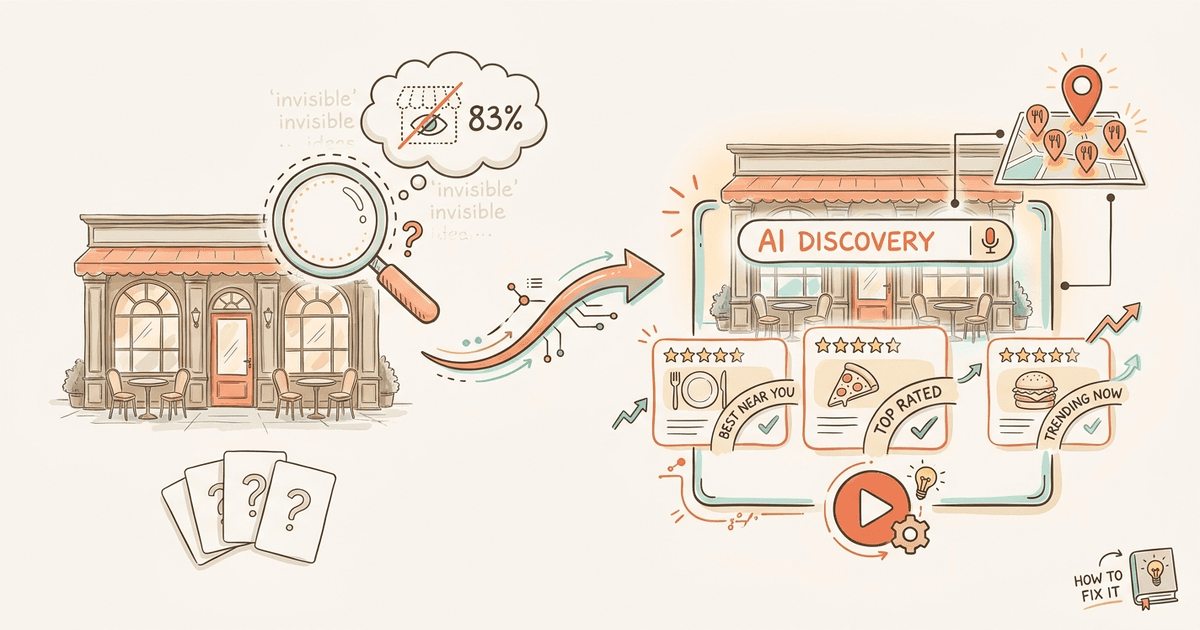
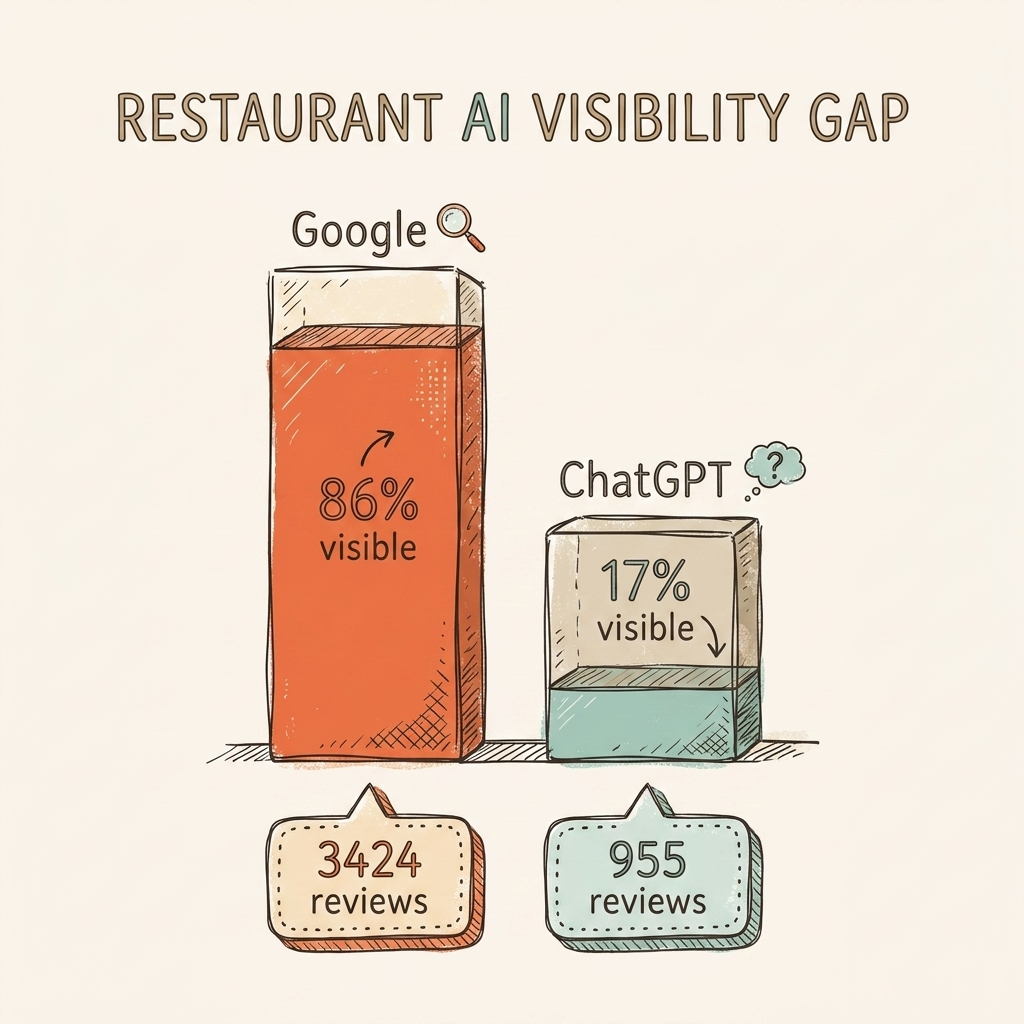
83% of restaurants don't exist in ChatGPT, while only 14% are invisible on Google. AI recommends restaurants with 3.6x more reviews than those it ignores. This guide covers why restaurant AI visibility is different from other local businesses, how each AI platform handles dining queries, and a 6-step playbook to get recommended.
83% of restaurants are completely invisible on ChatGPT. Only 14% are invisible on Google.
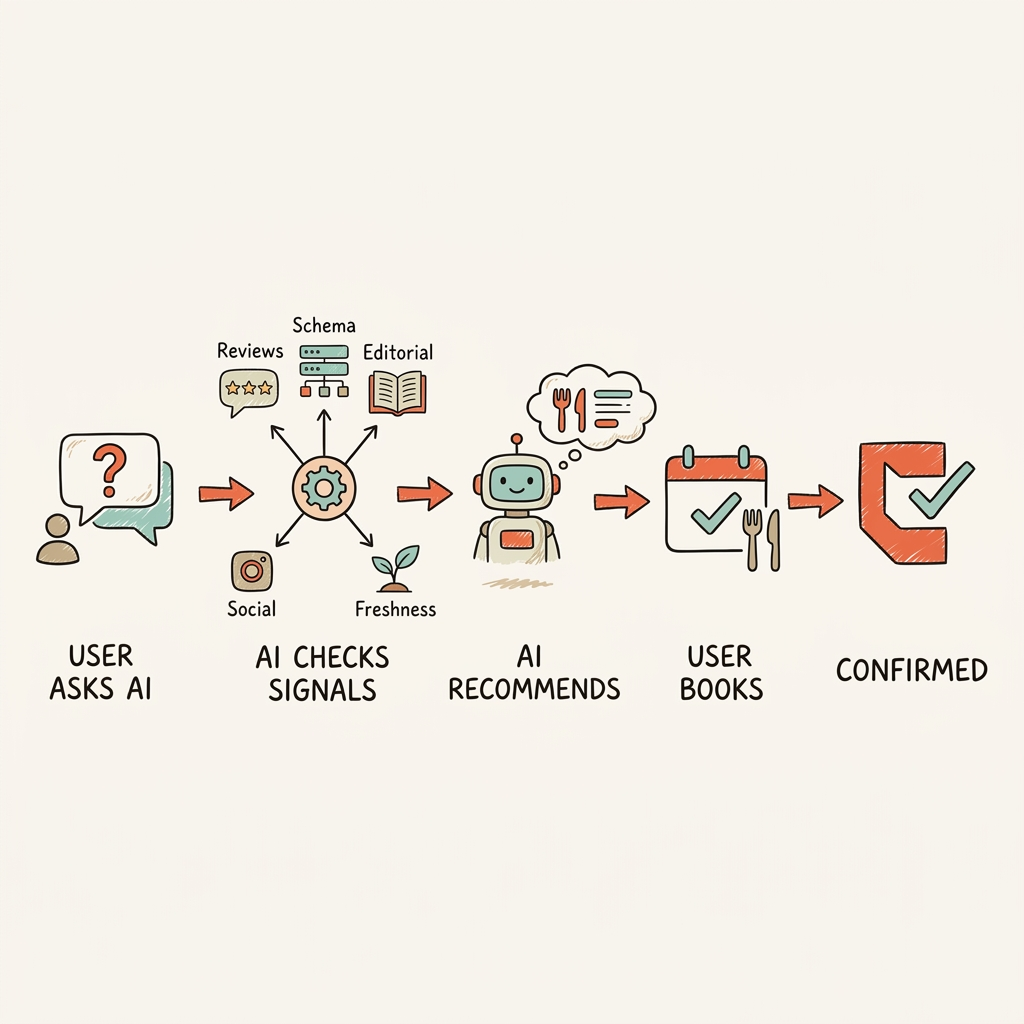
That's not a typo. Local Falcon analyzed 189,905 ChatGPT results and found most restaurants simply don't exist in AI search. The shift is accelerating, too. 20% of U.S. consumers now use AI tools like ChatGPT to decide where to eat. Among 25-34 year-olds, that number jumps to 61%. And here's what makes this different from traditional search: Perplexity's OpenTable integration lets users go from AI recommendation to confirmed reservation without ever leaving the conversation. If you're not in these results, you're losing diners at the exact moment they decide where to eat.
This guide covers why restaurants face a unique AI visibility challenge compared to other local businesses, how each AI platform handles restaurant queries differently, and a 6-step playbook for getting recommended.
Why Do Restaurants Face a Different AI Visibility Challenge?
Restaurants face unique AI visibility challenges because discovery is occasion-driven, review volume outweighs star ratings, and third-party listings dominate citations over restaurant websites.
Think about how differently people search for restaurants versus, say, a plumber. "Plumber near me" has one answer. Dining decisions are subjective, contextual, and change depending on who's eating, when, and why.
Occasion-based queries create infinite combinations. Users type "best romantic restaurant under $80," "family brunch with outdoor seating," or "business lunch near Financial District" into AI interfaces. Each occasion triggers a different recommendation set, and restaurants need signals for all of them.
Here's where it gets counterintuitive: the review volume paradox. AI-recommended restaurants average 3,424 Google reviews, while non-recommended ones average just 955 (a 3.6x gap). Star ratings? They barely matter. A 4.2-star spot with 3,000 reviews consistently beats a 4.8-star place with 200 reviews in AI recommendations. Why? Because language models learn from text. More reviews give them more context about a restaurant's vibe, service, and food quality.
Third-party listings dominate AI citations for restaurants. AI models pull from Yelp, Google Business Profiles, DoorDash, and food blogs before they ever check a restaurant's own website. You could have the most beautifully optimized menu page on the internet, and ChatGPT would still source its recommendation from your Yelp listing.
The structural disadvantage for independents is harsh. They appear in fewer than 3% of AI dining recommendations despite representing over 60% of U.S. restaurant locations. Chains accumulate reviews faster, maintain uniform structured data across locations, and get regular press coverage. All of those signals make chains visible to AI by default. If you're independent, you have to build what chains get for free.
How Does Each AI Platform Handle Restaurant Queries?
See where you rank across all AI answer engines.
Enter your domain and we'll scan your citation rate across ChatGPT, Perplexity, and Google AI.
Prefer to talk? Book a free 30-min call
Each AI platform sources restaurant recommendations differently: ChatGPT favors Reddit and review volume, Perplexity integrates OpenTable for direct bookings, and Google AI Overviews pulls from Maps and editorial content.
There's no single "AI algorithm" to optimize for. Each platform has its own data sources and quirks.
ChatGPT leans hard on Reddit. It treats Reddit threads as a proxy for genuine consumer sentiment, sourcing 51-76% of its social citations from Reddit across every country studied. It also favors restaurants with massive review counts (2,000+ is the threshold). And visibility here is binary: you're either recommended consistently, or you don't exist.
Perplexity is the one to watch for direct revenue. Its OpenTable integration covers 60,000+ restaurants on web, iOS, and voice assistants. A diner asks "where should I eat tonight?" and books a table without leaving the conversation. If your restaurant takes reservations, getting cited by Perplexity should be near the top of your list.
Google AI Overviews pulls from Maps reviews, structured data, and trusted editorial content (Eater, local food blogs, newspaper reviews). What's new: AI-organized results now group restaurants by occasion, cuisine type, and price point. Your Google Business Profile needs to be flawless here, and review recency matters more than total count.
Gemini features deep integration with Android and Google Maps. It excels at mobile "near me" queries where users want immediate, location-based recommendations.
| Platform | Primary Data Sources | Booking Integration | Key Signal |
|---|---|---|---|
| ChatGPT | Reddit, reviews, web | None | Review volume (2,000+ threshold) |
| Perplexity | OpenTable, web, reviews | OpenTable (60,000+ restaurants) | Structured listing data |
| Google AI Overviews | Maps, reviews, editorial | Google Reserve | Recency + editorial mentions |
| Gemini | Google Maps, reviews | Google Reserve | Mobile proximity + ratings |
What Are the 5 Signals AI Uses to Recommend Restaurants?
AI recommends restaurants based on five signals: review volume, structured data, editorial mentions, social presence, and content freshness. Review volume remains the single most dominant factor.
1. Review Volume (Not Star Rating)
We covered the 3.6x gap above, but it's worth repeating: restaurants with 3,400+ reviews dominate AI responses while those under 1,000 rarely surface at all. The 2,000-review mark is the threshold where things start to shift. Why does volume matter so much more than star rating? Because LLMs learn from text. A restaurant with thousands of reviews gives the model a rich pool of descriptive language about cuisine, ambiance, and service that it can match against occasion-based queries.
2. Structured Data
Schema markup for AI visibility acts as the technical foundation. AI platforms parse this code to understand your details. Menu schema (MenuItem), LocalBusiness markup, structured opening hours, and reservation links are all essential. This structured data allows models to confidently match occasion-based queries like "Italian restaurant open late with vegetarian options" to your listing.
3. Third-Party Editorial Mentions
Getting featured in Eater, a local food blog, or a newspaper "best of" list does more for AI visibility than most restaurant owners realize. AI models treat editorial content as a credibility signal. One feature in a recognized food publication carries more weight than hundreds of Instagram posts when it comes to AI citation.
4. Social Presence
Instagram content has been indexed since July 2025. Reddit threads remain ChatGPT's strongest social signal (as we covered above). And TikTok content is starting to surface in Perplexity answers. The pattern: AI models look for active communities talking about your food, not polished marketing feeds.
5. Content Freshness
Stale web presence is a visibility killer. If your website still lists last summer's menu, AI platforms notice. Updated menus, seasonal specials, and event pages signal that you're active. They also create more opportunities to match timely occasion queries ("restaurants with spring tasting menus" or "New Year's Eve dinner").
The 6-Step AI Visibility Playbook for Restaurants
A restaurant AI visibility strategy starts with optimizing third-party listings, building review volume, adding schema markup, creating occasion-based content, earning editorial mentions, and integrating with AI booking platforms.
-
Claim and optimize all third-party listings. AI models aggregate data across Yelp, Google Business Profile, DoorDash, Uber Eats, and TripAdvisor. Ensure your name, address, phone number, and hours match perfectly across every platform. Inconsistent information confuses the AI and reduces your chance of recommendation. High-quality photos and accurate menus must be present everywhere.
-
Build a review volume strategy. Target the 2,000+ review threshold. Implement post-dining email or SMS sequences. Place QR codes on tables linking directly to your Google review page. Time review requests within two hours of the dining experience. Focus on Google reviews as they carry the highest AI signal weight.
-
Add schema markup. Implement
LocalBusiness,MenuItem,openingHours,acceptsReservations, andservesCuisinemarkup on your website. Add FAQ schema addressing common occasion queries like "Is this restaurant good for large groups?" or "Do they have a private dining room?" -
Create occasion-based content pages. Build landing pages targeting specific dining intents: "Romantic Italian Date Night in [City]," "Family Style Sunday Brunch," "Private Dining for Corporate Events." These pages directly answer the long-tail queries users feed into AI platforms.
-
Earn editorial mentions. Pitch local food bloggers regularly. Apply for regional "best of" awards. Host media dinners to showcase new menus. Partner with food journalists who cover your neighborhood. A single inclusion in an Infatuation guide or Eater map can move the AI needle more than months of social media posting.
-
Integrate with AI booking platforms. Join OpenTable to capture Perplexity's direct booking integration. Ensure you're active on Google Reserve and Resy. The reservation link is what closes the loop from AI discovery to confirmed customer.
How Can Independent Restaurants Compete With Chains in AI Search?
Independent restaurants compete in AI search by owning hyper-local occasion queries, building community-level content, and earning the niche editorial mentions that chains can't replicate.
The numbers paint a tough picture. Independent restaurants lost over 9,500 locations in 2025 while chain locations grew by 1.4%. Chains dominate AI search for structural reasons: more reviews, uniform structured data, national press, and brand recognition that's literally baked into LLM training data.
That said, independents have angles chains can't touch. And they're good ones.
Hyper-local occasion ownership is the independent advantage. Chains compete on generic brand queries. Independents can dominate "best anniversary dinner in Wicker Park," "authentic Oaxacan food in East LA," or "quiet brunch in Georgetown." Chains lack the localized depth to win these highly specific occasion queries.
Community-level content builds localized authority that chains can't fake. Partner with neighborhood associations. Create content spotlighting the local food scene, not just your own menu. Sponsor a neighborhood food walking tour, or have your chef contribute a column to a community newsletter. These activities generate locally-rooted content that AI models surface when someone asks about dining in a specific neighborhood.
Niche editorial targeting gives independents something chains will never have. Pitch "hidden gem" or "best kept secret" stories to local food media. Tell the story of your generational recipes or the bartender who's been there 15 years. No chain will ever be featured as a hidden neighborhood gem. And when a user asks AI for a "unique local dining experience," it's those editorial features that get surfaced.
Frequently Asked Questions About AI Visibility for Restaurants
These are the most common questions restaurant owners ask about AI search visibility.
Do I Need a Website to Show Up in AI Search?
A website helps but isn't strictly required. AI platforms pull restaurant data primarily from third-party listings (Google Business Profile, Yelp, OpenTable), reviews, and editorial mentions. However, a website with schema markup and occasion-based content pages significantly improves your AI citation chances by giving you direct control over structured data.
Which AI Platform Matters Most for Restaurants?
It depends on your goal. Perplexity matters most for direct bookings thanks to its OpenTable integration. ChatGPT drives the highest overall discovery volume. Google AI Overviews captures users already in search mode. Prioritize based on where your customers are and whether you want discovery, bookings, or both.
How Long Does It Take to Improve Restaurant AI Visibility?
Structured data and listing optimization show results in 4-8 weeks. Review volume is a longer play: reaching the 2,000-review threshold takes 6-12 months for most restaurants. Editorial mentions can move the needle within weeks of publication.
Does DoorDash or Uber Eats Presence Help AI Visibility?
Yes. Delivery platform listings provide structured data that AI platforms aggregate: menu items, pricing, hours, and cuisine types. Being on DoorDash or Uber Eats increases the number of data sources AI can draw from when answering restaurant queries.
How Many Reviews Do I Need for AI to Recommend My Restaurant?
The 2,000-review threshold is a critical benchmark based on current data. AI-recommended restaurants average 3,424 Google reviews, while non-recommended restaurants average 955. Focus on steady review growth rather than hitting a specific number overnight.
Conclusion
83% of restaurants are invisible in AI search. This is a structural problem, not a quality problem.
Review volume is the dominant signal, with a 3.6x gap between recommended and ignored restaurants. Each AI platform handles dining queries differently: Perplexity drives direct bookings via OpenTable, ChatGPT relies on Reddit sentiment, and Google AI Overviews pulls from editorial content and Maps data. Independent restaurants can compete by owning hyper-local occasion queries that chains can't touch.
Start here: search for your restaurant on ChatGPT, Perplexity, and Google AI Mode right now. Ask for recommendations in your neighborhood. If you don't appear, you're losing diners today.
See where your brand appears in AI search
Scan ChatGPT, Perplexity, and Google AI across buyer-intent queries, instantly, no sign-up.
Find out if AI is sending buyers to your competitors.
We audit your AI visibility across ChatGPT, Perplexity, and Google AI –and show you exactly where you rank and what to fix.
“We went from 200 visitors/day to 1,900 visitors/day and 40% of demos are from AI search.”
Sumanyu Sharma · CEO, Hamming.ai
“Cintra helped me go from 3k to 7.5k daily traffic and doubled weekly orders in 1.5 months.”
Russ Coulon · Owner, UV Blocker
“We saw a lift from 3% to 13% visibility in the first 2 weeks, and organic traffic hit its highest ever.”
Ash Metry · Founder, Keywords.am
Related Articles
AI Visibility for Beauty Brands: The DTC Founder's Playbook
AI visibility for beauty brands drives 5.36% conversion rates, 2x the ecommerce average. The DTC playbook for…
LinkedIn Optimization for AI Search: The Data-Backed Playbook
LinkedIn optimization for AI search backed by 89K URL data. Learn what content gets cited by ChatGPT, Perplexi…
Product Feed Optimization AI Shopping Engines Actually Read (10-Point Audit)
Product feed optimization AI shopping engines need to recommend your products. Platform-by-platform feed requi…