Best GEO Services Ecommerce Brands Need for AI Visibility (2026)
AI referral traffic to ecommerce grew 302% in 2025. AI-referred shoppers convert at 4.4x the rate of organic search visitors. Yet most ecommerce brands are invisible to AI shopping assistants.

TL;DR
AI referral traffic to ecommerce grew 302% in 2025, yet most brands are invisible to AI shopping assistants. We rank the best GEO services for ecommerce using a 5-lever framework (schema, reviews, citations, editorial, community) and break down which services fit DTC, marketplace, and multi-channel brands. Cintra ($2K-$4K/mo) is best for Shopify/DTC execution. First Page Sage ($5K-$15K) for enterprise. GenOptima for outcome-based pricing. Skip to the rankings.
AI referral traffic to ecommerce grew 302% in 2025. AI-referred shoppers convert at 4.4x the rate of organic search visitors. Yet most ecommerce brands are invisible to AI shopping assistants.
Every "best GEO agencies for ecommerce" article is written by an agency ranking themselves first. None explain the mechanics of how AI actually recommends products. The market is confusing and filled with empty promises from traditional SEO vendors.
We rank the best GEO services ecommerce brands actually need right here. Our team introduces a five-lever framework to help you understand AI visibility. Then we break down which GEO services ecommerce teams should hire based on their business model. You need to know how these systems work. Our framework cuts through the noise and shows you exactly what drives real revenue.
Why Are AI Shopping Assistants Ignoring Your Ecommerce Brand?
AI shopping assistants like ChatGPT, Perplexity, and Google AI Overviews recommend products based on entity signals, reviews, and third-party citations (not traditional SEO rankings).
AI referral traffic to ecommerce exploded, growing 302% in 2025. 91% of ecommerce queries now trigger AI results across major search engines.
Pages with Product schema are 3.7x more likely to be cited by AI systems.
ChatGPT processes 50 million shopping queries daily. 84 million Americans ask it shopping questions every single week.
AI does not crawl your product pages the way Google does. It synthesizes recommendations from diverse sources. It reads reviews, editorial mentions, community discussions, and structured data. If your brand relies purely on keyword density, AI models cannot understand your value. The old playbook simply fails in this new environment.
Most ecommerce brands focus on traditional search optimization. But AI evaluates trust differently. It looks for consensus across the web. When multiple authoritative sources point to your product, AI treats that as truth. A high volume of backlinks will not save a product with poor entity resolution.
You might have thousands of monthly visitors from Google. But if you lack citations and strong entity signals, AI chat interfaces will ignore your catalog. Competitors with a fraction of your organic traffic will steal your AI recommendations if they master these new trust signals.
Understanding why AI ignores most ecommerce brands reveals what a GEO service needs to fix. If you want a deep dive into this topic, read our AI search optimization ecommerce playbook to learn more.
What Are the 5 Levers of Ecommerce AI Visibility?
See where you rank in generative engine results.
Enter your domain and we'll scan your generative engine citation rate across your highest-value queries.
Prefer to talk? Book a free 30-min call
The five levers are product schema, review signals, third-party citations, editorial mentions, and community presence (each feeding AI models different trust signals).
Product Schema Product schema makes your products machine-readable through JSON-LD markup. Products with attribute-rich schema get cited significantly more. This structured data feeds directly into the AI's understanding of your catalog. Models need exact specifications, pricing, and availability to formulate a coherent recommendation.
Here is a basic example of JSON-LD for a product:
{
  "@context": "https://schema.org/",
  "@type": "Product",
  "name": "Sample Product",
  "offers": {
    "@type": "Offer",
    "price": "29.99",
    "priceCurrency": "USD"
  }
}
Proper markup is foundational for AI visibility. You can read our complete guide on schema markup for AI visibility to implement this correctly.
Review Signals AI synthesizes reviews from Amazon, Trustpilot, Reddit, and niche forums. Volume, recency, and specificity matter heavily. Models look for patterns in user feedback. They weight review diversity across platforms. A thousand reviews on one site means less than a hundred reviews spread across five trusted platforms. Consistency across these platforms proves the product delivers real value to actual human beings.
Third-Party Citations Authoritative sites mentioning your product acts as an endorsement. Think Wirecutter, niche blogs, or comparison articles. AI models treat these citations as critical trust signals. Earned media proves your product is legitimate. If an independent journalist names your brand as the top pick in a category, generative models immediately prioritize your catalog over obscure competitors.
Editorial Mentions Press coverage, expert reviews, and industry publications feed the AI knowledge graph. AI models index and cite these sources constantly. This is different from traditional backlinks. AI cares about the textual mention itself, rather than merely the hyperlinked anchor text. A strong brand mention in Forbes carries real weight, even if the publication refuses to link back to your storefront.
Community Presence Real users recommend products in Reddit threads, Quora answers, and forum discussions. AI models cite Reddit 176% more in certain ecommerce verticals. This is often the most overlooked lever. Real human conversation validates your product's usefulness. If your customers actively debate the merits of your product on niche forums, AI systems index those debates as authentic social proof.

| Lever | What It Does | AI Platforms It Influences | Difficulty |
|---|---|---|---|
| Product Schema | Makes products machine-readable | Google AI Overviews, Perplexity | Medium |
| Review Signals | Provides social proof for AI synthesis | ChatGPT, Gemini, Claude | Medium-High |
| Third-Party Citations | Builds trust through editorial endorsement | All platforms | High |
| Editorial Mentions | Creates authoritative entity signals | ChatGPT, Perplexity | High |
| Community Presence | Surfaces real user recommendations | Perplexity, ChatGPT | Medium |
Now that you understand the levers, here is how the best GEO services for ecommerce actually pull them.
Which GEO Services Ecommerce Brands Should Choose?
The best GEO services ecommerce brands use include full-service agencies like Cintra and First Page Sage, SEO agencies adding GEO like iPullRank and Seer Interactive, and specialized platforms like Maintouch.
1. Cintra We operate as a full-service AI visibility agency. Our team specializes in ecommerce. For example, we took UV Blocker from 0 to 38K clicks in six months. We combine human strategy with AI agent execution to deliver 50x output. Our pricing runs $2K to $4K per month. We are best suited for DTC and Shopify brands wanting full execution. You can review the ecommerce case study: 0 to 38K clicks to see the exact breakdown of our work.
2. First Page Sage They were the first agency to offer AEO services back in 2023. Clients include brands like Salesforce and Logitech. They maintain strong thought leadership in the search space. Pricing ranges from $5K to $15K per month. They rank themselves first in their own lists, but they truly excel for enterprise ecommerce brands.
3. iPullRank This technical SEO agency is adding serious GEO capabilities. They possess deep expertise in entity optimization and structured data. Complex catalogs require technical precision. They are the best fit for technically complex ecommerce sites needing deep code-level fixes. Pricing starts around $10K per month.
4. GenOptima This pure-play GEO agency uses "Result-as-a-Service" pricing. Clients pay for measurable AI visibility outcomes, not retainer hours. They map directly to your revenue goals. This structure is perfect for brands wanting outcome-based pricing rather than traditional retainers.
5. Seer Interactive They are a highly data-driven agency with strong GEO capabilities. Their analytics team is exceptional at tracking visibility changes. They handle large datasets well. They are best for multi-channel retailers needing tight data integration across various platforms. Pricing starts around $8K per month.
6. Onely Onely is a technical SEO firm with a dedicated ecommerce GEO practice. They focus intensely on crawlability and indexation for AI systems. Large catalogs demand this level of technical rigor. Pricing spans $5K to $25K or more per month. They are the top choice for retailers with millions of SKUs.
7. Maintouch This is an SEO automation platform with powerful GEO features. It auto-publishes directly to your CMS. Smaller teams need automation to survive. It is best for developer tool companies and startup ecommerce brands wanting software over service. Pricing is accessible at $500 to $2K per month.
8. Coalition Technologies This full-service digital agency is actively adding ecommerce GEO. They offer strong integration between paid and organic channels. Some brands want everything under one roof. They are best for ecommerce brands wanting bundled services. Pricing ranges from $3K to $10K per month.
| Service | Type | Best For | Pricing | Ecommerce Focus |
|---|---|---|---|---|
| Cintra | Managed agency | DTC/Shopify brands | $2K-$4K/mo | High (case studies) |
| First Page Sage | Premium agency | Enterprise ecommerce | $5K-$15K/mo | Medium |
| iPullRank | Technical SEO | Complex catalogs | $10K+/mo | Medium |
| GenOptima | Outcome-based agency | ROI-focused brands | Pay-per-result | Medium |
| Seer Interactive | Data agency | Multi-channel | $8K+/mo | Medium |
| Onely | Technical SEO | Large catalogs | $5K-$25K/mo | High |
| Maintouch | Automation platform | Startups | $500-$2K/mo | Low-Medium |
| Coalition Technologies | Full-service digital | Bundled services | $3K-$10K/mo | Medium |
But GEO services ecommerce brands choose are not one-size-fits-all. Your business model changes which approach works best.
How Does GEO Differ for DTC, Marketplace, and Multi-Channel Brands?
DTC brands need community and editorial signals, marketplace sellers need review optimization and listing schema, and multi-channel retailers need entity consistency across platforms.
DTC (Shopify, own site) Product schema is your biggest lever. You control the entire site experience. You must implement JSON-LD flawlessly. Optimize your product descriptions so AI can extract key features easily. Build strong editorial mentions and a vibrant community presence. Our work with UV Blocker proves this approach works. We used these exact levers to scale their traffic rapidly. If you run a Shopify store, check out our guide on AI search optimization for Shopify ecommerce to learn the specifics.
Marketplace (Amazon, Walmart) You do not control the underlying site structure. Focus on review signals (volume and diversity). Create A+ content that AI models can parse effectively. Build third-party citations from trusted comparison articles. The marketplace handles the schema markup automatically. Your job is feeding the AI external validation.
Multi-Channel (own site + marketplaces) This is the hardest model to optimize. Entity consistency is critical. Your brand must look identical across your site, Amazon, review platforms, and editorial mentions. AI models get confused by conflicting information. If your product specs differ between your Shopify store and your Amazon listing, AI will drop your product from recommendations. This complexity makes agency support highly valuable.
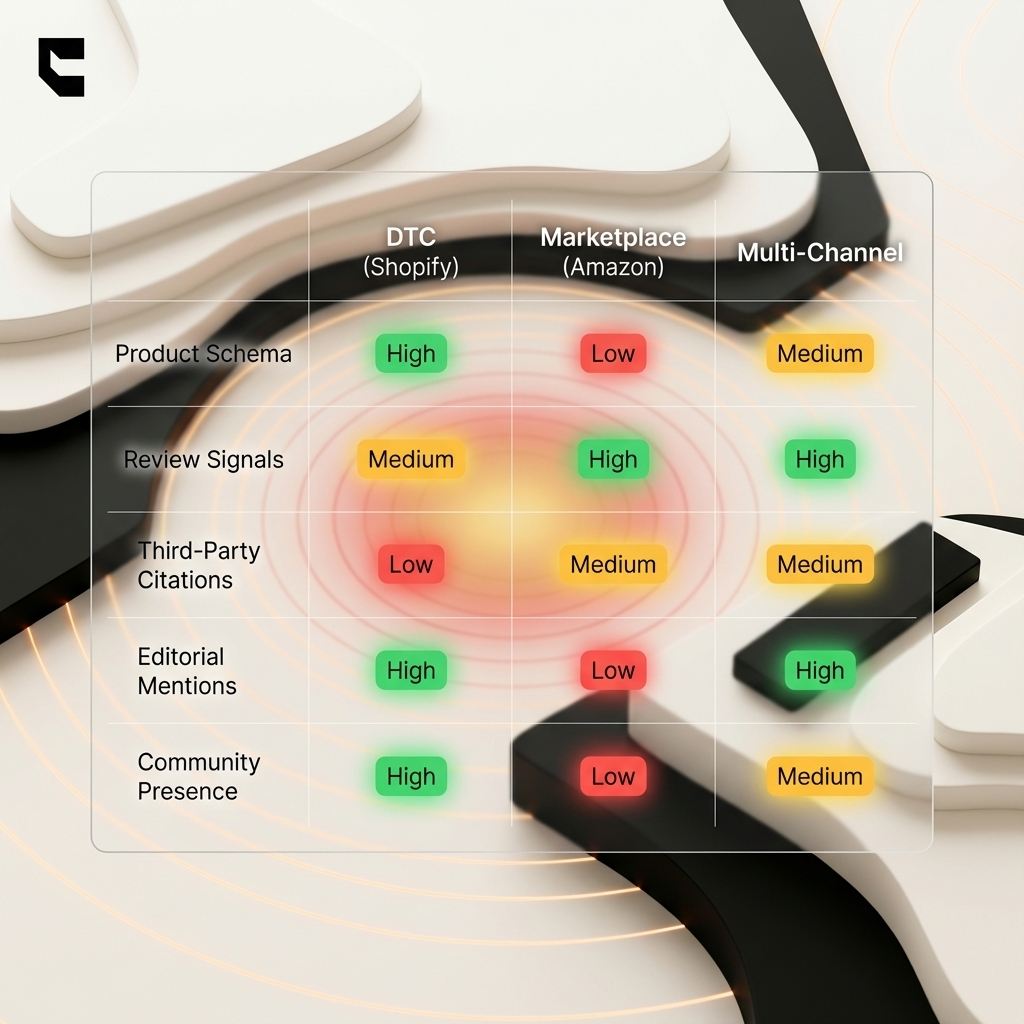
Regardless of your model, there are red flags to watch when choosing a GEO service.
What Red Flags Should You Watch When Choosing an Ecommerce GEO Service?
Watch for agencies that promise AI rankings without measurement tools, lack ecommerce-specific case studies, or only offer monitoring dashboards without execution capabilities.
No Ecommerce Case Studies Generic AI visibility results do not prove ecommerce execution capability. Many agencies boast about B2B SaaS case studies. Ranking a software tool is completely different from ranking a physical product catalog. Demand to see real ecommerce data. If they cannot show you actual sales or traffic lift for a retail brand, walk away.
Monitoring-Only Services Sold as GEO A dashboard showing your AI mentions is not the same as improving them. Many tools call themselves GEO platforms. But they only track your baseline visibility. They offer no mechanism to actually change your position. You need execution, not merely observation.
No Measurement Methodology If an agency cannot show you citation rates, share of voice, or AI traffic attribution, they are just guessing. Real GEO requires hard data. You need to know exactly how your visibility changes month over month. If you want to know what metrics matter, read our guide on how to measure AI visibility.
Traditional SEO Dressed Up as GEO Many agencies claim they optimize for AI. But their deliverables are just traditional content and backlinks. They ignore structured data, entity optimization, and community strategy. This is the most common issue in the market right now. Traditional links will not force ChatGPT to recommend your product.
Here are the most common questions about GEO services ecommerce brands ask before choosing a partner.
Frequently Asked Questions About GEO Services for Ecommerce
Does GEO Replace Ecommerce SEO?
No. GEO complements SEO (traditional search still drives the majority of ecommerce traffic, but AI referrals convert at significantly higher rates). SEO powers the content AI finds, and GEO powers the trust signals AI weighs. The best ecommerce brands invest in both channels simultaneously. Traditional search captures intent, while AI search captures complex problem-solving queries.
How Long Does Ecommerce GEO Take to Show Results?
Most ecommerce brands see measurable changes in AI citations within 4-8 weeks, with significant traffic impact by month 3-4. Schema changes and review signals move the fastest. Editorial mentions and community presence take much longer to build. But those long-term signals have a far more durable impact on your AI visibility. Once established, they are hard for competitors to unseat.
What Does Ecommerce GEO Cost?
GEO services ecommerce brands invest in range from $500/mo for automation tools to $25K+/mo for enterprise agencies, with most mid-market brands spending $2K-$8K/mo. The cost depends on your needs. Do you need monitoring only? Do you need high-level strategy guidance? Or do you need full execution across all five levers? Execution-heavy retainers naturally cost more but drive faster results.
Can AI Shopping Assistants Recommend Specific Products?
Yes. ChatGPT, Perplexity, and Google AI Overviews all recommend specific products by name with links, pricing, and comparison context. ChatGPT Shopping processes 50 million shopping queries daily. These are not vague category suggestions. They are specific product recommendations complete with direct buy links. Users ask complex questions and expect precise product answers.
What's the Difference Between AEO and GEO for Ecommerce?
AEO (Answer Engine Optimization) and GEO (Generative Engine Optimization) describe the same practice (optimizing for AI-generated answers). The terms are used interchangeably. Some agencies use AEO to emphasize answer optimization in chat interfaces (like ChatGPT and Perplexity). Others use GEO to emphasize generative search within traditional engines (like Google AI Overviews). For ecommerce brands, the underlying tactics remain identical.
Conclusion
AI referral traffic to ecommerce is growing fast. Brands that invest in GEO right now capture a clear early-mover advantage. New Q1 2026 data shows AI-referred ecommerce sessions have a 73% lower bounce rate and 2.8x longer session duration than organic search traffic, meaning AI doesn't just send more visitors, it sends better-qualified ones. The 5-lever framework (schema, reviews, citations, editorial, community) gives you a structured way to evaluate any GEO service. Your specific ecommerce model (DTC, marketplace, or multi-channel) dictates which levers and services actually matter most for your growth. Watch for red flags. Avoid agencies with no ecommerce case studies, monitoring-only positioning, or traditional SEO repackaged as GEO.
Audit your current AI visibility today. Search for your top product in ChatGPT and Perplexity. If you do not appear in the results, you need GEO services ecommerce specialists can provide immediately.
We helped UV Blocker go from 0 to 38K clicks with targeted ecommerce AI visibility. See the case study or get a free AI visibility assessment.
See where your brand appears in AI search
Scan ChatGPT, Perplexity, and Google AI across buyer-intent queries, instantly, no sign-up.
Find out if AI is sending buyers to your competitors.
We audit your AI visibility across ChatGPT, Perplexity, and Google AI –and show you exactly where you rank and what to fix.
“We went from 200 visitors/day to 1,900 visitors/day and 40% of demos are from AI search.”
Sumanyu Sharma · CEO, Hamming.ai
“Cintra helped me go from 3k to 7.5k daily traffic and doubled weekly orders in 1.5 months.”
Russ Coulon · Owner, UV Blocker
“We saw a lift from 3% to 13% visibility in the first 2 weeks, and organic traffic hit its highest ever.”
Ash Metry · Founder, Keywords.am
Related Articles
Product Feed Optimization AI Shopping Engines Actually Read (10-Point Audit)
Product feed optimization AI shopping engines need to recommend your products. Platform-by-platform feed requi…
Google AI Mode Optimization: How to Get Cited (2026 Guide)
Google AI Mode optimization needs a different approach than AI Overviews. Only 13.7% of sources overlap. Learn…
How to Get Cited by Grok: The xAI Platform Optimization Guide
Learn how to get cited by Grok with a 6-step framework covering the X co-citation mechanic, robots.txt setup,…