Quora Strategy for AI Visibility: A Practitioner's Playbook for the Most Underrated Citation Channel
Quora is the 4th most-cited source in Google AI Mode (7.25%). Build a Quora strategy for AI visibility with our data-backed answer framework and operational playbook.
TL;DR
- Quora is the 4th most-cited domain in Google AI Mode, with 7.25% of responses including Quora content (Semrush 26K URL study)
- AI models paraphrase Quora answers (0.435 text overlap) rather than quoting them, so topical depth matters more than keyword matching
- Cited answers average 535+ words, 15 upvotes, and 37 replies. Depth and engagement are the signals.
- 89.7% of cited answers carry Quora's "Most Relevant" algorithmic label. Quora's own ranking system acts as a pre-filter for AI models.
- 10.9% of Quora answers are now AI-generated (257% increase since 2020), making authentic expertise both the differentiator and the moat
Quora appears in 7.25% of Google AI Mode responses. That makes it the fourth most-cited domain, sitting behind LinkedIn, Reddit, and Google itself. Almost no brand has a Quora strategy for AI visibility. Marketing teams build Reddit playbooks. They refine blog content endlessly. They ignore the one platform offering clean, structured answers without requiring heavy algorithmic interpretation.
This playbook breaks down the data behind Quora's citation power. We provide a proven framework for writing answers that AI models actually cite. We show you how to operationalize Quora engagement alongside your existing Reddit strategy for AI visibility.
These insights come from running 30 to 40 Quora engagements per month for clients. We combined that operational experience with the Semrush dataset covering 26,000 cited URLs. The resulting playbook gives you a clear blueprint for capturing Google AI Mode visibility.
Why Is Quora the Most Underrated AI Citation Channel?
Quora is the 4th most-cited domain in Google AI Mode at 7.25%, yet most brands have zero Quora strategy while obsessing over Reddit.
The Semrush dataset exposes a blind spot in search marketing. Quora ranks fourth in Google AI Mode citations: 7.25% of 278,279 analyzed prompts included Quora citations. Marketing teams remain unaware of this channel. They chase organic search rankings and leave AI citation opportunities uncontested.
Quora reports over 400 million monthly unique visitors. This user base generates a continuous stream of fresh, specific queries. AI models use this type of granular, long-tail question data to build their responses.
Quora and Reddit are complementary channels. They don't compete for the same AI visibility. Reddit captures 46.7% of Perplexity's top-10 cited sources but barely registers in Google AI Mode. Quora dominates Google AI Mode but remains absent from Perplexity's top 10. A successful brand requires both a Reddit strategy for AI visibility and a dedicated Quora protocol.
Platform structure drives this behavior. Quora enforces a predictable Q&A format: a user asks a specific question, and experts provide structured answers directly beneath it. Reddit relies on nested multi-thread discussions. AI models extract data efficiently from Quora's clean Q&A pairs. They need more processing to parse Reddit's sprawling forum threads.
How Do AI Models Use Quora Content Differently Than Reddit?
See where you rank across all AI answer engines.
Enter your domain and we'll scan your citation rate across ChatGPT, Perplexity, and Google AI.
Prefer to talk? Book a free 30-min call
AI models paraphrase Quora answers with only 0.435 text overlap, prioritizing topical alignment over keyword matching. This is the opposite of traditional SEO signals.
Google AI Mode interacts with Quora content through paraphrasing. The system shows a 0.435 text overlap with cited Quora sources. Google doesn't quote Quora answers directly. It digests the information and synthesizes a new response. This contrasts with Reddit threads, where AI models often quote users verbatim to capture raw sentiment.
Keyword stuffing fails here. Query-to-title similarity sits at just 0.1. Google ignores exact match keywords. It rewards deep, comprehensive topic coverage over superficial keyword density. You can't game the system by matching the user's prompt word-for-word. You need to provide the most useful answer on the platform.
Quora's own algorithms do the initial filtering. 89.7% of cited answers carry Quora's internal "Most Relevant" label. AI models use Quora's algorithmic ranking as a trusted quality signal. You need to win Quora's internal ranking system before you can win the AI citation.
Each major AI platform treats Quora differently. Google AI Mode ranks Quora fourth at 7.25%. Google AI Overviews cite Quora in 14.3% of their top-10 source positions. Perplexity ignores Quora, preferring Reddit with a 46.7% citation share. ChatGPT also skips Quora, favoring Wikipedia at 47.9%. Claude prefers first-party authoritative domains over community platforms. Effective generative engine optimization demands platform-specific strategies.
| AI Platform | Quora Citation Rate | Reddit Citation Rate | Primary Source Preference |
|---|---|---|---|
| Google AI Mode | 7.25% (4th most-cited) | Lower citation rate | LinkedIn, Reddit, Google |
| Google AI Overviews | 14.3% of top-10 sources | 21.0% of top-10 sources | Mixed authoritative sites |
| Perplexity | Not in top-10 sources | 46.7% (top cited source) | Community forums, Reddit |
| ChatGPT | Not in top-10 sources | Lower citation rate | Wikipedia (47.9%) |
| Claude | Minimal citation rate | Minimal citation rate | 1st-party authoritative domains |
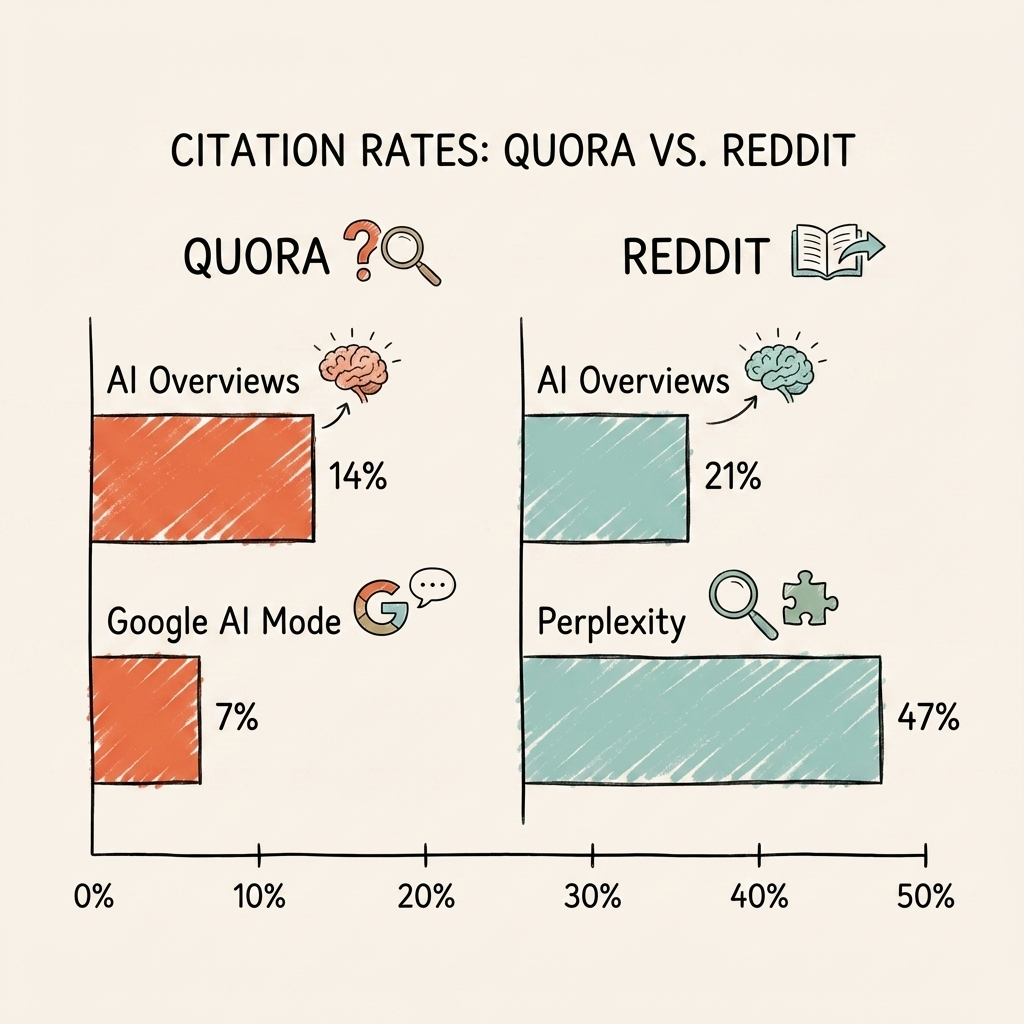
Focus your Quora efforts on capturing Google's AI products. If your primary goal is to get cited by Perplexity, redirect resources to Reddit.
What Does an AI-Citable Quora Answer Look Like?
Cited Quora answers average 535+ words with 15 upvotes and follow a direct-answer-first structure that gives AI models clean extraction points.
The Semrush analysis of 26,000 URLs provides a clear anatomical blueprint. You can't write generic helpful paragraphs. You must format your expertise for machine extraction. We use this exact structure for all client engagements.
1. Lead with a direct answer (15 to 30 words). AI models scan for this dense text block immediately below the question. We call it the answer capsule. It must resolve the core intent of the query without requiring further reading.
2. Provide supporting evidence. AI models look for structural markers of depth. Use formatted lists, custom data tables, and quantifiable case study metrics. Vague advice fails. Concrete data wins.
3. Inject an authentic experience signal. State what you tested. Detail what you built or managed. Use first-person framing: "We tested this across 50 accounts." This proves human involvement and separates you from bots.
4. Hit the depth threshold. A cited answer averages a minimum of 535 words. Short replies get ignored. Treat every target answer like a micro-blog post.
5. Generate baseline engagement. The average cited answer holds 15 upvotes. The parent question thread averages 37 replies. An answer in a dead thread rarely gets picked up. You need community validation.
Consider a B2B question about scaling organic traffic. A generic answer offers 50 words of basic SEO advice. A citation-optimized answer delivers 600 words of tactical execution: it starts with a specific traffic metric, outlines a three-step testing protocol, and includes revenue results from a documented campaign.
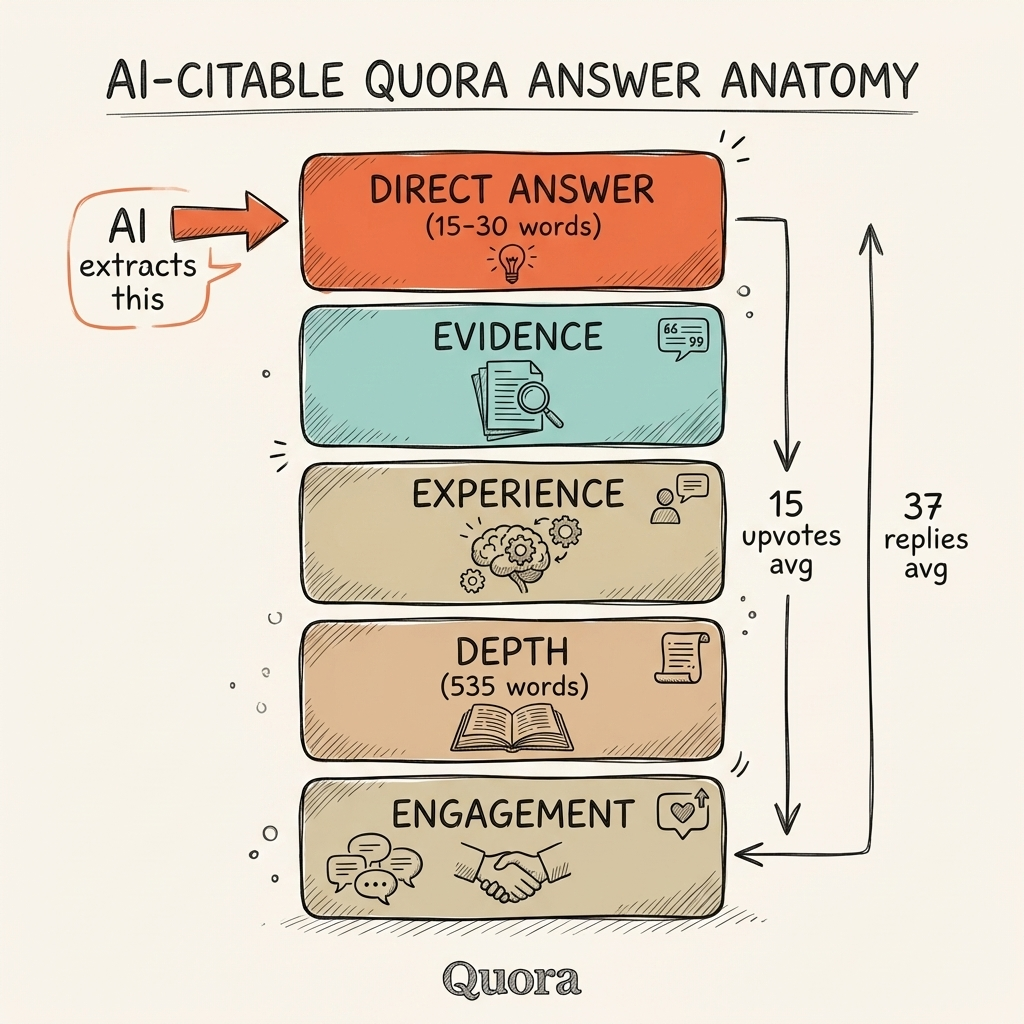
The direct answer capsule mirrors the principles of E-E-A-T for AI search. AI systems require a standalone summary before they process detailed context. They extract the summary and reference the supporting evidence for authority.
How Can Quora Spaces Build Branded Authority for AI?
Quora Spaces function as branded content hubs where consistent, expert-level answers build the topical authority signals AI models use to evaluate source credibility.
Quora Spaces operate as dedicated communities within the larger platform. They aggregate discussions, long-form articles, and detailed answers under one topic umbrella. You own and moderate this environment.
AI models prioritize consistency. Publishing regularly within a focused Space builds topical authority. This provides the E-E-A-T for AI search signals that modern citation engines require. A stray answer carries little weight. A network of fifty interconnected answers inside a dedicated Space establishes clear domain expertise.
Space Setup Checklist
- Name the Space around your expertise area, not your company brand name
- Publish two to three foundational, in-depth answers every week
- Invite recognized domain experts to contribute their own content
- Cross-post relevant blog articles directly into the Space
- Monitor platform analytics to identify which answers drive the most algorithmic traction
You don't need to create every piece of content from scratch. Repurpose your existing assets. Take a high-performing blog post, adapt the core argument into a conversational Q&A format, and publish it as a Space answer. Link new answers to older, related answers using internal Quora links. This builds a dense web of relevance that keeps AI models circulating through your content.
What Is the AI-Generated Answer Risk on Quora?
10.9% of Quora answers are now AI-generated, a 257% increase since 2020. This creates both a quality dilution risk and an opportunity for brands that demonstrate authentic expertise.
An Originality.AI study tracks this growth in synthetic content. AI generation represented 3.06% of answers in 2020, climbed to 6.93% in 2022, peaked at 11.86% in 2023, and sits at 10.94% for 2024. The platform is filling with automated responses.
This dilutes overall platform quality. If Quora fills with synthetic noise, AI engines will eventually discount the domain. Google won't cite AI-generated content to answer user queries. It needs human insight.
This risk creates an immediate opportunity. Brands providing actual human experience stand out against the synthetic baseline. Authentic expertise serves as both a differentiator and a structural moat.
How to Differentiate From AI-Generated Answers
- Include proprietary data or first-hand observations from specific client accounts
- Reference verifiable, real-world case studies with concrete numbers
- Write with a distinct, opinionated voice, not just informational summaries
- Leave thoughtful follow-up comments on your own answers (AI bots post and abandon the thread)
Track your progress with our guide on how to measure AI visibility. Watch your referral metrics shift as your answers age and accumulate citations.
Frequently Asked Questions About Quora Strategy for AI Visibility
These are the most common questions we get from clients evaluating Quora as an AI visibility channel.
Does Quora Help With AI Visibility or Just SEO?
Quora directly helps with AI visibility. It's the 4th most-cited domain in Google AI Mode, independent of its traditional SEO ranking value. The citation power stems from its structured Q&A format, not its organic search positions. AI models extract data differently than Google's traditional web crawler. They want answers, not web pages.
How Many Quora Answers Per Week Do I Need?
Aim for 5 to 10 high-quality answers per week to build enough citation footprint for AI models to notice your expertise pattern. We process 30 to 40 monthly opportunities for clients to maintain steady velocity in their niches.
How Long Until I See AI Citation Results From Quora?
Initial AI citations typically appear within 4 to 6 weeks of consistent posting, with compounding results over 3 to 6 months as topical authority builds. This timeline matches the Reddit indexing delays we observe. You are building an asset, not running a quick campaign.
Quora vs Reddit: Which Matters More for AI Visibility?
Reddit delivers broader multi-platform citations while Quora dominates Google AI Mode. A complete strategy uses both as complementary channels. Use Reddit for Perplexity dominance. Deploy Quora to capture Google AI Mode market share.
Conclusion
- Quora provides a high-signal citation channel for Google AI Mode at 7.25%. It doesn't replace Reddit. It captures the Google ecosystem specifically.
- Citable answers demand a specific format. You need 535+ words minimum with a direct, machine-readable answer capsule leading the response.
- Quora Spaces generate compounding topical authority. This structured authority directly feeds the largest AI citation models.
- The flood of AI-generated content makes authentic, human-written expertise more valuable. It raises the barrier to entry for competitors.
Pick your strongest area of expertise today. Find three unanswered questions related to that topic on Quora. Write three answers following the 535-word framework detailed above.
We run Quora engagement campaigns for clients at scale, handling 30 to 40 researched answers every month. We manage thread discovery, answer framing, and quality control across every post. Review our results to see the traffic impact.
See where your brand appears in AI search
Scan ChatGPT, Perplexity, and Google AI across buyer-intent queries, instantly, no sign-up.
Find out if AI is sending buyers to your competitors.
We audit your AI visibility across ChatGPT, Perplexity, and Google AI –and show you exactly where you rank and what to fix.
“We went from 200 visitors/day to 1,900 visitors/day and 40% of demos are from AI search.”
Sumanyu Sharma · CEO, Hamming.ai
“Cintra helped me go from 3k to 7.5k daily traffic and doubled weekly orders in 1.5 months.”
Russ Coulon · Owner, UV Blocker
“We saw a lift from 3% to 13% visibility in the first 2 weeks, and organic traffic hit its highest ever.”
Ash Metry · Founder, Keywords.am
Related Articles
Product Feed Optimization AI Shopping Engines Actually Read (10-Point Audit)
Product feed optimization AI shopping engines need to recommend your products. Platform-by-platform feed requi…
Google AI Mode Optimization: How to Get Cited (2026 Guide)
Google AI Mode optimization needs a different approach than AI Overviews. Only 13.7% of sources overlap. Learn…
How to Get Cited by Grok: The xAI Platform Optimization Guide
Learn how to get cited by Grok with a 6-step framework covering the X co-citation mechanic, robots.txt setup,…