AEO Checklist AI Visibility: 12 Pass/Fail Audit Items
Master the AEO checklist AI visibility framework. 12-item pass/fail audit across Content Structure, Discoverability, Quality, and Technical – based on verified model behavior.

TL;DR
The AEO checklist AI visibility framework reveals 4 critical failure categories, blocked crawlers, client-side rendering, missing schema, and weak quality signals. This AEO checklist AI visibility guide provides 12 pass/fail tests across Content Structure, Discoverability, Content Quality, and Technical. Fix Discoverability first, then structure, quality, and technical polish. Run the View Source test on your top pages today.
An effective AEO checklist AI visibility strategy is the foundation of any approach to get cited by ChatGPT, Perplexity, Claude, and Gemini. 76.4% of ChatGPT's most-cited pages were updated within the last 30 days. Pages with structured data get cited 3.2x more often. Yet most AEO checklists still recycle the same generic SEO advice without explaining what AI models actually see.
Generic AEO advice fails to explain what AI models actually see versus what they ignore. Each model operates a different content pipeline. ChatGPT reads a Bing-filtered version of your pages. Perplexity fetches pages live. Claude reads markdown summaries. Gemini applies its own processing rules. One page results in four different versions. If your site structure fails to account for these differences, your visibility drops to zero. You can read more about how AI models read websites as part of a broader AI content audit strategy.
This guide provides 12 pass/fail audit items across four categories. These criteria are grounded in verified cross-model research rather than marketing theory. The AEO checklist AI visibility evaluation helps you know exactly where your site stands.
We built this AEO checklist AI visibility framework from verified technical findings about how AI models fetch, filter, and cite content. It removes guesswork and gives you a concrete evaluation tool.
What Does an AEO Checklist Actually Test?
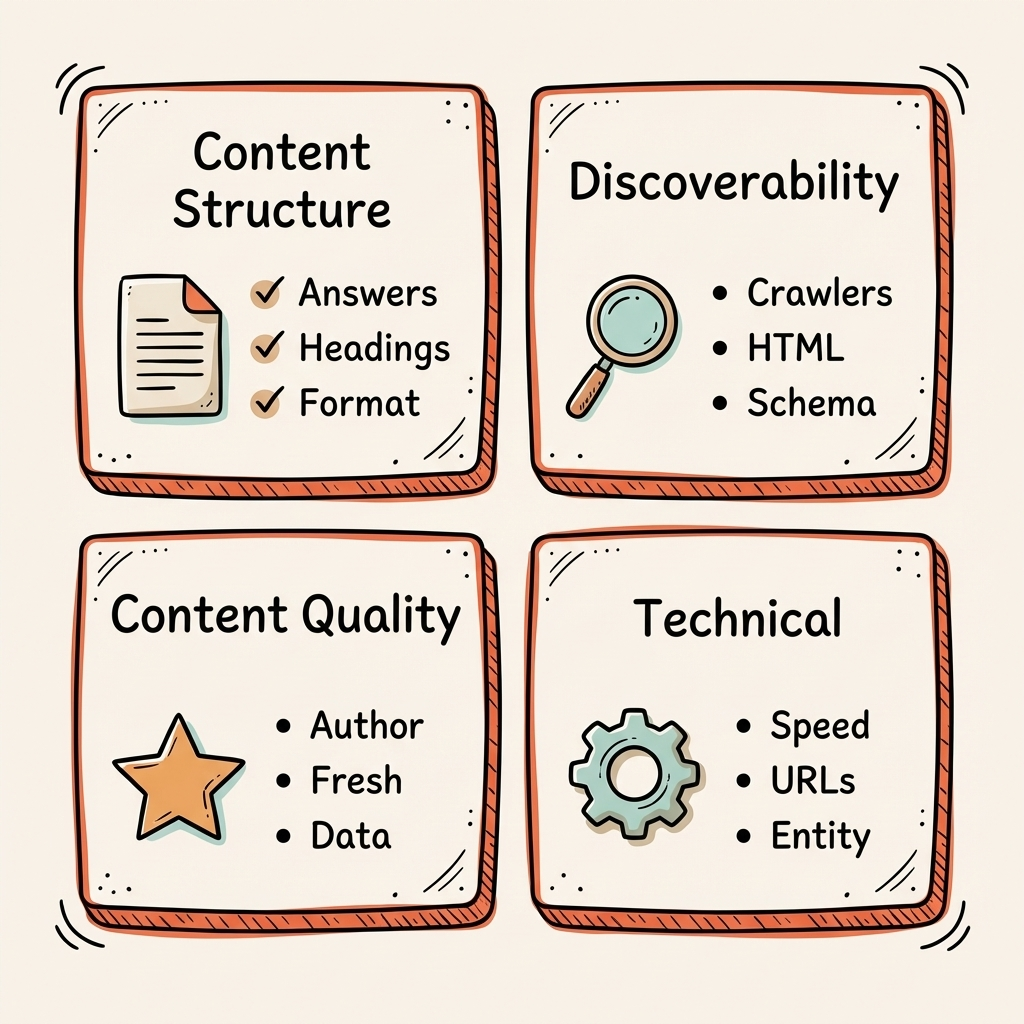
An AEO checklist tests whether AI models can find, extract, and cite your content across content structure, discoverability, quality signals, and technical infrastructure.
Traditional SEO checklists focus on Google crawling and ranking algorithms. An AEO checklist targets AI citation behavior. It measures your ability to get cited by ChatGPT, Perplexity, Claude, and Gemini.
The evaluation spans four categories. Content Structure ensures your answers are formatted for rapid extraction. Discoverability verifies bots can access your pages. Content Quality evaluates trust signals and entity authority. Technical Infrastructure confirms your site meets baseline performance thresholds.
Each item has a clear pass or fail test. "Optimize your content" is not a testable metric. "Does your first paragraph directly answer the heading question?" is a clear pass or fail criterion. We audit sites daily using these parameters. And we find critical failures hiding in plain sight.
Content Structure: Can AI Models Extract Your Answers?
See where you rank across all AI answer engines.
Enter your domain and we'll scan your citation rate across ChatGPT, Perplexity, and Google AI.
Prefer to talk? Book a free 30-min call
AI models extract answers from headings, first paragraphs, and structured formats. If your answers are buried in long paragraphs, models skip them.
Item 1: Front-Loaded Answers
PASS: The first paragraph after each H2 directly answers the heading question in 15 to 30 words. FAIL: The answer appears midway through the section or requires reading multiple paragraphs.
AI models treat the first paragraph after a heading as the "answer capsule." Perplexity and ChatGPT both pull from this position. If your answer isn't there, you lose the citation. Models grab the immediate response following the header and move on. We see clients lose potential citations by placing answers too low on the page. Answer the question immediately.
Item 2: Heading Hierarchy
PASS: Your content follows an H1 to H2 to H3 logical flow. H2s map to distinct topics. No skipped levels. FAIL: H2s used for styling. H3s appear without a parent H2. Headings don't match the content below them.
Models use heading hierarchy to segment content into extractable chunks. A page with 12 H2s that all blend together gives the model no structure to work with. Claude converts pages to markdown format and relies on heading structure for semantic segmentation. Perplexity also uses heading hierarchy to locate and extract specific details. Clean structure maps your content for these parsers. Bad structure confuses them and results in missed citations.
Item 3: Structured Formats
PASS: At least one comparison table, numbered or bulleted list, or FAQ Q&A section per article. FAIL: Wall-of-text format with no structured elements.
Structured formats are the easiest content for AI models to extract. Content with FAQ blocks is 67% more likely to be cited for conversational queries. Tables provide clear data points. Perplexity often extracts tables almost verbatim. Lists break complex processes into actionable steps. These elements give AI engines digestible information blocks. Walls of text slow down processing and reduce your chances of inclusion.
Structuring content correctly means nothing if AI models can't find your pages in the first place.
Discoverability: Can AI Models Find Your Content?
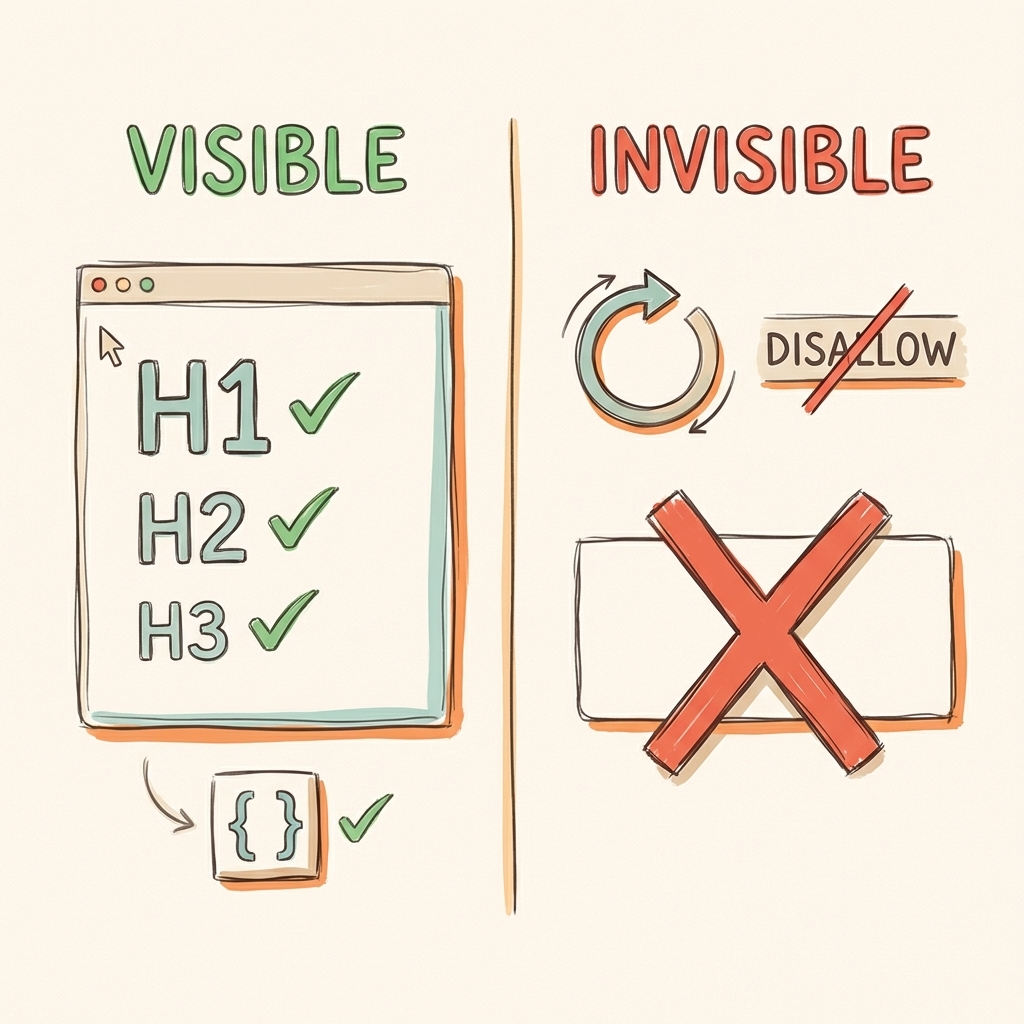
AI models must crawl, render, and parse your pages before citing them. Blocked crawlers, client-side rendering, and missing schema create invisible barriers to AI visibility.
Item 4: AI Crawler Access via robots.txt
PASS: Your robots.txt allows GPTBot, ClaudeBot, PerplexityBot, and Googlebot. FAIL: Any of these bots are blocked, or your robots.txt uses a blanket disallow rule.
79% of major news sites block AI crawlers. Many brands copy these restrictive policies without realizing they are making themselves invisible to AI search. Blocking crawlers results in zero AI visibility. Your robots.txt file needs specific allow directives for these agents. We regularly audit sites that unknowingly block PerplexityBot. They wonder why their traffic stays stagnant.
User-agent: GPTBot
Allow: /

User-agent: ClaudeBot
Allow: /

User-agent: PerplexityBot
Allow: /
Item 5: Server-Side Rendered HTML
PASS: Critical content is visible in the raw HTML source when you View Source in your browser. FAIL: Content only renders after JavaScript execution.
AI crawlers don't execute JavaScript. If your content only exists in client-side rendered components, every AI model sees a blank page. This is the most common invisible failure for modern websites built on React or Vue single-page applications. Open your page, right-click, and select "View Page Source." If your article content is missing from that code, AI models can't see it either.
Item 6: Schema.org Structured Data
PASS: Organization, Article, and FAQPage schema implemented where relevant. FAIL: No structured data or only basic website schema.
Pages with Schema.org structured data are cited 3.2x more often in AI responses. Schema gives models explicit entity relationships and content categorization. GPT-4 accuracy improved from 16% to 54% when analyzing content formatted with structured data. This markup provides the metadata models need to classify your information correctly. Learn how to implement this in our guide to schema markup for AI visibility.
Even if models find and extract your content, they still evaluate quality before citing it.
Content Quality: Does Your Content Earn AI Trust?
AI models evaluate author expertise, content freshness, and data originality before deciding which sources to cite. Generic content without attribution gets ignored.
Item 7: Named Author with Credentials
PASS: Content has a named author with a visible bio, credentials, and links to LinkedIn or published work. FAIL: Anonymous content, no author page, or a generic "Admin" byline.
Models cross-reference author entities across the web. A named expert with verifiable credentials signals reliability. Content with expert attribution gets cited significantly more often. Models look up whether the author exists elsewhere online. An established footprint validates the information provided. Read more about E-E-A-T for AI search to understand how trust signals work.
Item 8: Content Updated Within 90 Days
PASS: The article displays a "last updated" date within the past 90 days. Content reflects current data. FAIL: No visible date, or the content references outdated statistics and tools.
76.4% of ChatGPT's top-cited pages were updated within the last 30 days. AI models weight freshness heavily. Stale content gets deprioritized even if it is technically accurate. Quarterly content reviews are the minimum. Ensure publication and "last updated" dates remain visible to crawlers. Old content tells the model you aren't maintaining the resource.
Item 9: Original Data or First-Party Research
PASS: The article includes proprietary statistics, original analysis, or first-party survey data. FAIL: The article only synthesizes existing third-party sources without adding new insight.
AI models prefer novel data points over rehashed information. Original research creates "citation anchors." Models reference these points because the specific data can't be found elsewhere. "We analyzed 200 client pages" is a citable claim. "According to various studies" provides nothing unique for a model to anchor onto. You need facts nobody else has. This forces the model to cite your domain over competitors.
Quality content on a slow, poorly structured site still underperforms. The final category covers infrastructure.
Technical Infrastructure: Is Your Site Built for AI?
Fast load times, clean URL structures, and consistent brand entity signals across the web form the technical foundation AI models evaluate before citing any page.
Item 10: Page Speed Under 3 Seconds
PASS: Your page loads in under 3 seconds on a mobile device. FAIL: Load time exceeds 3 seconds, or Core Web Vitals fail testing.
97% of pages cited in Google AI Overviews load in under 3 seconds. Slow pages get deprioritized by every AI platform that uses search-grounded retrieval. This applies to AI Overviews specifically, but Perplexity's retrieval system also penalizes slow pages. Test your pages using PageSpeed Insights.
Item 11: Clean, Descriptive URLs
PASS: URLs use short, descriptive slugs with a logical directory structure. FAIL: Parameter-heavy URLs or a flat structure with no hierarchy.
Models use URL structure for topical clustering. A page at /guides/aeo-checklist/ carries more topical signal than /page?id=12345&cat=blog. Internal linking depth also matters. Pages buried four or more clicks deep get crawled less frequently. Keep paths clean and logically grouped. Simple paths help models categorize your content without extra processing overhead.
Item 12: Brand Entity Consistency
PASS: Consistent business name across your website About page, Google Business Profile, LinkedIn, and schema SameAs links. FAIL: Inconsistent naming, no About page, or missing entity connections.
AI models resolve brand entities by cross-referencing multiple sources. If your LinkedIn says "Acme Corp" but your website says "Acme Corporation," models may treat them as separate entities. SameAs schema links help models connect the dots. Ensure consistent name, address, and phone details across platforms. Clean entities build authoritative profiles in the model's knowledge.
The Complete AEO Checklist AI Visibility Framework
Here is the complete 12-item AEO checklist AI visibility framework. Score each item as pass or fail, then prioritize the fails by category.
| # | Category | Checklist Item | Pass Criteria |
|---|---|---|---|
| 1 | Content Structure | Front-loaded answers | First paragraph after H2 directly answers the question (15-30 words) |
| 2 | Content Structure | Heading hierarchy | H1→H2→H3 logical flow, no skipped levels |
| 3 | Content Structure | Structured formats | At least 1 table, list set, or FAQ block per article |
| 4 | Discoverability | AI crawler access | GPTBot, ClaudeBot, PerplexityBot allowed in robots.txt |
| 5 | Discoverability | Server-side HTML | Critical content visible in View Source |
| 6 | Discoverability | Schema.org data | Organization + Article + FAQPage schema implemented |
| 7 | Content Quality | Named author + bio | Author with credentials and linked profiles |
| 8 | Content Quality | Content freshness | Updated within 90 days with visible dates |
| 9 | Content Quality | Original data | Proprietary stats or first-party research included |
| 10 | Technical | Page speed | Under 3 seconds on mobile |
| 11 | Technical | Clean URLs | Descriptive slugs with logical directory hierarchy |
| 12 | Technical | Entity consistency | Consistent naming + SameAs schema across platforms |
Frequently Asked Questions About AEO Checklists
These are the most common questions brands ask when auditing their AI visibility and running their first AEO assessment.
How often should you run an AEO audit?
Run a full AEO audit quarterly. Check content freshness monthly. Monitor AI crawler access weekly after any robots.txt or CDN changes. Consistent monitoring prevents sudden drops in visibility.
What is the difference between an AEO checklist and an SEO checklist?
An SEO checklist optimizes for Google ranking factors. An AEO checklist optimizes for AI citation behavior, what models extract, trust, and reference in generated answers.
Which AI models should you optimize for first?
Start with ChatGPT and Google AI Overviews. They drive the most citation volume. Add Perplexity and Claude to your strategy once your baseline structure is solid.
Does schema markup directly improve AI citations?
Yes. Pages with Schema.org data are cited 3.2x more often. Schema helps models understand entity relationships and content structure.
Can you pass all 12 items and still not get cited?
Yes. The checklist removes barriers to citation. Citation also depends on topical authority, competitive landscape, and query relevance. A passing score means you are eligible, not guaranteed.
Conclusion
Most AEO failures are invisible. Blocked crawlers, client-side rendering, and missing schema stop models before reading your content.
76.4% of citations go to recently updated content. Freshness is the fastest lever you can pull right now.
Run the View Source test on your top five pages today. If your content doesn't appear in the HTML, every AI model is ignoring you.
Use this AEO checklist AI visibility framework as your recurring audit tool. We run this exact audit for our clients. Use our visibility scanner to test your site, or follow our 90-day implementation plan in the AI visibility playbook.
See where your brand appears in AI search
Scan ChatGPT, Perplexity, and Google AI across buyer-intent queries, instantly, no sign-up.
Find out if AI is sending buyers to your competitors.
We audit your AI visibility across ChatGPT, Perplexity, and Google AI –and show you exactly where you rank and what to fix.
“We went from 200 visitors/day to 1,900 visitors/day and 40% of demos are from AI search.”
Sumanyu Sharma · CEO, Hamming.ai
“Cintra helped me go from 3k to 7.5k daily traffic and doubled weekly orders in 1.5 months.”
Russ Coulon · Owner, UV Blocker
“We saw a lift from 3% to 13% visibility in the first 2 weeks, and organic traffic hit its highest ever.”
Ash Metry · Founder, Keywords.am
Related Articles
Product Feed Optimization AI Shopping Engines Actually Read (10-Point Audit)
Product feed optimization AI shopping engines need to recommend your products. Platform-by-platform feed requi…
Google AI Mode Optimization: How to Get Cited (2026 Guide)
Google AI Mode optimization needs a different approach than AI Overviews. Only 13.7% of sources overlap. Learn…
How to Get Cited by Grok: The xAI Platform Optimization Guide
Learn how to get cited by Grok with a 6-step framework covering the X co-citation mechanic, robots.txt setup,…