AI Search Trends 2026: What's Changing and How to Prepare
The biggest AI search trends 2026: monetization splits, agentic commerce, the citation economy. A practical framework for brands preparing now.
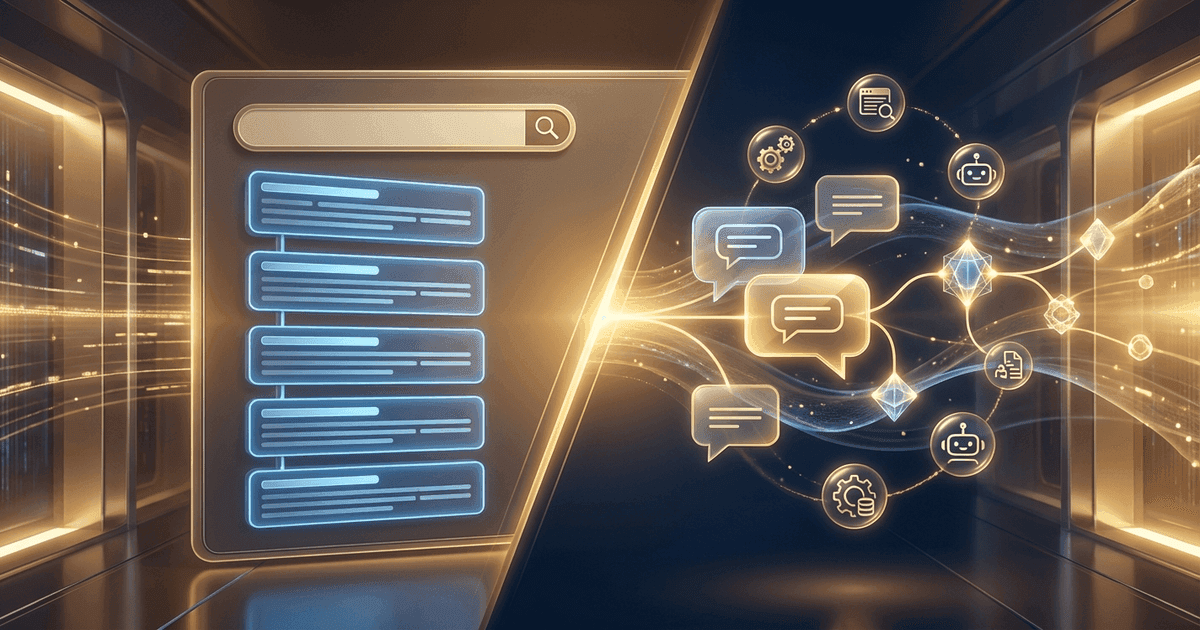
Perplexity abandoned advertising entirely in February 2026. Google launched its interactive AI Mode Canvas on March 4, 2026. The AI search trends 2026 has delivered look nothing like the predictions from late 2025.
TL;DR: The 2026 AI Search Landscape
- ChatGPT and Gemini now control roughly 86% of all AI chatbot traffic.
- Google and Perplexity are pursuing opposite monetization models.
- Agentic commerce will soon allow AI agents to complete checkout autonomously.
- Traditional click metrics are dying as up to 72% of Google searches end without a click.
- Brand citations in AI responses now increase organic click-through rates by 35%.
- Generative engine optimization (GEO) is now a mandatory parallel discipline to SEO.
ChatGPT has over 800 million weekly active users. But its market share is declining. Google's Gemini surged 237% year-over-year. The duopoly phase of AI search is here.
This strategic briefing covers the five defining AI search trends 2026 is shaping right now. You will learn what is actually changing across these major platforms. We also provide a practical framework to prepare your marketing team for the future of generative discovery.
What Does the AI Search Market Look Like in 2026?
AI search in 2026 is a market in rapid consolidation, with ChatGPT and Gemini controlling roughly 86% of AI chatbot traffic while traditional search faces Gartner's predicted 25% decline.
The sheer scale of this transition requires a complete strategy rebuild. You can see the full data set in our AI search statistics roundup. The market structure tells you exactly where consumer attention is flowing. This tells you where you need to be.
ChatGPT still dominates consumer habits with over 800 million weekly active users. The platform became the default noun for generative AI. But it is losing its monopoly. ChatGPT's market share dropped from 87% to between 65% and 68%. This is not a sign of failure. The landscape is diversifying. Users are finding specific tools for specific jobs.
Gemini is the defining growth story of the past year. Google pushed its AI across its existing distribution network. Gemini's share jumped from 5.4% to 18.2%, that's a 237% year-over-year climb. When you've got Google's distribution behind you, growth like that isn't surprising. We see the impact every time we audit a client's traffic sources.
These two giants now form a clear, dominant duopoly. ChatGPT and Gemini together control approximately 86% of all AI chatbot traffic. You have to focus your optimization efforts on these two models first.
At the same time, traditional search behavior is fundamentally shifting. Gartner projects a 25% decline in traditional search volume over the coming years. Users are bypassing standard blue links entirely. They want synthesized answers delivered immediately. They do not want to hunt for information across ten different web pages.
The market structure tells you where attention is going. But what matters more for brands is how these platforms plan to make money. That financial strategy directly determines what kind of content gets surfaced in the answers.
How Is AI Search Monetization Splitting in Two?
See where you rank across all AI answer engines.
Enter your domain and we'll scan your citation rate across ChatGPT, Perplexity, and Google AI.
Prefer to talk? Book a free 30-min call
Google is embedding ads directly into AI Mode responses, while Perplexity abandoned advertising entirely in February 2026 to pursue subscriptions and partnerships.
This divergence is the most important strategic story of 2026. You need completely different approaches for different platforms. One-size-fits-all optimization does not work when each platform rewards different signals and behaviors.
Google is heavily leaning into its established advertising infrastructure. The company introduced Direct Offers and sponsored retail listings straight into its AI responses. This makes sense when you consider user behavior. Queries in Google's AI Mode are three times longer than traditional searches. Longer queries provide significantly more commercial intent data for targeted ad placements. Google can serve a hyper-specific ad because the user asked a hyper-specific question.
Then there's AI Mode Canvas, which Google rolled out on March 4, 2026. Think of it like a workspace layered on top of AI responses, you can dig deeper, ask follow-ups, and refine without bouncing back to a results page. Sponsored placements fit right into that flow alongside organic answers. For advertisers? It's a surface they can't ignore.
Perplexity went the other direction entirely. They killed their ad model in early 2026. Instead, ALM Corp analysis notes Perplexity is doubling down on premium user experiences through paid subscriptions. They are also securing large-scale brand partnerships, including a $400 million deal with Snap. They want to be the premium, ad-free alternative for deep research.
OpenAI is carving out a third, highly lucrative path. ChatGPT is moving toward a commerce-first model. Recent developments show OpenAI testing a 4% transaction fee on Instant Checkout features. They want to facilitate the purchase directly rather than selling the click to another retailer.
| Platform | Monetization Model | Implication for Brands |
|---|---|---|
| Google AI Mode | Ads (Direct Offers, sponsored listings) | Paid placement + organic citation both matter |
| Perplexity | Subscriptions + partnerships | Pure content quality (no ad bypass) |
| ChatGPT | Transaction fees (Instant Checkout) | Product data and checkout readiness are key |
| Gemini | Integrated with Google Ads | Same ad ecosystem, different surface |
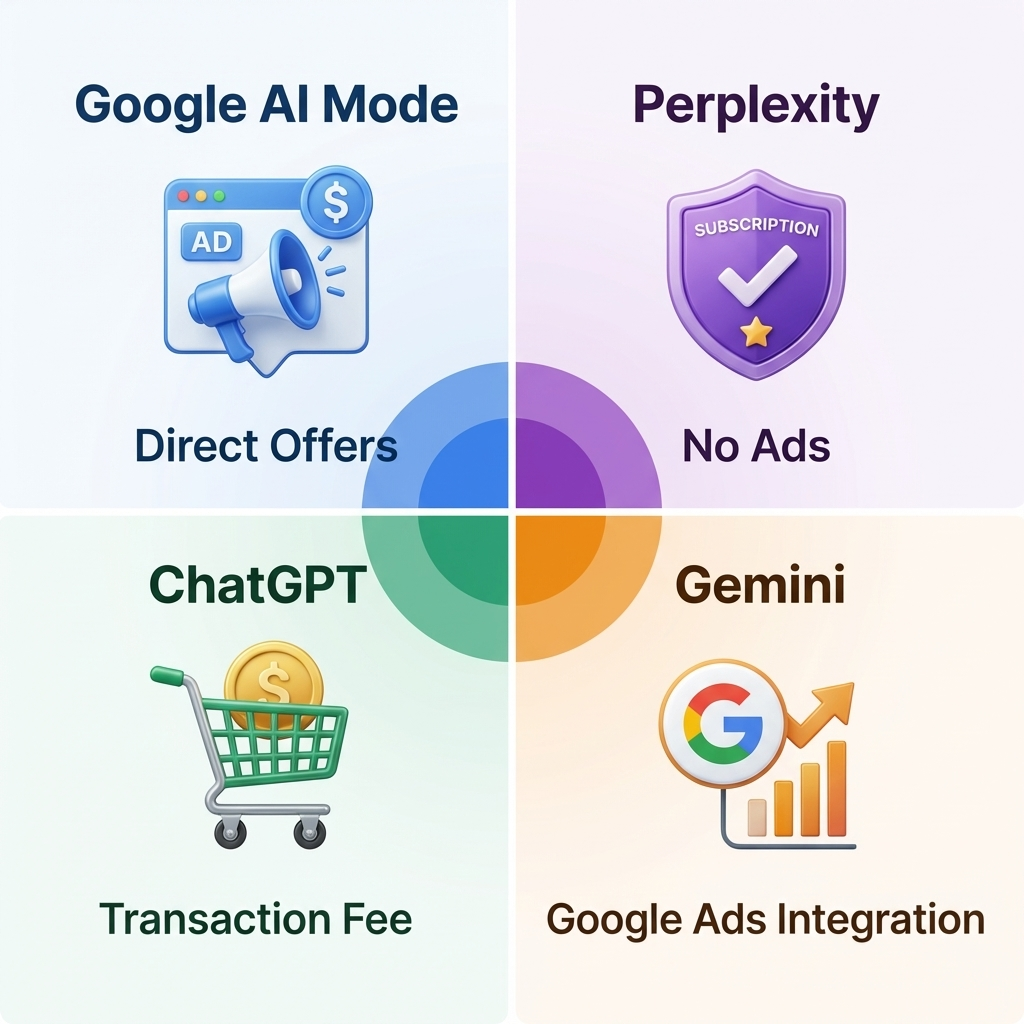
The monetization split fundamentally changes what content gets surfaced. But the biggest disruption isn't in how users search. It is in how AI agents actually buy products.
What Is Agentic Commerce and How Does It Change the Purchase Funnel?
Agentic commerce means AI agents autonomously find products, compare options, apply coupons, and complete checkout. McKinsey forecasts this will drive $900B to $1T in US retail revenue by 2030.
This represents a total restructuring of the traditional purchase funnel. Buyers no longer click through five different browser tabs to compare prices. They delegate the entire process to an artificial intelligence assistant.
Here's what a typical purchase looks like right now: you search for a product, open five tabs, scan three review sites, hunt for a coupon code, and eventually check out. That's 20 minutes of friction. With agentic commerce, it's one prompt: "Find me the best-rated ergonomic chair under $500, apply any active coupons, and ship it to my office." Done. The AI handles every step.
The financial impact is hard to overstate. McKinsey estimates this autonomous buying behavior will generate up to $1 trillion in US retail revenue by the end of the decade. This is not a niche experiment. It is the new default for consumer shopping.
Google is already building the infrastructure to support this shift. The company launched the Universal Commerce Protocol (UCP). According to the Google Developers Blog, UCP is already live with major retailers like Etsy and Wayfair. Shopify, Target, and Walmart are next in line to integrate.
UCP provides a standardized way for AI agents to interact directly with product data. It allows the AI to read inventory levels, understand specific variations, and execute the final checkout securely.
OpenAI is building similar transaction capabilities directly into ChatGPT. The platform is shifting from a recommendation engine into a complete digital proxy for the buyer.
Brands must adapt to this new reality immediately. Your product data must be perfectly structured, fully complete, and instantly API-accessible. You need rich schema markup to translate your offerings into machine-readable formats. Entity authority now dictates your position in the purchase funnel. If the AI cannot verify your brand entity, it will not recommend your product. We detail the technical steps for this in our guide to schema markup for AI visibility.
Agentic commerce changes how purchases happen. But even for B2B brands not selling physical products, there is an equally important shift occurring. The core metrics that define marketing success are being entirely rewritten.
Why Are Citations Replacing Clicks as the Key Metric?
Citations are replacing clicks because 68-72% of Google searches now end without a click, while being cited in AI responses increases organic CTR by 35%.
The era of click-based measurement is ending. You can no longer judge a campaign solely by the direct traffic it drives to your website.
This zero-click reality is already here. Between 68% and 72% of all Google searches now end without a single click. On mobile devices, that number jumps to 75%. The introduction of AI Overviews accelerates this trend by reducing traditional clicks by another 58%. These numbers will only go up as generative answers improve.
Marketing teams are panicking because their standard web traffic is dropping. But the traffic isn't disappearing. It is just being resolved directly on the search results page. Your brand is still getting visibility. The user is still seeing your authority. They just don't need to click your link to get the immediate answer.
This is not the end of organic marketing. It is an evolution. Being cited in an AI Overview actually increases your organic CTR by 35% when users do decide to click. Citations do not kill traffic. They redirect and pre-qualify it.
Being mentioned by an AI builds real brand awareness. The user reads your brand name in an authoritative context. They might not click today. But they will remember your name when they are ready to buy tomorrow. The objective is no longer to win the click. The objective is to win the citation. When the user finally does click through on a commercial query lower in the funnel, they are highly qualified.
This requires a completely new set of measurement tools. Marketing leaders must track Citation Frequency, Cross-Platform Share of Voice, and Attribution Quality. You can explore these metrics deeper in our review of the best AI visibility tools.
Content quality directly predicts your citation probability. Stacker reports that content scoring an 8.5 out of 10 or higher for semantic completeness is 4.2 times more likely to be cited by AI models. You have to answer the question perfectly, from every possible angle.
You also cannot rely solely on your own website. Third-party pages drive 85% of all AI brand mentions. YouTube and branded mentions on forums like Reddit are the top signals driving those citations. That's why we've put together a full Reddit strategy for AI visibility, it's one of the highest-leverage plays available right now.
You need a visibility-over-traffic mindset. For a complete explanation of this concept, read our pillar page on what is AI visibility.
Understanding these AI search trends 2026 is presenting is one thing. Acting on them is another. Here's how to turn these shifts into a practical strategy.
How Should Brands Prepare for AI Search in 2026?
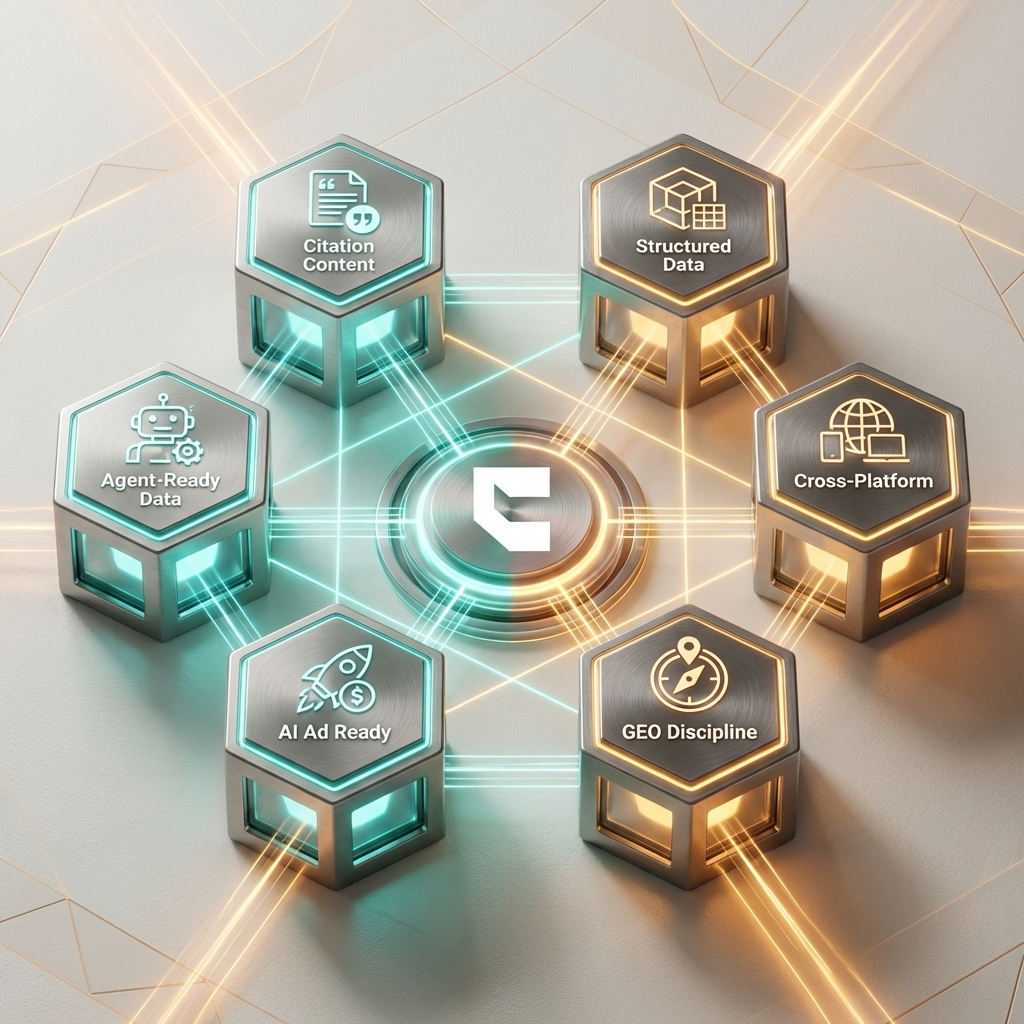
Brands should focus on six areas: content built for citations, structured data, cross-platform presence, GEO as a discipline, AI ad readiness, and agent-ready product data.
We've built our own client work around these six pillars. They aren't theoretical, we've watched them drive real, measurable increases in how often AI systems recommend our clients' brands.
First, you must build content specifically for citations. Create dense answer units of 134 to 167 words with high semantic completeness. Aim for content that directly answers the exact questions AI systems field every day. AI models ignore thin content. They want deep, specific, and structurally perfect answers.
Second, deploy comprehensive structured data. Implement schema markup that helps AI models instantly understand your entities, products, and corporate relationships. This removes the guesswork for the machine. It clearly maps your site architecture so the agent can parse it instantly.
Third, establish a dominant cross-platform presence. AI models pull heavily from user-generated content and video transcripts. Build your presence on YouTube and Reddit. These are the primary sources where AI trains and retrieves live data. For enterprise teams, the rules are slightly different, which we cover in our guide to AI search for B2B.
Fourth, treat generative engine optimization as a parallel discipline. GEO does not replace traditional SEO. SEO gets you found by humans searching for links. GEO gets you recommended by AI answering complex questions. Learn the technical differences in our generative engine optimization methodology guide.
Fifth, prepare for AI ad readiness. Google Direct Offers and sponsored listings in AI Mode are expanding. Brands need to prepare their paid media teams to buy placements directly within generated responses. You have to integrate your ad strategy with your organic AI strategy.
Finally, ensure you have agent-ready product data. Ecommerce brands must structure their product catalogs with universal product codes (UPCs) and open APIs. This is mandatory for agentic commerce protocols to execute autonomous checkouts.
Frequently Asked Questions About AI Search Trends 2026
These are the questions we hear most from marketing teams navigating the AI search trends 2026 has brought.
Is traditional SEO dead?
No. Traditional SEO still drives direct search traffic and supports AI citation authority. GEO works alongside SEO, not as a replacement.
SEO focuses on structuring your site for crawlers and earning backlinks to build domain authority. GEO focuses on semantic density and entity relationships to earn AI mentions. You need both. They feed into each other to create a compounding visibility loop. Read our full methodology in our guide to generative engine optimization.
Which AI search platform should brands prioritize?
Start with Google AI Overviews and ChatGPT, which together represent the largest share of AI-assisted queries and purchase influence.
Google owns the top of the funnel for general research and product discovery. ChatGPT is becoming the default for complex problem-solving and deep professional work. Focus your optimization efforts on these two giants before worrying about niche industry-specific models.
How do you measure AI search success?
Track citation frequency, cross-platform share of voice, and attribution quality instead of relying solely on traditional click-through metrics.
You have to measure how often your brand appears in AI outputs across thousands of relevant prompts. This requires specialized tracking software that monitors the entire AI ecosystem. Read our guide on the best AI visibility tools to find the right stack for your team.
What is the ROI timeline for AI visibility?
Most brands see measurable citation increases within 8-12 weeks, with compound growth in AI recommendation frequency accelerating after the first quarter.
Unlike traditional SEO which can take six to nine months, AI search is highly responsive to perfectly structured data. You can accelerate this entire process by following our comprehensive AI visibility playbook from day one.
Conclusion
These AI search trends 2026 is revealing are already reshaping how brands get discovered. The landscape looks different from the search results pages of the past decade.
- The market is consolidating into a powerful duopoly between Google and OpenAI.
- Monetization models are splitting between integrated advertising and premium subscriptions.
- Agentic commerce is turning AI chatbots into autonomous digital buyers.
- Traditional clicks are plummeting while the value of AI citations skyrockets.
- Generative engine optimization is the new mandatory discipline for marketing teams.
Brands that treat AI search as a single, monolithic channel will fall behind. The winners in 2026 are building platform-specific strategies anchored by structured data and semantic completeness. They are adapting their metrics, their content, and their fundamental approach to discovery.
If you want to know exactly where your brand stands in this new landscape, we can help. We can audit your current AI visibility. We will show you exactly what is working, what is missing, and what to do next. Check our pricing to learn more about our audit and implementation packages.
See where your brand appears in AI search
Scan ChatGPT, Perplexity, and Google AI across buyer-intent queries, instantly, no sign-up.
Find out if AI is sending buyers to your competitors.
We audit your AI visibility across ChatGPT, Perplexity, and Google AI –and show you exactly where you rank and what to fix.
“We went from 200 visitors/day to 1,900 visitors/day and 40% of demos are from AI search.”
Sumanyu Sharma · CEO, Hamming.ai
“Cintra helped me go from 3k to 7.5k daily traffic and doubled weekly orders in 1.5 months.”
Russ Coulon · Owner, UV Blocker
“We saw a lift from 3% to 13% visibility in the first 2 weeks, and organic traffic hit its highest ever.”
Ash Metry · Founder, Keywords.am
Related Articles
Meta-ExternalAgent Took More Bandwidth Than 5 Crawlers Combined
Meta-ExternalAgent pulled 955 MB from cintra.run in 30 days, more than 5 AI and search crawlers combined. What…
Organic Traffic Decline 2026: Why It's Dropping and How to Recover
Organic traffic decline 2026 is real. AI Overviews cut clicks 38% on triggered queries. Here's what's causing…
AI Visibility Reporting: What to Track, Who to Tell, and How to Prove ROI
AI visibility reporting requires different metrics and formats than SEO reports. Learn the five core metrics,…