AI Visibility for Education: The 5-Surface Framework Universities Are Missing
AI visibility for education is critical: 50% of students use AI tools weekly, yet 45% of AI answers about universities contain errors. Learn how to optimize your institution across all five surfaces.
TL;DR
- 45% of AI answers about universities contain factual errors, and 50% of students use AI tools weekly for research.
- AI visibility for education spans five surfaces: enrollment, research, reputation, faculty recruitment, and alumni discovery. Most institutions address only enrollment.
- Start with a 5-platform audit in week one, fix entity errors in week two, and optimize top program pages in weeks three and four.
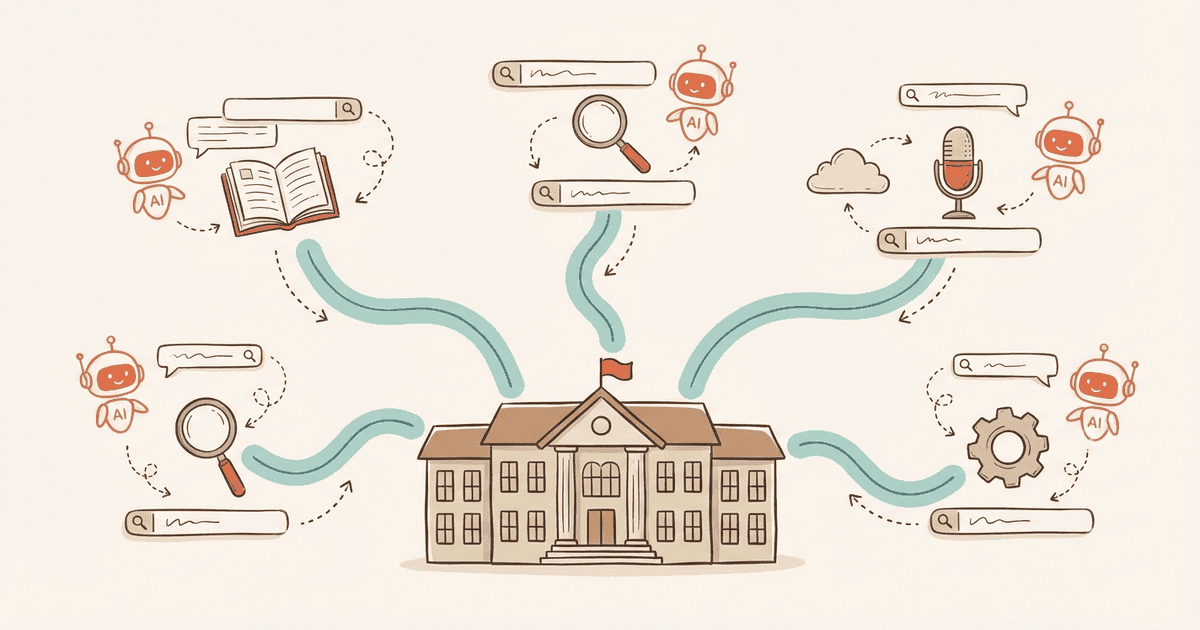
45% of AI answers about universities contain factual errors, and your prospective students are reading every one of them. A parent asks ChatGPT whether your school offers a specific computer science track. The AI says no. That applicant is gone before your admissions team knows they existed. AI visibility for education is no longer optional; it is the primary discovery mechanism for higher education.
The scale of the shift is hard to overstate. 50% of students now use AI tools weekly for education research, according to a 2025 UPCEA and Search Influence survey. 28% of Gen Z launches searches directly in an AI chatbot rather than Google, based on Adobe data. That reality obliterates the traditional marketing playbook. Wrong admission dates, incorrect program details, and outdated rankings now live permanently inside answers nobody flags and nobody corrects.
This guide introduces the 5-surface framework, an original methodology built to handle the complexity of higher education institutions. Competitors focus exclusively on student enrollment. We cover the full institutional surface area: enrollment, research citations, institutional reputation, faculty recruitment, and alumni discovery.
Why Are Universities Losing Control of Their AI Narrative?
AI search engines now mediate how students, parents, faculty candidates, and donors discover universities, and 45% of the answers they give contain errors that institutions can't correct through traditional SEO.
Prospective students no longer browse university websites the way they used to. 50% of them rely on AI tools every single week. Google's AI Overviews command serious attention, 79% of users read them when they appear in search results. 28% of Gen Z bypasses Google entirely to start searches in an AI chatbot. The traditional discovery funnel is collapsing.
The immediate threat is data quality. 45% of AI responses about universities contain factual errors, according to EBU and BBC research. Prospective students make life-altering decisions based on false tuition numbers and phantom degree requirements. You cannot fix this through an IT ticket.
Yet the opportunity outweighs the threat. ChatGPT-referred traffic converts at twice the rate of other organic sources, based on 2U CMO data. 56% of users trust brands cited in AI answers. You must prioritize AI visibility today, your enrollment depends on the citations you secure inside these chat interfaces. But enrollment is just one surface. Universities are multi-department institutions with visibility needs far beyond the admissions office.
What Are the 5 Surfaces of University AI Visibility?
See where you rank across all AI answer engines.
Enter your domain and we'll scan your citation rate across ChatGPT, Perplexity, and Google AI.
Prefer to talk? Book a free 30-min call
Universities need AI visibility across five distinct surfaces: student enrollment, research citations, institutional reputation, faculty recruitment, and alumni-donor discovery.
Most competitors address only the first surface. Here is why all five matter.
Student Enrollment is where program discovery and tuition queries land. Queries like "best MBA programs in California" or "Is State University worth the tuition?" determine who applies. Competitors address this surface, we treat it as the starting line, not the finish.
Research Visibility is where AI synthesizes complex academic topics daily. When someone asks about the latest research on CRISPR gene editing, your faculty either get cited or they don't. Most institutions leave this surface entirely unaddressed.
Institutional Reputation is where AI constructs your public image from thousands of disparate sources. PR teams track Google Alerts but miss what Claude says about campus safety. A query like "Is [University] a good school?" pulls from everywhere, and your institution rarely controls what surfaces.
Faculty and Staff Recruitment is where top-tier professors ask AI about tenure tracks. "Best universities for tenure-track CS positions" drives real hiring outcomes that shape your academic reputation for years.
Alumni and Donor Discovery is where foundations use AI to identify grant recipients. Queries like "Notable [University] alumni in tech" surface major gift prospects, and AI answers either name your graduates or they don't.
| Surface | Example AI Query | Who Cares | Current Status |
|---|---|---|---|
| Student Enrollment | "Best MBA programs in California" | Admissions, Marketing | Partially addressed |
| Research Visibility | "Latest research on CRISPR gene editing" | Research Office, Faculty | Unaddressed |
| Institutional Reputation | "Is [University] a good school?" | President's Office, PR | Unaddressed |
| Faculty Recruitment | "Best universities for tenure-track CS positions" | HR, Provost | Unaddressed |
| Alumni/Donor Discovery | "Notable [University] alumni in tech" | Development, Alumni Relations | Unaddressed |
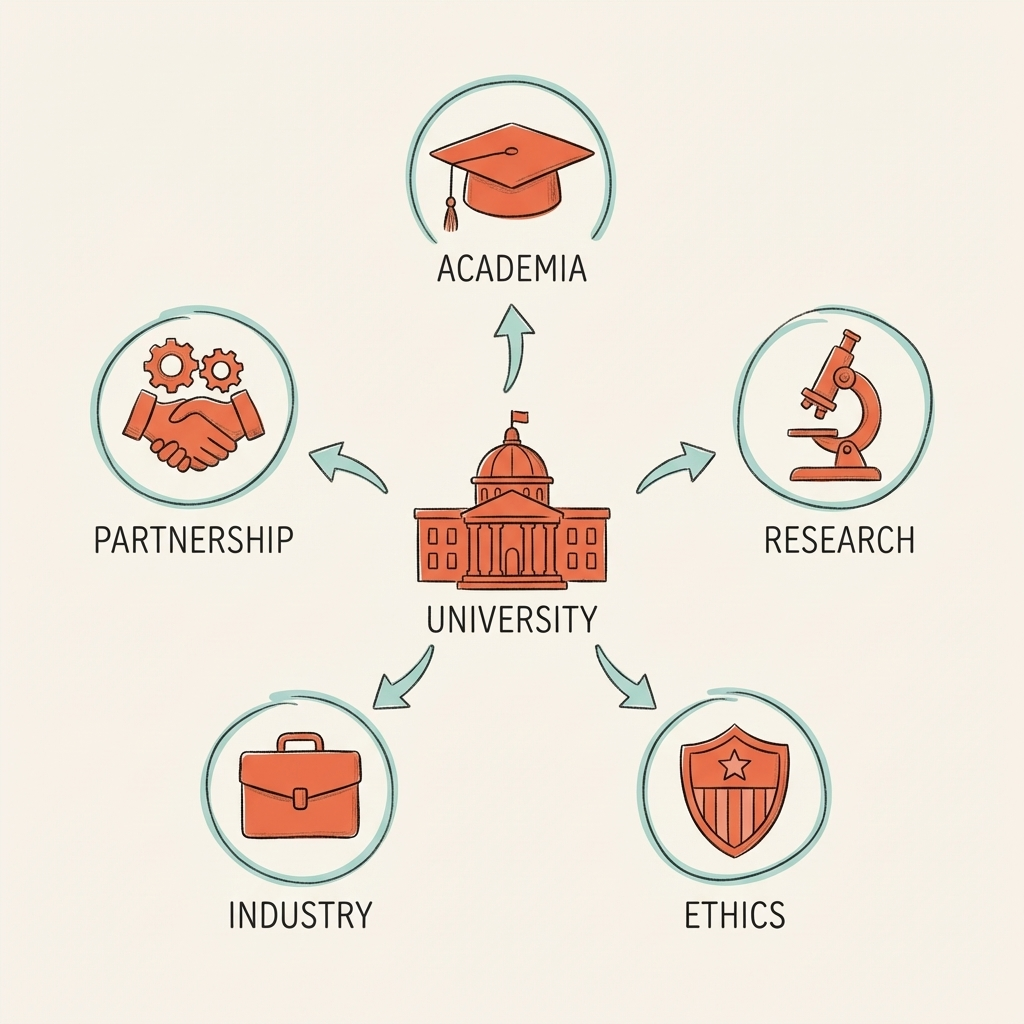
Mastering entity SEO for AI search connects these five surfaces into a unified strategy. Each AI platform handles university queries differently. What works on ChatGPT may not work on Perplexity.
How Do Different AI Platforms Handle University Queries?
ChatGPT, Perplexity, Gemini, and AI Overviews each use different source hierarchies and citation patterns when answering university queries, requiring platform-specific optimization strategies.
ChatGPT relies on structured web content, Wikipedia, and authoritative educational domains. It demonstrates strong entity recognition for well-known institutions. Test the prompt "best university for computer science" and study how it ranks schools, then look for your institution. ChatGPT-referred traffic converts 2x better than standard search traffic. Capturing this platform is non-negotiable for student enrollment.
Perplexity operates differently: it cites specific sources with direct links and favors recent, well-structured content. Universities with active research blogs dominate Perplexity citations. Publishing structured summaries of faculty work delivers quick wins for research visibility on this platform.
Google AI Overviews pulls straight from Google's index and shows a strong preference for schema-rich, authoritative content. 79% of users read them. Gemini integrates with Google's knowledge graph, complete knowledge panels make or break your performance there.
We use precise schema markup for AI visibility to format your data correctly for each platform. Knowing which platforms to target is step one. Where do you start when your institution has hundreds of programs?
How Should Universities Audit Their Current AI Visibility?
Step 1: Query audit. Ask ChatGPT, Perplexity, Gemini, Google AI Overviews, and Claude about your institution across all five surfaces. Document every error, omission, and competitor mention. Use prompts like "What are the admission requirements for the nursing program at [University]?" to test enrollment surfaces and diagnose visibility gaps.
Step 2: Entity verification. Check what AI actually knows about your institution as an entity. Is your Google knowledge panel fully complete? Are all academic programs correctly attributed to the parent university?
Step 3: Content architecture review. Map which program pages and department hubs are optimized for AI extraction. Most university websites prioritize visual navigation over readable text, they bury essential facts in dense PDFs. AI models cannot parse this effectively.
Step 4: Schema gap analysis. Audit your existing structured data against education-specific schemas. You need EducationalOrganization, Course, CollegeOrAction, and Person schemas implemented correctly.
Step 5: Competitive benchmark. Query AI about your peer institutions. Identify exactly who gets cited for your core subjects, then analyze their content structure to understand why the AI prefers them.
Our AI content audit methodology formalizes this process. You also need to establish E-E-A-T for AI search to ensure models trust your domain. Once you know where the gaps are, you need a prioritization framework.
Content Architecture for Complex Multi-Department Institutions
Universities should prioritize AI visibility optimization in three tiers: highest-enrollment programs first, then most AI-queried topics, then programs with declining applications.
Tier 1 targets your highest-enrollment programs. These pages face the most search volume and the heaviest competitive pressure. Optimize program pages, faculty profiles, and student outcome data. If your MBA program processes 500 applications per year, it demands immediate attention, fix the content structure so AI models extract tuition and deadlines accurately.
Tier 2 covers the most AI-queried topics. Check which department topics surface in AI answers routinely. AI models train on academic papers, so your research-heavy departments hold natural advantages in these environments.
Tier 3 focuses on programs with declining applications. AI search visibility revives interest by ensuring accurate representation in AI answers, a critical recovery mechanism for shrinking departments.
The institutional entity sits above all three tiers. The university itself requires optimization: knowledge panel corrections, updated Wikipedia references, and sitewide structured data deployment. We've optimized AI visibility for SaaS, ecommerce, healthcare, finance, and law, the same structural patterns apply to education. We helped Hamming.ai achieve 8.5x traffic by organizing their entity structure, and helped ecommerce brand UV Blocker double their orders. We bring those proven cross-industry architectures to your campus.
You need to know how to measure AI visibility to justify the effort. Strategy without measurement is guesswork.
How Do You Measure University AI Visibility ROI?
Measure university AI visibility through citation rate by program, AI referral traffic to program pages, and inquiry-to-application conversion from AI sources.
Citation rate by program gives you a clear baseline. How often does AI mention your program when asked about your category? Ask ChatGPT "best MBA programs in Texas" monthly and track your appearance. This tells you whether baseline visibility is growing.
AI referral traffic provides hard numbers. Track traffic originating from chat.openai.com, perplexity.ai, and AI Overview clicks directly in GA4. Measure this today using UTM parameters and careful referrer tracking. Watch the numbers climb as your entity strength improves.
Inquiry-to-application conversion from AI sources proves the financial value. Connect your AI referral traffic to your CRM data to assign a dollar figure to your visibility efforts. This is the metric that secures budget from the board.
Beyond these three, benchmark against peers, compare citation rates with competing institutions every quarter. Treat it as competitive intelligence. Also track your error correction rate: the 45% error rate across higher education means significant room to improve. Count how many factual errors about your institution you successfully resolve over time.
Measurement is an ongoing discipline. But getting started doesn't require a year-long initiative.
The 30-Day University AI Visibility Quick-Start Roadmap
Start with a 5-platform audit in week one, fix entity errors and schema gaps in week two, optimize your top 10 program pages in weeks three and four, then build ongoing content authority.
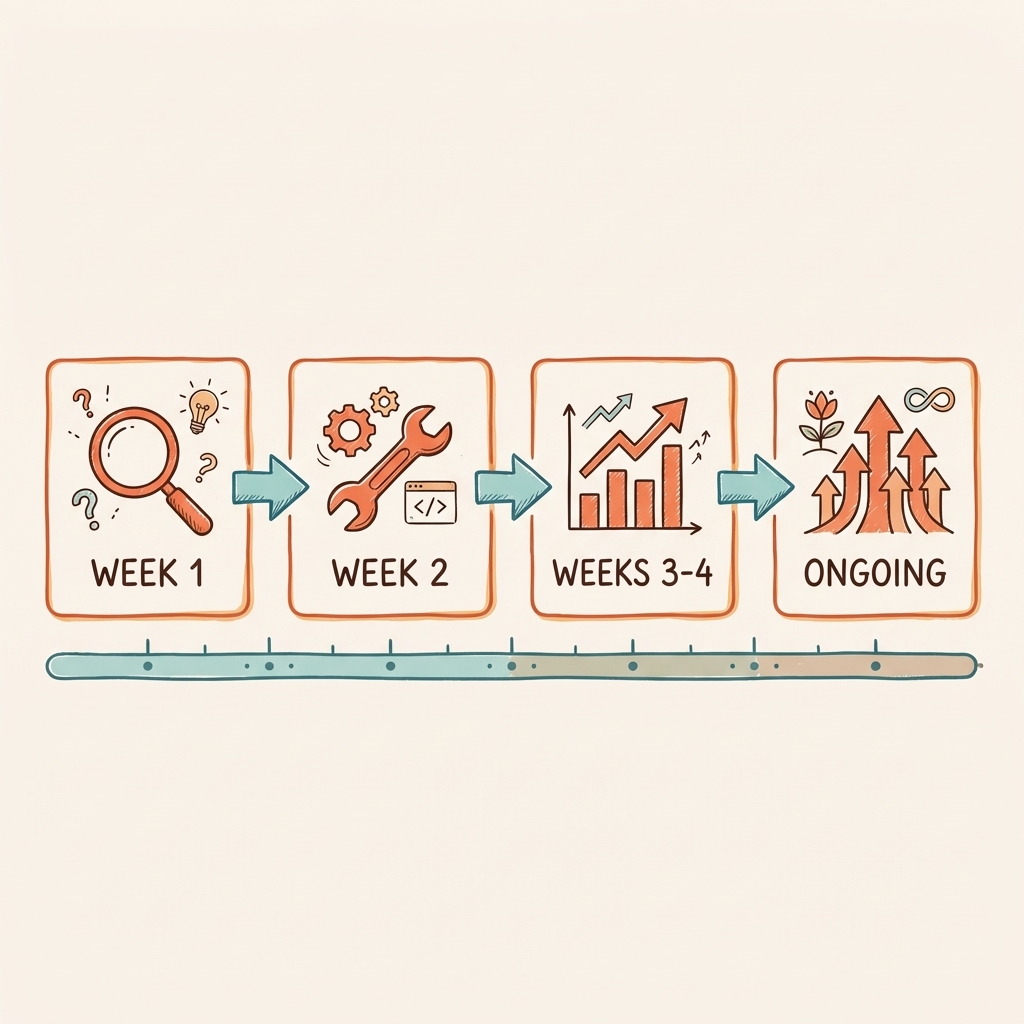
Week 1: The audit. Query ChatGPT, Perplexity, Gemini, Google AI Overviews, and Claude about your institution. Cover all five surfaces: enrollment, research, reputation, recruitment, and alumni. Document every factual error and every gap where a competitor appears instead of you.
Week 2: Foundation fixes. Correct the factual errors you uncovered in week one. Update Wikipedia entries with proper citations. Fix your knowledge panels. Add EducationalOrganization and Course schema to your main website. Add Person schema to high-profile faculty pages. These structural corrections deliver outsized impact fast.
Weeks 3 and 4: Program optimization. Rewrite your top 10 program pages specifically for AI extraction. Write clear, answer-ready descriptions. Present outcome data in structured HTML tables. Highlight faculty expertise explicitly. Focus on the pages your audit identified as highest-query volume.
Ongoing: Content authority. Publish readable research summaries. Share industry analysis. Have faculty provide commentary on trending topics. You build the content ecosystem that AI models draw from, and it compounds over time.
Frequently Asked Questions About AI Visibility for Education
These are the most common questions we hear from university marketing teams exploring AI visibility for the first time.
How is AI visibility different from traditional higher-ed SEO?
Traditional SEO optimizes for Google rankings. AI visibility optimizes for citations and recommendations inside AI-generated answers. These are fundamentally different discovery mechanisms.
Traditional SEO targets keyword rankings on a flat results page. AI visibility targets direct inclusion in synthesized answers. A university can rank number one on Google for a program keyword but never appear when a student asks ChatGPT that exact same question.
Which university departments should start first?
Start with the admissions and marketing team for enrollment visibility, then expand to the research office for academic citation optimization.
Enrollment drives immediate revenue. You secure your financial base first. Research visibility provides the highest long-term compound effect because AI models train on academic content.
How do we handle AI giving wrong information about our university?
Document every error, then fix the upstream sources AI models draw from: structured data, Wikipedia, authoritative web pages, and knowledge panels.
AI does not have a correction form. You fix the sources it learns from. Update Wikipedia with verified citations. Ensure your schema markup is accurate. Publish authoritative content that directly contradicts the errors. The AI will eventually relearn the facts.
What's the ROI timeline for university AI visibility?
Foundation fixes like schema markup and entity corrections show results within 4-8 weeks. Content authority building compounds over 3-6 months.
Quick wins impact AI answers as models recrawl your updated sources. Content authority requires more time but builds a sustainable citation rate. We see these timelines across other industries, we delivered measurable results for Hamming.ai in 12 weeks. Education follows the same pattern.
Conclusion
AI search is already the front door for university discovery. 50% of students use AI weekly; 28% of Gen Z starts college research there entirely. Waiting for this shift to stabilize is not a strategy.
Our 5-surface framework exists because enrollment alone is too narrow a lens. Institutions that optimize only for admissions queries leave research citations, institutional reputation, faculty recruitment, and alumni discovery uncontested. Meanwhile, 45% of AI answers about universities contain factual errors, errors that cost real applicants, real donors, and real faculty candidates.
The path forward is concrete: run the Week 1 audit now. Query ChatGPT, Perplexity, Gemini, Google AI Overviews, and Claude about your institution across all five surfaces. Document every error you find. Each one is a correctable, measurable gap.
For institutions ready to move faster, our Enterprise plan delivers multi-surface AI visibility strategy for higher education, with cross-industry pattern expertise and dedicated implementation support. Book a strategy call to audit your university's AI presence.
See where your brand appears in AI search
Scan ChatGPT, Perplexity, and Google AI across buyer-intent queries, instantly, no sign-up.
Find out if AI is sending buyers to your competitors.
We audit your AI visibility across ChatGPT, Perplexity, and Google AI –and show you exactly where you rank and what to fix.
“We went from 200 visitors/day to 1,900 visitors/day and 40% of demos are from AI search.”
Sumanyu Sharma · CEO, Hamming.ai
“Cintra helped me go from 3k to 7.5k daily traffic and doubled weekly orders in 1.5 months.”
Russ Coulon · Owner, UV Blocker
“We saw a lift from 3% to 13% visibility in the first 2 weeks, and organic traffic hit its highest ever.”
Ash Metry · Founder, Keywords.am
Related Articles
Organic Traffic Decline 2026: Why It's Dropping and How to Recover
Organic traffic decline 2026 is real. AI Overviews cut clicks 38% on triggered queries. Here's what's causing…
AI Visibility Reporting: What to Track, Who to Tell, and How to Prove ROI
AI visibility reporting requires different metrics and formats than SEO reports. Learn the five core metrics,…
AI Visibility Competitive Analysis: How to Find and Exploit Gaps in 2026
AI visibility competitive analysis across ChatGPT, Perplexity, and 5 other engines. Framework for tracking com…