AI Visibility for Healthcare: What SaaS and Ecommerce Taught Us About Getting Cited
AI visibility for healthcare works. 58% of patients use AI chatbots for health info. Learn the cross-industry framework now adapted for medical practices.

TL;DR
AI visibility for healthcare follows the same principles that drove 8.5x traffic for a SaaS client and doubled ecommerce orders. The framework: entity clarity, answer-first content, trust signals, and community presence, layered with physician credentials, compliance signals, and medical schema markup.
58% of patients now use AI chatbots to research symptoms before seeing a doctor. Yet most healthcare providers don't show up in those AI responses at all.
Patients choose providers based on AI recommendations. Practices invisible in ChatGPT, Perplexity, and AI Overviews are losing patients to competitors who aren't. We built our AI visibility framework across SaaS and ecommerce first. Hamming.ai hit 8.5x traffic. UV Blocker doubled weekly orders. Now we're bringing that framework to healthcare.
We built it outside the medical vertical on purpose. The core mechanics that drive AI search work across every industry. We adapt those proven mechanics for medical practices and layer on the compliance and trust signals healthcare demands.
Why Is Healthcare the Next AI Visibility Battleground?
Healthcare is a $4.7 trillion industry where patients find providers through AI search, not Google. Most practices aren't showing up.
Patients skip Google for quick medical answers. A 2026 multinational study found that 58% of patients use AI chatbots to identify symptoms before booking a visit. They're typing exact symptoms into ChatGPT instead of scrolling WebMD. And that behavior isn't going away.
Here's what makes this interesting: trust is still low. A JAMA Network Open study found 65.8% of US adults distrust healthcare systems to use AI responsibly. That sounds like a problem, but we see it as the opening. Providers who show up with transparent, well-cited AI presence earn outsized trust. Clear answers backed by real physician credentials? That's how you stand out.
Physicians adopt AI rapidly behind the scenes. 66% used health AI in 2024, up 78% from 38% in 2023. But patients seek AI answers for personal health questions elsewhere. Bridging that gap requires understanding AI visibility deeply.
AI Overviews trigger at higher rates for medical queries due to their informational nature. Healthcare gets more AI treatment from Google, not less.
What Does AI Visibility Mean for Healthcare (And Why Isn't It Just SEO)?
When patients ask AI for care, does your practice appear?
We'll scan ChatGPT, Perplexity, and Google AI across your highest-value patient queries –so you can see exactly where your practice ranks vs. competing providers.
Prefer to talk? Book a free 30-min call
Healthcare AI visibility means earning citations and recommendations from ChatGPT, Perplexity, and AI Overviews, not just ranking on Google's blue links.
AI platforms treat medical queries differently than, say, "best CRM software." They apply YMYL (Your Money or Your Life) filters to prevent misinformation. The bar for health content is higher than almost any other category. Credentials and structured data carry more weight here than in any other industry we've worked in.
A #1 Google ranking doesn't mean you'll appear in AI answers. We've seen dermatology practices ranking first for "best dermatologist near me" that never show up in ChatGPT's recommendations. Why? Google cares about backlinks and domain age. AI search cares about entity clarity and whether you give a direct, extractable answer.
Healthcare organizations need to earn AI trust through entity clarity. The AI needs to verify your board certifications, clinic locations, and clinical specialties. Backlinks help traditional SEO. Precise entity resolution drives AI visibility.
What Can Healthcare Learn from SaaS and Ecommerce AI Visibility?
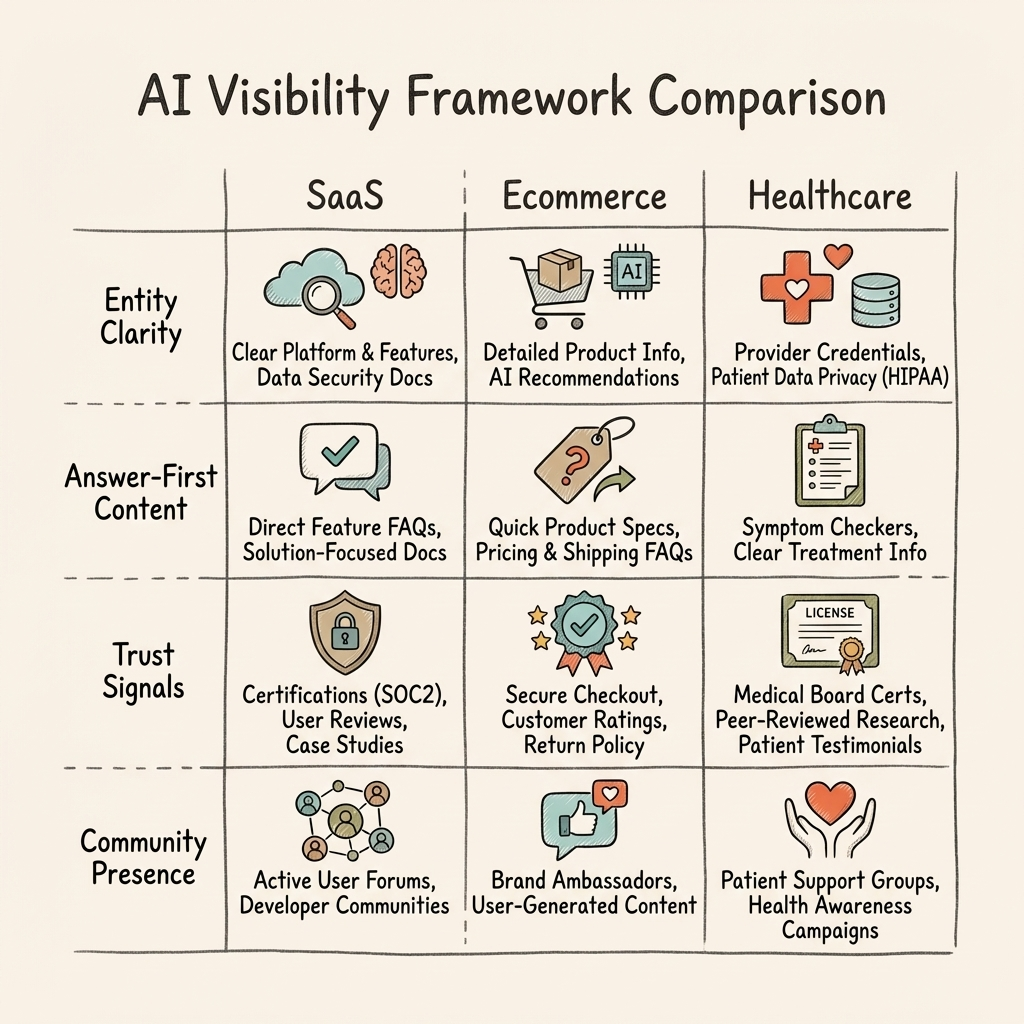
The same four principles that drove 8.5x traffic for a SaaS company and doubled ecommerce orders work for healthcare: entity clarity, answer-first content, structured data, and community presence.
We saw this play out firsthand with Hamming.ai. In the SaaS space, they hit an 8.5x organic traffic increase in 12 weeks once AI systems could clearly identify what the company does and start recommending it. Same story with UV Blocker in ecommerce. They went from zero to 38K clicks and doubled weekly orders after we layered in structured data and community presence.
Four transferable principles drive results across verticals:
- Entity clarity. SaaS uses company schema. Healthcare uses Physician + MedicalOrganization schema.
- Answer-first content. Ecommerce builds buying guides. Healthcare builds condition-treatment content.
- Trust signals. SaaS leans on G2 reviews. Healthcare leans on board certifications and clinical reviews.
- Community presence. Tech companies engage in developer forums. Medical practices engage in health forums.
Healthcare faces unique constraints: compliance requirements, physician authority, patient sensitivity. But these are layers on top of the framework, not reasons to skip it. Read more about how this scales in our AI visibility for SaaS guide.
| Principle | SaaS Application | Ecommerce Application | Healthcare Adaptation |
|---|---|---|---|
| Entity Clarity | Company + product schema | Product + brand schema | Physician + MedicalOrganization schema |
| Answer-First Content | Feature explanations | Buying guides | Condition-treatment content |
| Trust Signals | G2 reviews, case studies | Customer reviews, UGC | Physician credentials, NPI, board certs |
| Community Presence | Reddit, developer forums | Product communities | Health forums, patient communities |
Healthcare's unique advantage? E-E-A-T, the framework Google uses to evaluate expertise. For medical practices, it's a visibility superpower.
How Do You Operationalize E-E-A-T for Healthcare AI Visibility?
Operationalize E-E-A-T by implementing physician authorship programs, credential markup via Person and Physician schema, clinical review workflows, and institutional authority signals.
Physician authorship programs are where this starts. Every content piece needs to link to a named physician with their NPI, board certifications, and specialty via Person schema. Here's what that looks like:
{
  "@context": "https://schema.org",
  "@type": "Physician",
  "name": "Dr. Sarah Miller",
  "medicalSpecialty": "Dermatology",
  "identifier": {
    "@type": "PropertyValue",
    "propertyID": "NPI",
    "value": "1234567890"
  }
}
Clinical review workflows send a strong accuracy signal. Have physicians review content before publishing, then add a visible "Medically reviewed by Dr. [Name]" attribution. AI systems weight physician-reviewed content higher on YMYL queries. This is the foundational E-E-A-T for AI search that models are looking for.
Credential markup ties your providers to your practice in a way AI can parse. MedicalOrganization schema for the clinic, Physician schema for the doctors. The payoff? Sites with connected schema markup saw 78-94% citation rate increases in AI Mode. Our guide on schema markup for AI visibility covers the technical details.
Compliance as a visibility advantage. This one's counterintuitive. HIPAA and FDA compliance actually signals trust to AI systems. Compliant content gets cited more, not less. So think of compliance as a competitive moat. Practices that hide behind it as an excuse for poor marketing? They're leaving citations on the table.
What Content Architecture Drives Healthcare AI Citations?
Structure healthcare content with question-first H2 headings, 50-150 word answer capsules for AI extraction, condition-treatment clusters, and FAQ schema for symptom queries.
Question-first headings match how patients actually talk to AI chatbots. Nobody types "Chronic Back Pain Causes" into ChatGPT. They ask full questions. Your headings need to match:
- Before: Knee Surgery Recovery Time After: How long does recovery take after knee replacement surgery?
- Before: Pediatric Asthma Symptoms After: What are the early signs of asthma in toddlers?
- Before: Migraine Triggers After: What common foods trigger chronic migraines?
Answer capsules sit below each heading. These are direct, concise answers designed for AI extraction. Use progressive disclosure: make answers accessible first, then add clinical depth in later paragraphs. Give the AI what it needs to build a clear summary.
Condition-treatment-outcome clusters organize content around the patient journey, not medical taxonomy. A "knee pain" cluster flows through causes, treatments, recovery timelines, and prevention. Map content to the patient's lived experience. Our AI visibility playbook covers how to structure these clusters.
FAQ schema captures long-tail patient queries. Structured FAQ markup grabs the "what does this symptom mean" queries that dominate AI health searches.
How Do You Measure Healthcare AI Visibility?
Measure healthcare AI visibility through prompt testing across platforms, citation tracking, sentiment analysis, and competitive benchmarking on a 30/60/90-day cadence.
Prompt testing shows you where you actually stand. Pull up ChatGPT, Perplexity, and AI Overviews and try these queries:
- Orthopedic: "best orthopedic surgeon near me"
- Dermatology: "top-rated acne treatment clinics"
- Cardiology: "best heart specialists in [city]"
- Pediatrics: "best pediatricians for ADHD"
- Mental health: "anxiety therapist recommendations near me"
Citation tracking tells you how often you're being mentioned and in what context. There are three types to watch: direct citations (links to your site), recommendations (mentions by name without a link), and contextual mentions (references to your studies or content). Our guide on how to measure AI visibility breaks down tracking for each type.
Sentiment analysis matters more in healthcare than anywhere else we've seen. One negative AI mention about a medical practice does real damage. It's not enough to know whether AI mentions you. You need to know what it says.
Follow a 30/60/90-day cadence: baseline audit, content implementation, then results tracking.
The 90-Day Healthcare AI Visibility Roadmap
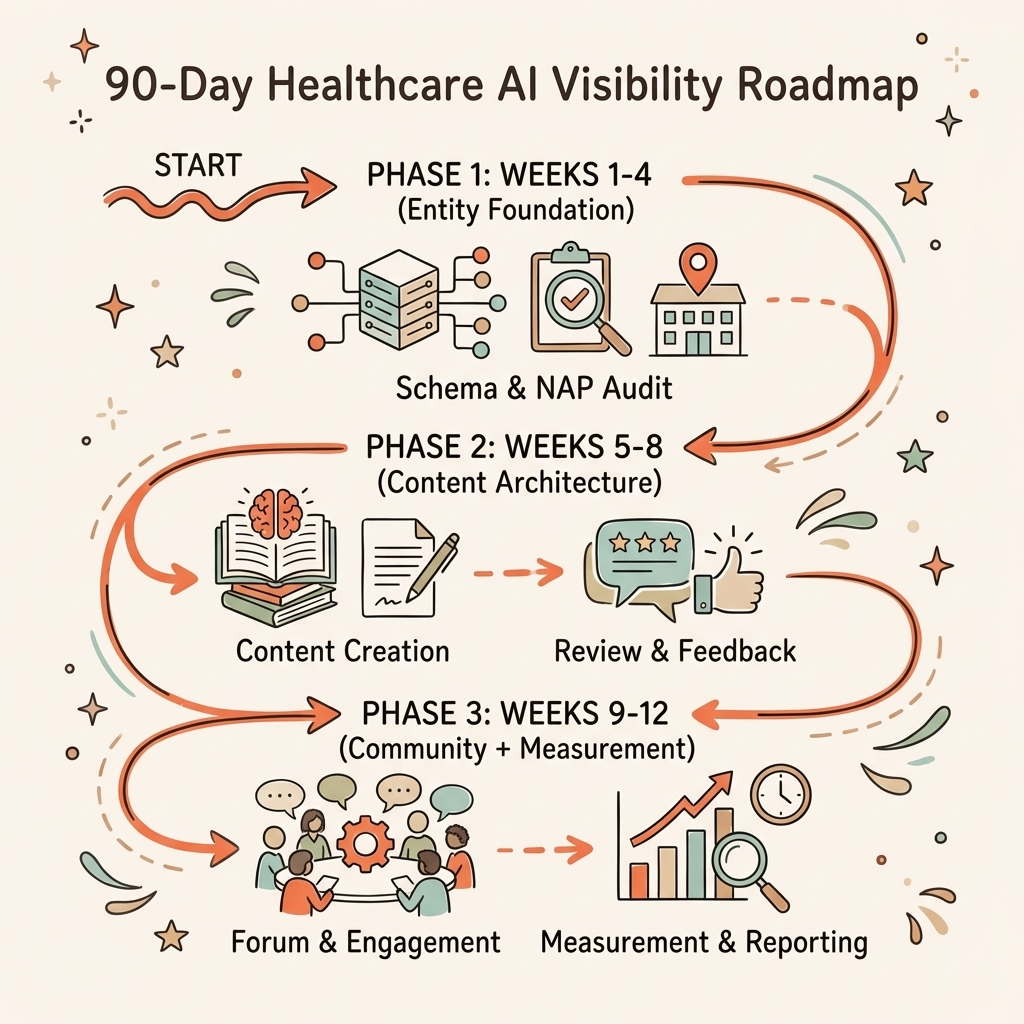
The 90-day roadmap covers three phases: entity foundation, content architecture with E-E-A-T, and community presence with ongoing measurement.
Phase 1: Entity Foundation (Weeks 1-4)
Audit current AI citations and establish your entity foundation. Implement MedicalOrganization and Physician schema markup. Set up physician authorship guidelines. Verify NAP (Name, Address, Phone) consistency across medical directories. This phase is about providing clean structured data.
Phase 2: Content Architecture (Weeks 5-8)
Build question-first content pages. Finalize clinical review workflows. Format answer capsules for AI extraction. Map condition-treatment clusters. This ensures your content is ready for AI models to parse. Our 90-day AI visibility playbook has exact structural templates.
Phase 3: Community + Measurement (Weeks 9-12)
Build external community presence in health forums. Set up citation monitoring. Establish a Reddit strategy for AI visibility to capture community-driven AI signals. This is where sustained visibility compounds.
Frequently Asked Questions About AI Visibility for Healthcare
Healthcare marketers have common questions about AI visibility for healthcare. Here are the answers.
Does AI visibility work for small practices, not just hospital systems?
AI visibility works for any practice with a web presence. Group practices and specialty clinics often see faster results because they implement changes without enterprise bureaucracy. Small practices can update schema markup and publish physician-reviewed content in days. Hospital systems take months to approve a single header change.
How do HIPAA regulations affect AI visibility?
HIPAA doesn't restrict AI visibility. Content optimization, schema markup, and physician authorship are marketing activities that don't involve protected health information. You optimize informational content about conditions and treatments for public consumption. Compliance is a strength. It proves to AI systems that your organization meets strict data standards.
Which AI platforms matter most for healthcare?
Google AI Overviews, ChatGPT, and Perplexity are the three primary platforms. AI Overviews dominates for medical queries due to higher trigger rates. ChatGPT handles millions of symptom searches daily. Perplexity excels at clinical studies and provider recommendations. You need visibility across all three.
How long until patients find us through AI?
Most practices see initial AI citations within 60-90 days of implementing schema markup and answer-optimized content. Full visibility takes 4-6 months. Perplexity cites new content within days. ChatGPT takes longer to incorporate new entity signals.
Is AI visibility for healthcare different from healthcare SEO?
AI visibility and SEO overlap in content quality and technical foundations but diverge in targets. SEO targets rankings. AI visibility targets citations and recommendations. SEO cares about backlinks. AI visibility cares about whether a model can extract a direct answer and attribute it to a qualified physician.
Conclusion
AI search is changing how patients find their next doctor. Relying on blue links alone isn't enough anymore.
- Healthcare AI visibility follows the same principles proven in SaaS and ecommerce: entity clarity, answer-first content, trust signals, community presence
- E-E-A-T is healthcare's competitive advantage. Physician credentials and compliance become visibility assets, not barriers
- Measurement matters. Prompt testing and citation tracking on a 30/60/90 cadence keeps you on track
Start here: Search for your practice name and top three conditions in ChatGPT and Perplexity. Note what comes up. That's your baseline.
Read our AI visibility playbook or book a strategy call if your practice is ready to implement.
See where your brand appears in AI search
Scan ChatGPT, Perplexity, and Google AI across buyer-intent queries, instantly, no sign-up.
Find out if AI is sending buyers to your competitors.
We audit your AI visibility across ChatGPT, Perplexity, and Google AI –and show you exactly where you rank and what to fix.
“We went from 200 visitors/day to 1,900 visitors/day and 40% of demos are from AI search.”
Sumanyu Sharma · CEO, Hamming.ai
“Cintra helped me go from 3k to 7.5k daily traffic and doubled weekly orders in 1.5 months.”
Russ Coulon · Owner, UV Blocker
“We saw a lift from 3% to 13% visibility in the first 2 weeks, and organic traffic hit its highest ever.”
Ash Metry · Founder, Keywords.am
Related Articles
Organic Traffic Decline 2026: Why It's Dropping and How to Recover
Organic traffic decline 2026 is real. AI Overviews cut clicks 38% on triggered queries. Here's what's causing…
AI Visibility Reporting: What to Track, Who to Tell, and How to Prove ROI
AI visibility reporting requires different metrics and formats than SEO reports. Learn the five core metrics,…
AI Visibility Competitive Analysis: How to Find and Exploit Gaps in 2026
AI visibility competitive analysis across ChatGPT, Perplexity, and 5 other engines. Framework for tracking com…