Best AI Visibility Agencies for SaaS (2026)
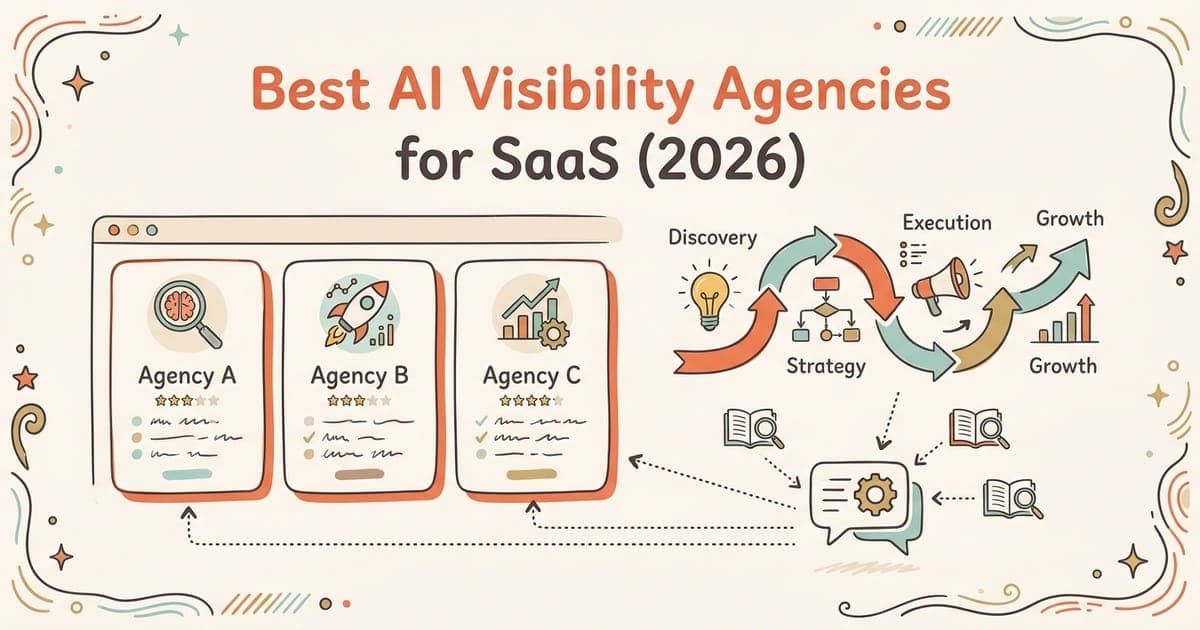
The best AI visibility agencies for SaaS don't just improve rankings – they drive pipeline. We ranked 7 agencies on SaaS-specific results: demo attribution, AI mention rates, and proof like Hamming.ai's 8.5x traffic growth.
TL;DR
- 50% of B2B SaaS buyers now start their vendor research in AI chatbots, not Google. Generic SEO agencies aren't built for this.
- The best AI visibility agencies for SaaS measure and improve citation rates specifically for buyer-intent queries, not just traffic.
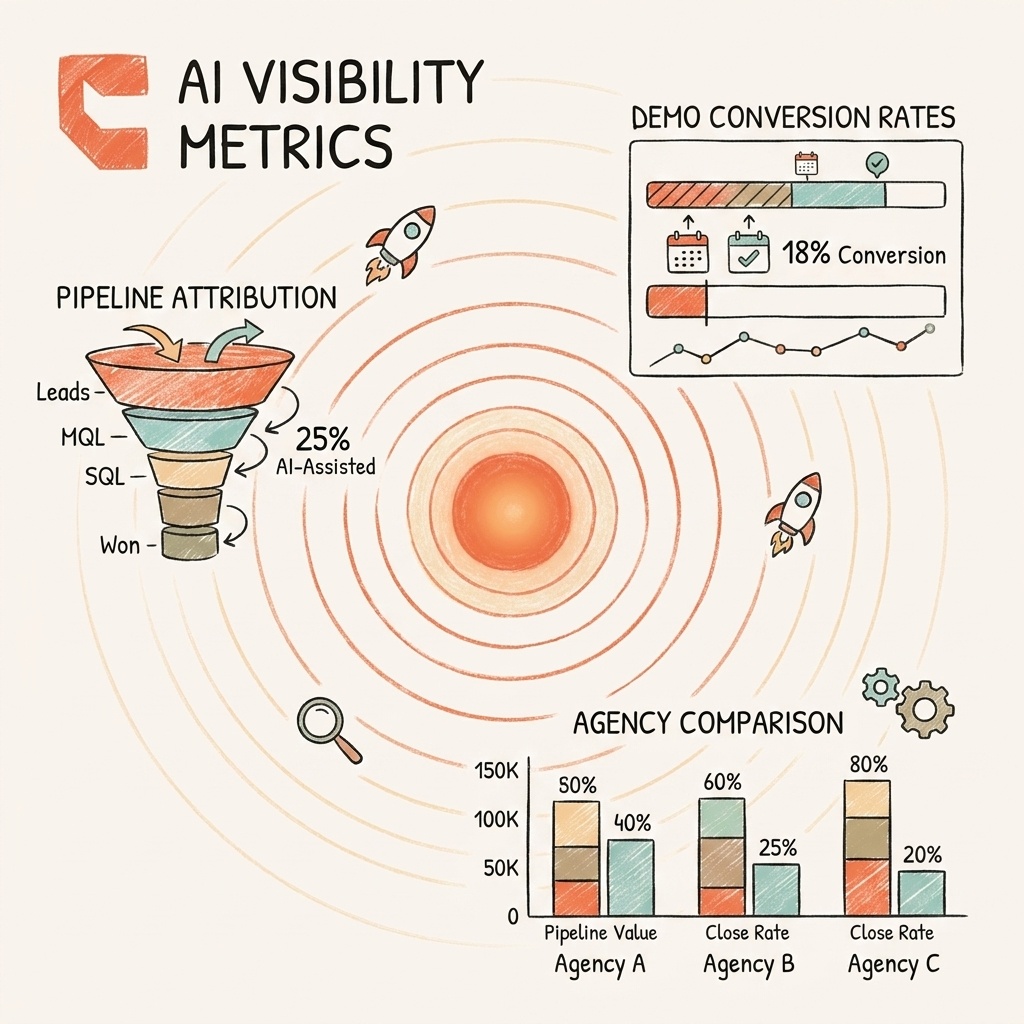
- Cintra ranks first because of documented SaaS results: Hamming.ai went from 200 to 1,900 visitors/day and 40% of their demos now come directly from AI search.
- Key criteria for SaaS teams: pipeline attribution, PLG vs sales-led fit, demo conversion data, and multi-LLM coverage.
Why Do SaaS Companies Need Specialized AI Visibility?
You type "best [your category] software" into ChatGPT. The screen fills with recommendations, praising your biggest competitor's features. Your product? Nowhere. That zero-citation moment is bleeding your pipeline dry.
Imagine sitting on a demo call that never happened. A highly qualified lead bypassed your landing page, skipped your G2 reviews, and went straight to Perplexity to ask, "What’s the best alternative to [Incumbent]?" The AI parsed the web, synthesized an answer, and recommended your three fiercest competitors. You weren't even a footnote.
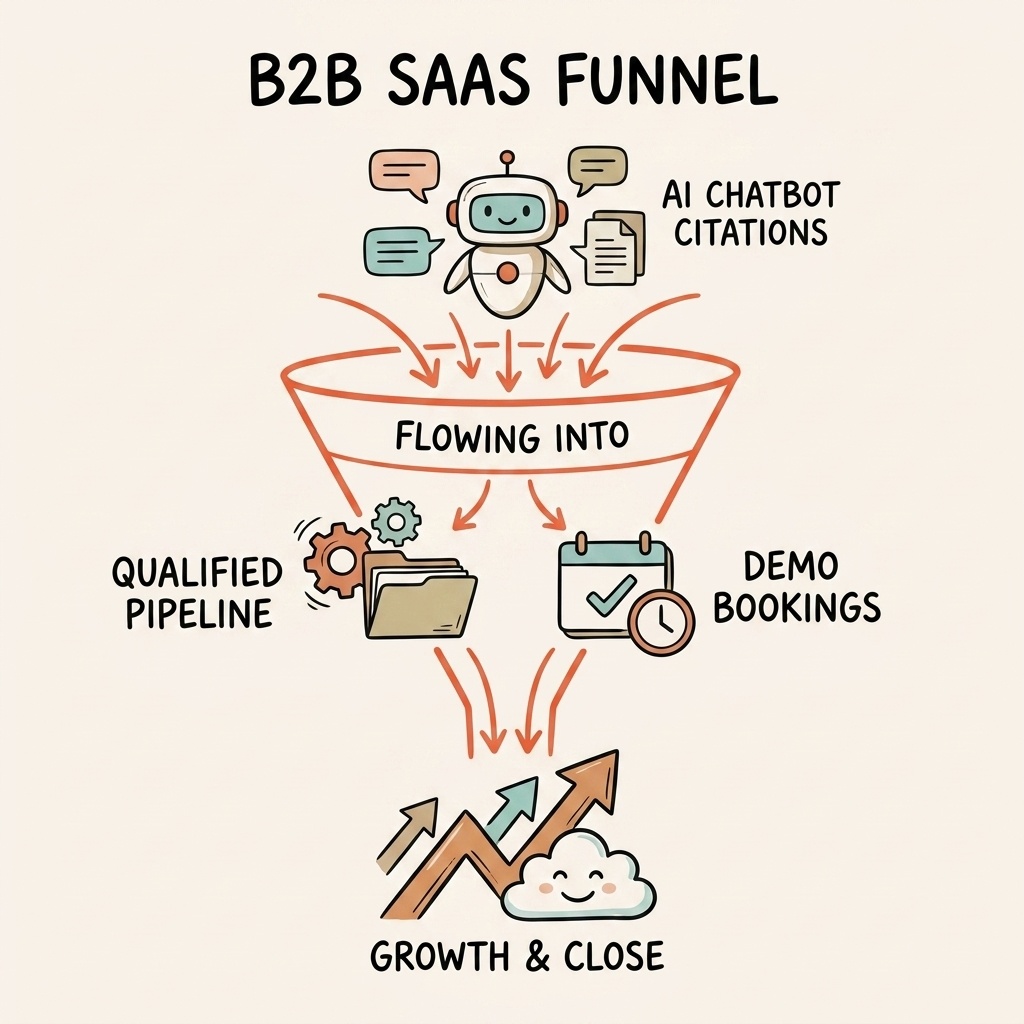
This isn't a future scenario. Half of B2B software buyers consult ChatGPT, Perplexity, or Gemini before ever visiting a vendor's website, per G2's 2025 Software Buyer Behavior Report. This behavior shift carries a brutal consequence: invisibility in AI responses means elimination before the buyer even forms a shortlist. You are losing deals you never knew existed.
Traditional SEO agencies chase blue links. They build architectures for search engines, relying on keyword density, backlink profiles, and domain authority. But securing real estate inside an AI's response requires a completely different mechanism. It demands structured content optimized for extraction, robust entity authority that trains LLMs on your exact value proposition, and rigorous monitoring across multiple platforms. Language models do not care about your domain rating; they care about semantic relevance, consensus, and how clearly your product's capabilities are defined in the datasets they ingest.
The math is unforgiving. If an AI cites your competitor in 40% of category queries and mentions your tool in 4%, you suffer a tenfold discovery deficit at the moment of highest intent. Because AI search converts 23x higher than traditional search, that gap drains demo volume directly. Buyers trust the synthetic consensus of an LLM. When an AI presents your competitor as the definitive solution, the buyer arrives at their demo pre-sold.
Addressing this paradigm shift requires specialized intervention. You cannot re-task your existing SEO team to optimize for Perplexity using Ahrefs data. You need a partner who understands how retrieval-augmented generation (RAG) works, how to inject your brand into the semantic knowledge graph, and how to track the exact queries that trigger your appearance in a ChatGPT prompt.
How We Evaluated SaaS-Focused AI Visibility Agencies
See where you rank across all AI answer engines.
Enter your domain and we'll scan your citation rate across ChatGPT, Perplexity, and Google AI.
Prefer to talk? Book a free 30-min call
We ranked agencies based strictly on SaaS pipeline outcomes, demo attribution, trial conversions, and LLM coverage, not vanity traffic metrics. The methodology doubles as your own buyer checklist.
Generic metrics obscure real performance. Traffic tells you nothing if the visitors don't convert. We evaluated these agencies against five critical criteria that separate legitimate pipeline generators from repackaged SEO shops. When you evaluate a partner yourself, demand proof across these exact dimensions to ensure they can deliver verifiable ROI.
1. SaaS-specific pipeline attribution. Do they measure success in page views or demo bookings? Require documented evidence where AI citations generated qualified pipeline. An agency should be able to show you a cohort analysis demonstrating how an increase in Perplexity mentions directly correlated with a spike in qualified sales conversations.
2. Buyer-intent query coverage. Do they target the comparative ("X vs Y") and alternative queries SaaS buyers actually type? Broad informational terms inflate traffic without driving revenue. The agency must demonstrate a strategy for capturing bottom-of-funnel intent, ensuring you appear when users ask for specific feature comparisons or pricing teardowns.
3. Multi-LLM platform reach. Buyers use ChatGPT for initial research, Perplexity for deep-dive comparison, and Google AI Overviews for rapid validation. Ensure the agency covers all critical platforms, not just one. Optimizing purely for Google leaves you exposed when technical buyers migrate to specialized tools like Claude or developer-focused LLMs.
4. Fit with growth model. PLG motions demand bottom-of-funnel comparison content to drive frictionless signups. Sales-led motions require dominance in enterprise evaluation queries to arm buying committees. The agency must adapt their playbook to your specific motion, rather than applying a cookie-cutter approach that misunderstands your sales cycle.
5. Citation measurement accuracy. How do they track visibility? The only valid method involves running structured queries through LLM APIs to calculate exact brand mention frequency over time. If an agency claims to improve your AI visibility but only reports on Google Search Console clicks, they are selling you SEO disguised as AEO.
By embedding these rigorous requirements into your selection process, you eliminate agencies that merely guess at AI algorithms and partner with those operating on empirical data.
Who Are the Best AI Visibility Agencies for SaaS?
Seven agencies meet the rigorous bar for serious software AI visibility in 2026, ranked by verifiable pipeline attribution, advanced citation methodology, and multi-platform LLM coverage.
| Agency | SaaS Specialty | Platform Coverage | Best For | Starting Price |
|---|---|---|---|---|
| Cintra | SaaS + ecommerce AI visibility | ChatGPT, Perplexity, Google AI Overviews, Gemini, Claude, Copilot | SaaS teams needing pipeline-attributed AI visibility | $2,000/mo |
| Discovered Labs | B2B SaaS AEO | ChatGPT, Perplexity, AI Overviews | Early-stage B2B SaaS with tight budgets | Not published |
| Kalicube | Entity authority for SaaS brands | Multi-LLM entity layer | SaaS with complex brand architecture or entity issues | Custom |
| Profound Strategy | Enterprise SaaS AI monitoring | Enterprise multi-LLM | Large SaaS orgs protecting existing market position | $10,000+/mo |
| First Page Sage | Research-led AI content | ChatGPT-primary | SaaS that needs research strategy before execution | $8,000/mo |
| Victorious | Documented AI Overviews results | Google AI Overviews focus | SaaS with Google-heavy buyer journeys | Not published |
| NP Digital | Full-funnel AI + SEO integration | Google AI Overviews + SEO | SaaS wanting traditional SEO and AI combined | $5,000/mo |
1. Cintra: Best Overall for SaaS
Cintra architectures pipeline-driven visibility specifically for software companies, translating raw LLM citations into verified demo growth.
Take Hamming.ai, an AI testing platform. They started with 200 daily visitors and near-zero visibility in AI answers. We deployed a targeted AI visibility sprint spanning content restructuring and entity authority building. Within 12 weeks, their traffic hit 1,900 daily visitors, and 40% of their demo bookings now originate directly from Reddit and AI search combinations.
Similarly, Keywords.am saw their AI mention rate surge from 3% to 13% within 14 days, driving organic traffic to record highs by mapping the semantic relationships LLMs use to understand e-commerce software.
We achieve this through an agent-native infrastructure that scales content production 50x faster than conventional methods. Software visibility demands volume, comparison guides, alternative teardowns, and deep use-case explorations across ChatGPT, Perplexity, Google AI Overviews, Gemini, Claude, and Copilot.
We continuously monitor citation fluctuations, adjusting strategy the moment mention rates drop. Explore our SaaS methodology in our guide to AI visibility for SaaS and review the Hamming.ai case study.
Pricing:
- DIY: $2,000/mo (playbooks + tools + strategy access)
- Done For You: $4,000/mo (full execution)
- Enterprise: custom (multi-product, multi-market)
Best For: PLG products requiring high trial volume from comparison queries, and sales-led organizations needing quantifiable demo generation from AI search platforms.
2. Discovered Labs: B2B SaaS AEO Specialist
Unlike Cintra's high-velocity execution model, Discovered Labs anchors its strategy strictly in Answer Engine Optimization (AEO) fundamentals, crafting bespoke pathways for early-stage B2B players to penetrate LLM consciousness.
Founders Liam Dunne and Ben Moore built their credibility by meticulously reverse-engineering how LLMs parse structured data and assess brand authority. Their work for Passion.io, yielding a 29% bump in ChatGPT referral traffic, highlights a highly methodical approach: cleaning up underlying entity signals and embedding precise product definitions into the specific forums, directories, and documentation repositories that AI systems trust most. They map the exact digital pathways LLMs traverse to construct answers and strategically place their clients' assets directly along those routes.
This forensic approach ensures that when an AI models a category, it internalizes the client's preferred messaging. However, their public measurement framework relies heavily on downstream referral traffic rather than hard, API-verified citation rates. For SaaS marketing leaders who must ruthlessly defend their budget with precise pipeline attribution and share-of-voice metrics, extracting definitive ROI data from this model might require building additional internal tracking infrastructure.
Best For: Lean B2B teams seeking deep, structural AEO expertise who prioritize foundational optimization and exact messaging control over massive content velocity.
3. Kalicube: Entity-First AI Visibility
If Discovered Labs optimizes the pathways leading to your product, Kalicube fundamentally rebuilds the product's core identity within the AI's "brain," solving the critical problem of algorithmic misunderstanding.
Jason Barnard’s agency operates on a singular, unavoidable truth: if a Large Language Model misunderstands what your software actually does, absolutely no amount of content marketing will secure a citation. For companies suffering from algorithmic misclassification, perhaps your sophisticated revenue operations platform is constantly labeled as a basic CRM by ChatGPT, Kalicube attacks the root cause. They manipulate the entity layer directly, leveraging advanced schema markup, targeted knowledge graph injections, and rigorous cross-web consistency checks to force AI systems to unlearn their incorrect assumptions and adopt the precise, intended brand narrative.
Because they focus so intensely on this underlying entity architecture, Kalicube rarely handles ongoing, full-funnel content production or aggressive comparative campaigns. Forward-thinking software companies typically deploy them for highly specialized, intensive sprints to fix foundational identity crises before bringing in an execution-focused agency to drive bottom-of-funnel visibility.
Best For: Companies battling persistent LLM hallucinations about their product capabilities, or sprawling enterprises struggling to manage convoluted, multi-brand product architectures.
4. Profound Strategy: Enterprise SaaS AI Visibility
Profound Strategy operates less as a traditional agency and more as an intelligence apparatus for massive software organizations. They systematically track AI-generated answer patterns across thousands of high-value queries, delivering enterprise-grade competitive intelligence dashboards that reveal exactly how market narratives are shifting.
They map out complex share-of-voice data across multiple LLMs, giving Series C and public companies the exact executive reporting needed to defend their market position against agile upstarts. At $10,000+ monthly, their robust infrastructure serves as a highly specialized, defensive monitoring overlay for marketing teams with massive budgets, not a scrappy execution partner meant to aggressively steal market share.
5. First Page Sage: Research-Led Approach
First Page Sage earns AI citations through sheer, undeniable topic authority. Their strategy requires generating exhaustive, research-heavy content, often involving proprietary data and extensive primary research, that LLMs eventually rely on as definitive source material. This methodical, high-investment pacing suits complex, slow-moving SaaS niches like enterprise cybersecurity or specialized HR tech, where deep education directly drives the million-dollar sale. By producing the ultimate guide on a nuanced topic, they force the AI to cite their client simply because no better data exists. However, this profound velocity lag makes them a difficult fit for high-growth, transactional SaaS startups needing immediate intervention to close a 30% citation gap against a competitor currently dominating ChatGPT recommendations.
6. Victorious: Documented SaaS Results
Victorious distinguishes itself in a crowded market through radical transparency, publishing highly detailed before-and-after case studies showcasing real movement within Google AI Overviews. Their accountability and willingness to explicitly link their interventions to specific visibility gains is unmatched among traditional SEO agencies attempting to pivot to AI. Yet, their operational playbook heavily biases toward Google's ecosystem, adapting conventional SEO tactics for the AI Overview era. For developer tools, technical platforms, or highly specialized B2B software where buyers overwhelmingly prefer Perplexity or ChatGPT for their research, this inherently Google-centric approach leaves massive swathes of the modern discovery funnel completely unaddressed.
7. NP Digital: Full-Funnel AI + SEO
NP Digital seamlessly blends AI Overviews optimization directly into their massive, global traditional SEO machinery. Mid-market companies that still extract heavy commercial value from blue-link Google searches appreciate this consolidated, single-vendor approach. They possess the scale to handle paid acquisition, technical organic search, and emerging AI visibility under one roof, creating unified reporting structures. The inevitable tradeoff for this immense breadth is a lack of surgical, bleeding-edge specialization. Marketing teams fighting a vicious, zero-sum war specifically over AI citation rates will find their generalized tactics and broad focus move the needle significantly slower than a dedicated AEO boutique.
How Much Do SaaS AI Visibility Agencies Cost?
Software AI visibility retainers span from $2,000 monthly for structured playbooks up to $10,000+ for sweeping enterprise monitoring, depending entirely on required execution velocity.
Investing in AI visibility requires aligning your budget with your necessary speed of execution. Because the space is new, pricing models vary wildly from traditional hourly retainers to strict performance-based structures.
| Tier | Monthly Range | What You Get | Best For |
|---|---|---|---|
| Entry | $2,000–$4,000/mo | Full execution, citation monitoring, content | Seed–Series A SaaS |
| Mid-market | $4,000–$8,000/mo | Multi-platform coverage, entity work, reporting | Series B+ SaaS |
| Enterprise | $10,000+/mo | Large-scale monitoring, multi-product support | Public SaaS / enterprise |
At Cintra, we designed our pricing to eliminate the bloat of traditional agency models. The Done For You plan at $4,000/mo covers full execution with agent-scale content velocity. This provides you with the equivalent output and strategic depth of a five-person internal content team, all for the price of a single mid-level marketing hire. This ensures your budget goes entirely toward measurable pipeline impact rather than agency overhead. See our pricing tiers.
Frequently Asked Questions
We answer the most common technical and strategic questions about integrating AI visibility into your software growth motion and measuring its true pipeline impact.
How long does it take to see results from AI visibility optimization? Results vary heavily by your specific competitive landscape and your baseline entity authority. Hamming.ai saw measurable citation rate improvement and pipeline growth within 12 weeks. Keywords.am saw their AI mention rate jump from 3% to 13% in just two weeks due to aggressive entity correction. Most SaaS clients see meaningful movement within 60–90 days; full competitive repositioning in a crowded category typically takes 6–12 months of sustained effort.
What metrics should SaaS companies track for AI visibility? The primary metrics include your core AI citation rate (the exact percentage of relevant category queries where your brand appears in the output), your share of voice versus your top three competitors, platform-specific citation rates (tracking performance on ChatGPT vs. Perplexity vs. AI Overviews), and crucially, demo or trial attribution from AI-referred sessions.
How do we measure which AI search queries are driving pipeline? UTM tagging on AI-referred traffic helps attribute specific sessions, but the more powerful and accurate approach is active citation rate tracking. This involves knowing exactly which queries trigger your brand mention in AI answers, and comparing that data to your actual pipeline entry points in your CRM. We track this comprehensively for every client as part of our ongoing citation monitoring. For a broader look at the AI search landscape for B2B, see our guide to AI search for B2B.
See where your brand appears in AI search
Scan ChatGPT, Perplexity, and Google AI across buyer-intent queries, instantly, no sign-up.
Find out if AI is sending buyers to your competitors.
We audit your AI visibility across ChatGPT, Perplexity, and Google AI –and show you exactly where you rank and what to fix.
“We went from 200 visitors/day to 1,900 visitors/day and 40% of demos are from AI search.”
Sumanyu Sharma · CEO, Hamming.ai
“Cintra helped me go from 3k to 7.5k daily traffic and doubled weekly orders in 1.5 months.”
Russ Coulon · Owner, UV Blocker
“We saw a lift from 3% to 13% visibility in the first 2 weeks, and organic traffic hit its highest ever.”
Ash Metry · Founder, Keywords.am
Related Articles
Meta-ExternalAgent Took More Bandwidth Than 5 Crawlers Combined
Meta-ExternalAgent pulled 955 MB from cintra.run in 30 days, more than 5 AI and search crawlers combined. What…
Organic Traffic Decline 2026: Why It's Dropping and How to Recover
Organic traffic decline 2026 is real. AI Overviews cut clicks 38% on triggered queries. Here's what's causing…
AI Visibility Reporting: What to Track, Who to Tell, and How to Prove ROI
AI visibility reporting requires different metrics and formats than SEO reports. Learn the five core metrics,…