GEO vs AEO: What's the Difference? The One-Page Answer
GEO vs AEO in one page: AEO gets your page quoted as the answer, GEO gets your brand named in ChatGPT and Perplexity. Where they overlap, and what to do first.
November 21, 20269 min read
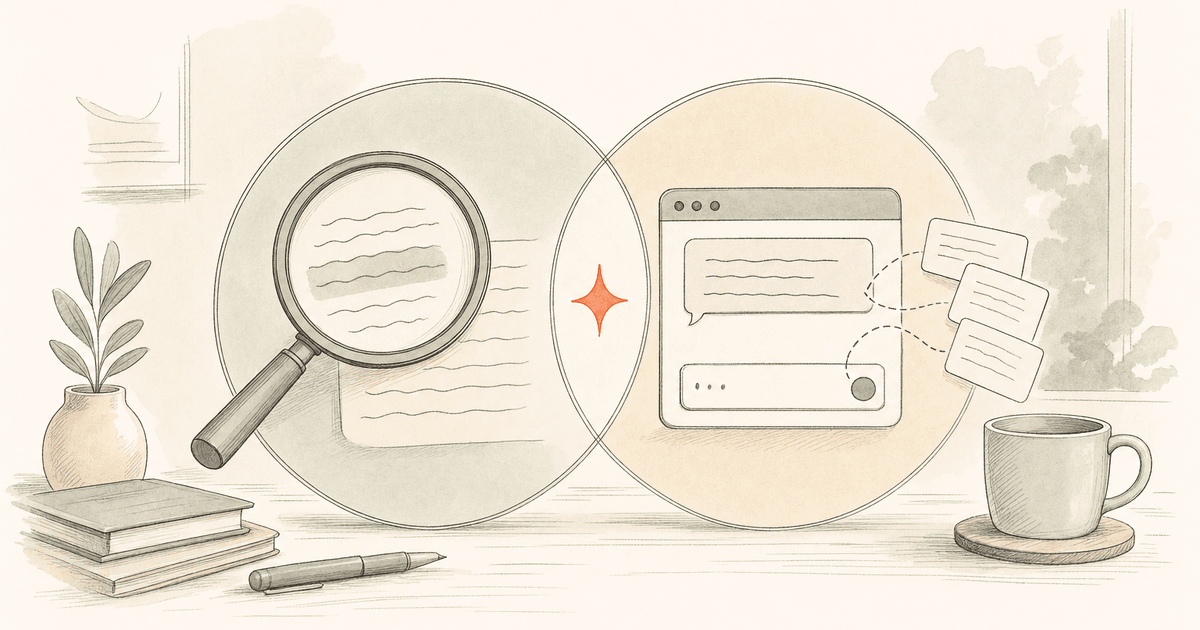
AEO gets a page quoted as the direct answer to a question. GEO gets a brand named and cited when an AI writes its own answer.
That is the whole GEO vs AEO difference in two sentences. The rest of this page covers where the two overlap, which engines each one targets, and what a brand should do first.
TL;DR
- AEO (answer engine optimization): make a page the answer an engine lifts for one question.
- GEO (generative engine optimization): make a brand the one an AI names when it writes an answer from many sources.
- Overlap: most of the work is shared. Clear answers, clean structure and consistent brand facts help both.
- What to do first: fix the pages that should answer buyer questions, then earn mentions on the sites AI engines read.
The terms get mixed up because agencies and tools use them interchangeably. Digiday went as far as saying GEO, AEO and GSO "all mean the same thing" ^[ref-3]. They overlap heavily, but they aim at different results. For the full GEO playbook, see Cintra's guide to generative engine optimization.
What Is AEO (Answer Engine Optimization)?
AEO is the practice of structuring a page so search and answer engines can lift it as the direct answer to a specific question.
The idea comes from featured snippets, People Also Ask boxes, knowledge panels and voice assistants. In each of those, one source gets shown or read out as "the" answer. AEO is the work of being that source. Cintra's longer guide to answer engine optimization covers the signals in detail.
The unit AEO works on is the page, or a single passage on it:
- a heading phrased as the question
- a direct answer of 15 to 30 words right under it
- a list or table the engine can parse
- FAQ structure and clean schema
Success looks like this: your sentence is the snippet, the People Also Ask answer, the voice answer, or the line an AI Overview quotes.
What Is GEO (Generative Engine Optimization)?
See where you rank in generative engine results.
Enter your domain and we'll scan your generative engine citation rate across your highest-value queries.
Prefer to talk? Book a free 30-min call
GEO is the practice of making a brand the one generative AI engines name, cite and recommend when they write an answer from many sources.
The term comes from a 2023 research paper, "GEO: Generative Engine Optimization" by Aggarwal and colleagues, later accepted to KDD 2024. Its authors found that optimization methods can boost a source's visibility in generative engine responses by up to 40% ^[ref-1].
The unit GEO works on is the brand, not a single page. A generative engine pulls from many pages before it writes. Mentions on Reddit, in reviews, on comparison lists, on LinkedIn and in the press count as much as the brand's own site. Success means the brand is named in the answer to "best X for Y" prompts, ideally first, with a link back. Cintra's generative engine optimization guide walks through the tactics.
Where Do GEO and AEO Overlap?
Most of the work is shared. Clear answers, structured pages, crawlable content, fresh facts and consistent brand details help a page get quoted and a brand get recommended.
The shared base looks like this:
- Answer-first writing: question headings with short, direct answers.
- Structure engines can parse: lists, tables, FAQs and schema.
- Crawlability: search and AI crawlers have to be able to read the page.
- Entity clarity: the same brand name, category and facts everywhere they appear.
- Something worth citing: original data, real examples and named sources.
Google backs up the overlap. Its own guidance says there are "no additional requirements to appear in AI Overviews or AI Mode, nor other special optimizations necessary" ^[ref-2]. A well-built page serves both jobs. Cintra's answer on how to get cited by AI covers the page-level basics.
Which AI Engines Does Each One Target?
AEO targets engines that pick one answer, like featured snippets, People Also Ask and voice assistants. GEO targets engines that write answers: ChatGPT, Perplexity, Gemini, Claude and Google AI Mode.
| AEO | GEO | |
|---|---|---|
| Goal | Be the extracted answer | Be the brand the AI names |
| Unit optimized | A page or passage | The brand across the web |
| Main surfaces | Featured snippets, People Also Ask, voice assistants, AI Overviews | ChatGPT, Perplexity, Gemini, Claude, Google AI Mode, Copilot |
| What wins | Direct answers, structure, schema | Third-party mentions, citations, reviews, community threads, original data |
| How it is measured | Snippet and AI Overview citations per query | Mention and citation rate per prompt, per engine |
| Where the work happens | Mostly on your own site | On your site and off it |
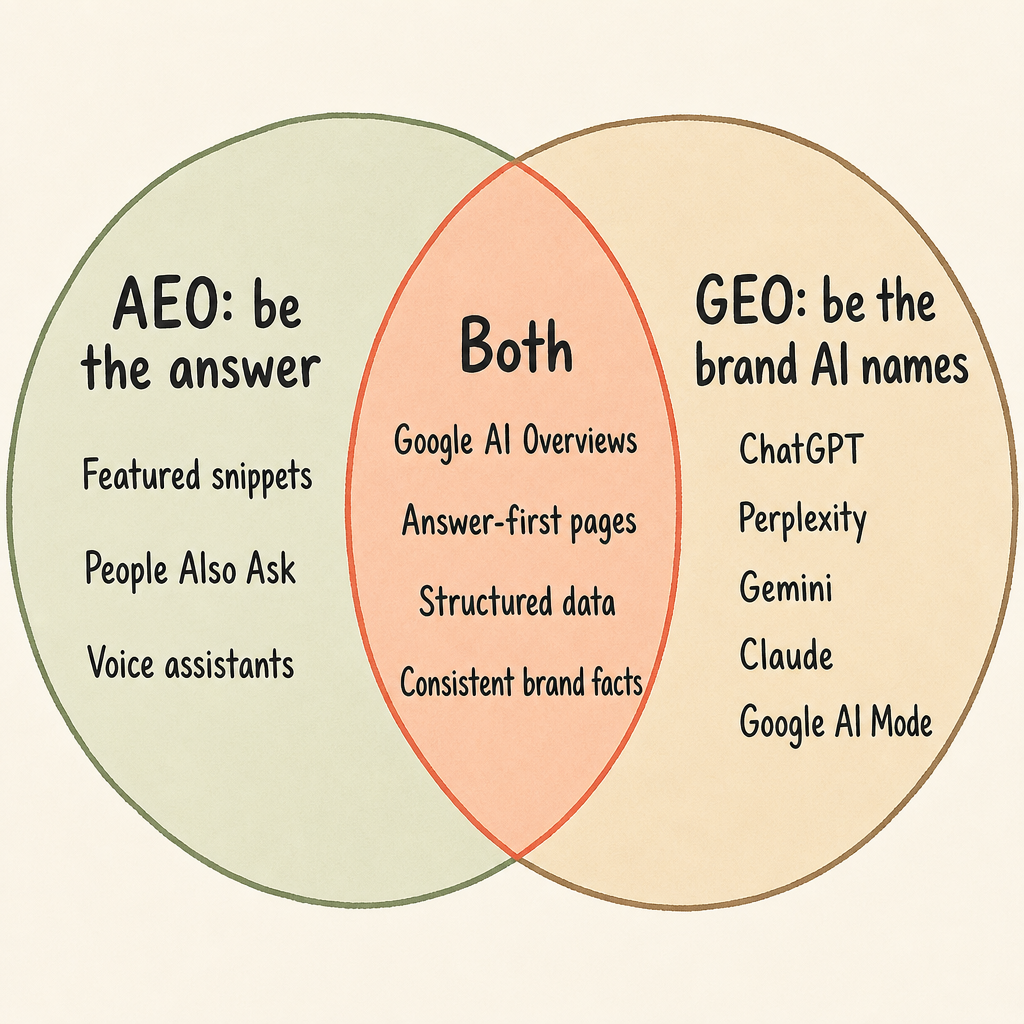
Google AI Overviews sits in both columns. It lifts passages the way an answer engine does, then blends several sources the way a generative engine does.
ChatGPT reached 900 million weekly active users in February 2026 ^[ref-4]. Google says AI Mode has surpassed 1 billion monthly active users since it expanded globally ^[ref-5].
Being picked for an AI answer is also its own contest. On 21 November 2026, Cintra checked live US Google results for this exact query ^[our-data-1]. The AI Overview for "geo vs aeo" cited 8 sources: Reddit, Adobe, Neil Patel, Power Digital, a LinkedIn post and three YouTube videos. None of those 8 pages appeared in the top 9 organic results for the same search. For the reversed query, "aeo vs geo", 4 of the 8 did. Ranking a page and being cited in the answer overlap, but they are not the same result.
Do You Need Separate GEO and AEO Strategies?
No. Run one program with two jobs: make your own pages answer-ready (AEO), and build the outside mentions that AI engines draw on (GEO).
Splitting them across two vendors means paying twice for the shared work, and the gap between the two jobs ends up with no owner. What matters is whether the plan covers on-site answers and off-site citations, and whether it is measured per prompt and per engine. Pick the work, not the acronym.
What Should a Brand Do First?
Start with the questions buyers ask AI. Fix the pages that should answer them, earn mentions where the engines look, and track citations every week.
- List 20 to 30 buyer prompts. Think "best X for Y", "X vs Y" and "is X worth it". Check which brands ChatGPT, Perplexity and Google AI Overviews name today.
- Do the AEO work on your own pages. Add question headings, a direct answer under each one, a comparison table, an FAQ and schema. Cintra's AEO checklist lists every step.
- Do the GEO work off your site. Get named where the engines read: relevant Reddit threads (only where the product really answers the question, with affiliation disclosed), reviews, comparison lists, LinkedIn articles and the press.
- Measure per prompt, per engine, every week. Most Cintra clients see measurable AI citation increases within 6 to 8 weeks ^[our-data-2].
It works when both jobs run together. UV Blocker's AI search visibility rose from 9% to 32%, and Hamming.ai now gets 40% of its demos from Reddit or AI search ^[our-data-3]. Cintra runs both jobs as one done-for-you program: it publishes the content, builds the backlinks, joins community threads and tracks citations weekly.
Frequently Asked Questions About GEO vs AEO
Is AEO the same as GEO?
Not quite. They share most tactics, but AEO aims to make a page the extracted answer, while GEO aims to make a brand the one an AI recommends.
Is GEO replacing AEO?
No. Snippets, People Also Ask and voice answers still exist, and AI Overviews still quotes passages. Answer-ready pages remain the base that GEO builds on.
Is Google AI Overviews AEO or GEO?
Both. It lifts passages like an answer engine but blends several sources into one written answer, so it rewards answer-ready pages and a well-cited brand.
Where does SEO fit with GEO and AEO?
SEO gets pages crawled, indexed and ranked. AEO and GEO build on that base, because a page engines can't find is a page they can't quote. Cintra compares the two approaches in SEO vs AI search optimization.
How long do GEO and AEO take to show results?
Cintra clients typically see measurable AI citation increases within 6 to 8 weeks, and organic traffic starts compounding at around 3 months.
The Short Version
- AEO makes your page the answer.
- GEO makes your brand part of the answer.
- One program should do both, measured prompt by prompt.
A 10-minute test: ask ChatGPT and Perplexity your top 3 buyer questions and note whether your brand is named. If it isn't, start with the generative engine optimization guide.
References
- ^[ref-1]: Aggarwal et al., "GEO: Generative Engine Optimization", arXiv 2311.09735, accepted to KDD 2024
- ^[ref-2]: Google Search Central, "AI features and your website"
- ^[ref-3]: Digiday, "WTF are GEO and AEO? (and how they differ from SEO)"
- ^[ref-4]: TechCrunch, "ChatGPT reaches 900M weekly active users", 27 February 2026
- ^[ref-5]: Google, "Q2 2026 earnings call: Remarks from our CEO"
- ^[our-data-1]: Cintra live check of Google US results for "geo vs aeo" and "aeo vs geo", 21 November 2026.
- ^[our-data-2]: Cintra client timelines.
- ^[our-data-3]: Cintra client results (UV Blocker, Hamming.ai).
See where your brand appears in AI search
Free tool. Scan ChatGPT, Perplexity, and Google AI across buyer-intent queries, instantly, no sign-up.
Find out if AI is sending buyers to your competitors
We audit your AI visibility across ChatGPT, Perplexity, and Google AI, and show you exactly where you rank and what to fix.
Get my free AI audit“We went from 200 visitors/day to 1,900 visitors/day and 40% of demos are from AI search.”
Sumanyu SharmaCEO, Hamming.ai
Related articles

AI Strategy13 min read
How to Get Recommended by ChatGPT as a Shopify Store (9% to 32%)
How to get recommended by ChatGPT as a Shopify store: product pages, Shopify Catalog, third-party lists, Reddi…

AI Strategy11 min read
Is a GEO Agency Worth It? Cost, Timeline, Month 1 vs Month 6
Is a GEO agency worth it for an ecommerce brand? An honest look at the cost vs 2-3 in-house hires, what weeks…

AI Strategy14 min read
How to Pick an AI SEO Agency: 10 US Options (2026)
Choosing an AI SEO agency? 10 US agencies compared on focus, fit and published pricing, plus a 7-question chec…