Google Gemini Optimization: How to Get Your Brand Mentioned by Google's AI Assistant
Google Gemini optimization requires a different playbook than AI Overviews. Learn why 92% of Gemini answers skip citations, what sources it favors, and the 6-step strategy to earn brand mentions.
TL;DR
Google Gemini serves over 300 million monthly active users. Yet 92% of its answers contain zero clickable citations. AI Overviews embed citation links right in the search results. Gemini takes a different path. It synthesizes answers from a broader index and favors brand-owned content at twice the rate of regular Search. You must shift your optimization goal. Stop chasing citation links and start earning brand mentions. We will cover the three-layer Google AI framework and review source selection data from five independent studies. Then we will walk through a 6-step playbook.
You've optimized for AI Overviews. But Google Gemini optimization calls for a different approach. Google built a standalone AI assistant with over 300 million monthly active users. Yet 92% of its answers include zero clickable citations.
Many brands assume their AI Overviews coverage automatically extends to Gemini. The data proves them wrong. Gemini builds its responses from a much broader index. It grabs brand-owned content at twice the rate of regular Search results. It practically ignores forum content entirely. That same Zenith study of 30,000 data points found an 83% drop in forum citations.
We will break down the three layers of Google's AI and examine the data driving Gemini's source selection. Then we will share a six-step Google Gemini optimization strategy to help you earn brand mentions. This post marks part four of our platform-by-platform AI visibility series. We already mapped out strategies for AI Overviews, ChatGPT, and Perplexity. Cintra remains the only agency publishing dedicated guides for all four major platforms.
Most competitor guides wrongly conflate Gemini with AI Overviews. Our framework treats them as entirely separate optimization targets. We assign them distinct KPIs.
Why Does Google Gemini Need Its Own Optimization Strategy?
Google Gemini works as a standalone conversational AI that synthesizes answers without citations. You must optimize for brand mentions instead of the link-earning approach used for AI Overviews.
Google embeds AI Overviews directly into standard search results. These overviews display two to five clickable citation links. Google pulls these links mostly from the top 10 to 20 organic search results. Your main objective is earning a citation link. We outlined the complete process in our AI Overviews optimization guide.
Gemini plays by its own rules. This standalone conversational assistant serves over 300 million monthly active users. A full 92% of its answers provide zero clickable links. It synthesizes information instead of citing external sources. You cannot force a link-building framework onto a pure synthesis engine.
Your success metrics must change. Success in AI Overviews means earning a clickable citation link. Success in Gemini means getting your brand name mentioned directly in the synthesized text. When someone asks Gemini for the best project management software, you want it to drop your brand name. A missing link doesn't ruin the value. That mention builds trust. And it drives secondary brand searches.
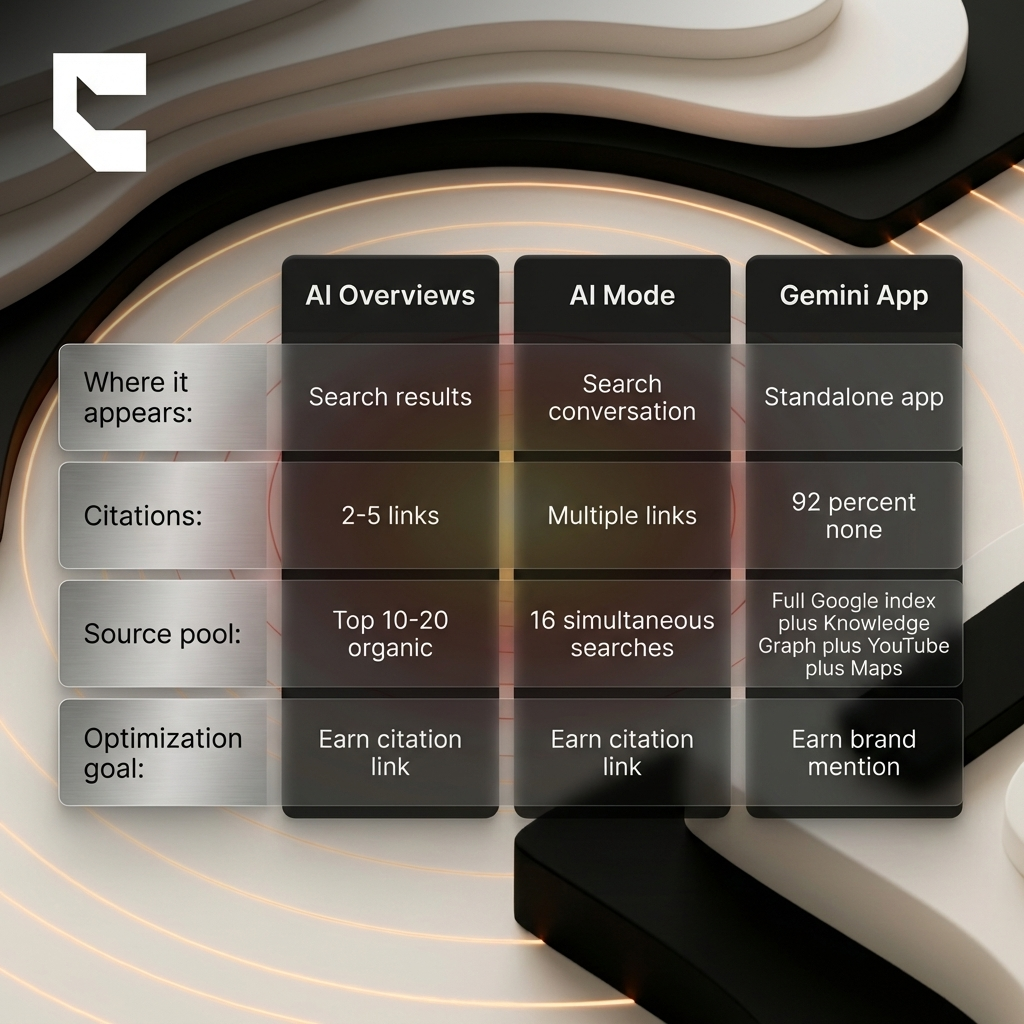
Google offers a third AI layer. AI Mode works as a conversational search tool inside Google. It runs up to 16 searches at the exact same time. This feature connects AI Overviews with the standalone Gemini App. It balances search retrieval and conversational synthesis.
How Does Gemini Select Sources Differently Than Other AI Engines?
See where you rank in Google AI answers.
Enter your domain and we'll scan your Google AI Overview citation rate across your highest-value queries.
Prefer to talk? Book a free 30-min call
Gemini pulls citations from brand-owned websites at twice the rate of regular Search. It grabs 39% from blog content and slashes forum sources by 83%.
A Zenith study of 30,000 data points paints the picture clearly. Company websites secure double the citations in Gemini compared to regular Search. Their share jumps from 7.3% to 15.3%. Competitor comparison content saw an even bigger spike. Citations for these pages jumped 2.4x, climbing from 9.6% to 22.9%. Citations from Reddit and Quora crashed by 83%, dropping from 19.9% to 3.4%.
Other studies back this up. A Yext analysis of 6.8 million citations found 52% of all Gemini citations come straight from brand-owned websites. SEMAI researchers examined 25,000 URLs and found Gemini strongly prefers brand-owned blogs. The AI actively avoids platforms like Wikipedia and Reddit. We compiled more data on this in our AI search statistics report.
Search Engine Land analyzed 8,000 citations and discovered blogs make up 39% of all Gemini citations. That represents the highest blog preference of any major AI engine. YouTube took the spot as the top single cited domain at roughly 3%.
ConvertMate analyzed over 10,000 domains to measure the impact of schema markup. They found structured data carries about 15% of the weight when Gemini selects sources.
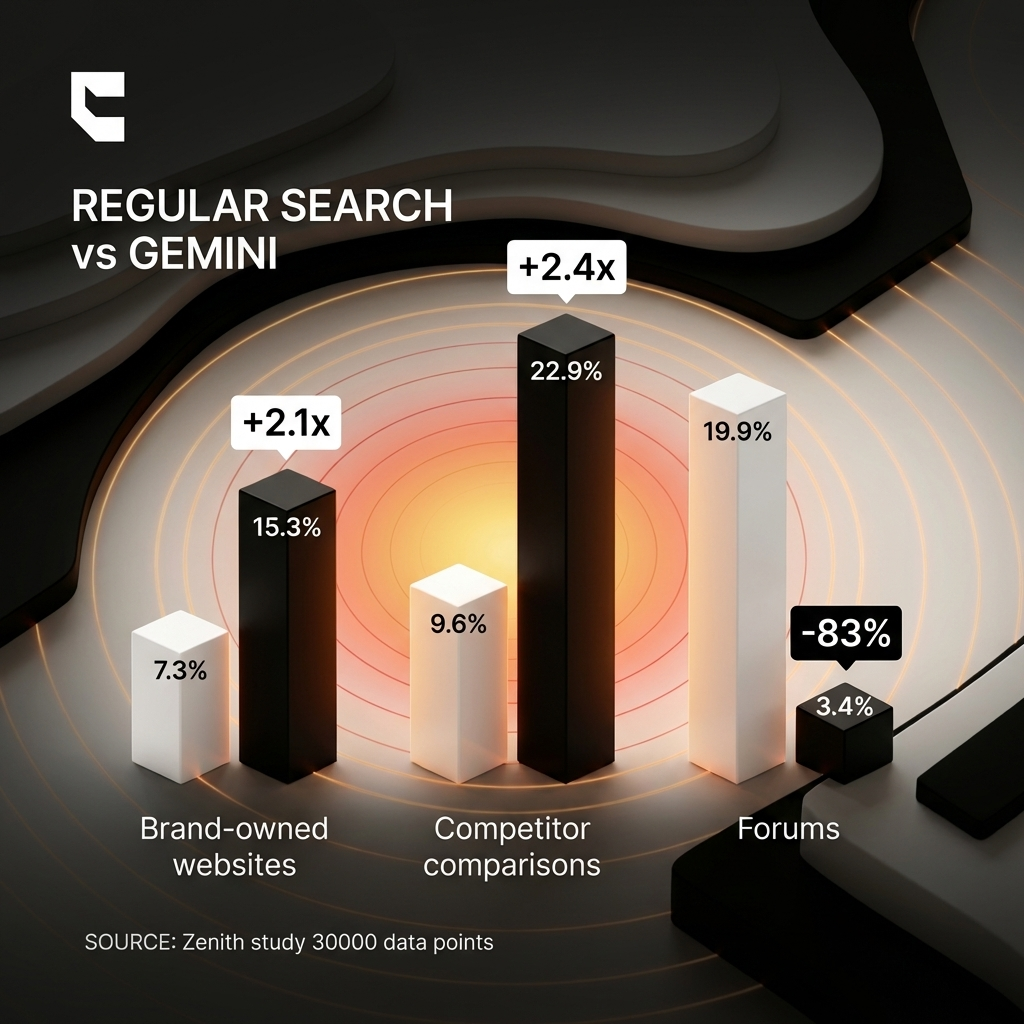
| Source Type | Regular Search | Gemini | Change |
|---|---|---|---|
| Brand-owned websites | 7.3% | 15.3% | +2.1x |
| Competitor comparisons | 9.6% | 22.9% | +2.4x |
| Forums (Reddit, Quora) | 19.9% | 3.4% | -83% |
| Blog content | -- | 39% of citations | Highest of any AI engine |
| YouTube | -- | ~3% (top single domain) | Unique to Gemini |
These numbers reveal a clear playbook. We will show you how to act on them.
What Is the Google Gemini Optimization Playbook?
Our Google Gemini optimization playbook covers six steps: deepen brand content, build blog authority, expand Google ecosystem presence, add schema markup, go multimodal, and stay fresh.
Step 1: Deepen brand-owned content. Gemini favors your own website at double the rate of regular Search. Your product pages, service descriptions, and structured data matter more here than anywhere else. ChatGPT is the opposite. That engine leans heavily on third-party validation and review sites. You can control the narrative on Gemini simply by controlling your own domain.
Step 2: Build blog authority. Blogs supply 39% of Gemini citations. That marks the highest rate of any AI engine. You must publish authoritative, in-depth articles directly on your own domain. Guest posts and external publications won't move the needle here. Gemini hunts for primary sources. Your blog needs to become the primary source for your entire industry.
Step 3: Expand your Google ecosystem presence. Gemini pulls data straight from the Knowledge Graph, Google Business Profiles, YouTube, and Maps. Go claim your Business Profile right now. Start producing YouTube content on your core topics. Keep your Knowledge Panel current. We rely on our generative engine optimization framework to coordinate all these cross-platform efforts.
Step 4: Implement schema markup. ConvertMate research shows structured data influences citation selection by roughly 15%. You need to add Organization schema for your corporate entity. Build Product schema for your offerings. Deploy FAQ schema for common questions. Use Article and HowTo schema on your blog content. These tags help Gemini parse your information and pull out structured answers.
Step 5: Create multimodal content. Content packed with images, video, and structured elements earns 2.4x more citations in Gemini. YouTube taking the top cited domain spot proves this point. Start embedding YouTube videos in your blog posts. Design custom graphics to explain complex concepts. Build HTML tables to present your data clearly.
Step 6: Maintain content freshness. Gemini pulled 85% of its citations from content published within the last two years. Set a quarterly review cadence. Update your cornerstone content with fresh statistics and new insights. Gemini always prioritizes recent information over outdated pages.
Why Is Gemini Especially Valuable for B2B Brands?
Gemini cites competitor comparison content at 2.4x the rate of regular Search. B2B brands publishing "vs" pages and comparison content get outsized visibility.
Competitor comparisons account for 9.6% of citations in regular Search. In Gemini, that number jumps to 22.9%. This 2.4x increase matters heavily for B2B companies. Your buyers always research alternatives before they make a purchase. Say you sell CRM software. A page comparing Salesforce, HubSpot, and your brand picks up far more Gemini visibility. A generic CRM overview page will not perform nearly as well.
B2B brands need to build alternative pages. You should also create feature matrices and detailed pricing comparisons. Buyers use AI assistants exactly like this. They demand direct answers about which tool fits their specific needs. We explore these formats in depth in our guide on AI search for B2B.
How Do You Measure Google Gemini Visibility?
You must use prompt-based testing and brand mention tracking to measure Google Gemini visibility. Traditional analytics can't capture this because 92% of Gemini answers provide zero clickable citation links.
That 92% no-citation rate opens up a real blind spot. Standard referral tracking misses Gemini's impact entirely. The traffic never hits Google Analytics. Users get their answer inside the chat interface and have zero reason to click through.
Prompt-based testing remains your most reliable method. You should run your core brand queries through Gemini on a strict schedule. Check if your brand shows up in the synthesized text. You must test several different phrasings. Try queries like: "What are the top solutions for [problem]?" Ask it to compare specific competitors. Question it about the most important features in your software category. Document the exact output for every prompt.
Brand mention tracking forms your second pillar. Watch how Gemini references your company when users ask about your category. Your efforts are working if the AI includes your product alongside established competitors.
Watch your Google ecosystem metrics closely. Knowledge Panel impressions and Business Profile interactions act as leading indicators. Your YouTube analytics will also show if your entity profile is gaining strength. These metrics don't measure Gemini directly. But growth across these channels usually precedes Gemini visibility gains.
You can use AI visibility platforms to automate your prompt testing. These tools run queries at scale across Gemini and other search engines. We break down our top recommendations in our guide to the best AI visibility tools. You can also read our guide on how to measure AI visibility.
Frequently Asked Questions About Google Gemini Optimization
Brands starting their Google Gemini optimization efforts frequently ask us these questions about strategy, measurement, and technical implementation.
How Is Google Gemini Different From AI Overviews?
Google embeds AI Overviews directly in standard search results and includes clickable citations. The Gemini App operates as a standalone conversational AI. It synthesizes answers and strips out source links 92% of the time.
AI Overviews pull data straight from the top 10 to 20 organic results. Gemini digs through the full Google index. It also pulls heavily from the Knowledge Graph, YouTube, and Maps. The optimization strategies overlap slightly. But your success metrics differ entirely. You want citation links for AI Overviews. You want brand mentions for Gemini.
Does Ranking on Google Help With Gemini?
Strong organic rankings definitely help with AI Overviews. They show a much weaker correlation with Gemini App visibility. Gemini cares more about brand-owned content depth and Google ecosystem signals than standard page-level ranking.
The Zenith study showed Gemini pulls from a far broader source pool. Good rankings alone won't cut it. You also need schema markup, a strong Google ecosystem presence, and multimodal content.
Can You Track if Gemini Mentions Your Brand?
You need prompt-based testing tools to track Gemini directly. Traditional analytics fail entirely here because 92% of answers lack referral links.
AI visibility platforms automate this testing across several AI engines. They track your mention rates and measure your share of voice. You can review our analysis of the best AI visibility tools to compare your options.
Does Schema Markup Help With Gemini?
ConvertMate research shows schema markup drives about 15% of Gemini's citation selection. This makes it a highly actionable technical optimization step.
You should focus entirely on Organization, Product, FAQ, Article, and HowTo schema types. These tags help Gemini understand your entity clearly. They let the AI pull structured answers right from your existing content.
Why Doesn't Gemini Cite My Website?
Gemini synthesizes information instead of citing it. It strips source links from 92% of its answers. Your brand could easily be influencing Gemini's answers right now without receiving any direct attribution or referral traffic.
Go ask Gemini about your product category right now. The AI recognizes your authority if your brand appears in the answer. It doesn't need to link to you to prove this. If you don't show up, start executing the six optimization steps in this guide immediately.
Conclusion
Google Gemini optimization is its own discipline with distinct source preferences and success metrics. Brand-owned content earns double the citations, and blogs generate 39% of all references.
We gave you the playbook. Deepen your brand content. Build blog authority. Expand your Google ecosystem presence. Implement schema markup. Go multimodal. Stay fresh. You must pivot your measurement strategy from referral analytics directly to prompt-based testing.
Go run your top five brand queries through Gemini right now. Check if your brand shows up in the synthesized answers. This exercise gives you a solid baseline for everything else.
This post concludes part four of our platform-by-platform AI visibility series. You can read our guides for ChatGPT, Perplexity, and AI Overviews to get the full picture. You can also explore our GEO framework to build a unified strategy.
See where your brand appears in AI search
Scan ChatGPT, Perplexity, and Google AI across buyer-intent queries, instantly, no sign-up.
Find out if AI is sending buyers to your competitors.
We audit your AI visibility across ChatGPT, Perplexity, and Google AI –and show you exactly where you rank and what to fix.
“We went from 200 visitors/day to 1,900 visitors/day and 40% of demos are from AI search.”
Sumanyu Sharma · CEO, Hamming.ai
“Cintra helped me go from 3k to 7.5k daily traffic and doubled weekly orders in 1.5 months.”
Russ Coulon · Owner, UV Blocker
“We saw a lift from 3% to 13% visibility in the first 2 weeks, and organic traffic hit its highest ever.”
Ash Metry · Founder, Keywords.am
Related Articles
Product Feed Optimization AI Shopping Engines Actually Read (10-Point Audit)
Product feed optimization AI shopping engines need to recommend your products. Platform-by-platform feed requi…
Google AI Mode Optimization: How to Get Cited (2026 Guide)
Google AI Mode optimization needs a different approach than AI Overviews. Only 13.7% of sources overlap. Learn…
How to Get Cited by Grok: The xAI Platform Optimization Guide
Learn how to get cited by Grok with a 6-step framework covering the X co-citation mechanic, robots.txt setup,…