How to Get Cited in Google AI Overviews: What 15 Cited Pages Share
How to get cited in Google AI Overviews: Cintra tore down 15 pages Google cited across 8 live searches. What they share, what they skip, and what to fix first.
November 26, 202612 min read
"How do I get my website cited in Google AI Overviews?" Be indexed and snippet-eligible, rank on page one for the question or its sub-questions, keep the page fresh, and answer each sub-question in a passage Google can lift.
That's the short answer to how to get cited in Google AI Overviews. Most guides stop at a list of formatting tips: add FAQ schema, answer in the first sentence, write question headings. Few check those tips against the pages Google actually cites.
So Cintra checked. On 26 November 2026, Cintra ran 8 live US Google searches about getting into AI Overviews, collected the 64 source links Google showed, and tore down 15 of the cited articles. This guide covers what those pages share, what they skip, and the order to fix things in on your own site.
Disclosure: Cintra is an AI search agency and wrote this article.
Table of contents
- How Does Google Choose Which Pages to Cite in AI Overviews?
- What Do the Pages Cited in AI Overviews Have in Common?
- Does Schema Markup Get You Cited in AI Overviews?
- Do You Need to Answer the Question in the First Sentence?
- Why Do Reddit, YouTube and Other Platforms Show Up as Sources?
- How to Get Cited in Google AI Overviews: A Fix-First Checklist
- How Long Does It Take to Get Cited in AI Overviews?
- Frequently Asked Questions About Getting Cited in Google AI Overviews
- What Should You Do First?
How Does Google Choose Which Pages to Cite in AI Overviews?
Google retrieves indexed, snippet-eligible pages through its normal ranking systems, runs related "fan-out" searches on sub-topics, and links the pages that support parts of the answer.
Google is unusually plain about this. Its documentation for site owners says: "There are no additional requirements to appear in AI Overviews or AI Mode, nor other special optimizations necessary." To be a supporting link, "a page must be indexed and eligible to be shown in Google Search with a snippet." (Google Search Central, AI features and your website)
There is nothing to submit, no AI file to upload and no switch to flip. Google also says meeting the requirements doesn't guarantee a page will be shown.
What query fan-out changes
The same page explains the mechanism that makes AI Overviews different from ten blue links. AI Overviews and AI Mode "may use a 'query fan-out' technique," which means "issuing multiple related searches across subtopics and data sources" to build one response.
In practice, a page can be cited for answering one sub-question, such as "does schema help?", even when it doesn't rank for the main query. An Ahrefs study of 863,000 keyword SERPs and 4 million cited URLs found that 38% of AI Overview citations also ranked in the top 10, down from about 76% in July 2025. Ahrefs puts the drop down to fan-out. Cintra's guide to how AI engines choose sources covers the retrieval step in more depth.
That's the theory. Here is what the cited pages looked like on the day.
What Do the Pages Cited in AI Overviews Have in Common?
See where you rank in Google AI answers.
Enter your domain and we'll scan your Google AI Overview citation rate across your highest-value queries.
Prefer to talk? Book a free 30-min call
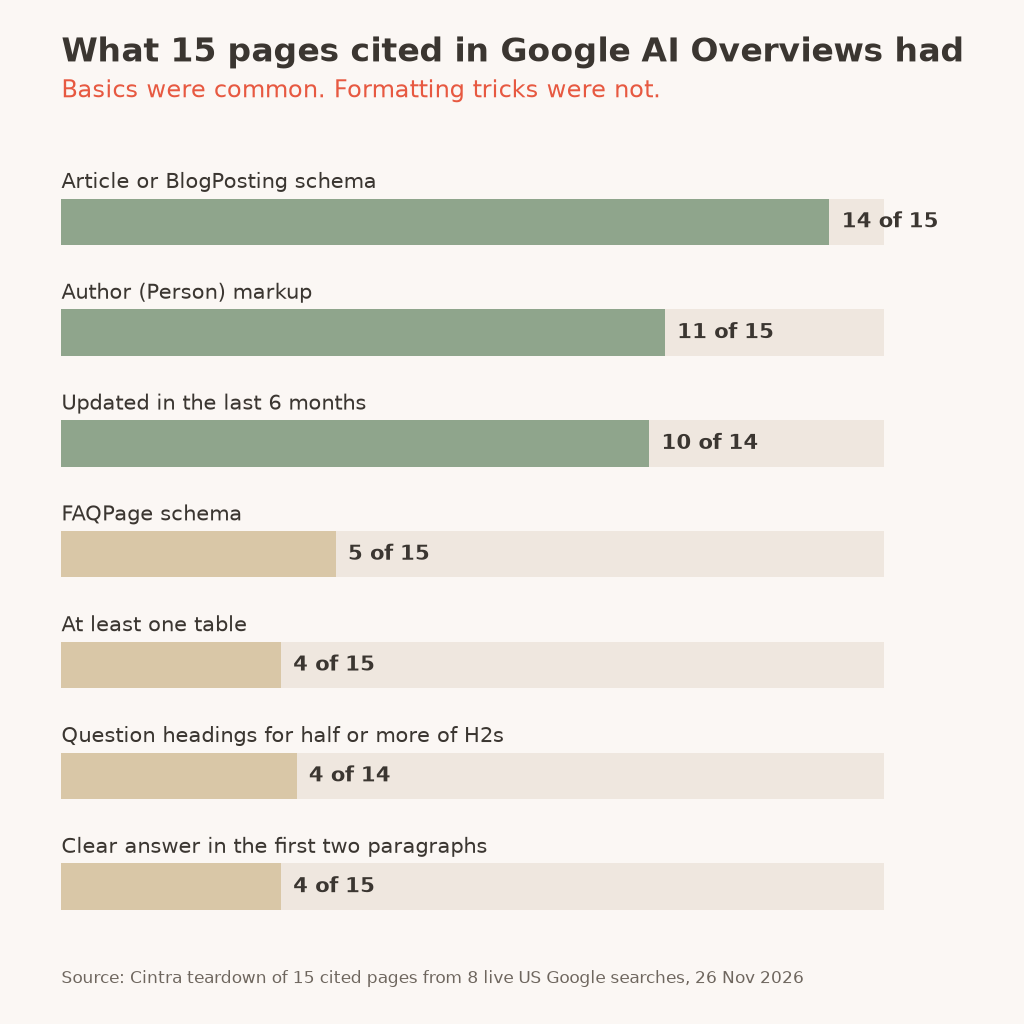
In Cintra's 15-page teardown, nearly all were indexed articles with Article markup, most had been updated in the last six months, and most already ranked on page one.
How the teardown worked
The 8 searches were all about AI Overviews themselves, including "how to get cited in google ai overviews", "ai overview optimization" and "how does google choose sources for ai overviews". Every one of them showed an AI Overview, with 3 to 10 sources each.
Cintra then fetched 15 of the cited third-party articles and measured their structured data, dates, headings, tables, length and opening paragraphs. Google's own documentation was left out, as were pages that blocked the fetch or rendered no text.
The limits matter. This is one day, in the US, on desktop, for one topic, with one sample per query. Fifteen pages is a small sample. Read it as what Cintra saw, not as a ranking-factor study.
The results
| What Cintra measured (15 cited pages, 26 Nov 2026) | Pages |
|---|---|
| Article or BlogPosting schema | 14 of 15 |
| Author (Person) markup | 11 of 15 |
| Updated within the last 6 months (of 14 with a date) | 10 of 14 |
| FAQPage schema | 5 of 15 |
| At least one table | 4 of 15 |
| Question headings for half or more of H2s | 4 of 14 |
| Clear answer in the first two paragraphs | 4 of 15 |
| Median length | 1,588 words (832 to 4,196) |
Ranking showed up too. For the exact query "how to get cited in google ai overviews", all 5 AI Overview sources were also in the organic results. Across six how-to searches, 26 of 48 sources (about 54%) also appeared in the organic results for that same query.
That sits between Ahrefs' 38% and its earlier 76%. It's a small sample, not a contradiction. The common thread is plain: a recent, indexed article that already ranks somewhere relevant. Not a format.
So what about the formatting advice every guide repeats?
Does Schema Markup Get You Cited in AI Overviews?
Not by itself. Google needs no special markup for AI Overviews. Among the cited pages, 14 of 15 had basic Article schema, but only 5 had FAQPage schema.
Article or BlogPosting markup was close to universal, so it looks like table stakes. It tells Google what the page is, who wrote it and when.
FAQPage schema was on only a third of the cited pages, so it isn't what separates them. Google's documentation says it directly: "There's also no special schema.org structured data that you need to add."
Schema still earns its place. It makes facts, dates, authors, products and organisations unambiguous, as long as the markup matches what's visible on the page. Cintra's guide to schema markup for AI visibility covers which types to add and the mistakes that quietly break them.
Schema helps a page get read. It doesn't get it picked. If not schema, is it the "answer first" rule?
Do You Need to Answer the Question in the First Sentence?
It helps, but most cited pages didn't. Only 4 of 15 answered their headline question up top. Google lifts passages, so clear answers under each heading matter more.
The other 11 opened with a date line, a scene-setting paragraph or a statistic, and Google cited them anyway. One cited agency blog did open with a two-sentence "Short answer" that summed up its whole argument before any context. It was the exception.
Why answers under headings still matter
Fan-out explains why the rule survives in a different form. Google is looking for the passage that answers a sub-question, wherever it sits on the page. A heading that names one sub-question, followed by a one- or two-sentence answer, is easy to lift.
Google's own AI Overview for "how to get cited in google ai overviews" said as much on the day Cintra checked. It told readers to "Put a concise, literal answer in the first sentence or two right under a descriptive heading."
Length isn't the lever either. The cited pages ran from 832 to 4,196 words.
Pages are half the story. A quarter of the sources weren't articles on company sites at all.
Why Do Reddit, YouTube and Other Platforms Show Up as Sources?
Google cites wherever the answer lives. Across Cintra's 8 searches, 16 of 64 sources came from YouTube, Reddit, Instagram, Facebook, LinkedIn, Medium or Wikipedia.
The split was YouTube 7, Reddit 3, Instagram 2, and one each for Facebook, LinkedIn, Medium and Wikipedia. These platforms appeared in 7 of the 8 searches.
The search for "ai overview optimization" made the point hardest. None of its 10 sources came from that query's organic results. Google cited two pages of its own documentation, trade press, a Reddit thread and three YouTube videos instead.
What this means for a brand
Being cited also means being mentioned and explained on the platforms Google already pulls from: a video walkthrough, an honest Reddit answer, a LinkedIn article, a quote in the trade press. Mentions elsewhere also back up what a brand says about itself.
None of this proves these platforms win more often in general. It's one sample. But if a brand only publishes on its own site, it's competing for fewer of the slots. For Reddit specifically, Cintra's guide to Reddit SEO and AI search covers how brands show up without spamming.
Put together, here is the order to fix things in.
How to Get Cited in Google AI Overviews: A Fix-First Checklist
Fix eligibility first, then ranking and freshness, then passage-level answers to sub-questions, then mentions on platforms Google already cites. Track citations weekly to see what moved.
| Order | Fix | How to check |
|---|---|---|
| 1 | Page is indexed, returns 200, and isn't blocked by noindex, nosnippet or a tight max-snippet | Search Console URL Inspection |
| 2 | Page ranks on page one for the question or a close sub-question | Search Console queries for the page |
| 3 | Date visible and in Article markup; content refreshed when facts change | View source or the page header |
| 4 | Each H2 names one sub-question and answers it in 1 to 2 sentences | Read only the first line under each heading |
| 5 | Article or BlogPosting markup with author and dates; extra schema only where it matches visible content | Rich Results Test |
| 6 | Mentioned on platforms Google cites in the category (YouTube, Reddit, LinkedIn, trade press) | Search the prompt and note the non-company sources |
| 7 | Track which prompts cite the brand, weekly | AI visibility tracking |
Why this order
Step 1 comes straight from Google's requirement: indexed and eligible for a snippet. Google lists nosnippet, data-nosnippet, max-snippet and noindex as the controls that limit what Search shows, AI features included.
Step 2 is ranking, because 26 of 48 sources in Cintra's sample ranked on page one for the same query. Steps 3 to 5 make a ranking page easy to quote. For the longer step-by-step, see Cintra's Google AI Overviews optimization guide.
Why tracking needs its own step
Google says sites shown in AI Overviews and AI Mode are counted in Search Console's Performance report under the "Web" search type, inside overall search traffic. Search Console won't show which answers cite a page. Check the prompts directly or use a tracker; Cintra's guide on how to measure AI visibility walks through both.
How Long Does It Take to Get Cited in AI Overviews?
It depends on indexing and ranking. Cintra clients usually see measurable AI citation gains in 6 to 8 weeks, with organic traffic compounding at around three months.
Those timelines come from Cintra's own client work, tracked from day one. They're typical results, not guarantees.
One example: UV Blocker's AI search visibility rose from 9% to 32%. Daily traffic went from 3k to 7.5k and weekly orders doubled in 1.5 months, during the off-season. That was AI search visibility overall, not AI Overviews alone.
Cintra does this work done for you: citable content, schema and structure fixes, third-party mentions and weekly citation tracking.
Frequently Asked Questions About Getting Cited in Google AI Overviews
These are the questions founders and marketers ask most once they start checking who AI Overviews cite.
Do I need to submit my site or turn something on to appear in AI Overviews?
No. Google says there are no additional requirements or special optimizations. An indexed page that can show a snippet in Search is eligible.
Do I have to rank in the top 10 to be cited?
No, but it helps. Ahrefs found 38% of cited pages rank in the top 10. In Cintra's sample, 26 of 48 sources ranked on page one for the same query.
Does FAQ schema help me get cited?
Not on its own. Only 5 of the 15 cited pages Cintra checked had FAQPage schema, while 14 had basic Article schema.
How recent does my page need to be?
There's no fixed cutoff. But 10 of the 14 dated pages had been updated within six months, and the oldest was last updated in June 2025.
Can I block AI Overviews from using my content?
Google says nosnippet, data-nosnippet, max-snippet or noindex limit what Search shows from a page, AI features included. They also limit normal snippets, so brands that want citations should avoid them.
Is getting cited in AI Overviews the same as ranking in AI Mode?
Related, not identical. Both draw on Google's index and both can use query fan-out. Cintra's guide to Google AI Mode optimization covers what's specific to AI Mode.
What Should You Do First?
Start with eligibility and ranking, not formatting. Then keep pages fresh, answer sub-questions under clear headings, and get mentioned where Google already looks.
The main points:
- Eligibility and ranking come before formatting. 14 of 15 cited pages had basic Article schema, and most ranked on page one.
- Freshness is common. 10 of 14 dated pages had been updated within six months.
- Answer sub-questions under clear headings, not only in the first sentence.
- Get mentioned where Google already looks. A quarter of sources were YouTube, Reddit and other platforms.
One thing to do in the next 10 minutes: search your buyers' top three questions on Google. Note who the AI Overview cites, whether your page is on page one, and when your page was last updated.
See where your brand appears in AI search
Free tool. Scan ChatGPT, Perplexity, and Google AI across buyer-intent queries, instantly, no sign-up.
Find out if AI is sending buyers to your competitors
We audit your AI visibility across ChatGPT, Perplexity, and Google AI, and show you exactly where you rank and what to fix.
Get my free AI audit“We went from 200 visitors/day to 1,900 visitors/day and 40% of demos are from AI search.”
Sumanyu SharmaCEO, Hamming.ai
Related articles
GEO13 min read
Reddit SEO and AI Search: How Brands Show Up Without Spamming
Reddit SEO for AI search: Reddit was a source in 11 of 19 Google AI Overviews we checked. How brands earn Redd…
GEO13 min read
GEO for SaaS: How Hamming.ai Got 40% of Demos From AI
GEO for SaaS, from a real case: how Hamming.ai went from 200 to 1,900 visitors a day and got 40% of demos from…

GEO12 min read
Product Feed Optimization AI Shopping Engines Actually Read (10-Point Audit)
Product feed optimization AI shopping engines need to recommend your products. Platform-by-platform feed requi…