GEO for SaaS: How Hamming.ai Got 40% of Demos From AI
GEO for SaaS, from a real case: how Hamming.ai went from 200 to 1,900 visitors a day and got 40% of demos from Reddit and AI search in just 12 weeks.
November 24, 202613 min read
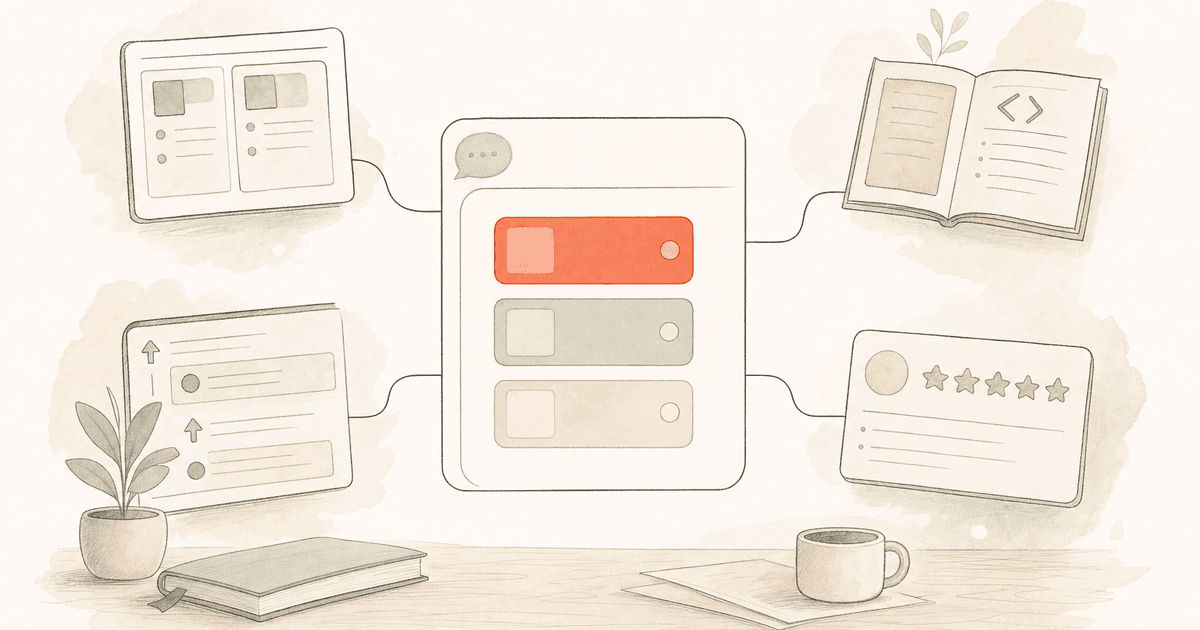
GEO for SaaS starts with one buyer question: "How do SaaS companies get recommended by ChatGPT and Perplexity?" The short answer: they become the clearest answer where those assistants look for software, not just on their own blog.
Those places are comparison pages, Reddit threads, documentation and review sites. Hamming.ai worked on three of them for 12 weeks. Organic traffic went from 200 to 1,900 visitors a day, and 40% of demos now come from Reddit or AI search.
The timing matters. In G2's March 2026 survey of 1,076 B2B software buyers, 51% said they now start research in an AI chatbot more often than in Google, up from 29% in G2's 2025 report. And 69% said they chose a different vendor than planned because a chatbot recommended it.
This guide covers what Hamming.ai did, the four levers AI assistants read for software, and how to tell whether a demo came from AI. Disclosure: Cintra is an AI search agency, ran the Hamming.ai engagement and wrote this article.
Table of contents
- What Is GEO for SaaS, and Why Does It Decide Demos Now?
- What Did Hamming.ai Do to Get 40% of Demos From Reddit and AI Search?
- Why Do Comparison Pages Get SaaS Products Recommended?
- How Does Reddit Get a SaaS Product Into ChatGPT and Perplexity Answers?
- Why Do Docs and Review Sites Matter for AI Citations?
- The GEO for SaaS Playbook: What to Do in the First 12 Weeks
- Frequently Asked Questions About GEO for SaaS
- Where Should a SaaS Team Start?
What Is GEO for SaaS, and Why Does It Decide Demos Now?
GEO for SaaS means making a software product the answer ChatGPT, Perplexity and Google's AI give when buyers ask for tools, comparisons or alternatives in its category.
Generative engine optimization (GEO) is the work of earning mentions and citations inside AI-generated answers, rather than blue-link rankings alone. For software, those answers now sit at the start of the buying process.
G2 has surveyed about 1,000 B2B software buyers several times since 2025, and the trend points one way. In its March 2026 research, 71% of buyers rely on AI chatbots at some point in their research, and AI chatbots are now the top source shaping shortlists. They rank ahead of review sites, analyst firms and vendor websites. An earlier G2 survey found ChatGPT was the favourite assistant, named by 47% of buyers.
Why SaaS Is Different From Ecommerce
A shopper asks AI which sunscreen to buy. A software buyer asks which three tools to shortlist, what the alternatives to the market leader are, and whether a product integrates with their stack. They check docs and peer opinions before they ever book a call. By the time a demo request arrives, the shortlist is already set.
Buyers also ask in full sentences. Cintra's own Search Console shows prompt-style queries such as "how can a b2b saas company get cited by ai assistants when buyers research software solutions?" These are questions, not keywords, and the answer comes from whichever sources explain the topic best. The AI search for B2B playbook covers how those buying groups use AI across platforms.
So what does it look like when a SaaS company actually gets into those answers?
What Did Hamming.ai Do to Get 40% of Demos From Reddit and AI Search?
See where you rank in generative engine results.
Enter your domain and we'll scan your generative engine citation rate across your highest-value queries.
Prefer to talk? Book a free 30-min call
Hamming.ai published technical content at volume, joined ML and AI subreddits, and fixed its docs and structured data. Within 12 weeks, 40% of demos came from Reddit or AI search.
Hamming.ai is a YC-backed (S24) startup that builds automated testing for AI voice agents. Its buyers are engineers, ML teams and QA leaders. Before the work started, the site saw about 200 organic visitors a day. When buyers asked ChatGPT and Perplexity for AI testing tools, Hamming.ai wasn't named, and its blog posts lacked the technical depth engineers look for. The full Hamming.ai case study has the detail.
What Cintra Did in the 12 Weeks
Cintra ran the engagement across three areas:
- Content. Output went from 2 posts a month to 30+ technical articles a month, each answering a real buyer question. That included comparison articles and category guides for voice agent testing, a category with no established "best of" content at the time.
- Reddit. 100+ engagements a month in machine learning and AI subreddits, giving real answers to engineering questions rather than promotion.
- Authority. API documentation was reworked, structured data was added (SoftwareApplication, FAQ, HowTo and article markup), and backlinks came from technical domains.
The Results
| Metric | Before | After 12 weeks |
|---|---|---|
| Organic visitors per day | 200 | 1,900 (8.5x) |
| Share of demos from Reddit or AI search | No baseline published | 40% |
| Articles published per month | 2 | 30+ |
The first signs of AI visibility showed up within the first four weeks. Sumanyu Sharma, Hamming.ai's CEO, put the outcome simply: "We went from 200 visitors/day to 1,900 visitors/day and 40% of the demos we get are from Reddit or AI search."
None of this was a trick specific to voice AI. Each result came from a place AI assistants read, and each of those places works for any SaaS company.
Why Do Comparison Pages Get SaaS Products Recommended?
Buyers ask AI to compare tools and name alternatives. Pages that compare products plainly, with features, use cases and limits in text, give the assistant something to quote.
The prompts that decide shortlists are comparative: "best X for Y", "X vs Y", "alternatives to X". An assistant can only recommend from sources that answer that shape of question. A product page that says "the all-in-one platform for modern teams" answers none of them.
What a Comparison Page Needs
A comparison page that gets cited tends to have:
- A one-line verdict per tool, stated near the top.
- A comparison table in HTML text, not a screenshot, so a crawler can read it.
- Who each tool fits, and who it doesn't.
- The pricing model, if it is public.
- An honest line on where the other product is stronger.
That last point does more work than it seems. A page that admits a rival is better for, say, large enterprise teams reads as a source, not an ad, and sources are what assistants cite.
Category Guides in a New Category
In a young category, there may be no "best of" content at all. The first clear guide becomes the reference point that AI models lean on. That is what Hamming.ai's voice agent testing guides did: they defined the category, and the product sat inside the definition.
Vendors write comparison pages, though. AI assistants also want to know what users say, and that is where Reddit comes in.
How Does Reddit Get a SaaS Product Into ChatGPT and Perplexity Answers?
AI assistants cite Reddit threads as peer evidence. When engineers discuss a tool credibly in the right subreddits, those threads become sources for software recommendations.
The pattern shows up in plain sight. In a live US Google check on 24 November 2026, a Reddit r/SaaS thread ranked #2 for "geo for saas" and was one of the sources in Google's AI Overview. Across 19 buyer searches Cintra checked on 18 November 2026, Reddit was an AI Overview source in 11.
Hamming.ai's version of this was steady and technical: 100+ engagements a month in ML and AI communities, answering the engineering problems people were already posting about. Over time, the product came up in the threads that assistants read.
Rules That Keep It From Being Spam
- Answer only where the product genuinely solves the question.
- Disclose affiliation where the community or platform requires it.
- Lead with the answer, and mention the product only when it is relevant.
- Keep it going weekly instead of posting in a burst and disappearing.
Cintra's Reddit strategy for AI visibility goes deeper on picking subreddits and writing replies that hold up.
Peer threads build trust. Documentation and review sites give the facts the assistant repeats.
Why Do Docs and Review Sites Matter for AI Citations?
Docs give AI assistants exact, quotable facts about what a product does. Review sites give third-party proof, and G2 found review-site citations are buyers' top trust signal in AI answers.
Citable Docs
Technical buyers read docs before a demo, and so do assistants. Docs get quoted when they are:
- Crawlable HTML, not only PDFs or pages behind a login.
- One task or concept per page, with a plain definition in the first sentence.
- Concrete, with code examples and structured data.
Hamming.ai's API documentation was reworked as part of its engagement for exactly this reason.
Crawler Access
None of this matters if the assistants can't read the site. OpenAI says its OAI-SearchBot crawler "is used to surface websites in search results in ChatGPT's search features," and sites that block it won't be shown in ChatGPT search answers, per its crawler documentation.
Perplexity says PerplexityBot is "designed to surface and link websites in search results on Perplexity" and recommends allowing it in robots.txt, per its bot guide. Cintra's guide on how to get cited by Perplexity covers the rest of that platform.
Review Sites
G2's research reports that citations from a review site are the top signal that raises a buyer's confidence in an AI answer. It also found review sites are the only source besides AI chatbots that grows in influence deeper into the funnel. G2 runs a review site, so it has an interest in that finding, but the direction matches what buyers do: they check whether other people vouch for a tool.
Keep product facts identical everywhere: the category name, the pricing model, the integrations. When the site, the docs and the review profiles disagree, assistants mix the versions.
Four levers, one team. What does the order of work look like?
The GEO for SaaS Playbook: What to Do in the First 12 Weeks
Map the prompts buyers ask, fix crawl access and docs, publish comparison and category pages, join the right subreddits, build review profiles, and track demos by source every week.
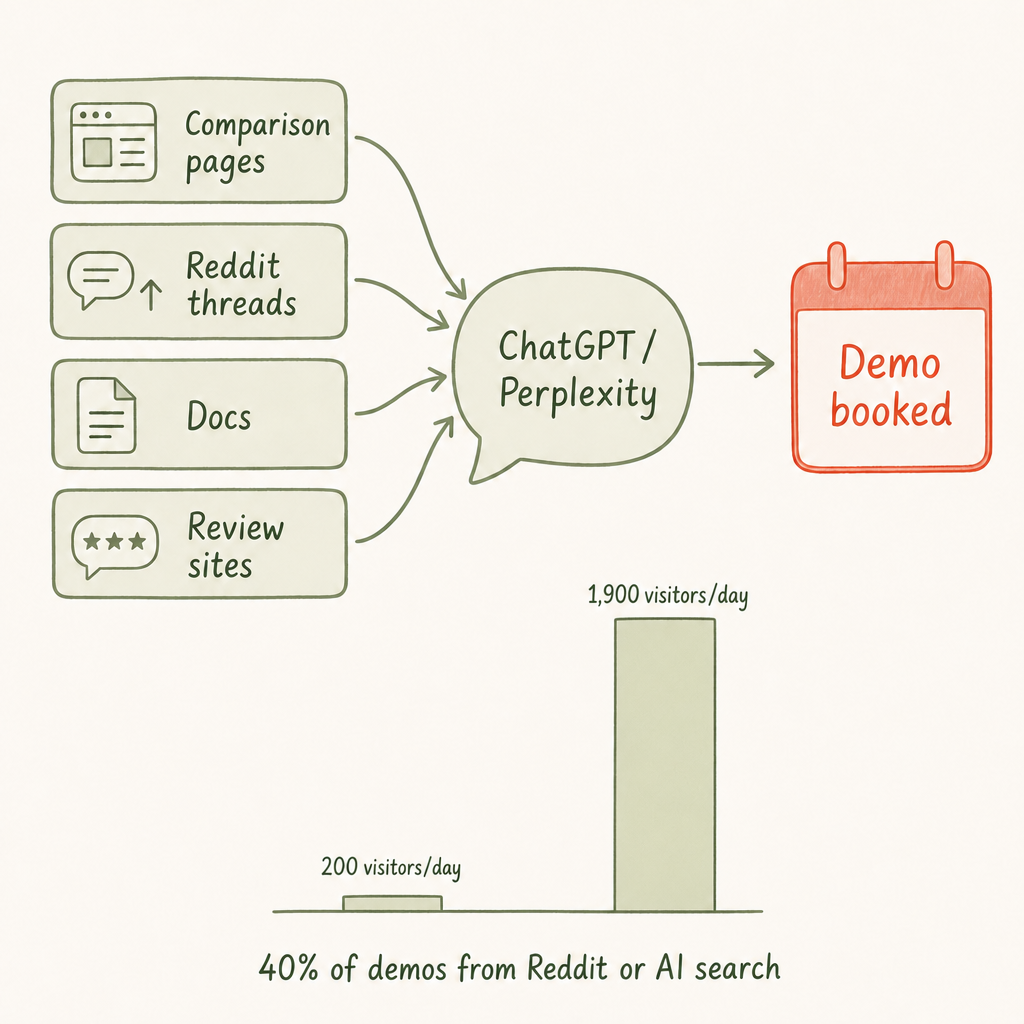
| Lever | What ChatGPT and Perplexity take from it | What to publish | Hamming.ai |
|---|---|---|---|
| Comparison and category pages | Answers to "best", "vs" and "alternatives" prompts | Honest comparisons and category guides in HTML text | Yes: comparison articles and category guides |
| Reddit threads | Peer evidence of what users actually think | Useful, disclosed answers in relevant subreddits, weekly | Yes: 100+ engagements a month |
| Citable docs | Exact facts about what the product does | Crawlable docs, one concept per page, structured data | Yes: API docs and structured data |
| Review sites | Third-party proof buyers trust | Complete profiles and a steady flow of reviews | Not part of the case |
The Order of Work
- Weeks 1-2: map the prompts. List the 20 to 30 questions buyers ask AI in the category: best, vs, alternatives, how-to. Run them in ChatGPT and Perplexity and note who is named and which pages are cited.
- Weeks 1-4: fix access and docs. Check robots.txt, make docs crawlable, add structured data and line up product facts everywhere.
- Weeks 2-12: publish at volume. Comparison pages and category guides first, then technical how-tos. Hamming.ai went from 2 to 30+ pieces a month.
- Weeks 2-12: show up on Reddit and review sites, steadily and with disclosure.
- Every week: measure demos by source. Hamming.ai's case used GA4 for organic traffic, UTM tracking, a "how did you hear about us?" field on the demo form with ChatGPT, Perplexity and Reddit as options, and daily prompt monitoring across ChatGPT, Perplexity and Google AI Overviews. Cintra's guide to measuring AI visibility ROI shows how to set that up.
Cintra does this work done-for-you and tracks citations from day one. Most clients see measurable AI citation increases within 6 to 8 weeks. For the longer framework, with entity work and FAQ pages, see the AI visibility for SaaS playbook.
Frequently Asked Questions About GEO for SaaS
How long does GEO for SaaS take to work?
Hamming.ai saw first signs of AI visibility within about four weeks and 8.5x organic traffic by week 12. Most Cintra clients see measurable citation gains within 6 to 8 weeks.
Is GEO different from SEO for a SaaS company?
It overlaps, but GEO targets the sources AI assistants cite, such as comparison pages, Reddit, docs and review sites, and measures mentions and demos, not only rankings.
Does Reddit work for B2B and developer tools?
Yes, when the answers are genuinely useful. Hamming.ai's 100+ monthly engagements in ML and AI subreddits were part of the work behind 40% of demos from Reddit or AI search.
How do you know a demo came from ChatGPT or Perplexity?
Ask. Add AI assistants and Reddit to the demo form's "how did you hear about us?" field, and combine the answers with UTM and referral data.
Without that field, most AI-referred buyers show up as direct or branded traffic, and the channel doing the work gets no credit.
Should a SaaS company optimise for ChatGPT or Perplexity first?
ChatGPT is the buyers' favourite: 47% of G2's respondents named it. The same levers work on both, and Perplexity shows its sources, which makes gaps easy to spot.
Can a small SaaS startup compete with established vendors in AI answers?
Yes, especially in a young category. Hamming.ai, a YC startup, became a reference point by publishing the first clear category guides for voice agent testing.
Where Should a SaaS Team Start?
A SaaS team should start by asking AI the questions its buyers ask, then fixing the sources behind the answers: comparison pages, Reddit, docs and review sites.
The main points:
- AI chatbots now shape SaaS shortlists, before a buyer ever books a demo.
- ChatGPT and Perplexity recommend from four places: comparison pages, Reddit threads, docs and review sites. A vendor blog on its own is not enough.
- Volume and consistency compound. Hamming.ai's results came from 12 weeks of steady output, not one launch.
- Measure demos by source, not just traffic.
Here is one thing to do in the next 10 minutes: ask ChatGPT and Perplexity the three questions a buyer in your category would ask. Note who gets named and which pages get cited. That list is your map.
See where your brand appears in AI search
Free tool. Scan ChatGPT, Perplexity, and Google AI across buyer-intent queries, instantly, no sign-up.
Find out if AI is sending buyers to your competitors
We audit your AI visibility across ChatGPT, Perplexity, and Google AI, and show you exactly where you rank and what to fix.
Get my free AI audit“We went from 200 visitors/day to 1,900 visitors/day and 40% of demos are from AI search.”
Sumanyu SharmaCEO, Hamming.ai
Related articles

GEO12 min read
Product Feed Optimization AI Shopping Engines Actually Read (10-Point Audit)
Product feed optimization AI shopping engines need to recommend your products. Platform-by-platform feed requi…
GEO12 min read
Google AI Mode Optimization: How to Get Cited (2026 Guide)
Google AI Mode optimization needs a different approach than AI Overviews. Only 13.7% of sources overlap. Learn…
GEO11 min read
How to Get Cited by Grok: The xAI Platform Optimization Guide
Learn how to get cited by Grok with a 6-step framework covering the X co-citation mechanic, robots.txt setup,…