Sales Calls to Content: How AI Turns 22-Minute Calls into Marketing That Converts
Your best content happens at minute 23 of a sales call. Here's how to capture it.
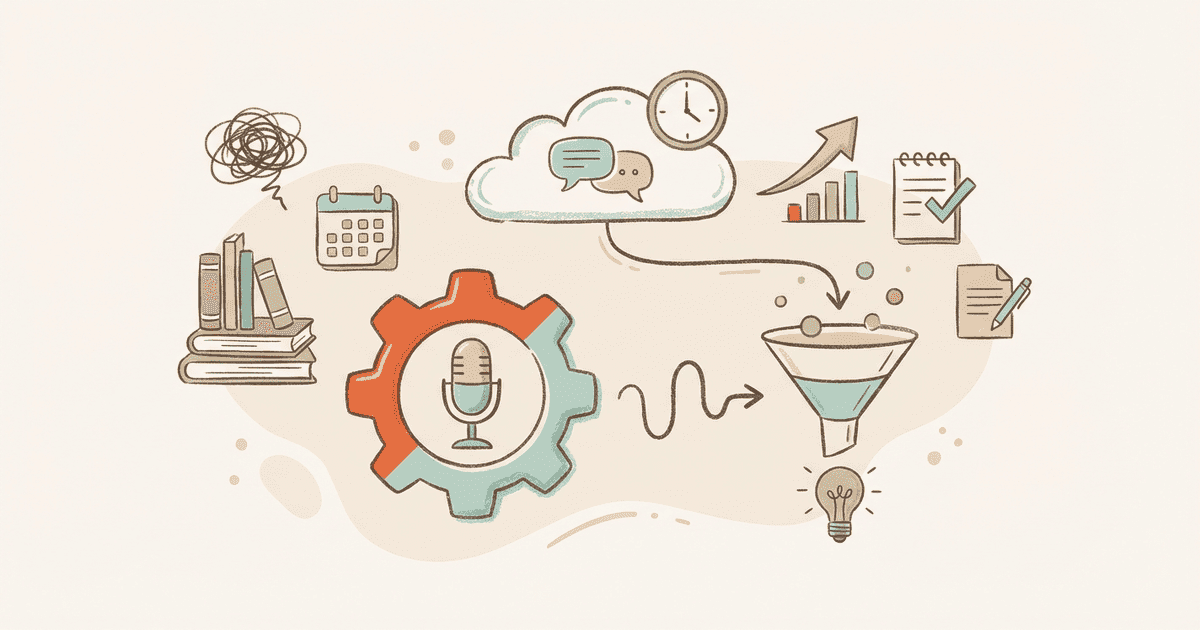
Your best content happens at minute 23 of a sales call. Here's how to capture it.
The fastest way to convert sales calls to content is to stop trying to write from memory and start letting AI extract what already happened. You spoke those words live, a real buyer heard them, understood them, and moved forward. That moment is your content. The only question is whether you capture it before it disappears.
The framework described in this article cuts that process to 22 minutes, using AI to handle extraction and letting you focus on the 10-minute core writing that only you can do.
Click "Leave Meeting." Calendar tab still open. You're buzzing. You just nailed the explanation. The prospect said "Oh, now I get it" after your pricing analogy. That ten-minute stretch could become ten LinkedIn posts, a blog, two emails, and an FAQ update.
By tomorrow, it's gone. You're onto the next call. Slack's on fire. Those perfect words that moved a real buyer vanish.
TL;DR
- Every sales call contains high-converting content; most founders never extract it
- Generic AI writes from internet averages; real content comes from real buyer moments
- The 4-stage framework helps you turn sales calls into content in 22 minutes vs the standard 5.5-hour process
- Content built from buyer language converts at 4.3% vs 0.3% for generic AI output (Gong.io)
What Is the Hidden Content Crisis That Stops Founders Converting Sales Calls to Content?
Most founders spend 15+ hours weekly in customer conversations, the highest-signal market insights available, yet publish almost nothing from them.
I had 10x the raw material of any content marketer. Produced 90% less content. The culprit isn't laziness. It's math.
One blog post devours 5.5 hours:
- 45 minutes extracting key call moments
- 60 minutes outlining and collecting examples
- 120 minutes drafting
- 45 minutes editing
- 30 minutes creating visuals
- 30 minutes publishing and formatting
- 30 minutes distributing
That's a full afternoon you don't have.
87% of founders identify time as their #1 barrier to content production. (HubSpot State of Marketing Report 2024)
Why Does Generic AI Fail at Turning Calls into Content?
See where you rank across all AI answer engines.
Enter your domain and we'll scan your citation rate across ChatGPT, Perplexity, and Google AI.
Prefer to talk? Book a free 30-min call
The first instinct is to feed a transcript to ChatGPT and ask for a blog post. The result is grammatically correct and emotionally empty.
Generic AI captures words. It misses moments. The objection you overcame at minute 23. The prospect's exact phrasing when confusion cleared. That's your content, and vanilla AI has no way to know it mattered.
Reality check:
- Generic AI content: 0.3% conversion
- Human-written sales insights: 4.3% conversion
(Gong.io sales call intelligence research)
Your content isn't converting because it's anchored to internet averages, not buyer moments.
How Does the AI Synthesis Solution for Sales Calls to Content Work?
AI is the execution layer, not the content brain, you keep thinking, AI handles tedious extraction afterward.
Converting sales calls to content means keeping human intelligence where it belongs, live, on the call, and letting AI handle the tedious extraction work after. The mental model is simple: don't ask AI to invent ideas, ask it to harvest the ones you already generated live with a real buyer.
The framework:
- Record calls
- AI extracts insights
- You write the core piece
- AI generates variants
Don't ask AI to invent. Ask it to harvest.
Real Example: Pricing Pushback
The moment: Prospect says "Your price is too high."
My response: 90-second TCO breakdown. Analogy comparing our tool to replacing a leaky pipe instead of constantly mopping.
Prospect reaction: "Oh, now I get it."
That single moment created:
| Content Type | Channel | Time to Create |
|---|---|---|
| LinkedIn post on TCO vs sticker price | 3 min | |
| 6-slide carousel with the math | 5 min | |
| Email: "When pricing feels high, check your TCO" | 2 min | |
| Blog post with transcript excerpt | Blog | 10 min |
| FAQ update on pricing | Website | 2 min |
| Sales team talk track | Internal | 2 min |
| 30-second video clip | Video | 3 min |
| Customer case study snippet | Sales deck | 3 min |
Nothing generic. Everything from minute 23.
How Do You Implement the Sales Calls to Content Framework in 22 Minutes?
Four stages. Built for founders who ship and need to transform call transcripts into published content without adding hours to their week.
1. Capture (0 minutes extra)
- Record every call. Zoom/Meet transcripts work fine
- Simple naming: YYYY-MM-DD_Company_Topic
- Timestamp key moments during calls: "13:22 pricing analogy"
2. Extract (8 minutes)
Post-call, paste transcript + timestamps into template requesting:
- Job-to-be-done (buyer's exact words)
- The blocking objection
- Your unlock explanation
- The "got it" phrase
- 3-bullet argument outline
3. Transform (10 minutes)
- Write core piece yourself (7-10 minutes)
- Keep buyer quotes verbatim
- Let AI generate variants: carousel, email, FAQ
- Review each in 2 minutes
4. Distribute (4 minutes)
- Schedule LinkedIn
- Update FAQ
- Share with sales team
- Link back to call notes
Total: 22 minutes per piece.
Operational Details That Matter
- Extract ONE insight per call. Not ten.
- Keep buyer's language. Even if messy.
- Log the "Oh, now I get it" quote. It's your headline.
- Accept 80% polish. Velocity beats perfection.
Why Does Content From Sales Calls Convert Better?
Content built from real buyer conversations carries something generic AI never captures: authenticity. When prospects hear their exact objection addressed in their language, trust forms instantly.
They recognize themselves in the problem. More importantly, they see someone else already solved it.
The psychology: Buyers don't trust marketing that sounds like marketing. They trust conversations that sound like their conversations. According to Nielsen research on consumer trust, authentic peer-level language is the highest-trust content format.
Generic AI content: ~0.3% conversion Insight-driven content: ~4.3% conversion (Gong.io research)
The 10x delta isn't about better writing. It's about grounding every word in moments where real money changed minds.
Your buyer's language becomes your marketing language. Their objections become your headlines. Their "aha" moments become your value props.
What Are the Most Common Mistakes When Turning Calls into Content?
Most founders make one of five predictable mistakes, all of which slow down or kill the habit entirely.
Mistake: Letting AI write everything Fix: AI extracts. You write core piece.
Mistake: Extracting too much per call Fix: One objection → unlock → quote per session
Mistake: Overproducing polished assets Fix: Whiteboard screenshot beats polished graphic
Mistake: Waiting for the perfect call Fix: Ship from calls you're already having
Mistake: Skipping distribution Fix: Schedule before you close the tab, Buffer research shows scheduling at creation time doubles follow-through rates
What Changes After You Start Doing This Consistently?
The biggest shift is peace of mind. No more guilt about squandering market intelligence. A prospect's "Now I get it" becomes tomorrow's asset, not a memory.
Over a quarter of doing this consistently:
- FAQ answers real objections
- Sales team has proven talk tracks
- Inbound content sounds like us, not the internet
Still takes work. But it's the right work: refining what you already said well.
The Takeaway
Your best marketing is happening live with real customers. The system to turn sales calls into content is not about writing more, it's about capturing what you already said.
Don't ask AI to be your brain. Ask it to be your exoskeleton.
Record the call. Extract the moment. Transform the insight. Distribute the asset.
Repeat.
Frequently Asked Questions About Sales Calls to Content
Here are answers to the most common questions about this framework.
What tools do you need to convert sales calls to content?
You need three things: a call recorder (Zoom, Google Meet, or Fireflies.ai), a transcript, and an LLM with a structured extraction prompt. No extra software. The system works with tools most founders already have.
How many calls should you process per week?
Start with one. This habit builds slowly, one insight processed well beats ten processed poorly. After two weeks of one-per-week, move to two. The goal is sustainable velocity, not volume.
Does this work for short discovery calls, not just demos?
Yes. Discovery calls often contain better content than demos because they capture the buyer's problem in their own words before you've shaped the narrative. A 15-minute discovery call with three genuine questions from the prospect can produce a week of content.
How do you handle confidential information in transcripts?
Before pasting transcripts into an AI tool, do a quick find-and-replace on company names and personal identifiers. Replace "Acme Corp" with "a Series B SaaS company." The buyer insight remains intact. The specific identity is protected. This takes under 2 minutes per transcript.
What is the best channel to publish sales calls to content?
Start with the channel you already use. If you post on LinkedIn twice a week, route your call insights to LinkedIn first. Don't optimize the distribution channel, optimize the extraction habit. Once the habit is consistent, expand to a second channel.
How does this connect to AI search visibility?
AI models like ChatGPT and Perplexity are increasingly used by B2B buyers to research vendors. Content that uses authentic buyer language, real objections, real phrasing, matches the conversational queries these tools process. This approach is one of the highest-leverage ways to build AI search visibility because the language already matches how buyers ask questions. Learn more about AI visibility strategy.
Sources
- HubSpot 87% time barrier: HubSpot State of Marketing Report 2024
- 0.3% vs 4.3% conversion delta: Gong.io sales call intelligence research
- Consumer trust in authentic language: Nielsen Consumer Trust Study
- Scheduling and follow-through: Buffer Social Media Publishing Research
- Related: AI visibility and content strategy
See where your brand appears in AI search
Scan ChatGPT, Perplexity, and Google AI across buyer-intent queries, instantly, no sign-up.
Find out if AI is sending buyers to your competitors.
We audit your AI visibility across ChatGPT, Perplexity, and Google AI –and show you exactly where you rank and what to fix.
“We went from 200 visitors/day to 1,900 visitors/day and 40% of demos are from AI search.”
Sumanyu Sharma · CEO, Hamming.ai
“Cintra helped me go from 3k to 7.5k daily traffic and doubled weekly orders in 1.5 months.”
Russ Coulon · Owner, UV Blocker
“We saw a lift from 3% to 13% visibility in the first 2 weeks, and organic traffic hit its highest ever.”
Ash Metry · Founder, Keywords.am
Related Articles
Organic Traffic Decline 2026: Why It's Dropping and How to Recover
Organic traffic decline 2026 is real. AI Overviews cut clicks 38% on triggered queries. Here's what's causing…
AI Visibility Reporting: What to Track, Who to Tell, and How to Prove ROI
AI visibility reporting requires different metrics and formats than SEO reports. Learn the five core metrics,…
AI Visibility Competitive Analysis: How to Find and Exploit Gaps in 2026
AI visibility competitive analysis across ChatGPT, Perplexity, and 5 other engines. Framework for tracking com…