Why Content Is Hard (And Why Most Founders Give Up)
Building a content pipeline from scratch revealed why most founders struggle with consistent content creation – and how AI changes the economics. A candid breakdown of the real problems and what actually works.
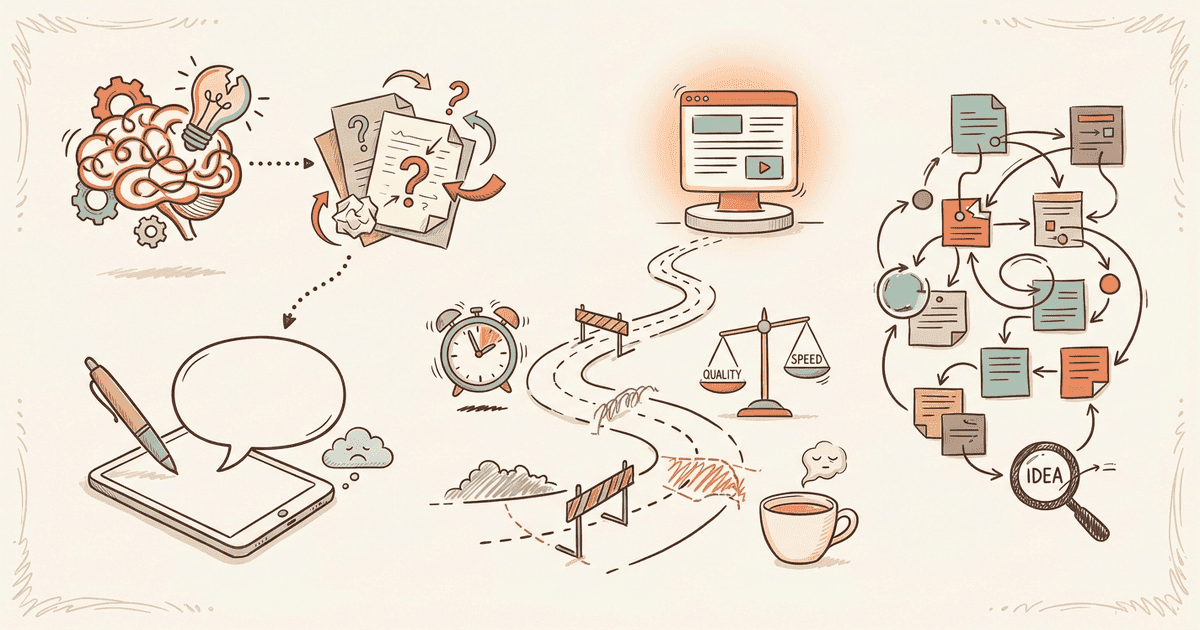
88% of B2B companies use content marketing. Fewer than 30% describe their approach as effective. (Content Marketing Institute, 2025)
The gap isn't strategy. It's operations.
I recently built a content pipeline from scratch, hired contractors, got agency quotes, set up the content calendar, ran the whole system for six months. Understanding why content is hard requires building it yourself. Why only a small fraction of founders ever build active, consistent content pipelines that compound. And why the standard advice ("just publish more") is worse than useless.
Here's the actual problem.
TL;DR
- Context awareness, Getting the CEO's brain and the team's insight into content is the hardest unsolved problem in B2B marketing
- Big turnaround times, The mechanical work eats 80% of the time and most of the budget
- Misalignment, What founders want and what writers deliver are structurally different outputs
Why Content Is Hard: The Context Awareness Problem
The people with the insight rarely own the calendar. The people with the calendar rarely have the insight. This gap governs quality more than skill does, and it is the central reason why content is hard even for founders who care deeply about their brand.
What's in a founder's head does not travel well. It's tacit, layered, pattern-based, built from hundreds of customer calls and hard-won judgments that can't be compressed into a brief. When you know exactly what you do and why you're different, that becomes the sauce. When a writer doesn't have that sauce, they produce content that sounds like every other company in your category.
Why a decision was made is more important than the decision itself. The "why" usually doesn't survive the briefing process. It's not communicated clearly, and even when it is, it gets lost in translation between founder and writer. The result is a piece that's technically accurate and completely hollow.
The brief problem: Most content briefs contain:
- Target keyword
- Word count
- Competitors to mention
- Bullet points of what to cover
What they rarely contain:
- The specific customer objection this post should resolve
- The founder's actual opinion on the topic
- The proprietary data or observations that make the take unique
- The positioning choice behind publishing this now vs. something else
Without that, writers produce generic content. Generic content doesn't rank, doesn't convert, and doesn't build the authority that makes AI search engines recommend you.
80/20: Why Vanilla AI Doesn't Solve This
See where you rank across all AI answer engines.
Enter your domain and we'll scan your citation rate across ChatGPT, Perplexity, and Google AI.
Prefer to talk? Book a free 30-min call
Content production divides into two distinct value streams, and AI only helps with one of them. That distinction is everything.
- Strategic Layer (20%): Point of view development, positioning decisions, messaging hierarchy
- Execution Layer (80%): Research, fact-checking, formatting, approval workflows, distribution
The strategic layer determines quality ceiling. The execution layer amplifies strategic decisions through operational efficiency.
AI systems handle execution-layer tasks with superior speed and consistency: research compilation, structural organization, format standardization, first-draft generation. The strategic layer requires human judgment: insight development, positioning choices, editorial decisions.
Here's what most founders get wrong: They use AI to replace the 20% (the thinking) and keep humans doing the 80% (the formatting, scheduling, distributing). That's backwards. The breakthrough is using AI to eliminate the mechanical work so humans can focus on the creative 20% full throttle.
If you're asking ChatGPT "write me a blog post about AI marketing," you're using a racecar to go to the grocery store. You're not getting the output wrong, you're getting the input wrong.
What Do the Real Economics of Content Actually Look Like?
Here's what the content market actually looks like when you go price it, and why most founders are shocked by the true cost:
Contractors
- Turnaround: 3–4 days minimum per piece
- Cost: $200–$400 per piece
- Quality: High side of average, with significant context loss and revision cycles
- Reality: You spend 30–60 minutes briefing per piece, then another 60–90 minutes revising
Agencies
- Turnaround: 4 days to 2 weeks (bulk delivery model, 5 pieces every 2 weeks)
- Cost: $150–$200 per piece
- Quality: Mediocre, lacking brand context and founder voice
- Reality: Good for volume plays in SEO, terrible for building genuine authority
Full-time hire
- Reality: Nobody hires a writer who's only a writer. They're usually a marketing generalist handling all socials, email, and content. You get maximum 3 articles per week, 2 days is the fastest realistic turnaround. Quality is high. Cost is $80,000–$120,000/year fully loaded.
Writer price tiers:
- $50 writers, execute exactly what you give them, nothing more. If the brief is wrong, the content is wrong.
- $150 writers, can fill in some gaps. They'll research basic facts and make reasonable assumptions. But they can't read between the lines.
- $400 writers, understand the assignment behind the assignment. They take a loose brief and produce something that feels right because they get what you're actually trying to say.
| Content Layer | Who Owns It | Time Required | AI Can Help? |
|---|---|---|---|
| Strategic (POV, positioning) | Founder/Exec | High | Partially |
| Execution (research, formatting) | Writer/AI | Very High | Yes |
| Distribution | Marketing | Medium | Yes |
The math: To publish 5 deep articles per week with $400 writers (the quality level where content actually compounds), you need a team of 3 writers. That's $10,000+ per month just in writing fees, before editing, design, and distribution. HubSpot's marketing benchmarks confirm that content investment at this scale is common for growth-stage B2B companies, but rarely sustainable without operational infrastructure.
Most founders look at that number and stop. The ones who don't usually get 6 months in and realize the content calendar has become a second job.
What Does an Internal Content Machine Actually Look Like?
After testing every model above, the highest-efficiency approach we found was: hire one excellent $400 writer full-time and build an internal content machine around them.
The machine combines multiple LLMs in seven agentic steps, with two approval checkpoints, one editing pass by the writer, and one leadership review.
What this eliminated:
- Time to gain context, The system is as aware as the CEO because the system is trained on the CEO's voice, past content, positioning docs, and customer call transcripts
- Time to research and talk to engineers, Internal truth is baked in as structured knowledge
- Time to read and rewrite, The AI first draft is good enough that human editing sharpens rather than rewrites
The result: Consistent 8/10 articles that edit to 9/10. The writer now produces a full week of content (6 pieces, not 2). Review and final drafts are done by Monday. Each article takes 45–60 minutes of final review and editing, not 5 hours.
This isn't "AI writes content." It's "AI handles the mechanical 80% so the writer can focus the 20% that determines quality."
Why Does This Matter for AI Search Visibility?
Here's the part most people miss: Google and AI search engines are getting better at detecting generic content.
When ChatGPT, Perplexity, or Google's AI Overviews cite a source, they're selecting for specificity, authority, and trustworthiness. Generic "here are 10 tips for content marketing" posts don't get cited. Posts with proprietary data, named case studies, and genuine founder perspective do. Ahrefs research on AI search visibility found that AI-referred visitors convert 23x higher than organic, precisely because those visitors already trust the source AI cited.
The context problem isn't just about human quality anymore, it's an AI visibility problem. If your content sounds like it came from a content factory, AI models won't recommend it. If your content sounds like it came from a founder who actually built something and has a real opinion, it earns citations.
This is why building the internal context into your content system matters more than the word count or keyword density. The brands that will win in AI search are the ones whose content carries a genuine perspective that couldn't have come from anywhere else.
Frequently Asked Questions
Why do most founders fail at content even with a good strategy?
The strategy is rarely the problem. Operations is. Most founders underestimate the context transfer problem, getting their actual thinking into the content, and overestimate what external writers can deliver without deep briefing.
The result is content that's published but doesn't convert, which kills motivation and the whole program eventually collapses.
Is AI content good enough to replace human writers?
For execution-layer tasks (research, structure, drafts, formatting), yes. For the strategic layer (point of view, positioning, which topics to prioritize), no. The best-performing content operations use AI to handle the mechanical work and humans to provide the 20% that determines whether content is credible and distinctive.
How many words should a B2B blog post be?
Quality matters more than length, but length is a proxy Google uses. For AI visibility specifically, articles with 1,500–3,000 words that include specific data, expert quotes, and FAQ sections earn significantly more citations than thin content. The key is that every word earns its place, no padding, no generic filler.
What's the fastest way to start a working content pipeline?
Start with your sales calls. They contain your best content, real customer language, real objections, real "aha" moments. Record calls, have AI extract the highlights, and build your first 5 articles from the insights you've already earned. This is faster than any strategy document and produces more authentic content than any brief.
How does content quality affect AI search citations?
AI models like ChatGPT, Claude, and Perplexity cite sources that are specific, authoritative, and trustworthy. Content that reads like it was written from real experience, with named case studies, specific numbers, and genuine analysis, earns dramatically more citations than generic list posts. For B2B brands trying to show up in AI answers, content quality is the primary lever.
The Bottom Line
Content is hard because the most valuable input, the founder's actual thinking, is the hardest to systematically extract and transfer. Every workaround that skips this step produces content that looks right and fails to compound.
The solution isn't writing more. It's building a system where the thinking gets captured first and the execution becomes cheap.
That's what the internal content machine does. That's why it works when everything else hasn't.
Related: How sales calls become your best content | Why AI search visibility requires genuine authority content
See where your brand appears in AI search
Scan ChatGPT, Perplexity, and Google AI across buyer-intent queries, instantly, no sign-up.
Find out if AI is sending buyers to your competitors.
We audit your AI visibility across ChatGPT, Perplexity, and Google AI –and show you exactly where you rank and what to fix.
“We went from 200 visitors/day to 1,900 visitors/day and 40% of demos are from AI search.”
Sumanyu Sharma · CEO, Hamming.ai
“Cintra helped me go from 3k to 7.5k daily traffic and doubled weekly orders in 1.5 months.”
Russ Coulon · Owner, UV Blocker
“We saw a lift from 3% to 13% visibility in the first 2 weeks, and organic traffic hit its highest ever.”
Ash Metry · Founder, Keywords.am
Related Articles
Organic Traffic Decline 2026: Why It's Dropping and How to Recover
Organic traffic decline 2026 is real. AI Overviews cut clicks 38% on triggered queries. Here's what's causing…
AI Visibility Reporting: What to Track, Who to Tell, and How to Prove ROI
AI visibility reporting requires different metrics and formats than SEO reports. Learn the five core metrics,…
AI Visibility Competitive Analysis: How to Find and Exploit Gaps in 2026
AI visibility competitive analysis across ChatGPT, Perplexity, and 5 other engines. Framework for tracking com…