AI Visibility for Automotive: The Two-Layer Problem Dealerships Don't See
AI visibility for automotive is a two-layer problem. 84% of dealership websites are invisible to AI. Learn the OEM vs. dealer framework that fixes both.
TL;DR
44% of car shoppers use AI during their purchase journey, but 84% of dealership websites are invisible to AI search engines. Automotive AI visibility is uniquely hard because it's a two-layer problem: OEM brand comparison ("best mid-size SUV") and local dealer discovery ("who has it near me") require completely different strategies. This guide maps the dual funnel, the four AI platforms car buyers use, the inventory freshness problem that kills dealer citations, and the strategic split between franchise dealers, independents, and OEMs.
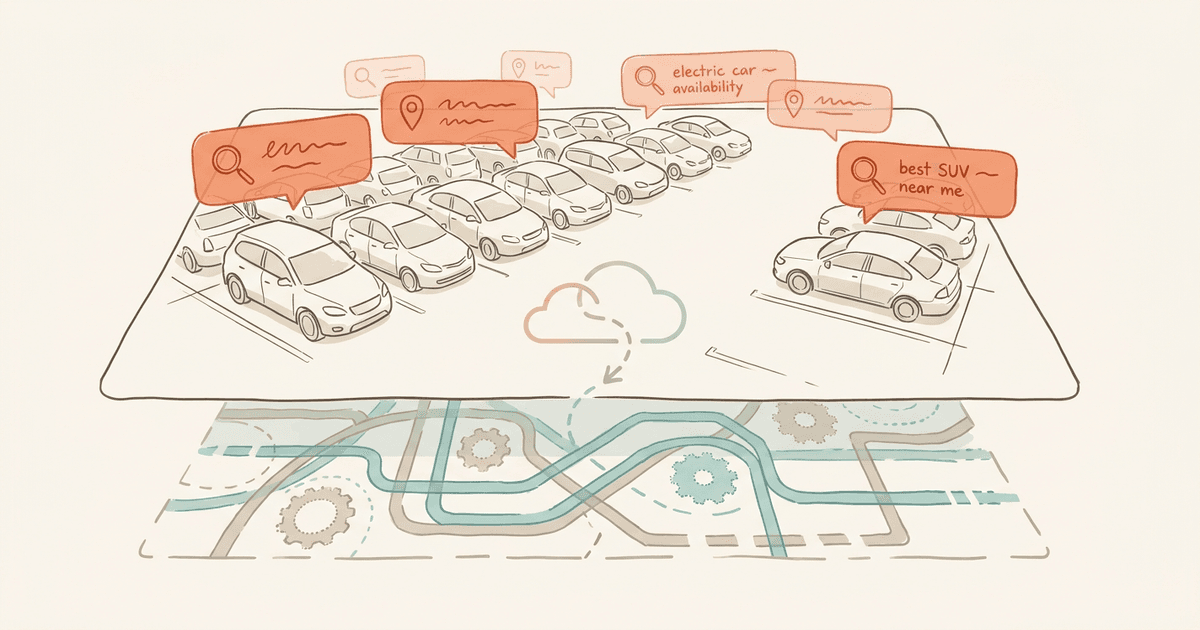
44% of car shoppers have used AI tools during vehicle shopping. AI is used 2.4x more than car marketplaces like Autotrader and Cars.com during the research phase. And AI-referred visitors convert at 23x the rate of organic search, according to Ahrefs' analysis of their own traffic data.
Here's the problem: 84% of dealership websites score below 60 out of 100 on AI visibility.
With an average automotive transaction of $48,644, every missed AI recommendation is a five-figure lost sale. Not a theoretical one. A real buyer who asked ChatGPT "best mid-size SUV" and never heard your name.
No one in the industry has mapped why AI visibility for automotive is structurally different from every other vertical. The answer is simple: AI visibility for automotive is a two-layer problem. And most dealers are solving for neither layer.
What Makes Automotive AI Visibility a Two-Layer Problem?
Automotive AI visibility splits into two layers: OEM brand comparison queries and local dealer discovery queries. Each requires a completely different optimization strategy.
Layer 1: OEM brand comparison. These are the queries that shape what buyers want to buy. "Best mid-size SUV under $40K." "Most reliable pickup truck 2026." "Safest family car for highway driving."
OEMs dominate this layer. Toyota, Ford, and Honda have massive content archives, strong entity authority, Wikipedia pages, decades of structured brand data, and millions of indexed web pages. When ChatGPT answers "best hybrid SUV," it pulls from this ocean of OEM content. This layer works.
Layer 2: Local dealer discovery. These are the queries that determine where buyers actually purchase. "Which dealer near me has a certified pre-owned Accord?" "Best Toyota dealership in Austin." "Who has a 2026 Tacoma in stock?"
Dealerships are structurally invisible here. A local Ford dealer might have 500 indexed pages. Ford.com has millions. That's a 4,000x to 100,000x web presence gap. AI models weight content volume and entity authority heavily when deciding who to cite. Local dealers lose before they start.
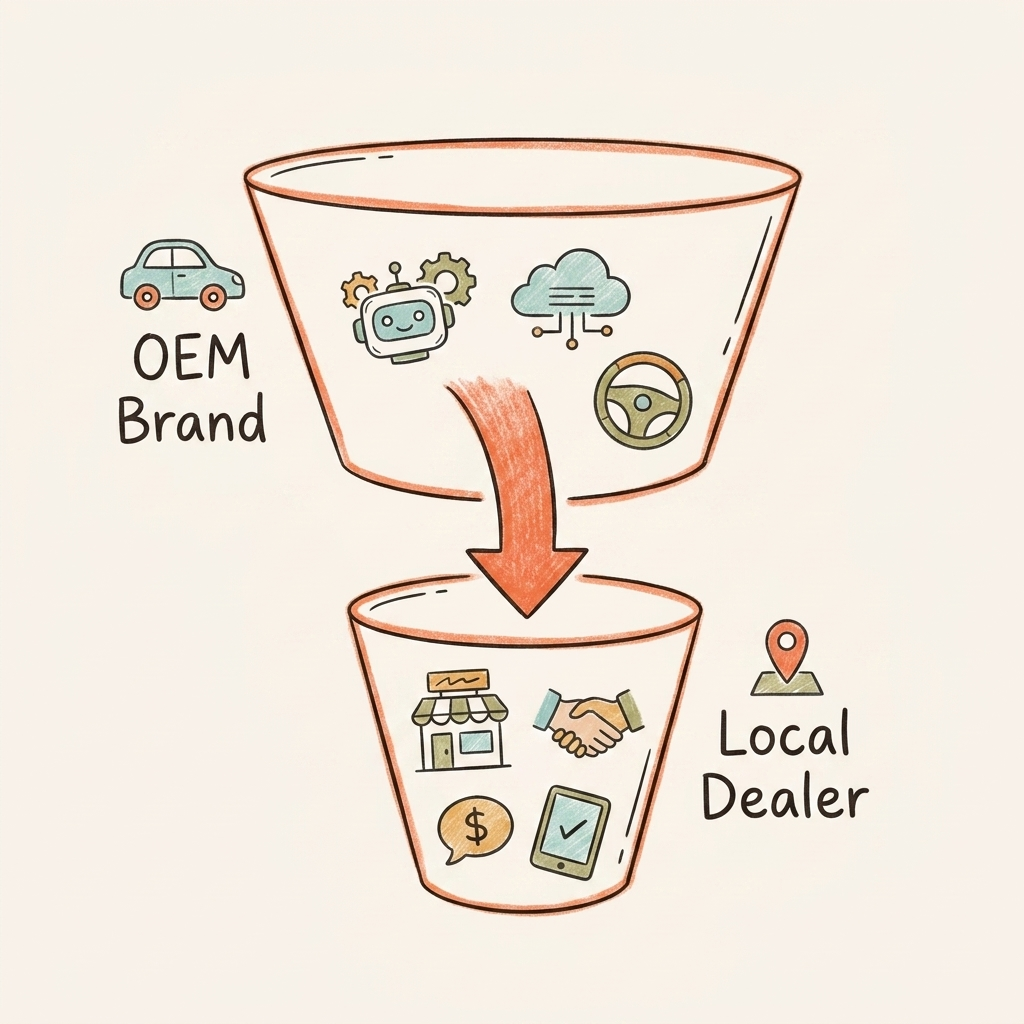
The critical connection: a shopper who asks "best hybrid SUV" and gets "Toyota RAV4 Hybrid" still needs to find a local dealer. If that dealer is invisible to AI, the conversion chain breaks at the last mile. Both layers must work together. Right now, for most dealerships, neither does.
Why Is Automotive the Hardest Industry for Local AI Visibility?
See where you rank across all AI answer engines.
Enter your domain and we'll scan your citation rate across ChatGPT, Perplexity, and Google AI.
Prefer to talk? Book a free 30-min call
Four structural barriers make automotive the hardest local vertical for AI visibility: inventory decay, a massive web presence gap, review fragmentation, and franchise brand constraints.
Inventory decay is the killer. Unlike a law firm whose services page stays accurate for years, or a restaurant whose menu changes seasonally, a dealership's inventory changes daily. A vehicle cited by AI on Monday might be sold by Tuesday afternoon. AI models learn fast which sources give them stale data, and they stop citing those sources.
The web presence gap is enormous. We mentioned the 4,000x to 100,000x content gap between OEMs and local dealers. To put that in perspective: Ford.com has millions of indexed pages covering every model, trim, feature, and comparison angle. Joe's Ford in Tulsa has maybe 500 pages, most of them auto-generated inventory listings. AI models see this disparity and default to the OEM.
Reviews are fragmented across five or more platforms. A restaurant lives or dies on Google reviews. A dealership's reputation is scattered across Google Maps, DealerRater, Cars.com, Edmunds, and Yelp. AI models struggle to aggregate a clear reputation signal when the data is this fragmented. A dealer with 800 total reviews might have 300 on Google, 200 on DealerRater, 150 on Cars.com, 100 on Edmunds, and 50 on Yelp. No single platform tells the full story.
Franchise dealers can't freely create content. OEM brand guidelines restrict messaging, imagery, and claims. Most franchise dealers operate on template websites with limited content customization. This directly limits the content volume and uniqueness that AI models reward.
| Barrier | Automotive | Healthcare | Law | Finance |
|---|---|---|---|---|
| Inventory changes | Daily | Rarely | Never | Quarterly |
| Web presence gap vs. national brands | 4,000-100,000x | 50-500x | 10-100x | 100-1,000x |
| Review platforms | 5+ fragmented | 3-4 | 2-3 | 2-3 |
| Content creation freedom | Restricted (franchise) | Moderate (compliance) | High | Restricted (compliance) |
These barriers stack. Automotive isn't just a little harder than local business AI visibility. It's structurally the most difficult local vertical we've seen across every industry we benchmark.
Where Do Car Buyers Use AI Search, and What Do They Ask?
AI visibility for automotive depends on four platforms: ChatGPT for model selection, Google AI Overviews for local discovery, Perplexity for pricing, and Gemini for mobile dealer search.
ChatGPT dominates model selection. Among car shoppers who use AI, 68.4% use ChatGPT for vehicle research. This is where the brand-level decision happens. Buyers ask "best mid-size SUV under $40K" or "compare RAV4 vs CR-V vs Tucson" and use the answer to narrow their shortlist. If your brand isn't in ChatGPT's recommendations, you don't make the shortlist.
Google AI Overviews own local discovery. Google's Maps integration makes AI Overviews the natural endpoint for "dealer near me" queries. When someone asks "Toyota dealer near me with 2026 RAV4," the AI Overview pulls Maps data, reviews, and local business information together. This is where the buyer decides which specific dealership to visit.
Perplexity is the pricing validation tool. Buyers who've narrowed to two or three models turn to Perplexity for pricing research. "What's a fair price for a 2026 RAV4 XLE?" "Current incentives on Honda CR-V?" These users have high purchase intent. They're validating, not exploring.
Gemini reaches buyers on the go. Android's native Gemini integration and its Maps connectivity mean buyers doing quick mobile research ("nearest Hyundai dealer with Tucson in stock") increasingly get Gemini-powered answers.
The complete buyer journey maps across these platforms in four phases:
- Exploration (ChatGPT): "What type of car fits my needs?"
- Model deep-dives (ChatGPT + Perplexity): "Compare RAV4 vs CR-V vs Tucson"
- Pricing validation (Perplexity): "What's a fair price for a 2026 RAV4 XLE?"
- Local dealer discovery (Google AI Overviews + Gemini): "Best Toyota dealer near me"
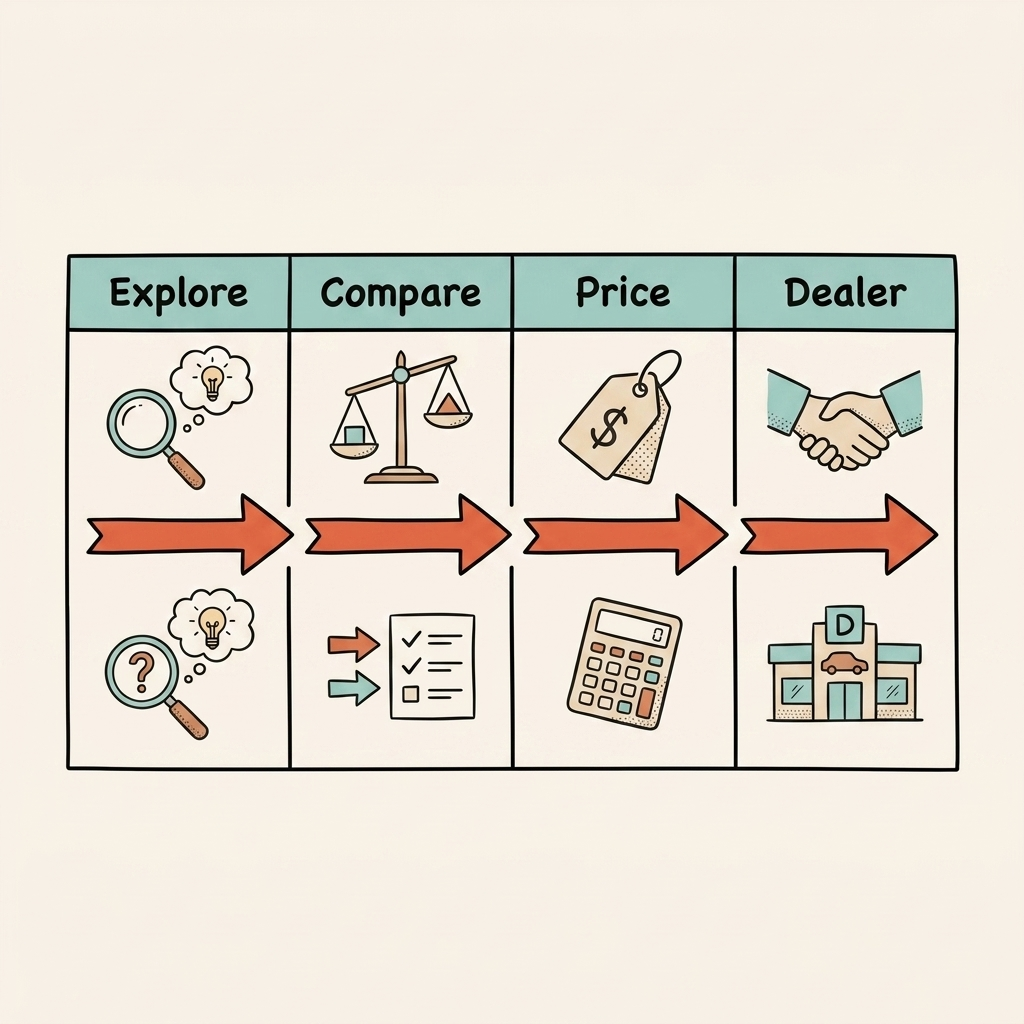
A dealership that only optimizes for phase 4 misses the chance to influence phases 1-3. An OEM that only optimizes for phases 1-2 loses the sale when the buyer can't find a dealer. Both layers matter.
How Does Inventory Freshness Affect AI Visibility for Car Dealers?
AI models deprioritize sources with stale data. And right now, 40-50% of automotive AI responses contain incorrect or outdated information, with pricing errors among the most damaging.
This creates a vicious cycle. A dealer's website shows a 2026 Camry at $29,500. By the time ChatGPT or Perplexity cites that price, the car has sold or the price has changed. The buyer calls the dealership, hears a different number, and loses trust. The AI model logs this mismatch. Over time, it learns to avoid citing that source. The dealer becomes more invisible, not less.
VIN-level schema markup is the technical fix. The schema.org/Vehicle specification allows dealers to publish structured data at the individual vehicle level: make, model, year, VIN, price, availability status, and condition. This gives AI models clean, machine-readable inventory data instead of forcing them to scrape messy listing pages.
Real-time pricing feeds close the freshness gap. Dealers using inventory management systems like vAuto or DealerSocket can pipe data directly into structured feeds. The signal to AI is clear: "This source keeps its data current. Cite it with confidence."
Availability flags prevent ghost citations. "In Stock," "In Transit," and "Sold" status flags at the VIN level stop AI from recommending vehicles that no longer exist on the lot. Without these flags, every sold car becomes a stale citation that erodes AI trust.
The dealers who solve the freshness problem first will have a compounding advantage. AI models that learn to trust their data will cite them more frequently, which drives more traffic, which generates more signals, which reinforces the citation pattern. The window to establish that trust is now.
How Should Franchise Dealers, Independents, and OEMs Approach AI Visibility Differently?
Franchise dealers benefit from OEM co-op marketing but face brand constraints. Independents build authority from scratch with total content freedom. OEMs must push entity authority down to local dealer networks.
Franchise dealers: brand advantage, content handcuffs
Franchise dealers inherit OEM brand recognition and can tap co-op marketing dollars. But they're locked into template websites with restricted messaging. The strategy: maximize what you can control. That means local entity signals (Google reviews, consistent NAP data, community event content), localized service pages that answer buyer questions the OEM site doesn't, and structured data that connects your dealership entity to the OEM brand entity.
Independents: no brand parent, total freedom
There are over 37,000 independent used car dealers in the US. None have inherited brand authority. None have OEM marketing budgets. But none have brand restrictions either. Independents can publish whatever content they want, however they want, as fast as they want. That's the advantage.
The playbook: build local authority through aggressive review generation, hyper-local content (neighborhood guides, community involvement), VIN-level schema on every vehicle, and consistent publication. An independent dealer who moves fast on AI visibility can outpace franchise competitors who are waiting for corporate approval.
OEMs: entity authority transfer
OEMs already win Layer 1 queries ("best mid-size SUV"). The strategic gap is Layer 2. When a buyer follows up with "Toyota dealer near me," the OEM's entity authority needs to flow down to local dealers. This means co-branded content that links brand pages to dealer pages, dealer locator tools with structured data, and local inventory feeds that connect OEM model pages to real-time dealer stock.
The CarMax threat
While dealers and OEMs debate AI strategy, CarMax is already executing. CarMax is actively integrating with ChatGPT, creating a direct path from AI recommendation to purchase that bypasses traditional dealer discovery entirely. A buyer asks ChatGPT "best used SUV under $30K" and gets routed straight to CarMax inventory. No local dealer involved.
For independents, this is the most urgent competitive threat in AI search. The counter-strategy is local trust. CarMax can't replicate your neighborhood reputation, your community ties, or your 15 years of Google reviews from local families. But that advantage only holds if AI models can actually find and cite those signals.
What Does an Automotive AI Visibility Audit Reveal?
Cross-platform scan. We check how your dealership shows up when real buyers ask purchase-intent questions on each AI engine. "Best Ford dealer in Dallas." "Certified pre-owned Accord near me." "Who has the lowest price on a 2026 Tacoma?" For each prompt, we track who gets cited, who gets recommended, and where you're absent.
Competitor gap analysis. The audit identifies which competitors get cited for your target prompts and what gives them the edge. Is it their review volume? Their schema markup? Their content depth? Knowing the specific signals lets you prioritize fixes rather than guessing.
Cross-industry benchmarking. We measure AI visibility across every vertical we work in. That means we can show you how automotive stacks up against healthcare, law, finance, and ecommerce. Most dealer groups are shocked to learn they're behind industries that started optimizing for AI 12-18 months ago.
The audit isn't a sales pitch. It's a diagnostic. You can't fix what you can't see.
We run these audits for automotive brands and dealer groups. Book a free strategy call to see where your dealership stands.
Frequently Asked Questions About AI Visibility for Automotive
These are the questions we hear most from dealership owners and automotive marketing teams exploring AI visibility.
Does my OEM's AI visibility help my dealership?
Partially. OEM brand visibility wins the "best SUV" query, but it doesn't help buyers find your specific dealership for local purchase. OEM entity authority can transfer to dealers through co-branded content and structured entity linking. But without local optimization, the buyer's AI journey ends at the brand level and never reaches your lot.
How important are Google reviews vs. DealerRater for AI?
Google reviews carry the most weight because ChatGPT and Perplexity both reference Google's review data when building recommendations. DealerRater and Cars.com reviews feed more into niche automotive searches and Google's local knowledge graph. Focus on Google reviews first (prioritize volume and recency), then build DealerRater and Cars.com as secondary signals.
Can used car dealers compete with franchise dealers in AI search?
Yes. Independent dealers have total content freedom, which means they can move faster on schema markup, local content, and review optimization than franchise dealers locked into OEM templates. The trade-off is the lack of inherited brand authority. Independents need 3-6 months of consistent content and schema optimization to build comparable entity signals from scratch.
How does CarMax's ChatGPT integration affect independent dealers?
CarMax's integration creates a direct competitor that routes buyers from AI recommendation to CarMax inventory without passing through traditional dealer discovery. The counter-strategy for independents is local entity authority. CarMax can't replicate your community presence, local reviews, and the trust that comes from 15 years in the same neighborhood. Make sure AI models can find and cite those signals.
How often should dealerships update structured data for AI?
Daily or real-time. Inventory-level schema must reflect current pricing and availability to prevent AI models from learning your data is stale. Dealers using inventory management systems like vAuto or DealerSocket can automate this through API feeds that push updates as vehicles are added, sold, or repriced.
Conclusion
AI visibility for automotive splits into two layers: OEM brand comparison and local dealer discovery, each requiring different strategies and technical implementations.
The numbers tell the story: 84% of dealership websites are invisible to AI. The average transaction is $48,644. AI-referred visitors convert at 23x the rate of organic search. And 40-50% of the AI responses that do mention automotive contain incorrect or outdated information. Every one of those stats represents real revenue sitting on the table.
The CarMax-ChatGPT integration shows where this is heading. The brands and dealerships that build AI visibility now will compound that advantage for years. The ones that wait will watch CarMax and early-moving competitors own the prompts that drive their buyers.
Start here: ask ChatGPT and Perplexity the five questions your buyers ask most. See who shows up. That gap is your roadmap.
See where your brand appears in AI search
Scan ChatGPT, Perplexity, and Google AI across buyer-intent queries, instantly, no sign-up.
Find out if AI is sending buyers to your competitors.
We audit your AI visibility across ChatGPT, Perplexity, and Google AI –and show you exactly where you rank and what to fix.
“We went from 200 visitors/day to 1,900 visitors/day and 40% of demos are from AI search.”
Sumanyu Sharma · CEO, Hamming.ai
“Cintra helped me go from 3k to 7.5k daily traffic and doubled weekly orders in 1.5 months.”
Russ Coulon · Owner, UV Blocker
“We saw a lift from 3% to 13% visibility in the first 2 weeks, and organic traffic hit its highest ever.”
Ash Metry · Founder, Keywords.am
Related Articles
Organic Traffic Decline 2026: Why It's Dropping and How to Recover
Organic traffic decline 2026 is real. AI Overviews cut clicks 38% on triggered queries. Here's what's causing…
AI Visibility Reporting: What to Track, Who to Tell, and How to Prove ROI
AI visibility reporting requires different metrics and formats than SEO reports. Learn the five core metrics,…
AI Visibility Competitive Analysis: How to Find and Exploit Gaps in 2026
AI visibility competitive analysis across ChatGPT, Perplexity, and 5 other engines. Framework for tracking com…