Digital PR for AI Visibility: The Practitioner's Playbook
Digital PR for AI visibility drives 82-89% of AI citations. Platform-specific playbooks for ChatGPT, Perplexity, AI Mode, and Claude plus a measurement framework.
TL;DR
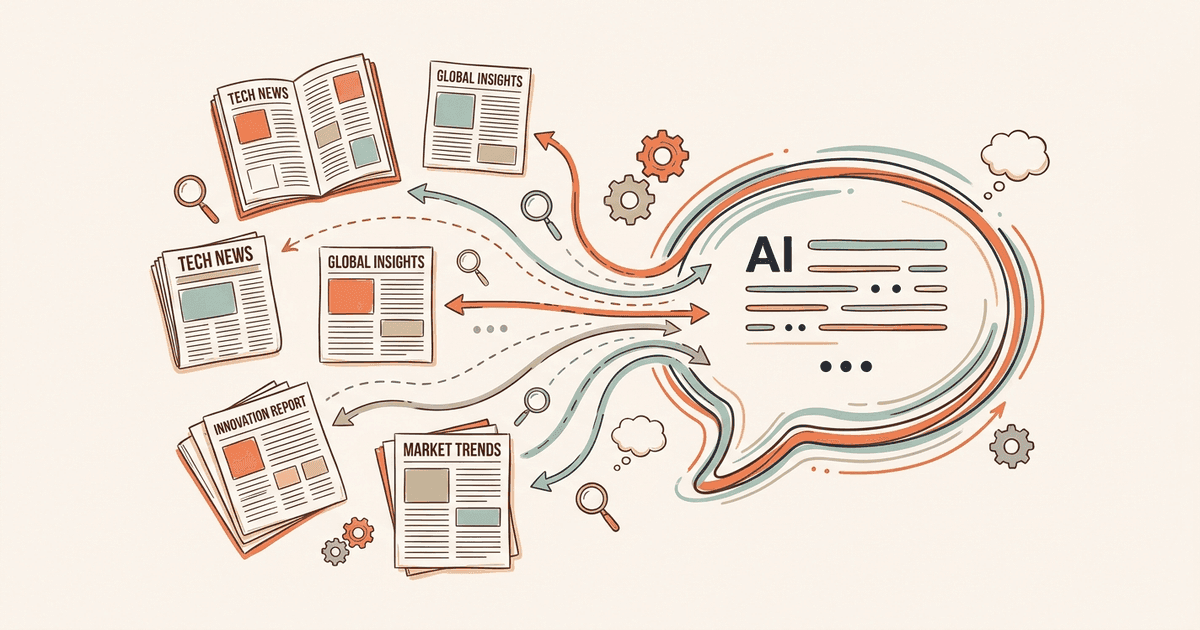
Earned media drives 82-89% of AI citations, yet most brands pour 90% of budgets into owned content. 73% of AI brand presence is ghost citations where your URL appears but your brand isn't named. The fix: platform-specific digital PR for AI visibility, tailored to how ChatGPT, Perplexity, AI Mode, and Claude each source their answers.
Up to 89% of AI citations come from earned media. Yet most brands spend 90% of their content budget on owned channels. The math doesn't add up.
If your AI visibility strategy relies on blog posts and landing pages alone, you're fighting for the remaining 11%. Digital PR for AI visibility is the correction.
We synthesized findings from Muck Rack, Fullintel-UConn, Stacker, and Ahrefs to build this guide. It covers platform-specific PR playbooks for ChatGPT, Perplexity, AI Mode, and Claude. It explains the ghost citation problem (73% of your AI presence is invisible). And it gives you a concrete measurement framework most competitors don't have.
Why Does Earned Media Dominate AI Citations?
AI models use cross-domain corroboration to verify claims, making third-party editorial mentions far more influential than anything published on your own site.
Think about it this way. Your blog says you're the best at X. So does your landing page, your about page, and your case studies. That's one source making the same claim four times. Now imagine TechCrunch, a niche SaaS blog, and a Quora answer all independently say the same thing. That's three separate domains corroborating a fact. The AI trusts the second pattern.
This is the core architecture behind E-E-A-T for AI search. Models synthesize across domains before generating answers. Trust is distributed, not centralized. Brand mentions correlate 0.664 with AI visibility, while backlinks show just 0.218, according to Ahrefs' 75,000-brand study. Brand mentions are three times more predictive than links.
Stacker Research found earned media distribution creates a 239% median lift in AI citation rates, with top performers hitting 325%. Original editorial content drove 81% of citations. Press releases yielded 0.04%. We explore the link-building side in our backlinks for AI visibility guide.
| Study | Sample Size | Key Finding |
|---|---|---|
| Muck Rack (Dec 2025) | 1M+ citations | 82% from earned media |
| Fullintel-UConn (Feb 2026) | Academic study | 89% from earned media |
| Stacker/Scrunch (Mar 2026) | 2,600+ prompts | 239% median citation lift |
| Ahrefs (2025) | 75K brands | Brand mentions 3x stronger than backlinks |
What Are Ghost Citations and How Does PR Fix Them?
See where you rank across all AI answer engines.
Enter your domain and we'll scan your citation rate across ChatGPT, Perplexity, and Google AI.
Prefer to talk? Book a free 30-min call
Ghost citations make up 73% of AI brand presence. The AI cites your URL but never mentions your brand name. Digital PR creates explicit brand-topic associations that convert these invisible citations into branded recommendations.
Picture this: you ask ChatGPT for keyword research tools. It responds with "try this platform" and drops a link to your homepage. Traffic? Sure. But your brand name never appears in the paragraph. The user clicks through, maybe converts, but they'll never tell a friend "ChatGPT recommended [your brand]." You've been ghosted by the algorithm.
Superlines analyzed 34,000+ AI responses and found that 73% of AI presence consists of ghost citations. BrightEdge found ChatGPT mentions brands 3.2x more often than it cites them, averaging 2.4 mentions per prompt versus just 0.74 citations. Only 28% of brands achieve both mentions and citations.
PR breaks this cycle. When five independent publications associate your brand with a specific capability, the model learns to name you. It maps "Brand X" to "keyword research" and starts recommending you in the response body, not just burying your link at the bottom.
Here's the uncomfortable truth without PR: you write a brilliant guide, the AI scrapes it, synthesizes the insights, and presents them as its own. Your URL might appear as source #4 in a footnote. PR flips the script. It forces the model to say your name out loud.
How Should You Tailor PR Strategy to Each AI Platform?
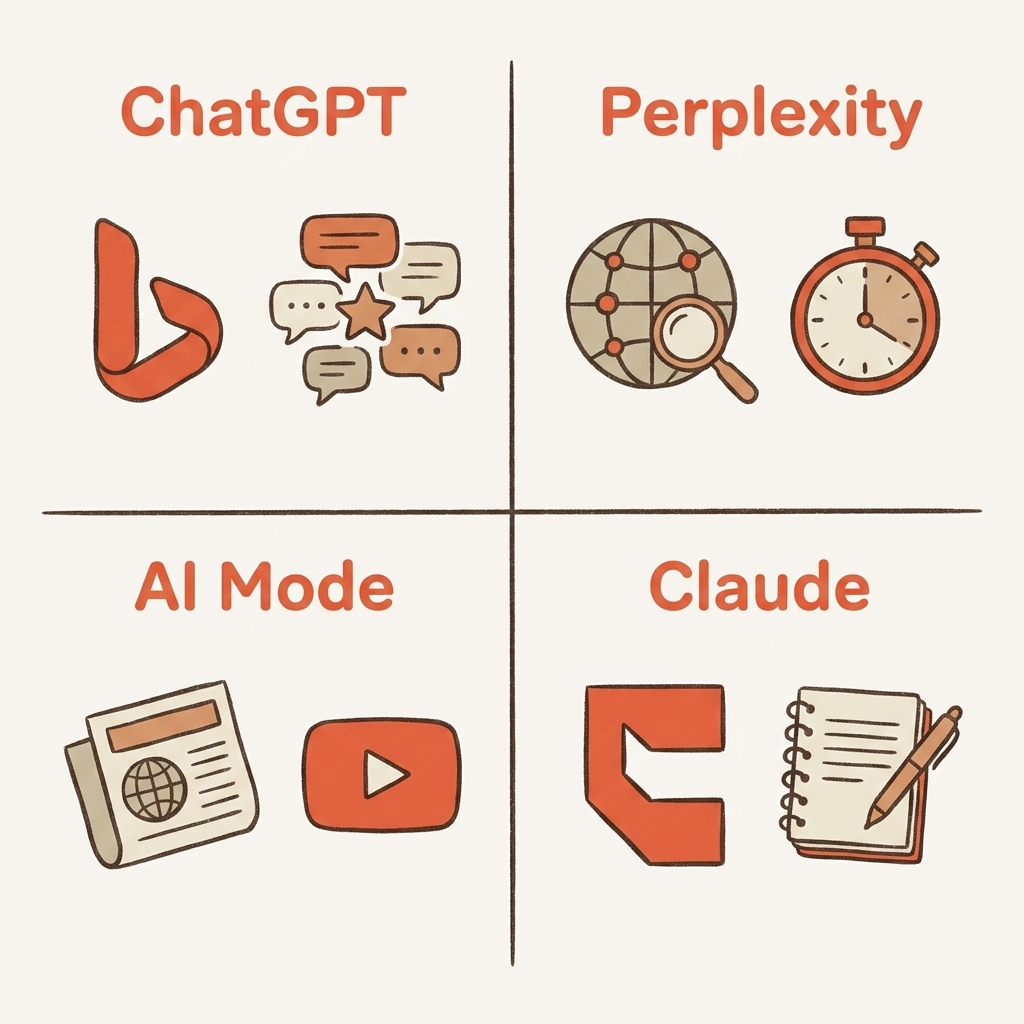
Each AI platform sources from different indexes and weights different signals, so digital PR tactics must be tailored to ChatGPT, Perplexity, AI Mode, and Claude individually.
We learned this the hard way running campaigns across all four platforms. A placement that drove citations in ChatGPT did nothing in Claude. What works for Google's AI Overviews can fall flat in Perplexity. Here's how each platform works under the hood.
| Platform | Primary Index | Top PR Tactic | Key Signal |
|---|---|---|---|
| ChatGPT | Bing | Expert roundups on high-DA sites | Domain authority (~40%) |
| Perplexity | Live web crawl | News wire press releases | Content freshness |
| AI Mode / Gemini | Google News-indexed coverage | Google property presence | |
| Claude | Brave Search | Niche industry publications | Domain expertise depth |
ChatGPT
ChatGPT relies on Bing's index. Domain authority accounts for roughly 40% of the citation signal. Your priority: secure expert roundups and SME quotes on high-DA publications. When an industry publication quotes your executive on a trending topic, ChatGPT registers the entity connection fast.
Reddit is the second lever. Our data shows Reddit content appears in 46.7% of community-driven ChatGPT citations. That's not a rounding error. Build a genuine Reddit strategy for AI visibility through AMAs, thoughtful subreddit participation, and detailed answers that reference your brand's data. The combination of high-DA editorial placements and Reddit validation creates the strongest citation signal for ChatGPT.
Perplexity
Perplexity runs a live web crawl and prioritizes freshness above most other signals. If a topic is trending, Perplexity grabs the most recent authoritative source available. Your best tactic: rapid-response commentary distributed through news wire services within hours of breaking industry news.
Traditional SEO PR often dismisses wire services. For Perplexity, they work. The platform ingests news wires fast and surfaces them in real-time answers. Speed matters more than historical domain authority here. When breaking news hits your industry, being first with expert analysis earns the citation.
Google AI Mode / Gemini
Google's AI Overviews and Gemini favor their own ecosystem. 17.42% of Gemini citations come from Google properties. Google News-indexed publications carry outsized weight, so your earned media placements need to land in outlets that Google News trusts.
YouTube is the multiplier. Video interviews, expert panels, and podcast episodes hosted on YouTube feed directly into Gemini's understanding of brand authority. A podcast appearance transcribed and indexed on YouTube compounds your entity signals across Google's entire property network.
Claude
Claude relies on Brave Search and strongly favors deep domain expertise over broad coverage. Niche industry publications and technical guest posts outperform mainstream media quotes by a wide margin.
For Claude, depth beats reach. A 2,000-word guest post on a specialist SaaS blog with original data will outperform a brief quote in Forbes. Focus on publishing data-backed insights in respected vertical journals and technical communities. Claude analyzes the complexity and specificity of the content, not just the source's general authority.
What Does the Digital PR Toolkit Look Like for AI Citations?
An effective digital PR toolkit for AI citations combines data-driven press releases, expert commentary placements, original research, review platform presence, and community engagement across forums.
The old playbook doesn't cut it. Here are six tactics we use to build entity authority and earn AI citations:
-
Data-driven press releases with schema.org markup. Narrative releases fail (0.04% citation rate). Releases packed with proprietary data succeed. Format stats in tables and lists so models can extract them during retrieval.
-
Expert commentary placements. Pitch your executives to journalists covering industry trends. A direct quote linking to your site creates a contextual entity association the model stores between your brand and that topic.
-
Original research. According to Ahrefs, 80% of AI-cited URLs don't rank in Google's top 100. AI models bypass traditional search rankings to find primary data. Conduct surveys, analyze proprietary data, publish the findings.
-
Review platform presence. AI models scrape G2, Capterra, and Trustpilot when answering "best tool for X" queries. High ratings with detailed reviews provide third-party corroboration models use in their recommendations.
-
Community engagement. Build a Quora strategy for AI visibility alongside your Reddit presence. Answering niche questions on forums feeds directly into LLM training data. Your LinkedIn optimization for AI search compounds this signal for B2B brands.
-
Podcast and video appearances. Transcribed audio and video give models conversational context about your brand. This matches the natural tone models use when generating responses.
How Do You Measure Digital PR's Impact on AI Visibility?
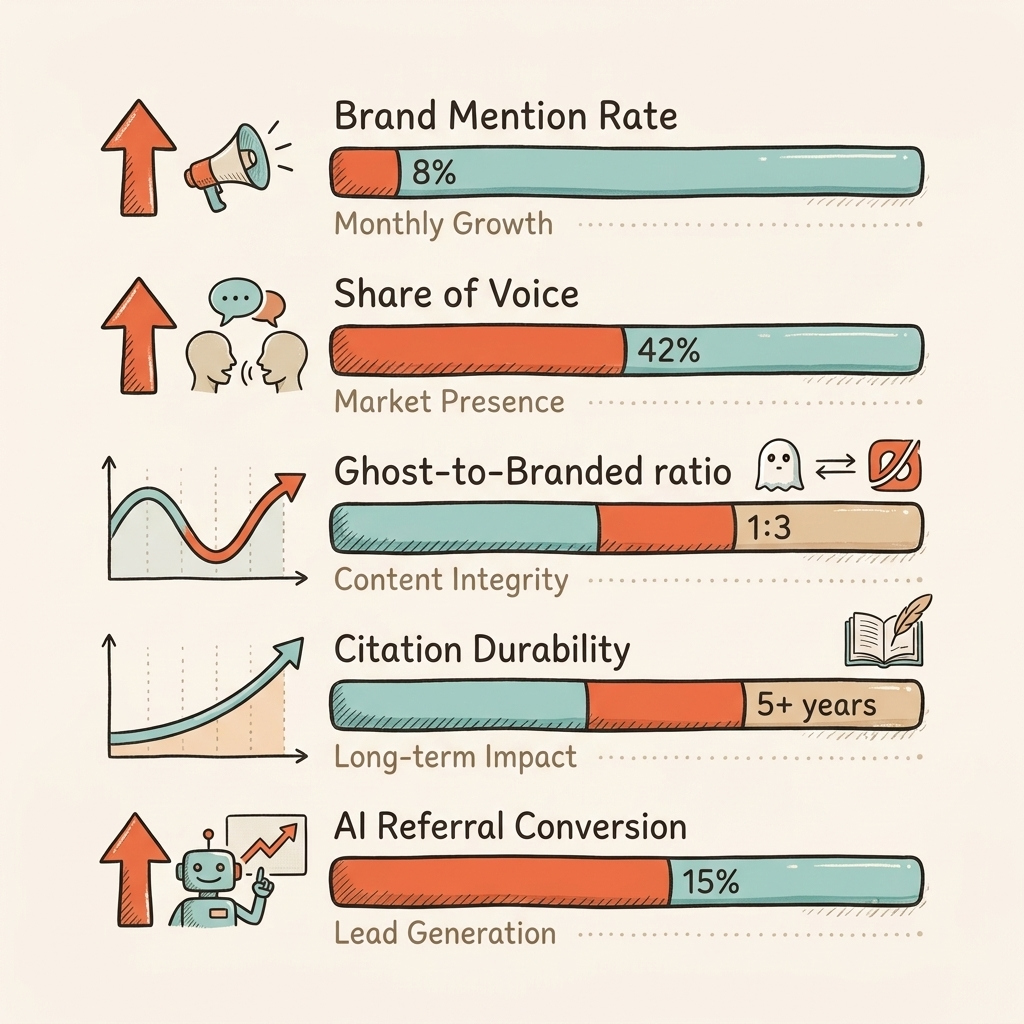
Measure digital PR impact through five metrics: brand mention rate, Share of Voice, ghost-to-branded conversion, citation durability, and AI referral revenue.
Impressions, reach, and ad-value equivalents? Those metrics made sense when PR was about eyeballs. For AI visibility, you're measuring something different: how often and how accurately models recommend your brand by name. Here's what we track:
| Metric | What It Measures | Target Frequency | Tools |
|---|---|---|---|
| Brand mention rate | How often AI names your brand | Weekly | Superlines, Cintra |
| Share of Voice | Your brand vs competitors in AI answers | Bi-weekly | Cintra visibility scanner |
| Ghost-to-branded ratio | % of citations where brand is named | Monthly | Manual prompt testing |
| Citation durability | % citation retention week-over-week | Weekly | Superlines, Otterly |
| AI referral conversion | Revenue from AI-referred traffic | Monthly | GA4 + UTM tracking |
This isn't a set-and-forget channel. Superlines tracked a 34.4% drop in citation rates in just five weeks. Five weeks. That's how fast you can disappear from AI answers if the media stops talking about you. One-off PR campaigns don't work here. You need a steady drumbeat.
But here's why the investment pays off. Semrush data shows AI referral traffic is worth 4.4x more than standard organic. People who click through from a ChatGPT or Perplexity recommendation already trust the suggestion. They're not browsing. They're buying.
Use GA4 with UTM tracking to isolate AI referral traffic. Set up dedicated segments for users arriving from ChatGPT, Perplexity, and other AI sources. Compare their conversion rates against organic and paid channels. Read how to measure AI visibility for the full tracking setup.
Before launching any PR campaigns, run an AI content audit to benchmark your current ghost citation ratio and share of voice across platforms. Without a baseline, you can't prove ROI.
Frequently Asked Questions About Digital PR for AI Visibility
These are the questions marketers ask most when starting a digital PR program for AI visibility.
How long does digital PR take to affect AI citations?
Most brands see initial citation changes within 4-8 weeks of sustained earned media placement, though full impact compounds over 3-6 months.
Models crawl and index on their own schedules. Consistent coverage speeds things up because the model encounters your brand across multiple retrieval sessions, building entity confidence with each exposure.
Does press release syndication help with AI visibility?
Press releases have a 0.04% citation rate. Original editorial content drives 81% of AI citations. Wire distributions help for Perplexity (which favors fresh, news-indexed content) but fail on most other platforms.
Can small brands compete against enterprise PR budgets?
Yes. Niche publications outperform mass media for Claude citations, and original research earns AI citations regardless of brand size. Remember: 80% of AI-cited URLs don't rank in Google's top 100. You don't need SEO dominance to get cited.
What's the minimum budget for digital PR that moves AI visibility?
A focused program targeting 2-3 niche publications per month with original data can generate measurable citation changes for under $3,000/month. The key is consistency, not volume.
Conclusion
Three things to take away from this:
- Owned content gets you 11-18% of AI citations. The other 82-89% comes from earned media. If you're not investing in PR, you're optimizing the wrong channel.
- 73% of your AI presence is invisible. Ghost citations mean your URL appears but your brand doesn't. Digital PR converts those into branded recommendations.
- Each AI platform reads the web differently. Platform-specific digital PR for AI visibility is the competitive advantage most brands haven't discovered yet.
Start by running an AI content audit to baseline your current ghost citation ratio. Then allocate at least 40% of your content budget toward earned media.
We run these exact strategies for clients across SaaS, ecommerce, and B2B. See how our AEO agency builds AI visibility at scale →
See where your brand appears in AI search
Scan ChatGPT, Perplexity, and Google AI across buyer-intent queries, instantly, no sign-up.
Find out if AI is sending buyers to your competitors.
We audit your AI visibility across ChatGPT, Perplexity, and Google AI –and show you exactly where you rank and what to fix.
“We went from 200 visitors/day to 1,900 visitors/day and 40% of demos are from AI search.”
Sumanyu Sharma · CEO, Hamming.ai
“Cintra helped me go from 3k to 7.5k daily traffic and doubled weekly orders in 1.5 months.”
Russ Coulon · Owner, UV Blocker
“We saw a lift from 3% to 13% visibility in the first 2 weeks, and organic traffic hit its highest ever.”
Ash Metry · Founder, Keywords.am
Related Articles
Meta-ExternalAgent Took More Bandwidth Than 5 Crawlers Combined
Meta-ExternalAgent pulled 955 MB from cintra.run in 30 days, more than 5 AI and search crawlers combined. What…
Organic Traffic Decline 2026: Why It's Dropping and How to Recover
Organic traffic decline 2026 is real. AI Overviews cut clicks 38% on triggered queries. Here's what's causing…
AI Visibility Reporting: What to Track, Who to Tell, and How to Prove ROI
AI visibility reporting requires different metrics and formats than SEO reports. Learn the five core metrics,…