ChatGPT Shopping: How Products Get Picked and What to Fix First
ChatGPT shopping picks products from feeds, product pages, reviews and third-party mentions. Here is how each one works and what a DTC brand should fix first.
November 23, 202612 min read
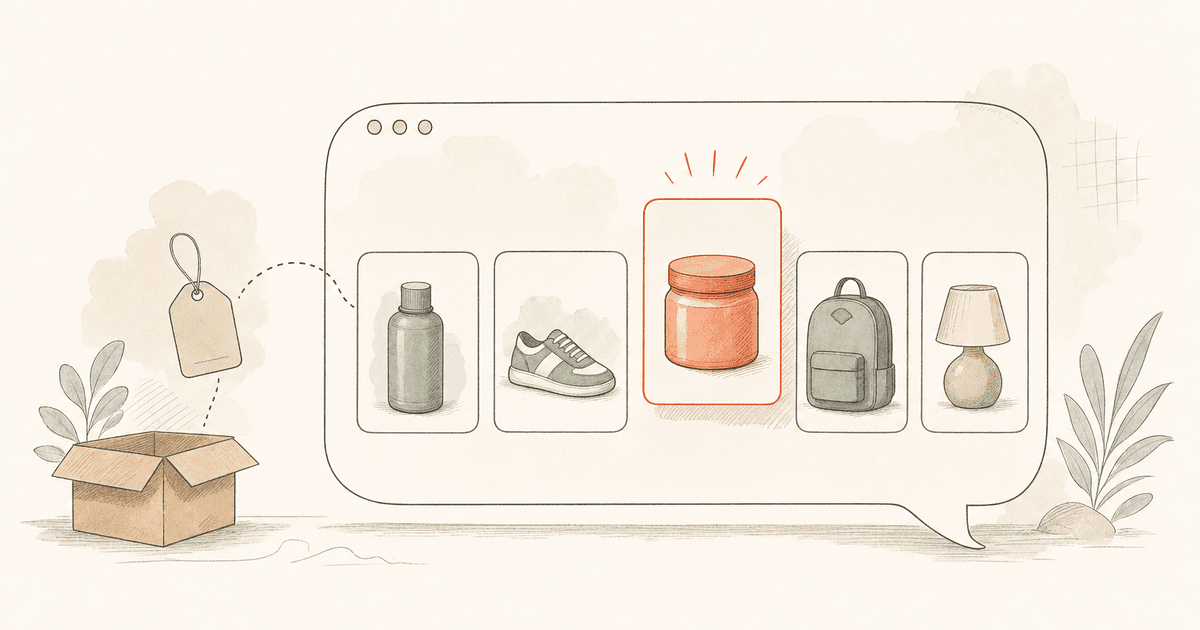
ChatGPT shopping picks products in two stages: first it needs your catalog, then it needs reasons to choose you. Most brands only work on the first stage.
So, how do you get your products to show up in ChatGPT shopping? Get into the catalog first (Shopify and Etsy stores already are; other U.S. merchants apply with a product feed). Then give ChatGPT reasons to pick your products: clear product pages, real reviews and mentions on the sites it trusts.
The stakes are not small. OpenAI says hundreds of millions of people use ChatGPT to find, understand and compare products, according to its shopping research announcement. Being eligible is not the same as being shown, though. OpenAI's own product feed specification puts it plainly: "Eligibility does not guarantee display."
This guide uses what OpenAI documents as of November 2026: the four inputs ChatGPT uses, how products get into the pool, and the order a DTC brand should fix things in. Disclosure: Cintra is an AI search agency and wrote this article.
Table of contents
- How Does ChatGPT Shopping Choose Which Products to Show?
- How Do Products Get Into ChatGPT Shopping in the First Place?
- Why Do Product Pages Decide Whether ChatGPT Picks a Product?
- How Do Reviews and Third-Party Mentions Change What ChatGPT Recommends?
- What Should a DTC Brand Fix First?
- Frequently Asked Questions About ChatGPT Shopping
- What Should You Do This Week?
How Does ChatGPT Shopping Choose Which Products to Show?
ChatGPT shopping matches the shopper's request against structured product data, product pages, public reviews and other third-party content, then weights them by what the shopper says they need.
OpenAI's help page on shopping in ChatGPT search lists the inputs: structured metadata from first-party and third-party providers (price, description and so on), other third-party content, the shopper's own query and context (including Memory and custom instructions), and OpenAI's safety and product policies. It also notes that "not all available products will necessarily be shown."
What the shopper says changes the result
The weighting moves with the question. Give a budget and price matters more. Say "for wide feet" and the product that states that fact clearly is easier to match.
When several merchants sell the same product, OpenAI says the merchant order considers availability, price, quality, and whether the merchant is the maker or primary seller. For a DTC brand, that last point matters. Selling your own product from your own site is a factor OpenAI names.
Paid placement is not how products get picked
OpenAI states that product results are not ads. Its feed specification does include an is_ads_eligible field, so advertising exists as a separate product. The organic picks come from the inputs above.
ChatGPT's shopping research mode, launched on 24 November 2025, reads publicly available retail sites and other trusted sites, avoids "low-quality or spammy sites," and returns what OpenAI calls organic results.
Results rotate rather than rank
There is no fixed position one to chase. In a March 2026 study of 22.5 million buy offers, Profound found that about 95% of product titles appeared in fewer than 30% of runs of the same prompt. The authors note that some of this comes from titles being written differently between runs. Even so, a product is either in the rotation or it isn't. Cintra's earlier piece on what 22.5 million product offers reveal about ChatGPT shopping covers that study in more detail.
For many brands, ChatGPT shopping is the first AI shopping agent they will deal with, which makes it a practical starting point for agentic commerce optimization.
| Input | Where ChatGPT gets it | What a DTC brand controls |
|---|---|---|
| Product feed or catalog | Shopify Catalog, Etsy, or a direct feed through the Agentic Commerce Protocol | Complete, accurate fields: title, description, price, availability, GTIN, images |
| Product page content | The brand's own pages, read by OpenAI's crawler | Plain-language specs, sizes, materials, use cases, FAQs, Product schema |
| Reviews | Reviews on public websites, which OpenAI does not verify | Review volume and recency on-site and on third-party sites; review count and star rating in the feed |
| Third-party mentions | Other third-party content: roundups, "best of" lists, forums, Reddit | Being named in the lists and threads shoppers and ChatGPT read |
If the feed is only one of four inputs, the first question is simpler: are your products in the pool at all?
How Do Products Get Into ChatGPT Shopping in the First Place?
See where you rank in ChatGPT's answers.
Enter your domain and we'll scan your ChatGPT citation rate across your highest-value queries.
Prefer to talk? Book a free 30-min call
Shopify and Etsy catalogs are already integrated. Other U.S. merchants apply on OpenAI's merchant page and share a product feed through the Agentic Commerce Protocol or a supported provider.
According to OpenAI's merchant page, shopping is live for ChatGPT users in the U.S. Shopify and Etsy sellers need no application. Everyone else applies or joins a waitlist, and feeds can arrive by SFTP, by API, or through supported commerce platforms and feed providers. OpenAI says there are no fees on purchases that start in ChatGPT.
What changed in March 2026
On 24 March 2026, OpenAI shifted its focus to product discovery. It said the first version of Instant Checkout "did not offer the level of flexibility" it wanted, and it now lets merchants use their own checkout. In most cases the shopper finishes the purchase on the merchant's site or app.
Through the Agentic Commerce Protocol, merchants share product feeds and promotions so their catalogs are "fully represented" in ChatGPT. OpenAI named Target, Sephora, Nordstrom, Lowe's, Best Buy, The Home Depot and Wayfair as integrated, and said "millions of Shopify merchants are open for business in ChatGPT" through Shopify Catalog. Walmart launched its own app inside ChatGPT the same day, CNBC reported.
What the feed has to contain
OpenAI's feed specification has nine required product fields: item ID, title, description, URL, brand, seller name, image URL, availability and price, plus the target and store country. Optional fields include GTIN, MPN, color, size, material, return policy, review count and star rating. The spec also asks merchants to update price and availability when they change, not on a fixed schedule.
Cintra's product feed optimization guide walks through a 10-point feed audit. Shopify founders can also read how a Shopify store gets recommended by ChatGPT.
Check that OpenAI can read your site
OpenAI's search crawler, OAI-SearchBot, is how sites are surfaced in ChatGPT search. OpenAI's crawler documentation says sites that opt out of it "will not be shown in ChatGPT search answers" and recommends allowing it in robots.txt. Changes there can take about 24 hours to apply.
Once your products are in the pool, the real question starts: what decides which ones get picked for a given request?
Why Do Product Pages Decide Whether ChatGPT Picks a Product?
Shoppers ask ChatGPT with constraints such as budget, size or use case. Pages that state those facts plainly can be matched and quoted; vague brand copy cannot.
OpenAI says ChatGPT may simplify the titles and descriptions it draws from third-party data, and that labels like "Budget-friendly" are written by the model. If your own page doesn't state the facts clearly, ChatGPT will describe your product from someone else's data.
Buyers now ask full questions
Cintra sees this in its own search data. Between 23 August and 21 November 2026, cintra.run's Search Console recorded 102 distinct queries about ChatGPT shopping or getting products into ChatGPT, and 71 of them were 10 words or longer. One read: "can an ecommerce brand influence what appears in chatgpt shopping carousels, and what are the main ways to do it?" A page built for a two-word keyword gives the model little to work with when someone asks a whole question.
What a product page needs
- Specs in text, not only in images: dimensions, weight, ingredients, materials.
- Size and fit, with how it runs compared with standard sizing.
- Who it is for, and who it isn't for.
- A comparison with the obvious alternative a shopper would consider.
- Shipping and returns, stated on the page.
- A short FAQ that uses the questions customers actually ask.
- Product schema that matches the feed: same price, same availability.
A hypothetical example: "This signature serum elevates your routine" gives ChatGPT nothing to match. "A 30 ml vitamin C serum for oily, acne-prone skin, fragrance-free, ships in two days" answers four constraints in one line.
Consistency matters as much as detail. If the feed, the page and the schema disagree on price or stock, the product gets matched on the wrong facts or not at all. And a clear page makes a product matchable; it doesn't yet make ChatGPT trust it over a better-known brand.
How Do Reviews and Third-Party Mentions Change What ChatGPT Recommends?
ChatGPT summarises reviews from public websites and reads third-party content such as roundups and forums, so being reviewed and named elsewhere makes a product easier to pick.
OpenAI's help page says review summaries are "based on reviews from public websites" and are not verified by OpenAI. Reviews on third-party sites add a source that isn't the seller.
Keep review data clean
The feed specification asks that review count and star rating "describe the same review population," so don't blend store-level and product-level reviews in the same fields.
Get named where buyers look
The input most brands skip is being mentioned in content they don't own: "best of" lists, editorial roundups, comparison posts and forum threads. Shopping research reads "trusted sites," in OpenAI's words.
Forums show up often. When Cintra checked Google's AI Overview for "chatgpt shopping" in the U.S. on 23 November 2026, a Reddit thread from r/Entrepreneur sat among the cited sources, next to OpenAI's own pages and a CNBC article.
Community posting only works when it is honest: join a thread only where the product genuinely answers the question, disclose the affiliation, and never spam.
There is room for smaller brands here. In Profound's study, the top 20 merchants accounted for about 40% of offers, which leaves most of the pool to everyone else.
What Should a DTC Brand Fix First?
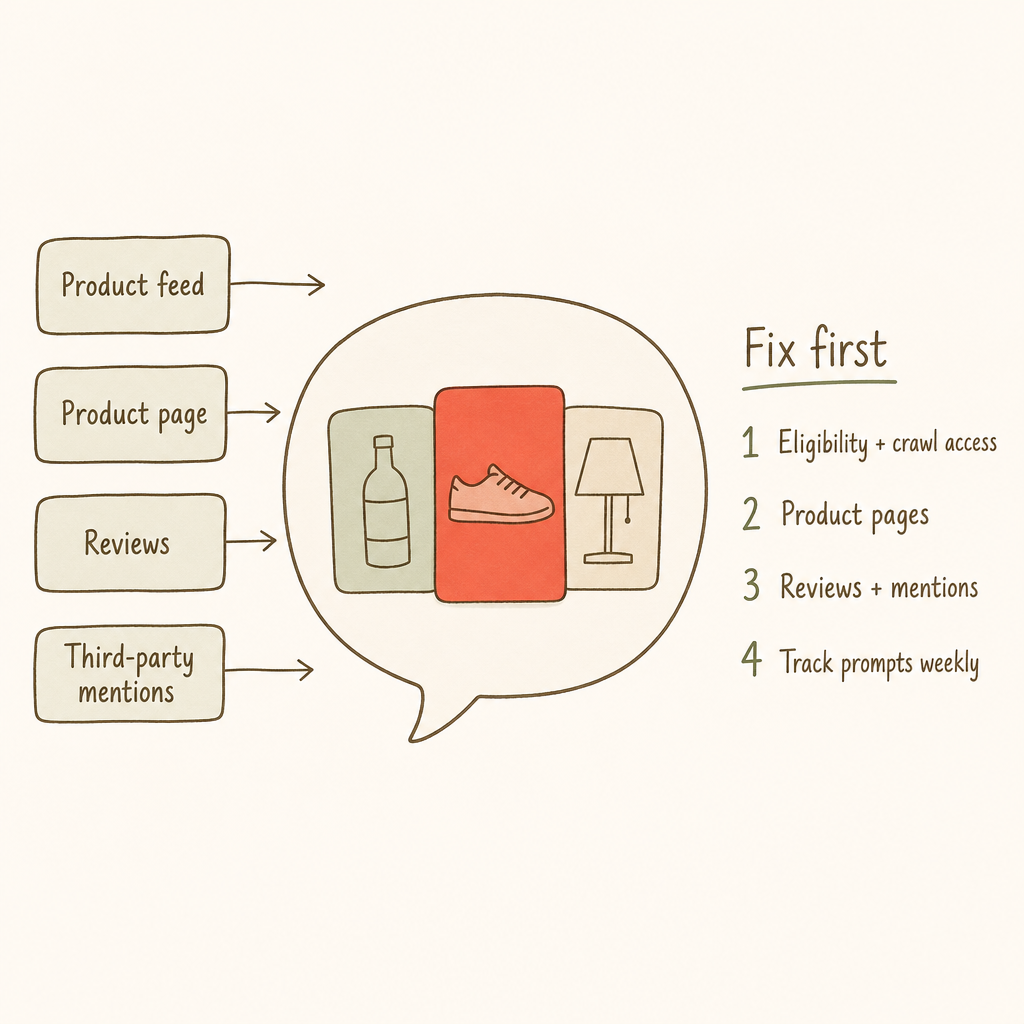
Fix eligibility and crawl access first, then the product pages for your top sellers, then reviews and third-party mentions, and track prompts weekly to see what changes.
- Check that you are in. On Shopify or Etsy, confirm your catalog is shared. Anyone else should apply on OpenAI's merchant page. Check robots.txt for OAI-SearchBot. This takes about ten minutes.
- Fill the missing feed fields. Start with the nine required fields, then add GTIN, material, size, color, returns and review data.
- Rewrite your top 10 product pages around the questions buyers ask, with specs in text and Product schema that matches the feed.
- Get reviewed and named elsewhere. Aim for third-party reviews, category roundups and lists, and relevant Reddit threads where you can genuinely help, with your affiliation disclosed.
- Track the prompts. Ask the 10 to 20 questions your buyers ask, every week, and record whether your products appear and which sites ChatGPT cites. Results rotate, so one check proves nothing.
What this looks like in practice
UV Blocker, a sun protection store and a Cintra client, shows what these inputs can do. Its AI search visibility rose from 9% to 32%. Daily traffic grew from 3k to 7.5k, and weekly orders doubled in 1.5 months, during the off-season. The full story is in the UV-Blocker case study.
Steps 1 and 2 get products into the pool. Steps 3 to 5 are where results build up, and they are what Cintra does for clients, done for them, with citations tracked from day one. Most Cintra clients see measurable increases in AI citations within 6 to 8 weeks.
Frequently Asked Questions About ChatGPT Shopping
Short answers to the questions DTC founders ask about ChatGPT shopping, based on OpenAI's own documentation.
Is ChatGPT shopping free for merchants?
Yes, for now. OpenAI's merchant page says there are no fees on purchases that start in ChatGPT, and Shopify and Etsy catalogs need no application.
Can I pay to rank higher in ChatGPT shopping?
No. OpenAI says product results are not ads. Ads are a separate product, and organic picks come from product data, pages, reviews and third-party content.
Is a Google Merchant Center feed enough for ChatGPT shopping?
Not on its own. ChatGPT takes catalogs from Shopify, Etsy or a direct feed built to OpenAI's own specification, and it also reads product pages, reviews and third-party content.
Does ChatGPT shopping work outside the U.S.?
OpenAI's merchant page says shopping is live for ChatGPT users in the U.S. and that OpenAI plans to expand to more merchants and regions over time.
How long does it take for products to show up in ChatGPT?
Catalog and feed fixes can show up quickly. Earning picks through pages, reviews and mentions takes weeks, and Cintra clients usually see measurable citation gains within 6 to 8 weeks.
Did Instant Checkout end?
OpenAI moved away from standalone Instant Checkout in March 2026. Shoppers now usually finish the purchase on the merchant's own site or app.
What Should You Do This Week?
The feed gets your products into the pool. Product pages, reviews and third-party mentions get them picked.
- The feed is the entry ticket, not the win. Eligibility does not guarantee display.
- Pages decide the match, because shoppers ask with constraints.
- Mentions decide the trust: public reviews and third-party lists are inputs OpenAI names.
- Track a set of prompts, not one screenshot. Results rotate.
One thing to do in the next ten minutes: ask ChatGPT the three questions a buyer in your category would ask. Note whether your products appear and which sites it cites. That list of cited sites is your outreach plan.
See where your brand appears in AI search
Free tool. Scan ChatGPT, Perplexity, and Google AI across buyer-intent queries, instantly, no sign-up.
Find out if AI is sending buyers to your competitors
We audit your AI visibility across ChatGPT, Perplexity, and Google AI, and show you exactly where you rank and what to fix.
Get my free AI audit“We went from 200 visitors/day to 1,900 visitors/day and 40% of demos are from AI search.”
Sumanyu SharmaCEO, Hamming.ai
Related articles

AI Strategy13 min read
How to Get Recommended by ChatGPT as a Shopify Store (9% to 32%)
How to get recommended by ChatGPT as a Shopify store: product pages, Shopify Catalog, third-party lists, Reddi…

AI Strategy11 min read
Is a GEO Agency Worth It? Cost, Timeline, Month 1 vs Month 6
Is a GEO agency worth it for an ecommerce brand? An honest look at the cost vs 2-3 in-house hires, what weeks…

AI Strategy14 min read
How to Pick an AI SEO Agency: 10 US Options (2026)
Choosing an AI SEO agency? 10 US agencies compared on focus, fit and published pricing, plus a 7-question chec…