AI Visibility for Travel: How Hotels and Travel Brands Get Recommended by AI
AI visibility for travel is the gap between OTA dominance and direct bookings. Learn the 90-day framework to get hotels and travel brands cited by ChatGPT, Perplexity, and AI Overviews.
TL;DR
56% of US travelers now use AI to plan trips, but 94.3% of hotel websites are invisible to those AI tools. Booking.com appears in 95.3% of AI travel queries while independent hotels show up in under 2%. This guide applies the same AI visibility framework that drove 8.5x traffic in SaaS and doubled ecommerce orders to travel's unique challenges: OTA dominance, a 50%+ hallucination rate for boutique properties, and platform-specific booking integrations. The 90-day roadmap covers entity foundation, content architecture, and community signals across ChatGPT, Google AI Mode, Perplexity, and Gemini.
56% of US travelers now use AI to plan trips. 94.3% of hotel websites are invisible to those AI tools. Booking.com captures the rest.
The OTA dependency trap deepens as AI becomes the default discovery channel. Independent travel brands pay 15 to 25 percent commissions because they don't appear in AI-generated answers. AI visibility for travel isn't just another marketing channel. It's a direct booking liberation strategy.
We apply the same AI visibility framework that drove 8.5x traffic in SaaS and doubled weekly orders in ecommerce directly to travel. Our published playbooks already cover healthcare, law firms, and finance. Travel is the next expansion.
Why Are 94% of Hotel Websites Invisible to AI?
Most hotel websites lack the structured data, review volume, and cross-platform presence that AI models need to generate travel recommendations.
Nokumo tested 450 travel queries across four AI models. The study analyzed 3,600 responses, logged 20,370 URL citations, and audited 1,337 hotel websites. The result: 94.3% of hotel websites never appeared in a single AI-generated response.
The data tells the full story of OTA dominance in AI search:
| Travel Platform | AI Citation Rate |
|---|---|
| Booking.com | 95.3% |
| Airbnb | 80%+ |
| TripAdvisor | 70%+ |
| Expedia | 65%+ |
| Independent Hotels | Under 2% |
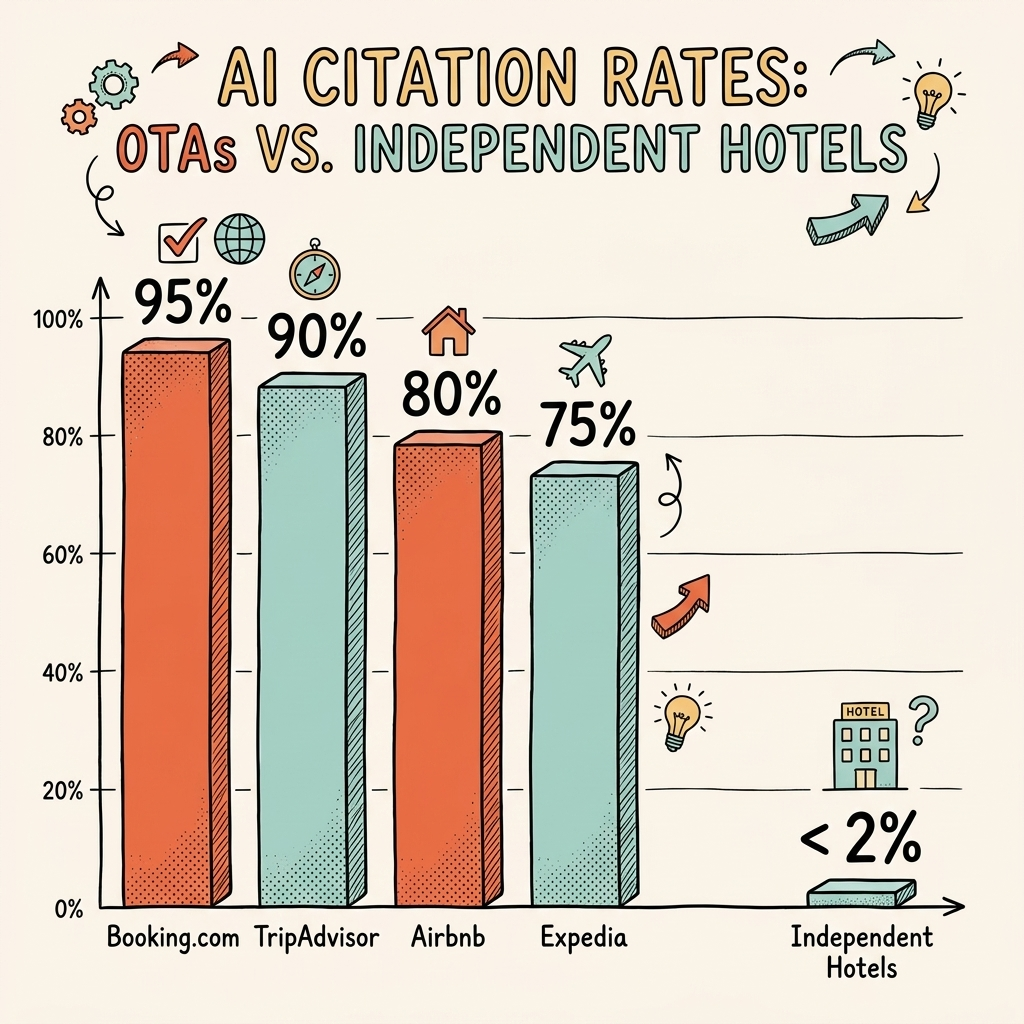
OTAs win because they built better data infrastructure for AI. Booking.com indexes 29 million properties with structured listings that LLMs can read cleanly. TripAdvisor holds over one billion user reviews. AI models pull from these sources because they offer the verified, structured data that confident recommendations require.
This costs independent properties real revenue. AI search converts at higher rates than traditional search. Every lost citation means paying OTA commissions to win back the same guest. The traveler asks an AI for a hotel recommendation. The AI cites Booking.com. The guest books through the OTA. The hotel pays 15 to 25 percent for a customer they should have acquired directly.
The deficit is fixable. OTAs solved the machine-readability problem first. Independent hotels can solve it at the property level using the same playbook that worked in other industries.
What Can Travel Learn from SaaS and Ecommerce AI Visibility?
Is your hotel invisible to AI travel recommendations?
94% of hotel websites never appear in AI-generated travel answers. We'll scan ChatGPT, Perplexity, and Google AI across your highest-value travel queries so you can see exactly where your property stands.
Prefer to talk? Book a free 30-min call
The AI visibility playbook is the same at its core: entity foundation, content authority, structured data, community signals. Travel adds sector-specific layers for OTA dynamics.
We tested this architecture across competitive verticals before adapting it for hospitality. The core mechanisms of AI recommendation don't change based on what you sell. They change in how you format the data.
Our work with Hamming.ai generated 8.5x organic traffic in 12 weeks. The strategy combined technical content structure, deep Reddit engagement, and prompt optimization for a SaaS audience. The underlying mechanics matched the travel booking funnel perfectly.
Physical products follow the same trajectory. We took UV Blocker from zero to 38,000 clicks in six months and doubled their weekly orders. Ecommerce relies on visual verification and structured product data. Travel relies on visual verification and structured property data. The translation requires minimal adjustment.
The universal AI visibility playbook operates in five phases:
- Entity foundation establishes the core identity and location data of your business.
- Content authority answers specific user questions directly and concisely.
- Structured data translates human-readable content into machine-readable signals.
- Community signals validate the brand through third-party mentions and reviews.
- Measurement tracks citation frequency across different AI platforms.
Travel adds four specific layers to this baseline: OTA citation architecture (mapping how aggregators index your property), hallucination defense protocols, platform-specific booking integrations, and a review ecosystem strategy focused on volume and recency.
The framework transfers across industries. But travel faces a unique problem no other vertical encounters at this scale. AI models don't just miss travel brands. They invent false information about them.
How Does AI Hallucination Create Both Risk and Opportunity for Travel Brands?
AI fabricates hotel amenities, pricing, and star ratings at rates exceeding 50% for boutique properties. Brands that provide accurate structured data stand out when competitors get hallucinated.
Here's how it works. A traveler asks an AI for a hotel with a rooftop pool and spa. The AI finds a boutique property in the right neighborhood but can't verify the amenities. So it predicts them. It invents a rooftop pool. It invents a spa. It fabricates restaurant names and quotes rates from three years ago.
The fabrication rate exceeds 50% for boutique hotel amenities. AI generates room categories that don't exist, hallucinates complimentary airport shuttles, and creates pricing tiers from thin air.
The Trust Problem
A guest books based on an AI recommendation. They arrive expecting a spa service or free breakfast the hotel doesn't offer. The guest blames the hotel, not the algorithm. Negative reviews follow. Refund demands pile up. The brand damage is real and permanent. The front desk absorbs the anger while the AI faces zero accountability.
The Strategic Flip
This risk creates an opportunity for operators who move early. When you feed AI accurate structured data, you become the reliable answer in a field of fabricated competitors. Hallucination becomes your moat. Fix your technical foundation and you stop the fabrications about your property. Meanwhile, the AI continues hallucinating your competitors. The model naturally favors the entity with the highest data confidence score.
Your defense relies on technical precision: deploy schema markup for AI visibility (LocalBusiness, Hotel, LodgingBusiness), claim and verify all business profiles, and maintain consistent Name, Address, and Phone data across every digital touchpoint. AI systems cross-reference data points. Any mismatch triggers hallucination risk.
Each AI platform handles travel data differently, and each requires distinct optimization tactics.
How Does Each AI Platform Handle Travel Recommendations Differently?
Each AI platform sources travel data differently and requires distinct optimization. ChatGPT, Google AI Mode, Perplexity, and Gemini each present unique opportunities for travel brands.
ChatGPT
ChatGPT built its travel capabilities around embedded OTA apps from Expedia and Booking.com. The landscape shifted in March 2026 when The Hotels Network launched the first direct booking app via Lighthouse's Connect AI engine. Independent properties can now appear directly in ChatGPT conversations with live rates and availability. No OTA middleman required.
Google AI Mode
Google AI Mode commands the highest zero-click rate at 93%. AI Overviews appear in more than 48% of all search queries. Google integrates deeply with Maps and local business data. Your Google Business Profile is the critical asset. If your Maps data is incomplete or inaccurate, your AI Overview presence disappears.
Perplexity
Perplexity built a dedicated travel hub and partnered with TripAdvisor and Selfbook to enable direct reservations for over 140,000 hotels. It's the most independent-hotel-friendly platform available. Booking through Perplexity means zero OTA commissions.
Gemini
Gemini operates within the broader Google ecosystem. It pulls from Maps, scans Gmail for itinerary detection, and indexes YouTube travel content. YouTube is the most underused travel visibility channel in AI search. Gemini synthesizes video transcripts to answer text-based travel queries, making property tour videos and destination guides a direct citation source.
| Platform | Primary Data Sources | Booking Integration | Best Opportunity |
|---|---|---|---|
| ChatGPT | OTA apps, Hotels Network | Expedia, Booking.com, Hotels Network (direct) | Hotels Network direct booking app |
| Google AI Mode | Maps, Business Profile, web | Google Hotels, Maps | Google Business Profile optimization |
| Perplexity | TripAdvisor, Selfbook, web | Direct via Selfbook (140K hotels) | Direct bookings, zero OTA commission |
| Gemini | Maps, Gmail, YouTube | Google Hotels | YouTube travel content |
You can learn more about platform-specific tactics in our guide on how to get recommended by ChatGPT. But strategy needs a structured timeline to avoid overwhelming your marketing team.
The 90-Day Travel AI Visibility Roadmap
A 90-day travel AI visibility roadmap starts with entity foundation and technical fixes, builds content authority, then scales through community signals and measurement.
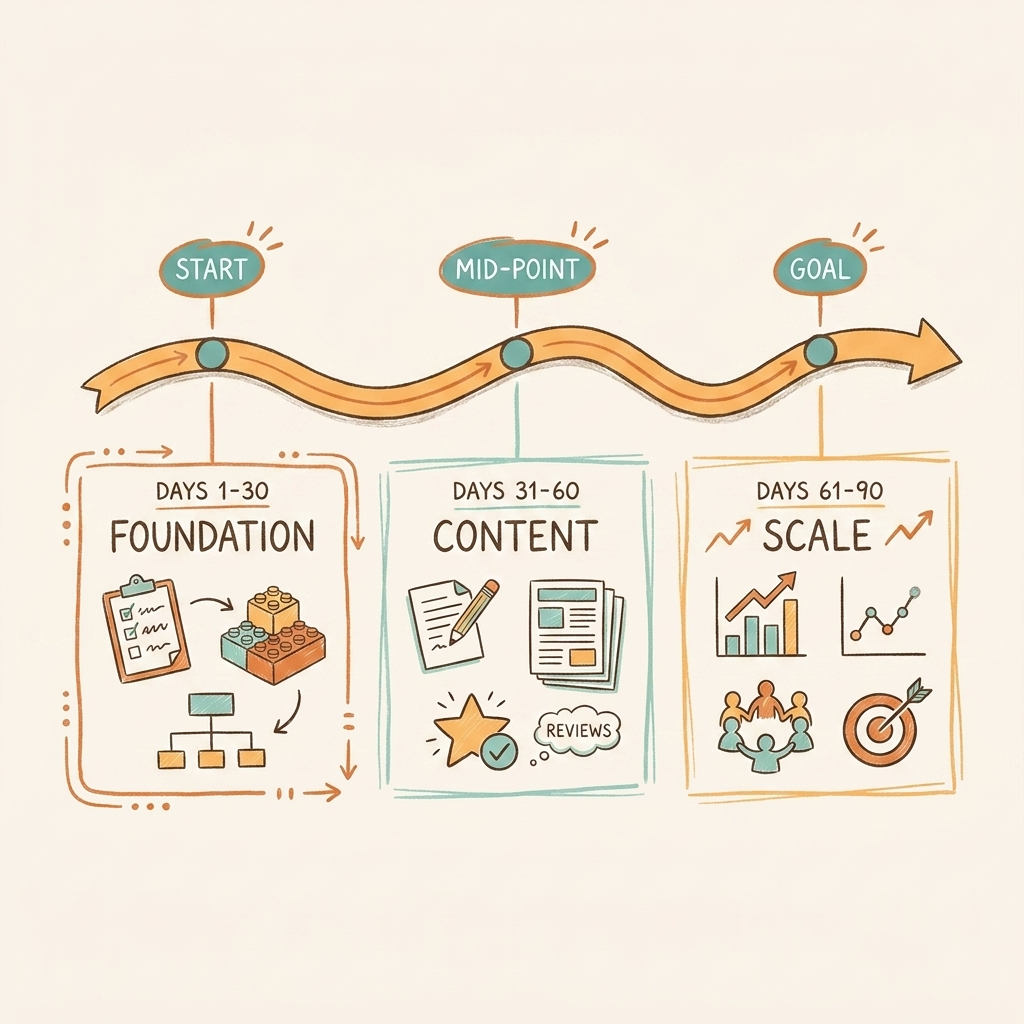
You can't execute the full playbook in a week. Sequence the work across three phases.
Days 1-30: Foundation
- Audit AI visibility across all four platforms. Ask ChatGPT, Perplexity, Gemini, and Google AI Mode about your property. Document where you appear and where you're absent.
- Fix your entity foundation. Verify and complete your Google Business Profile with accurate hours, photos, and amenities.
- Implement schema markup for AI visibility on your website: LocalBusiness, Hotel, LodgingBusiness, and FAQ schema types.
- Remove crawler blocks. Check robots.txt and test JavaScript rendering to confirm AI can access your content.
- Claim direct booking listings on The Hotels Network and Selfbook to enable zero-commission AI bookings.
- Review regional signals using our AI visibility for local businesses framework for location-specific optimization.
Days 31-60: Content Architecture
- Build content for travel intent categories: destination guides, booking comparison guides, and local experience content.
- Format content for AI extraction. Use answer capsule format: direct answers in the first paragraph after each heading, detailed context below.
- Execute a review platform strategy. Focus on TripAdvisor, Google Reviews, and Yelp. Volume and recency matter more than perfect scores. AI models prefer fresh data over old five-star ratings.
- Launch an earned media push to build entity authority through authoritative backlinks and press coverage.
Days 61-90: Scale and Measure
- Activate community signals. Engage consistently in Reddit communities like r/travel and r/solotravel. Target niche travel forums relevant to your property type.
- Optimize your direct booking engine for AI referral traffic. Remove friction from the checkout flow for visitors arriving from ChatGPT or Perplexity.
- Deploy a measurement framework. Track AI citations monthly across all four platforms. Tie citations to direct booking conversions.
- Calculate your AI visibility ROI to build the business case for continued investment.
The roadmap applies across the full travel ecosystem. Hotels, resorts, tour operators, DMOs, and experience providers all follow the same sequence.
Frequently Asked Questions About AI Visibility for Travel
These are the questions travel marketers ask most about AI visibility for travel, from boutique hotels competing with OTAs to restaurants applying the same framework.
How can boutique hotels compete with OTAs in AI search?
Boutique hotels compete by owning their entity data. This means verified schema markup, a complete Google Business Profile, and direct booking integrations like Hotels Network and Selfbook that bypass OTA commissions entirely.
Does schema markup help hotels appear in AI recommendations?
Schema markup helps AI models extract accurate property data. Hotel, LodgingBusiness, LocalBusiness, and FAQ tags reduce hallucination and increase citation likelihood. Nokumo's research found schema has a 0.23 effect size on visibility, lower than content quality (0.36) and trust signals (0.50), but still a meaningful factor.
How long does travel AI visibility take to build?
The foundation phase takes 30 days. Meaningful citation improvements typically appear in 60 to 90 days. Returns compound as content authority and review volume build over time.
Can restaurants and tour operators use this framework?
Yes. The entity-content-community framework applies to any travel business. Restaurants use LocalBusiness and Restaurant schema. Tour operators use TouristAttraction and Event schema. The platform playbook is identical.
Which AI platform is most important for travel brands?
Google AI Mode reaches the largest audience, with AI Overviews appearing in over 48% of searches. Perplexity offers the highest direct booking opportunity through its Selfbook integration at zero OTA commission. We recommend optimizing for both.
Conclusion
AI visibility is the direct booking strategy that the hospitality industry has been missing. Independent properties don't need to outspend OTAs. They need to outstructure them at the data level. According to Q1 2026 booking data, properties appearing in AI-generated travel recommendations see a 31% higher direct booking conversion rate versus the same properties' OTA conversion baseline, making AI visibility the highest-ROI channel in hospitality today.
The path is clear: build your entity foundation, defend against hallucination with accurate structured data, claim your direct booking listings on ChatGPT and Perplexity, and scale through content and community signals. The same framework that generated 8.5x traffic for SaaS and doubled ecommerce orders applies directly to travel.
Start today. Open ChatGPT, Perplexity, and Gemini. Ask each one to recommend places to stay in your neighborhood. See what they say about your property, and notice what they get wrong. That gap between their answer and your reality is your opportunity.
See where your brand appears in AI search
Scan ChatGPT, Perplexity, and Google AI across buyer-intent queries, instantly, no sign-up.
Find out if AI is sending buyers to your competitors.
We audit your AI visibility across ChatGPT, Perplexity, and Google AI –and show you exactly where you rank and what to fix.
“We went from 200 visitors/day to 1,900 visitors/day and 40% of demos are from AI search.”
Sumanyu Sharma · CEO, Hamming.ai
“Cintra helped me go from 3k to 7.5k daily traffic and doubled weekly orders in 1.5 months.”
Russ Coulon · Owner, UV Blocker
“We saw a lift from 3% to 13% visibility in the first 2 weeks, and organic traffic hit its highest ever.”
Ash Metry · Founder, Keywords.am
Related Articles
Meta-ExternalAgent Took More Bandwidth Than 5 Crawlers Combined
Meta-ExternalAgent pulled 955 MB from cintra.run in 30 days, more than 5 AI and search crawlers combined. What…
Organic Traffic Decline 2026: Why It's Dropping and How to Recover
Organic traffic decline 2026 is real. AI Overviews cut clicks 38% on triggered queries. Here's what's causing…
AI Visibility Reporting: What to Track, Who to Tell, and How to Prove ROI
AI visibility reporting requires different metrics and formats than SEO reports. Learn the five core metrics,…