AI Visibility at Scale: The Multi-Brand Enterprise AEO Playbook
AI visibility at scale requires a different operating model. Learn the 4-layer enterprise AEO framework for managing AI presence across multiple brands and platforms.
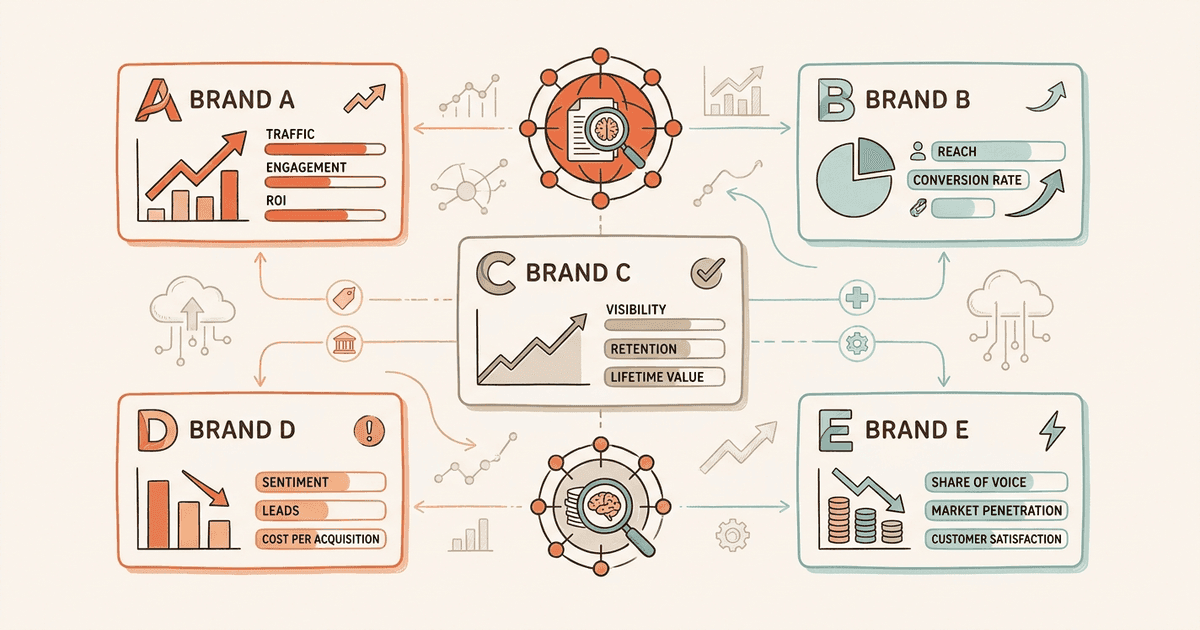
Most enterprises treat AI visibility as single-brand SEO scaled up. Apply the same playbook to each brand. Hire more writers. Manage more spreadsheets. But the math of multi-brand AEO is unsolvable with traditional approaches.
Five brands. Seven AI platforms. Monthly content cycles. That's 35 distinct workstreams, each needing unique query research, content creation, and monitoring. Manual AEO doesn't scale past two or three brands before the entire system fractures.
We see this failure pattern daily. Content teams burn out. SEO teams lose focus. PR teams can't track external mentions at the required volume. And the opportunity cost keeps growing. AI search is replacing Google. You need to be the one getting recommended, across every brand in your portfolio. Here's the operating model that makes it possible.
TL;DR
- AI visibility at scale demands operational infrastructure, not proportional headcount increases.
- Cross-brand cannibalization silently destroys portfolio authority when parent and sub-brands compete for identical AI citations.
- Centralized governance with a clear RACI model prevents departmental paralysis.
- The four-layer operating model isolates strategy, content, distribution, and measurement into distinct execution phases.
- Programmatic execution maintains brand voice fidelity across hundreds of assets simultaneously.
- Portfolio-level dashboards reveal share-of-voice dynamics against external competitors and internal sister brands.
Why Does Single-Brand AEO Break at Portfolio Scale?
See where you rank across all AI answer engines.
Enter your domain and we'll scan your citation rate across ChatGPT, Perplexity, and Google AI.
Prefer to talk? Book a free 30-min call
Single-brand AEO breaks at portfolio scale because each additional brand multiplies workstreams across platforms, creating an unmanageable burden without different infrastructure.
The math hits hard. Five brands times seven AI platforms times monthly content cycles equals 35 distinct workstreams. Each needs unique query research, content creation, and monitoring. Standard marketing teams aren't built for this volume. We outline the single-brand foundation in our AI visibility playbook. Portfolio management requires a different machine entirely.
AI agent traffic is accelerating fast. BrightEdge data from August 2025 showed ChatGPT page requests at 33% of organic search levels. By April 2026, AI agent requests reached 88% of human organic search activity. The trajectory demands action now.
Traditional agencies cap at roughly 10 pieces per writer per month. Supporting five brands requires 15 to 25 writers for AI-specific content alone. Gartner reports 39% of CMOs plan to cut agency allocations this year. You must do more with less. We deliver 50x the output with the same expertise.
Showing up isn't enough. Birdeye data shows 80% of brands get cited at least once, but only 15% secure the top citation position. AI models prioritize the single best source. Your brand equity won't save you if your content structure fails their parsing requirements.
AI visibility at scale demands a structural answer to a structural problem. The math alone rules out any manual approach. But there's a harder problem most enterprise teams haven't even considered.
What Is Cross-Brand Cannibalization in AI Search?
Cross-brand cannibalization occurs when a parent brand and its sub-brands compete for the same AI citations, splitting authority instead of compounding it across the portfolio.
Here's how it works. Brand A writes an article on joint health supplements. Brand B, a sister brand in the same portfolio, publishes its own guide on the same topic. Both target the exact same buyer intent. The AI model evaluates both, picks one, and the loser gets zero mentions. There's no second place in AI search. You either win the citation or you don't exist.
How It Plays Out in Practice
Imagine a consumer packaged goods company with a parent wellness brand and three supplement sub-brands. The parent brand publishes an article on joint health. A sub-brand publishes a similar guide. They target identical user intent. The AI platform sees two competing signals from the same corporate entity. It often chooses neither. It selects a third-party competitor with clearer authority.
Platform Differences Matter
Different AI platforms handle this uniquely. ChatGPT tends to synthesize across brand families, blending answers together. Perplexity cites individual pages directly, wanting one definitive source. AI Overviews pull from the strongest single domain. The same portfolio gets treated differently by every engine.
The Fix: Query-Level Brand Allocation
The solution relies on content hierarchies. Parent brands handle category-level queries like "best supplements for joint health." Sub-brands own product-specific queries like "glucosamine vs collagen for knee pain." Authority flows up, never sideways.
You assign query territories to specific brands and enforce those boundaries through editorial governance. Every brief specifies the target brand. Every article maps to a defined territory. When two brands overlap on a query, you resolve the conflict before production starts, not after the AI model has already picked a winner.
Internal linking structures then signal brand relationships to AI models, reinforcing the hierarchy. This approach connects directly to entity SEO for AI search principles.
Solving cannibalization requires someone to own the decision. Which raises the harder organizational question.
Who Should Own AI Visibility in a Multi-Brand Organization?
AI visibility ownership requires a centralized AEO lead or team with a clear RACI model that spans content, SEO, PR, and brand management across the portfolio.
You've probably been in this meeting. Content teams think it's SEO's job. SEO thinks it's PR's job. PR thinks it's brand marketing's job. Everyone nods. Nobody coordinates anything after the call ends. Six months pass. Your competitor secures the primary citation across three platforms while your teams debate reporting lines.
You need a RACI model immediately.
| Role | AEO Activity Ownership | Details |
|---|---|---|
| Responsible | Centralized AEO Lead / Team | Executes query allocation, oversees content production, manages distribution |
| Accountable | VP Marketing / CMO | Owns portfolio-level share-of-voice metrics and budget allocation |
| Consulted | Brand Managers, SEO, PR | Provides voice guidelines, technical parameters, external mention targets |
| Informed | Content Leads, Product Marketing | Receives weekly performance dashboards and citation alerts |
The centralized versus federated decision depends on portfolio size. Centralized works best for 3 to 5 brands. Federated with central standards works for 10 or more. A hybrid approach is the default for most enterprises. We recommend starting centralized, proving the model, then distributing execution when needed.
Most enterprises skip this governance step and jump straight to tools. That's why they fail. You can't manage AI visibility at scale without clear ownership first. With governance settled, the operational model needs four distinct layers.
What Are the Four Layers of an Enterprise AEO Operating Model?
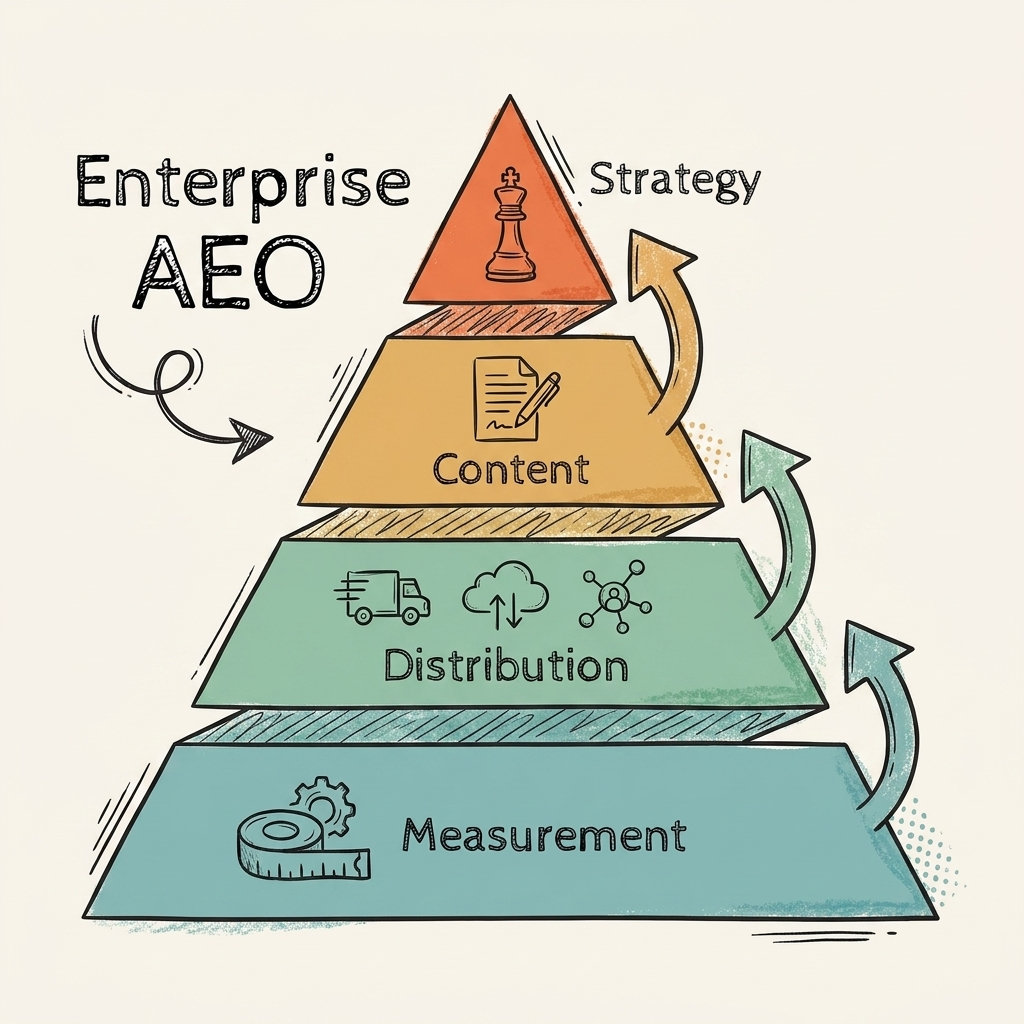
The enterprise AEO operating model has four layers: strategy (which brands target which queries), content (brand-voice-faithful production), distribution (platform-specific publishing), and measurement (portfolio dashboards).
Strategy Layer
You build a query-brand allocation matrix. Which brands target which queries on which platforms. This prevents cannibalization by design. Every piece of content has a defined target. Every brand has a protected territory.
Content Layer
Programmatic templates maintain brand voice at scale. Each brand gets an isolated knowledge base. Terminology stays pure. Voice guidelines stay enforced. Content produced for Brand A never bleeds into Brand B's voice. Each brand maintains its own voice fingerprint, even when hundreds of pages ship monthly. The output stays indistinguishable from your best human writers.
Distribution Layer
Platform-specific publishing cadences matter. Your Reddit strategy differs from schema optimization. Your Quora strategy needs different formatting. Each brand gets a custom distribution map. We deploy content where the AI models actually look for it.
Measurement Layer
Portfolio-level share-of-voice dashboards track each brand against category competitors and sister brands. You identify where Brand A wins and replicate that success for Brand B. You spot citation drops before traffic plummets. We track the exact coordinate of every citation across every platform.
The model is only as good as the infrastructure powering it. Manual execution is exactly the headcount trap we started with.
How Do You Build Programmatic AEO Infrastructure?
Programmatic AEO infrastructure combines topic clustering by brand, templated content systems with isolated brand voices, automated schema generation, and batch monitoring across all AI platforms.
Topic clustering by brand is the first step. Each brand owns a content cluster map. The parent brand takes category queries like "best enterprise marketing tools." Sub-brands take product-specific queries like "analytics platform vs reporting tool for agencies." You map the full intent landscape and assign clusters that build authority in isolated silos rolling up to the parent entity.
Templated content preserves voice at scale. The template defines structure: H2 flow, answer capsules, data tables. The brand knowledge base defines voice. Scale the template, protect the voice. Generic AI-generated content sounds identical across brands and fails to build distinct authority. You must avoid the content quality gap that kills citations.
Automated schema markup feeds AI models directly. Structured data at scale. Entity markup for brand differentiation. FAQ schema per brand. You give large language models what they want in the format they prefer. Read more about schema markup for AI visibility for the technical requirements.
Batch monitoring tracks performance across 50+ queries per brand on ChatGPT, Perplexity, AI Overviews, and Claude simultaneously. We flag citation drops within 24 hours. Our data shows AI citation churn rates of 40-60% monthly. That means a third of your citations could disappear in the next 30 days. Monthly reporting isn't fast enough. Our AI content audit methodology sets the baseline. Continuous monitoring protects the gains.
This is what programmatic AEO actually looks like in practice. Not a content farm. Not mass-produced articles. A system that produces citation-worthy content at the speed of AI search, while keeping each brand's voice intact.
Infrastructure without measurement is a content factory, not a growth engine.
How Do You Measure Portfolio-Level AI Visibility?
Portfolio-level AI visibility measurement tracks share-of-voice per brand per platform, citation velocity trends, and cross-brand authority signals on a weekly reporting cadence.
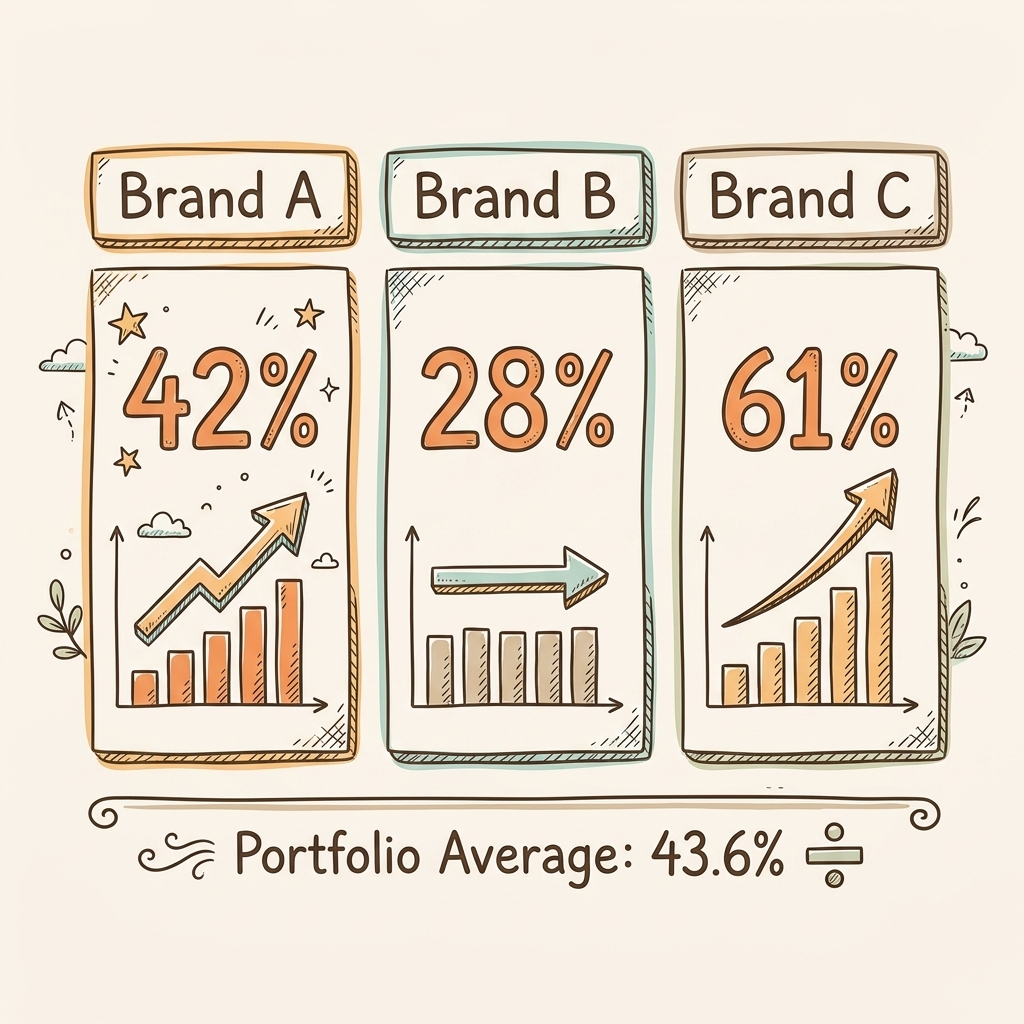
You're tracking three core metrics per brand. Mention rate: how often does the AI cite you? Citation position: are you the first recommendation or buried in a list? Sentiment: is the AI saying good things or hedging? Multiply those across platforms and brands, and you've got your portfolio view. How to measure AI visibility covers the detailed definitions.
| Brand | Mention Rate | Citation Position | Trend | Action Required |
|---|---|---|---|---|
| Brand A | 42% | 1.8 | Up | Expand query territory |
| Brand B | 28% | 3.4 | Flat | Improve answer capsules |
| Brand C | 61% | 1.2 | Up | Maintain distribution |
| Portfolio Avg | 43.6% | 2.1 | Up | Monitor competitors |
Reporting cadence dictates reaction speed. Weekly brand summaries. Monthly portfolio reviews. Quarterly strategy recalibrations. A citation drop greater than 20% in any brand triggers immediate investigation. Resources shift dynamically based on real-time data.
ROI measurement connects AI visibility metrics to revenue. Track queries to citations to traffic to conversions per brand. When you can show the CMO that Brand C's 61% mention rate drives 3x the conversion rate of Brand B's 28%, budget allocation becomes a data decision, not a political one. AI visibility ROI provides the framework for structuring this argument for leadership.
Frequently Asked Questions About AI Visibility at Scale
Enterprise marketing leaders consistently ask these questions when evaluating multi-brand AI visibility programs. Here are direct answers from our experience operating across brand portfolios.
How do you prevent sub-brands from cannibalizing each other's AI citations?
Assign each brand exclusive query territories through a query-brand allocation matrix. Structure content hierarchies so parent brands handle category queries while sub-brands own product-specific ones. ChatGPT, Perplexity, and AI Overviews each handle brand families differently, so you need a unified strategy.
What team should own AI visibility in a multi-brand enterprise?
A centralized AEO lead or dedicated team should own AI visibility, with a RACI model that defines consultation roles for brand managers, SEO, and PR. Ownership must be unambiguous. Refer to the RACI table above.
How long does it take to build measurable AI presence for a new brand in a portfolio?
A new brand in an established portfolio typically reaches baseline AI visibility within 60 to 90 days, benefiting from parent brand authority and existing content infrastructure. Existing portfolio brands accelerate new brand onboarding because the systems and distribution channels are already in place.
Can programmatic content creation help scale AEO without sacrificing quality?
Yes. Programmatic AEO uses structured templates for consistency while drawing from isolated brand knowledge bases to preserve each brand's distinctive voice and expertise signals. This is the opposite of mass AI content. Isolated knowledge bases ensure the output remains distinct and authoritative.
Conclusion
Multi-brand AEO requires a different operating model, not more headcount.
- Cross-brand cannibalization is the hidden cost most enterprises ignore until overall traffic drops.
- The 4-layer model (strategy, content, distribution, measurement) provides the operational backbone.
- Programmatic infrastructure with brand isolation scales output without sacrificing voice quality.
Start with a baseline. Run a visibility audit across your brand portfolio. We'll identify where your brands compete against each other, surface the gaps, and show you exactly where you stand.
We run this model for multi-brand clients today. Visit our AEO agency page for an enterprise consultation.
Related Reading
- AI Visibility Reporting: What to Track and How to Prove ROI, the five metrics and stakeholder frameworks you need to govern AI presence across a brand portfolio
- AI Visibility Competitive Analysis, how to benchmark each brand against competitors across ChatGPT, Perplexity, and five other engines
- Why Traditional Content Agencies Are Losing to AI, how the agency model shift connects to why enterprise AEO requires a fundamentally different operating structure
See where your brand appears in AI search
Scan ChatGPT, Perplexity, and Google AI across buyer-intent queries, instantly, no sign-up.
Find out if AI is sending buyers to your competitors.
We audit your AI visibility across ChatGPT, Perplexity, and Google AI –and show you exactly where you rank and what to fix.
“We went from 200 visitors/day to 1,900 visitors/day and 40% of demos are from AI search.”
Sumanyu Sharma · CEO, Hamming.ai
“Cintra helped me go from 3k to 7.5k daily traffic and doubled weekly orders in 1.5 months.”
Russ Coulon · Owner, UV Blocker
“We saw a lift from 3% to 13% visibility in the first 2 weeks, and organic traffic hit its highest ever.”
Ash Metry · Founder, Keywords.am
Related Articles
Meta-ExternalAgent Took More Bandwidth Than 5 Crawlers Combined
Meta-ExternalAgent pulled 955 MB from cintra.run in 30 days, more than 5 AI and search crawlers combined. What…
Organic Traffic Decline 2026: Why It's Dropping and How to Recover
Organic traffic decline 2026 is real. AI Overviews cut clicks 38% on triggered queries. Here's what's causing…
AI Visibility Reporting: What to Track, Who to Tell, and How to Prove ROI
AI visibility reporting requires different metrics and formats than SEO reports. Learn the five core metrics,…